
 LinkedIn
By December 31, 2027, the top three dedicated AEO platforms by agency subscriber volume will no longer enforce hard sub-500 prompt caps on their base agency plans. Vendors still selling agencies a few hundred tracked queries as though each were a scarce resource will have a harder time defending the invoice.
I have watched a version of this movie before. Paid search took roughly a decade to absorb much of the mechanical work sold by third-party bid tools. Answer engine optimization (AEO) software is running a similar cycle on a shorter clock. My bet is that prompt caps go first, monitoring becomes a bundled feature, and agencies charging retainers mainly to watch share of voice get priced out by platforms that ship changes.
The PPC precedent: the task moved into the engine
In 2014, agencies routinely paid third-party enterprise platforms 2% to 3% of their clients’ ad spend to calculate bid adjustments across match types and hour-of-day multipliers. Pulling search term reports and updating spreadsheets by hand was brutal work. Vendors such as Marin Software and Kenshoo could charge tens of thousands of dollars in monthly software fees to make it less brutal.
Then Google rolled out native Smart Bidding, followed by Target CPA, Target ROAS, and Performance Max. Much of the mechanical bid-adjustment work moved into Google’s own engine. Marin Software filed for Chapter 11 bankruptcy by mid-2025. One filing does not explain an entire company’s fate, but it is a warning to any software category whose main product is a task the underlying platform can absorb.
AEO and Generative Engine Optimization (GEO) vendors are now selling query monitoring as a scarce asset. Agencies buy the dashboards, resell the reports, and hope the margin holds. I have already made the case for why traditional Google Ads agencies face structural pressure when they bill for manual tasks machines can handle continuously. The same question applies here: when the measurement gets cheap, what work is left on the invoice?
Here are five predictions, with dates and conditions under which I will call them wrong.
Prediction 1: Prompt caps disappear from base agency plans by December 2027
Today’s AEO pricing resembles a cable package from 2004. AEO Vision’s Agency Starter plan costs $399 a month for an account-wide cap of 300 active prompts. Manage five clients and you are rationing 60 prompts per client across ChatGPT, Perplexity, and Gemini. Elsewhere, Peec AI lists tiers from €89 to €499 a month for 50 to 350 prompts; Otterly AI starts at $29 for 15 prompts, while Profound starts at an enterprise tier of $399. The prompt is being sold like a physical unit of inventory.

The mechanism behind my prediction is the gap between the price of a basic model call and the price of access to a tracking tier. Under OpenAI’s GPT-4o mini pricing, input tokens cost $0.15 per million and output tokens $0.60 per million. Standard Batch API rates halve those figures. At 50 input tokens and 500 output tokens, one illustrative batch request costs about $0.00015. Run 300 of those requests daily for 30 days and the raw token bill is roughly $1.35.
That is not the full cost of monitoring ChatGPT, Perplexity, and Gemini. It is one model-call example, not a vendor’s profit statement. Vendors still have to collect, store, and present results. But it shows why a hard cap sold as a reflection of scarce compute is a vulnerable pitch. As the query itself gets cheaper, customers will expect broader tracking for the same fee.
I will mark this prediction wrong if the top three dedicated AEO platforms by agency subscriber volume still enforce hard sub-500 query caps on their base agency plans at the end of 2027. Aggressive access restrictions that push monitoring above $0.10 per query would also break the mechanism behind my bet. Do not sign a long contract whose value depends on prompt scarcity lasting.
Prediction 2: Read-only visibility monitoring becomes a free checkbox
Standalone rank trackers once charged hundreds of dollars a month to automate checks against Google results. Then the underlying retrieval became cheap: providers such as DataForSEO list standard requests at $0.60 per 1,000. Rank tracking did not vanish, but a chart of positions became harder to sell as a complete product.
AI citation monitoring is heading toward the same problem. Checking whether a client appears in an answer is useful. It tells you where to investigate. But a dashboard that says a brand disappeared from a Perplexity answer does not put it back. Observation is a feature; remediation is the service.
By Q4 2027, I expect visibility monitoring to be bundled into broader execution platforms rather than billed as a standalone agency product. The mechanism is straightforward: once platforms that make changes can also measure whether those changes show up in answers, a separate read-only invoice becomes difficult to defend.
I will call this wrong if independent AEO monitoring products with no execution engine still account for more than 20% of agency search-tooling spend in Q4 2027. If agencies keep paying substantial standalone fees for scorecards without shipped changes, the checkbox has not arrived. Until then, ask a monitoring vendor what happens after its chart turns red.
Prediction 3: Agency pricing stops punishing every new domain
Multi-client economics break when the software bill rises each time an agency wins an account. Semrush’s AI Visibility Toolkit charges $99 a month per domain and caps tracking at 25 custom prompts. Across 12 clients, that is $1,188 a month before expanding a single client’s query set. Add a $60 block of 50 prompts for each domain and the bill reaches $1,908 a month, before paying a strategist or copywriter.
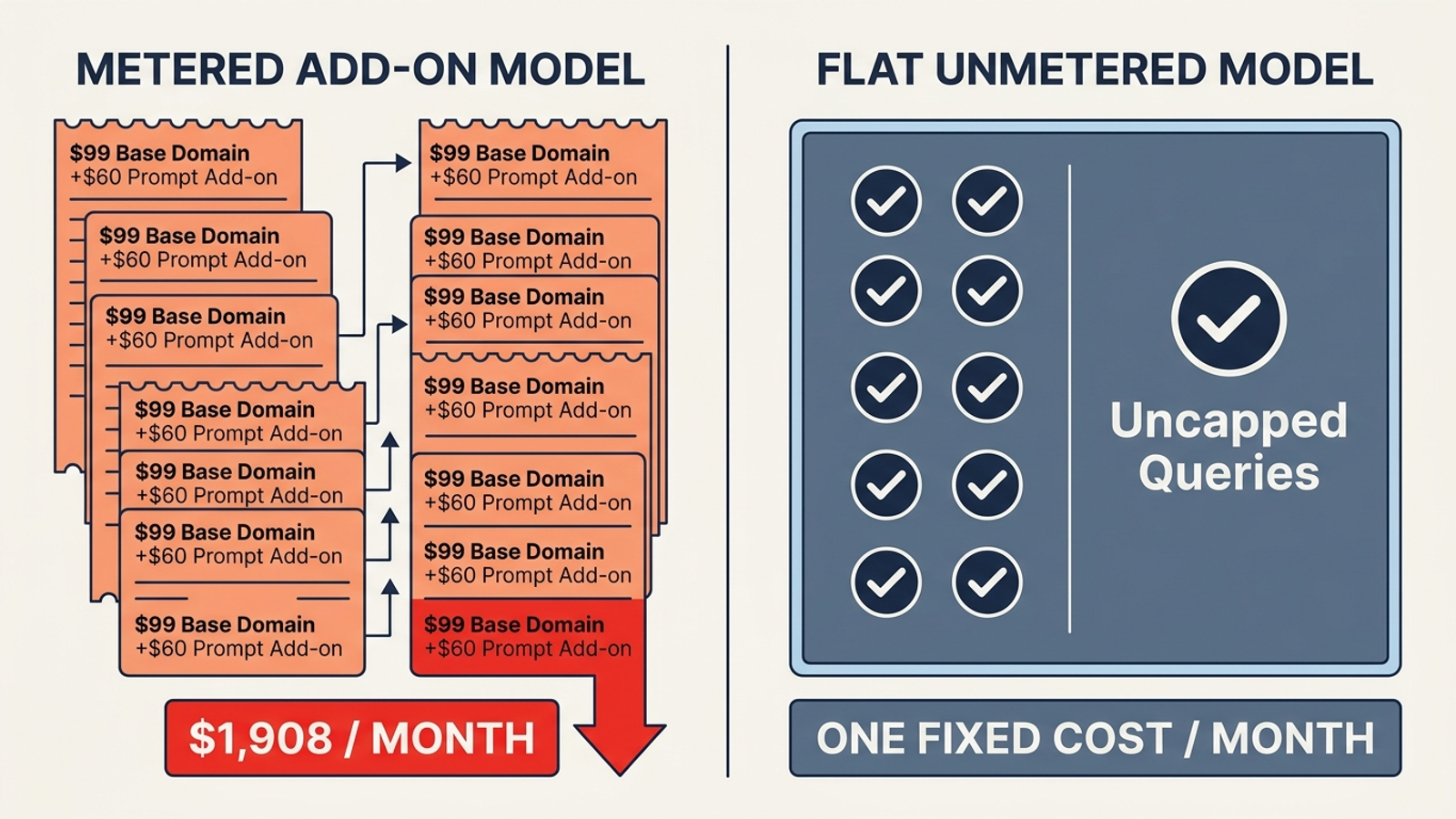
An agency charging $1,500 a month for organic search and passing $150 of that straight to a software vendor gives away 10% of top-line revenue for access, not execution. I expect the market to push toward flat-rate AEO pricing: predictable domain costs or multi-domain agency licenses without prompt buckets stacked on top. Agencies need to know what the next client will cost before they pitch the next client.
The pressure comes from the buyer’s margin, not a sudden burst of generosity from vendors. Agencies that cannot make metered software fit will look for another license model or build reporting scripts around cheaper retrieval. A growing client roster should improve an agency’s economics, not trigger another toll.
I will mark this wrong if, at the end of 2027, the three largest enterprise search platforms still require individual domain surcharges for basic agency client setup and agencies keep paying rather than moving to flat-rate alternatives. Ask for the price of client number 12 before celebrating the price of client number one.
Prediction 4: Advisory-only AEO retainers collapse by Q3 2027
During my PPC years, I watched a familiar mistake turn into a deliverable: an account manager spent five hours assembling a 30-slide PDF about falling conversion rates, walked the client through it, and called the work done. The diagnosis might have been right. The account was still broken.
AEO can repeat that habit faster. Agencies charge around $2,000 to $5,000 a month to show clients monthly visibility scorecards. A report saying their brand disappeared from a set of AI answers can be valuable once. A second report that records the same problem without technical remediation is just a sharper picture of the leak.
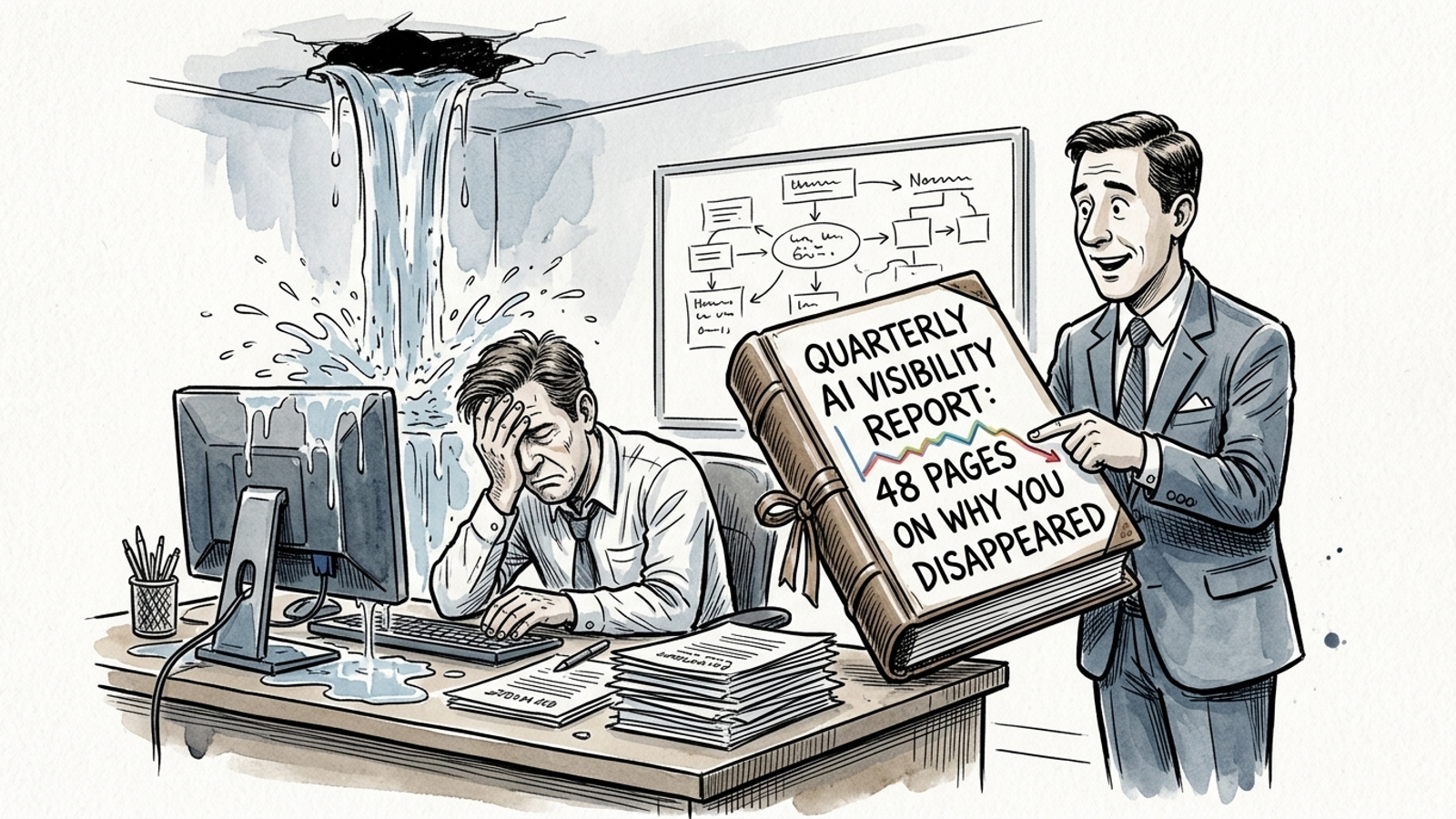
The mechanism is client fatigue. A marketing VP paying an agency five grand a month wants more than a CSV export and a Loom video explaining that a model’s answers changed. They want content fixes, entity work, or technical changes shipped. By Q3 2027, I expect clients to reject advisory-only AEO retainers that offer monitoring without delivery.
I will call this wrong if pure-monitoring AEO agencies keep retainer churn under 5% through 2027, or if standalone reporting retainers continue to command more than $3,000 a month without bundled CMS updates or technical deployments. If the contract promises visibility, check whether it also names who fixes what the tool finds.
Prediction 5: More AEO execution moves to the network edge by December 2027
Every performance marketer knows the developer-ticket graveyard. You find missing schema or broken entity structure, file a clear request, and wait while a CMS template change competes with the rest of the engineering queue. The audit may be finished; the site is not.
My fifth bet is that more AEO platforms will route around that delay with CDN middleware, using tools such as Cloudflare Workers, Fastly Compute, and Vercel. As Supple’s guide to Edge SEO describes, teams can adjust structured data, canonical information, and HTML responses at the network edge rather than waiting for changes to the origin CMS. Scrunch AI is among the tools using reverse-proxy delivery for structured entity work.
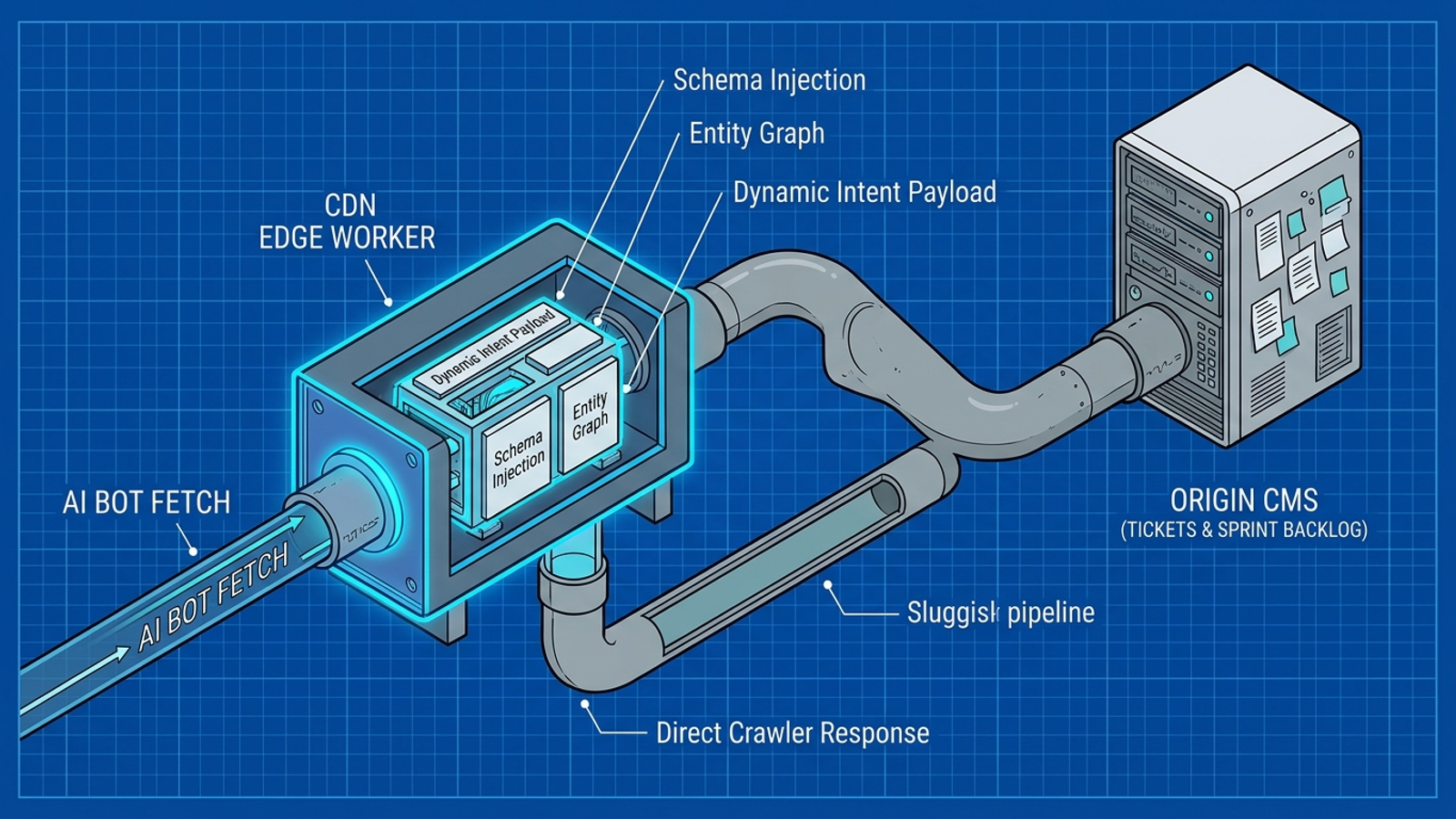
The advantage is operational: execution need not wait for every CMS ticket to clear. That does not mean an edge layer replaces every site change or avoids a client’s security review. It means an agency with permission to deploy one has another way to ship technical work while the origin-site backlog keeps moving at its usual pace.
I will mark this wrong if edge-based CDN changes account for less than 15% of active AEO deployments across agency rosters at the end of 2027, or if origin CMS platforms make autonomous entity updates immediate enough that the edge offers no meaningful delivery advantage. When evaluating a platform now, ask where its changes actually run.
What I would buy this quarter if these bets are right
If you own an agency, I would not pick an AEO vendor by the prettiest chart. I would look at what happens between finding a visibility gap and shipping a fix, then calculate the cost across the whole client roster. A 12-month contract built around prompt allowances can outlast the pricing model that made those allowances look valuable.
On a live demo, I would ask four questions in order:
- What happens when a client adds 500 product-SKU queries? If the answer is another query bucket or an enterprise-tier conversation, calculate the cost before accepting the quoted base price.
- Does the platform ship fixes, or export a report for my team to act on? If it stops at diagnostics, price it as an alarm, not as the person who turns off the alarm.
- What does it cost to connect 15 client domains? Get the full agency-roster price, including domain add-ons. A cheap first domain does not make a cheap operating model.
- Where do technical changes execute? If every fix requires an origin CMS theme change and a client engineering sprint, put that delay into your delivery plan. If the vendor proposes an edge layer, ask how it gets deployed and approved.
I am not arguing that agencies should stop interpreting results or setting direction. I am arguing that interpretation alone is a thin retainer when the software can count citations cheaply and the client still needs someone to act.
The December 2027 scorecard
I will check the predictions against the conditions above, not quietly redefine a win afterward:
- Prompt caps: Do the top three dedicated AEO platforms by agency subscriber volume still impose hard sub-500 caps on base agency plans? If yes, Prediction 1 fails.
- Monitoring: Do independent, read-only AEO trackers hold more than 20% of agency search-tooling spend in Q4 2027? If yes, Prediction 2 fails.
- Agency pricing: Do the three largest enterprise search platforms still require basic per-domain client-setup surcharges that agencies continue to pay rather than leave? If yes, Prediction 3 fails.
- Reporting retainers: Do pure-monitoring agencies keep churn under 5% through 2027, or retain more-than-$3,000 monthly reporting fees without technical delivery? If yes, Prediction 4 fails.
- Edge deployment: Does CDN-based edge execution remain below 15% of active AEO deployments across agency rosters? If yes, Prediction 5 fails.
The paid-search agencies that adapted to Smart Bidding had to stop treating manual bid adjustments as the product. AEO agencies face the same choice on a shorter clock: sell the act of watching answers, or own the work that follows. groas for agencies is built around continuous execution, combining autonomous paid-search management and live AEO delivery under a flat operating model without prompt metering or capacity ceilings.
Stop buying dashboards that bill you for counting queries. Buy the system that ships the changes.