

 LinkedIn

My pick for a business with no marketing team is a bundled managed service. The cheapest Facebook and Instagram ads management quote can leave you buying three other jobs separately: making the ads, checking tracking, and explaining what the numbers mean.
If nobody on your team can make images and videos, check conversions, or live inside Ads Manager, campaign management alone does not fill the gap. You need to buy the missing team, not just the person pressing the buttons.
That is the test behind this ranking. I care less about how impressive the proposal looks than how much work still lands on your desk after you sign it.
The ranking rule: count the jobs you still own
For a business with no marketing team, Facebook and Instagram advertising breaks into four jobs:
- Make the ads: supply fresh images, videos, and angles.
- Check the tracking: make sure conversions and purchase values hold up.
- Manage the campaigns: build, adjust, pause, and test.
- Explain the results: turn the numbers into a decision, not another dashboard login.
The first job catches buyers out. Quality Meta ads need fresh creative every 2–3 weeks, and guidance for Advantage+ points toward 3–5 new ads per week. Another creative-fatigue guide recommends weekly launches and at least 20 diversified ads live, with 20–30% of budget reserved for testing.
The exact cadence is less important to this buying decision than who owns it. I used to tell clients one good video would last a quarter. I was wrong. Creative is a weekly grocery run, not a quarterly stock-up.
A low management fee does not help much if you become the unpaid production department. Count the jobs before comparing the quotes.

1. A bundled managed service: the fewest handoffs, if the scope holds up
My pick is a bundled service that explicitly owns all four jobs. It suits a business that can pay a flat management fee plus ad spend and wants one vendor responsible for creative, tracking checks, campaign work, and reporting.
I will be plain about the relationship: groas publishes this blog. This is not the winner of an independent test. It is my recommendation for the owner who wants the work taken off their desk rather than divided among several suppliers.
What this model does better is reduce handoffs. You are not hiring a media buyer, finding a designer, and then discovering neither one owns the tracking problem. One relationship covers the work, provided the scope actually says so.
The groas Meta Ads service is a flat $1,499 per month, separate from ad spend. It is one of three services: Search Ads, Meta Ads, and SEO and AI search, each with a 7-day money-back guarantee. Its scope includes creative testing and winner scaling with a named strategist.
The done-for-you model combines a team with proprietary technology to manage, optimize, and execute campaigns. That includes creating, pausing, or modifying campaigns, budgets, targeting, and bidding settings. Execution is the point: you are not paying for a list of recommendations to implement yourself.
What rules it out: a supposed bundle that leaves the missing jobs with you. Creative testing is not, by itself, a clear promise about who makes every image and video. Before signing, get the production responsibilities and tracking checks written into the scope. You still supply product facts, access, and approvals, and nobody can guarantee advertising outcomes.
My buying rule is simple: if the proposal cannot name who makes the ads and who checks tracking, do not treat it as a complete bundle.
2. A traditional agency: useful process, but read the exclusions
An agency works best when you can reliably supply the material it needs. That means raw photos, video, and product facts, delivered on time, while an outside team runs the account around them.
What a good agency does better is bring process: account structure, a testing cadence, and regular reporting. That matters once you are spending real money. It also explains why an agency ranks above a standalone buyer here. The relationship can cover more of the operation.
The catch is the scope. Most retainers cover media buying, not making the ads. Management runs $500–$5,000+ per month, plus ad spend, with most agencies at $1,500–$3,000 per month or 10–15% of spend with minimums.
Then creative gets added. Pure media buying without creative runs $1,000–$5,000 per month for $5,000–$50,000 in spend, while adding user-generated content, static images, motion, and landing pages pushes fees to $3,000–$15,000 per month. Performance creative alone can be priced at $5,000–$15,000 per month on top of management.
Those are different scopes, not interchangeable quotes. Comparing the smallest number in one proposal with the largest bundle in another tells you very little.
What rules it out: the retainer leaves you as the creative department, with tracking fixes still waiting for someone else. Ask who makes the assets, who checks tracking, and who implements changes. If the answer keeps coming back to you, this is not the handoff you wanted.
3. A freelance media buyer: good value when the missing jobs are covered
A freelancer makes sense when creative and tracking are already solved. You need a steady pair of hands in Ads Manager, not someone to become an entire marketing department for a few hours a week.
What this option does better is price and flexibility. Freelancers run $500–$3,000 per month or 15–25% of spend and tend to be the cheapest entry point. On Upwork, Meta specialists list at $15–$40 per hour, so five hours a week pencils out to roughly $330–$880 per month.
Upwork describes the work as building campaigns in Ads Manager, setting budgets, and aligning campaigns with goals. That description is the tell. Buying campaign management is not automatically buying creative production.
The creative workload does not disappear because you hired an individual. One designer on Upwork notes that scaling Meta campaigns need fresh creative every week, not once a quarter. The mechanism is familiar: the same ads reach overlapping people, response drops, cost per result climbs, and the account needs new angles.
What rules it out: nobody has agreed to produce those new angles or handle tracking. If the contract covers only media buying, budget for a second creative purchase or expect to film the material yourself on Sundays.
That can be a sensible arrangement. It is not a missing team. Hire the freelancer when you have the other jobs covered, not because the hourly rate makes those jobs easy to overlook.

4. An in-house marketer: direct ownership, not a complete team
An in-house hire gives you ownership, but one salary does not buy every specialty. This option fits a business ready to make Meta ads a full-time job, with enough spend and creative volume to keep someone busy.
What it does better is proximity. The marketer sits in your Slack, learns your customers, and can shoot the ugly, honest phone video when the moment happens. You are not explaining the business from scratch every time an idea needs work.
But the cost is larger than the salary line. A U.S. marketing specialist runs about $9,400 per month with benefits, based on a BLS median salary of $78,760 loaded for benefits. Add a recruiter fee and weeks to fill the role.
Then look at the work left over: design, video editing, and the technical understanding needed for the pixel, Conversions API, and attribution. A smart generalist does not automatically arrive with all of it. Hiring someone to run the account does not, by itself, fix the tracking.
What rules it out: you want to avoid managing suppliers, but the new hire immediately needs a support crew. That can mean a designer for static ads, an editor for Reels, and analytics time or an outside tracking specialist. One hire starts turning into a department.
I rank this fourth for a business with no marketing team today, not because ownership is unimportant. It is because building that ownership requires more hiring and coordination than the job title suggests. Budget for the support before you make the offer.
5. Advertising software: fast execution still needs an operator
Software is leverage for someone doing the work, not a substitute for that person. It fits an owner or existing marketer who likes working in data and wants faster rules and alerts.
What it does better is speed. Automated rules can pause losers at 2 a.m. while you sleep. That is useful. It is also a narrower promise than taking responsibility for the account.
Rule tools such as Revealbot run about $79–$249 per month by spend, while Madgicx lists around $44–$249 per month for AI audience and creative recommendations. Enterprise options such as Smartly.io have no public price card. Under about $3,000 in monthly spend, the common advice is to stay in free Ads Manager.
The subscription looks cheap until you price your Sundays.
Tracking creates another job. Attribution tools such as Triple Whale and Northbeam run roughly $99–$500+ per month and can disagree with Ads Manager. After Apple’s App Tracking Transparency changes, perfect attribution no longer exists. Another dashboard does not remove the need to interpret the first one.
What rules it out: you have no time to act on what the software tells you. When two dashboards show different ROAS numbers, someone still has to decide what to trust and what to change. Automated actions can remove individual tasks; they do not make the owner’s remaining responsibilities disappear.
Buy software when you want leverage on work you can already own. Do not buy an alert feed when what you need is a handoff.

The side-by-side: four jobs, five ways to buy them
Read this table as a scope checklist, not a promise attached to a job title. A bundle only earns first place if the agreement covers the jobs. An agency retainer or freelancer contract only covers what it actually includes.
The fee matters, but so does the unpaid work beside it. Compare what you are buying before deciding which quote is cheapest.
| Option | Makes the ads | Checks tracking | Manages campaigns | Explains results | What still lands on your desk |
|---|---|---|---|---|---|
| 1. Bundled managed service | Included in the required scope | Included in the required scope | Yes | Reporting included in the required scope | Product facts, access, approvals |
| 2. Traditional agency | Often an add-on | Confirm scope | Yes | Reporting; confirm what it covers | Creative inputs and any excluded fixes |
| 3. Freelance media buyer | Separate unless scoped | Separate unless scoped | Yes | Confirm scope | Creative and tracking not included in the contract |
| 4. In-house marketer | Depends on skills | Depends on skills | Yes | Depends on skills | Hiring and specialist support |
| 5. Advertising software | Not a production team | Tools and flags | Rules and automated actions | Interpretation remains yours | Creative, decisions, and work beyond automation |
The verdict: buy the missing team, not the dashboard
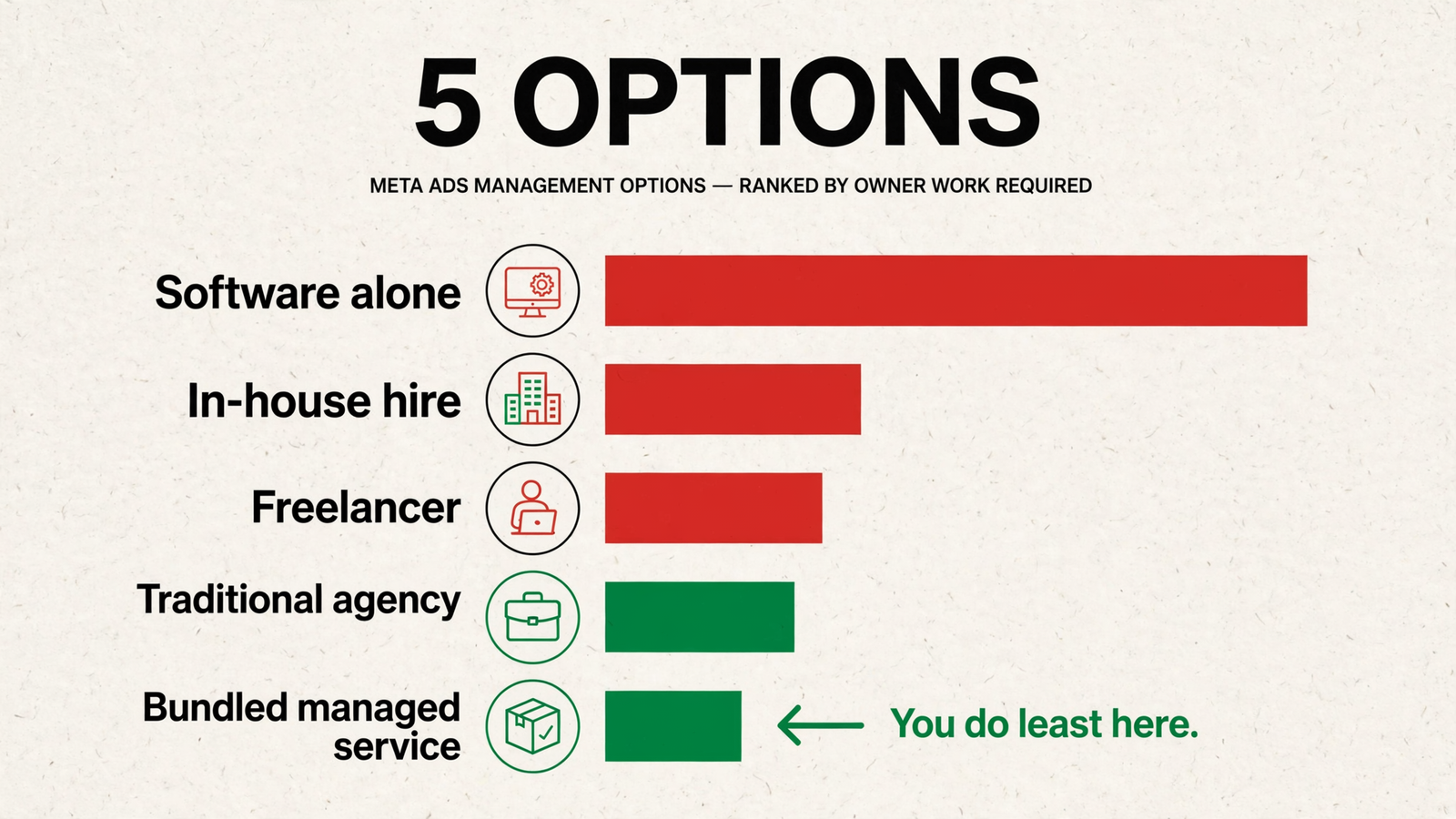
For an owner with no marketing team, my order stays the same: bundled service first, agency second, freelancer third, in-house hire fourth, software fifth. The ranking follows responsibility removed, not the lowest advertised fee.
I left boosting posts and DIY-by-night off the list on purpose. Boosting is not management. It is a tip jar with targeting. If you want the budget-first version of this comparison, read who should run your Facebook and Instagram ads, which ranks six options by budget and creative workload.
Before you sign anything, ask these five questions:
- Who makes the images and videos each week, and how many new ones per month are included?
- Who checks the pixel, Conversions API, and purchase values before scaling, and what happens when the numbers disagree?
- Who builds, pauses, and restructures campaigns, and how often do changes go live?
- What do I still supply: raw video, product facts, access, approvals? When is each due?
- What is the management fee, what is separate ad spend, and how do I leave if it does not fit?
If you skipped to the end: my pick is a bundled managed service for the owner who has nobody to make ads, check tracking, manage campaigns, or explain results. That is why groas comes first here, provided the agreed scope covers those jobs. Do not buy the cheapest management fee and discover you bought three extra jobs. Buy the missing team.


