

 LinkedIn
A mid-2024 playbook for getting cited in Google’s AI Overviews may be aimed at a search surface that lasted only a few months. I’ve seen this pattern in paid search: Google changes the machinery, agencies keep selling ways to manipulate the old interface, and clients pay for work that no longer has a job.
The citation story has moved just as quickly. In 2024, consultants prescribed accordion FAQs, inflated word counts, and pages that repeated a target question verbatim. Those tactics assumed that getting cited meant matching the visible answer box. But Google has changed when AI answers appear, where links sit, and how AI Mode gathers material for an answer. A tactic tied to one version of the interface has a short shelf life.
So when someone asks me how to earn a citation now, I start with a less glamorous question: When was the advice published? Here is the dated trajectory, from an opt-in experiment to AI Mode, and what each turn fixed or broke for the people publishing pages.
May 2023: SGE makes citations a separate contest
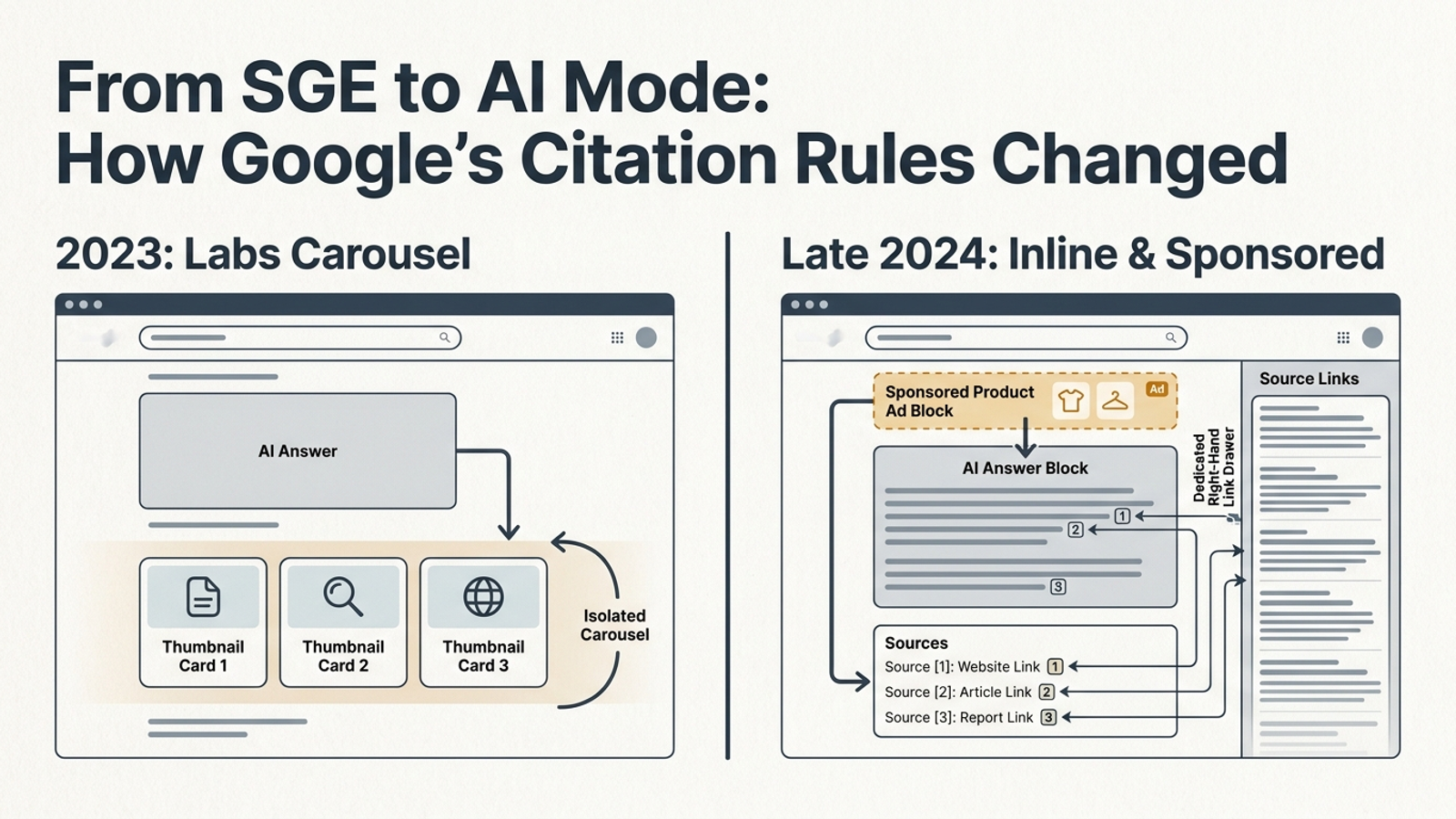
On May 10, 2023, Google introduced the Search Generative Experience, or SGE, in Search Labs. It was an opt-in experiment for multi-step, conversational searching. The generated answer occupied a prominent block above ordinary results, while source links appeared in a card carousel. A citation felt less like an attribution to a specific sentence and more like suggested reading beside the answer.
Ranking first was not the same as getting cited
For practitioners, the first question was obvious: would SGE simply summarize the highest-ranking organic pages? An early Authoritas study of SGE retrieval found that 62% of citation links came from domains outside the top 10 organic results. A first-page ranking was not a ticket into the generated answer, and a page that lacked one could still appear as a source.
That finding opened a useful possibility and a bad business model. Useful: a focused page answering a narrow question might get seen where a conventional ranking report would miss it. Bad: the idea that SGE was an alternate index you could flood with thin pages aimed at conversational long-tail phrases. The study showed a difference between citations and organic results; it did not show that volume or templated phrasing earned citations.
SGE was also still a lab experiment. Its trigger behaviour and presentation were not a durable specification for a publishing sprint. Treat an experimental citation pattern as a clue, not a rule. That distinction became expensive a year later.
May 2024: AI Overviews launch, then pull back
On May 14, 2024, Google brought the experiment into US search as AI Overviews. This was no longer a Search Labs curiosity that a user had to opt into. The wider rollout quickly exposed a problem: generated answers could repeat absurd material, including the now-infamous suggestion to put glue on pizza. The issue for practitioners was not just a week of embarrassing screenshots. It was that Google had reason to change how often the feature appeared and what material it trusted.
The trigger rate changed the size of the opportunity
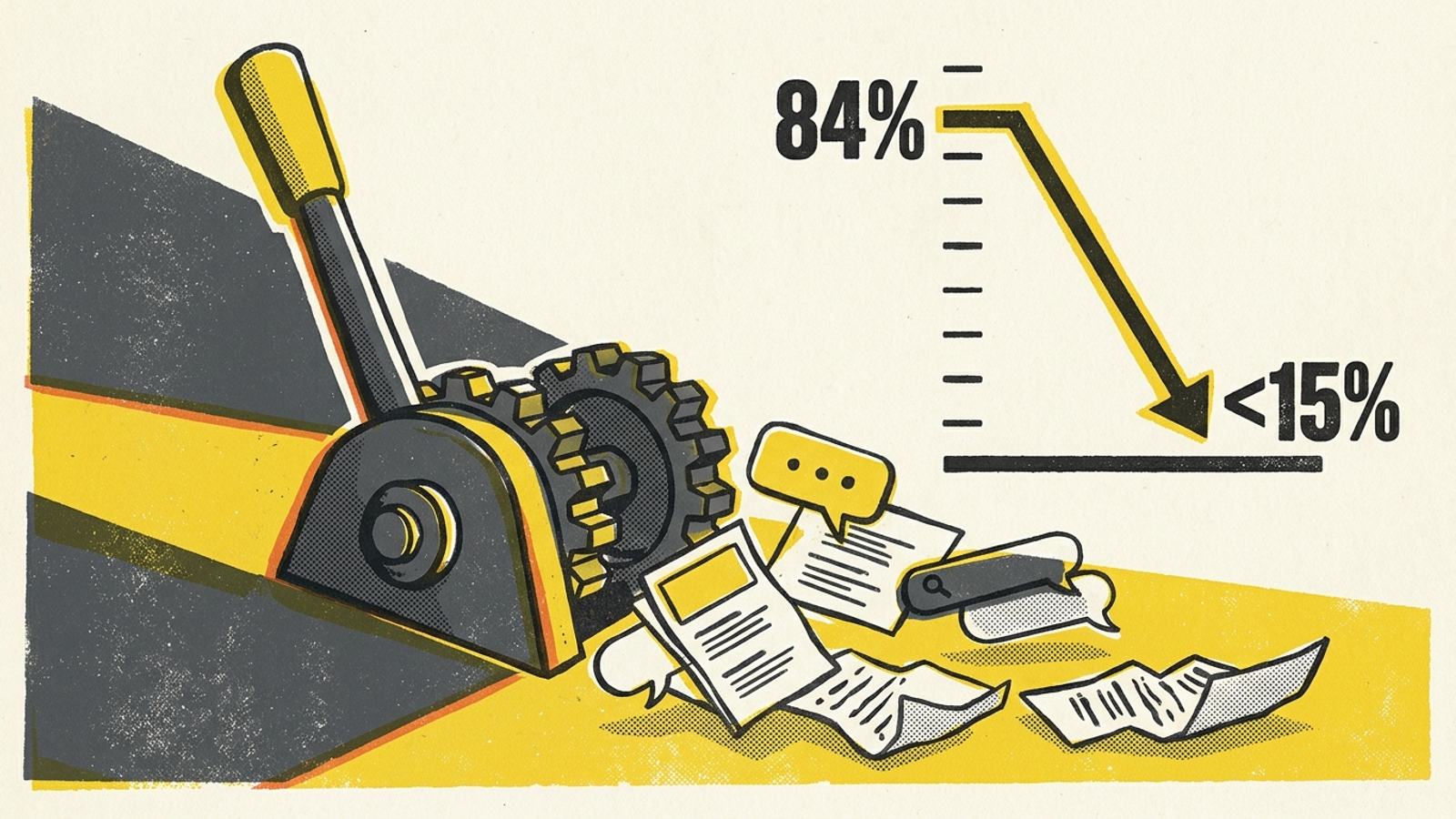
Google described changes intended to reduce nonsensical answers after the launch. Meanwhile, BrightEdge tracking showed AI Overview appearances falling from roughly 84% of its monitored queries during late SGE testing to under 15% within two weeks of launch. Those figures describe a monitored query set, not every search on Google. They still capture the operational shock: a feature that seemed nearly ubiquitous in testing became much less visible in that tracking.
If an agency sold you a June 2024 project based on screenshots from the SGE sandbox, its forecast now had a denominator problem. Even a page built exactly to that earlier brief could not earn an AI Overview citation on a query where no overview appeared. Before you change a page to chase a citation, check whether the answer surface appears for the queries that matter to you. Otherwise you are optimizing for an empty box.
The failure of the early playbook was not that clear answers stopped mattering. It was that a layout observed in an opt-in test had been mistaken for a stable channel. Trigger rate comes before citation rate. No amount of FAQ padding fixes that arithmetic.
October 2024: Links become more visible as ads arrive
On October 28, 2024, Google announced AI Overviews in more than 100 countries, reaching over 1 billion monthly users. The experience was also moving away from SGE’s isolated source carousel toward more prominent links associated with generated answers. That changed what a publisher could reasonably examine: not merely whether a URL appeared somewhere beside a summary, but whether it helped substantiate a particular part of the answer.
Sponsored space changed the commercial pitch
Three weeks earlier, on October 3, 2024, Google launched ads in AI Overviews for US mobile users. They drew on existing Shopping and Performance Max campaigns rather than a separate AI Overview ad format. Anyone who had spent time watching paid-search real estate evolve could see the problem for a popular sales pitch: consultants had been promising organic AI citations as a way to leapfrog paid results on buying-intent searches.
Once sponsored placements entered the experience, that pitch needed a rewrite. It did not mean an organic link could never matter on a commercial query. It meant you could no longer plan as if the generated block were protected organic territory. The window for organic citations on transactional searches had a different shape once ads shared the surface.
For a publisher, the durable work was less about reproducing a card layout and more about writing passages that could support specific claims: a direct answer, a clearly named product or process, and enough context to show why the answer applies. Do not build a content strategy around the number or position of cards in one screenshot. Google had already shown how quickly both could change.
2025: AI Mode makes the unseen sub-query matter
AI Mode took Google’s generated answers beyond the standard overview widget into a conversational search experience. Google’s Search Central documentation describes query fan-out: the system can issue multiple related searches to assemble an answer. The user types one request, but the answer may draw on pages that address several parts of the problem.
One prompt can lead to several citation paths
That mechanism weakens the familiar advice to mirror the user’s exact prompt in a heading and repeat it in the first paragraph. Exact phrasing can help a reader understand a page, but it does not cover the related questions AI Mode may search while building an answer.
A December 2025 Ahrefs analysis of 730,000 queries found that AI Overviews and AI Mode shared only 13.7% of cited URLs. It also found that 77% of cited domains appeared in only one of the two surfaces. AI Mode drew on an average of 9.2 domains per answer, compared with 7.7 for AI Overviews. The practical point is not that one surface has a secret preferred word count. It is that success in one does not guarantee visibility in the other.
Another study, examining 173,902 URLs across 10,000 queries, found that 51.2% of pages cited in AI Overviews ranked for both a primary keyword and at least one related fan-out sub-query. That is a reason to cover the connected parts of a topic, not a promise that adding more sections will buy a citation.
Say your page targets “best inventory software for small warehouse.” A buyer may also need answers about barcode scanning latency, legacy ERP integration, and hardware compatibility. A page that addresses only the headline phrase leaves those questions to other documents. Write for the problem behind the prompt, not just the characters in it.
December 2025–present: Build for the answer, not the widget
I read this timeline the way I read a paid-search changelog. Managers once built elaborate Single Keyword Ad Groups and manual negative-keyword structures to control where ads appeared. Then exact match loosened through close variants, responsive search ads arrived, and automated bidding took more of the execution. Performance Max pushed still more decisions behind the interface. The lesson was not that account structure never matters. It was that a business built on manipulating each visible control has to be rebuilt whenever Google moves the control.
The same mistake is easy to make with AI citations. A carousel becomes a different link treatment. A lab feature reaches the public, then appears less often in a tracked query set. A conversational mode gathers material through related searches the user never typed. Each turn breaks a tactic that treats today’s screen as the underlying system.
Consider the short-lived prescription to add FAQPage or HowTo markup and inflate every article to a target length. Research discussed in this review of AI Overview citation findings found no statistically meaningful correlation between that schema and citations; the reported correlation between total word count and citations was negligible. Markup can describe a page, and a long page can be useful. Neither is a substitute for answering the question.

Keep the parts that survive a redesign
I would put the next publishing sprint into three things:
- Answer-first passages. Give the direct answer near the start of a section. A reader should not have to cross three paragraphs of marketing preamble to find it, and neither should a retrieval system.
- Clear entities and relationships. Name the product, error code, pricing model, or comparison point when that detail is relevant and verified. “Seamless solution” tells neither a person nor a search system what connects to what.
- Crawlable structure. Keep critical answers accessible. Our landing page checklist for AI search addresses the technical side; persuasive copy cannot compensate for content that is hard to retrieve.
These are not guaranteed citation buttons. They make a page useful and understandable across changing retrieval paths, which is a better investment than decorating it for one answer-box design.
Stop buying yesterday’s interface
The corresponding cut list is short:
- Accordion FAQ padding: Five canned questions bolted onto a sales page do not repair a thin answer.
- Arbitrary word-count targets: If the operational answer takes 800 words, stretching it to 3,500 gives the reader more to cross and no clearer answer.
- Orphaned AEO-only pages: A page written in artificial conversational syntax still needs a reason to exist within the site.
- Pixel-level placement projects: A content plan built for a particular carousel or right-hand panel expires when the layout changes.
Before approving the next agency scope, date-stamp the advice behind it. Ask which search surface the recommendation describes, whether that surface still appears on your target queries, and what useful answer the work will add even if the interface changes again. That is where I think the line points next: not to a better trick for occupying an AI widget, but to pages clear enough to remain useful when the widget is replaced.