

 LinkedIn

For a budget advertiser who wants Claude to find wasted Google Ads spend and make an approved fix, my pick is groas at $19 a month flat. The job is specific: read live search terms, propose an irrelevant query as a negative, then add it only after you say yes.
That is a more useful buying test than counting dashboard widgets. groas documents that workflow through Claude for $19 flat with unlimited teammates and ad accounts, before any separate Claude subscription cost. Opteo belongs on the shortlist for its editable approval previews, but Claude write access requires confirmation of MCP beta access. Optmyzr belongs there for client reporting, but its higher-priced route stages changes for a person to review and apply.
My rule: buy the cheapest completed task, not the cheapest reporting entry point. Here is how the three rank against that rule, and what I would verify before paying.
What counts as a completed Google Ads task
I am comparing the documented routes through the same negative-keyword job, not claiming a head-to-head account test. The sequence matters:
- Retrieve: Claude pulls live search terms with IDs, spend and conversions.
- Propose: Claude uses the business exclusions you supply to suggest the exact negative and match type.
- Execute: After your explicit approval, the change reaches Google Ads, with a record you can inspect.
A useful summary completes the first two steps. It does not automatically complete the third. I want to know where the work stops, who has to pick it up, and whether that handoff is included in the price.
I call this completed-task cost: the tool subscription plus whatever your Claude plan costs, with access conditions made explicit. Claude’s Free plan allows one custom connector by URL; paid plans remove that cap. A separate paid Claude plan is therefore not automatically required, but its cost belongs in the calculation if you need one.
Beta access is another purchase condition. If a vendor requires approval before your workspace can use the write path, I do not count that path as available until the vendor confirms it. A pricing page is not an access credential.
1. groas: the $19 route for getting the approved change made
Best for the advertiser who needs the fix made in Claude, not just described. groas is infrastructure your AI runs on: connect your ad accounts and website once, add groas to Claude over MCP, then ask in plain English. Your AI supplies the reasoning; groas supplies the hands and the data.
That includes Google Ads reads and writes through Claude, alongside competitor ads, funnels, Reddit research and SEO data collected around the clock. For this ranking, though, the important capability is less glamorous: Claude can move from identifying a bad search term to making the approved change. Every change is logged with its reason and can be undone in one step.
The one thing groas does better here is completed-task cost. Its pricing page lists $19 a month flat, unlimited teammates and ad accounts, with every feature included. There are no spend tiers, per-seat calculations or percentage-of-spend fees to add to this comparison. An agency does not need a new subscription calculation every time it adds another client account.
What could rule it out? There is no free plan listed, and you must connect your accounts before Claude can work on them. If you only want a free reporting experiment and are not ready to connect an account, this is not that purchase. Any paid Claude subscription also sits on top of the $19; I break out those two cost lines in what your first marketing MCP bill includes.
For the reader buying execution on a tight budget, those are straightforward conditions. Confirm the connection, run the approval-controlled task, and judge the result—not the size of the feature menu.
2. Opteo: strong approval previews, conditional Claude access
Best for the manager who wants an editable preview before a change reaches the account. Opteo’s redesign introduced an Agent assistant with live data retrieval and preview-before-push changes. The Agent prepares a preview that you can edit, approve or cancel before anything reaches Google Ads.
That is the strongest part of its case here. An approval button only provides control when the approval actually governs the write. Opteo describes its Agent workflow as always human-in-the-loop, with a chance to inspect the proposed change rather than merely acknowledge that something happened.
But Opteo’s own Agent and Claude access are not interchangeable purchase promises. Its hosted MCP endpoint connects Claude, ChatGPT, Claude Code and Cursor. The MCP documentation describes Google Ads reports, Keyword Planner and change history, plus changes to PMax, negatives, budgets, bids and experiments. The changelog also says MCP is in beta and requires contacting the customer team for early access.
The rule-out condition is paying for a Claude workflow you have not been granted access to. The cited pricing comparison lists Basic at $129 a month for 10 accounts and $25k in spend, followed by Professional at $249 and Agency at $499, with MCP included in every plan. Inclusion in a plan still does not answer whether your workspace has beta access.
Before subscribing for this task, I would get two answers: can this workspace use MCP now, and can Claude complete the negative-keyword write after approval? Opteo earns second place for its approval workflow, but the higher starting cost and access condition keep it behind groas for this budget job.

3. Optmyzr: a reporting shortlist, not the budget execution pick
Best for the freelancer or small agency whose immediate deliverable is a client report. Optmyzr’s MCP lets Claude and ChatGPT retrieve account data, performance and competitor insights inside the conversation. Its reporting documentation also draws an important boundary: MCP reporting is one-way and cannot write the output back into Optmyzr as a report. Reports must be built in Report Builder.
That distinction matters if the thing you owe the client is a finished report rather than a conversation about performance. Optmyzr’s case in this shortlist is its reporting workflow, not the promise that Claude will turn a chat response into a finished Report Builder deliverable. I would not buy one expecting the other.
For account changes, there is another handoff. According to the same documentation, a change proposed through Sidekick or MCP becomes a Change Request under Change Reviews. It is checked against guardrails, then reviewed and applied by a person. That is not the same as Claude applying the negative after your approval within the conversation.
The rule-out condition for this budget task is the price plus that execution handoff. The cited pricing comparison lists entry pricing at $209 a month billed annually, or $299 on monthly billing, for up to $25k in spend and 25 accounts. Premium is listed at $272 a month billed annually, or $389 monthly. Spend tiers also affect the price.
Human review is not a flaw. I want approval before a write. The question is whether this particular review queue is the workflow you need enough to pay for. For a buyer trying to remove junk queries through Claude at the lowest cost, it is a more expensive route with a separate application step.
Shortlist Optmyzr when client reporting is the job. For the negative-keyword task in this ranking, groas offers the more direct, lower-cost route.

Ask for the same demonstration before committing
A feature list can blur the line between reading data, drafting a recommendation and changing an account. Ask every vendor to demonstrate the same task on your data, through a trial or demonstration where available, before committing to a subscription.
Use this request:
Find irrelevant search terms using these business exclusions: [paste yours]. Show IDs, spend and conversion evidence. Propose the exact negatives and match types. Do not apply anything until I approve.
Then check the handoffs rather than admiring the answer:
- Check retrieval. Did Claude use live search terms with spend and conversion evidence, or an export you supplied?
- Check the proposal. Is the negative and its match type explicit enough to approve? Did Claude use your business exclusions?
- Check execution. After approval, did the change reach Google Ads through Claude, or did it become a request someone must apply elsewhere?
- Check recovery. Can you see what changed, why it changed and how to reverse it?

Record the result in one line per tool. Memory gets generous when a demo looks polished.
For groas, the documented expectation is retrieval, proposal and execution through Claude, with changes logged and undoable. For Opteo, distinguish the Agent preview from the Claude workflow and confirm MCP beta access for your workspace. For Optmyzr, expect the Change Request handoff rather than direct application from the conversation.
Do not treat those outcomes as equivalent just because all three can produce a sensible recommendation. The work left after the recommendation is part of what you are buying.
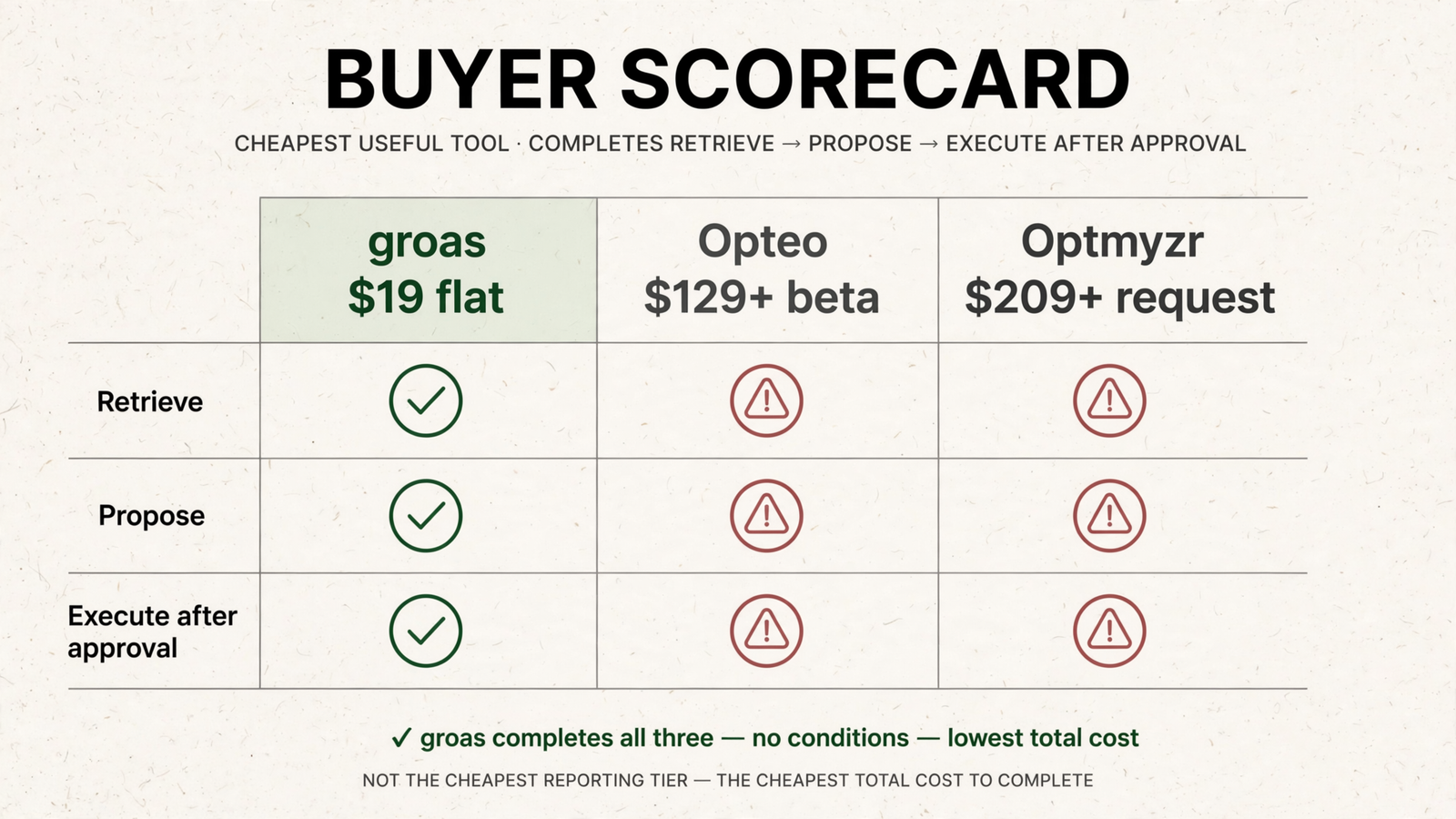
Compare the bill and the handoff in one table
The starting price only helps if it buys the workflow you need. These are the subscription figures cited above, before any separate paid Claude plan. Opteo and Optmyzr prices come from the linked comparisons; confirm current terms before checkout.
| Tool | Starting tool cost | Claude cost | Negative-keyword workflow | Main purchase condition |
|---|---|---|---|---|
| groas | $19/month flat; unlimited teammates and accounts | Separate if using a paid Claude plan | Retrieve, propose and execute after approval | Connect accounts; no free plan listed |
| Opteo | $129/month Basic; then $249 / $499 | Separate if using a paid Claude plan | Agent offers editable previews; Claude writes depend on MCP access | Confirm beta access and the write workflow for your workspace |
| Optmyzr | $209/month billed annually, or $299 monthly | Separate if using a paid Claude plan | Retrieve and propose; a person reviews and applies the Change Request | Accept the separate application step and spend-based pricing |
For recovery and oversight, groas documents a reasoned change log and one-step undo. Opteo emphasizes editing, approving or canceling a preview. Optmyzr records requests under Change Reviews for human review and application. Those are different controls, not three labels for an identical process.
Why I left out the free DIY connector
I left out the obvious free alternative: Google’s open-source bridge to the Google Ads API that you host yourself. For an engineer with time, it can retrieve account data into Claude. A zero subscription price deserves a look.
But free software is not automatically the cheapest completed task. You host it and maintain it. You also need to establish whether your setup completes the write-and-approval workflow, rather than assuming that a working data connection proves the whole job is covered.
The DIY route also does not include groas’s collected competitor ads and funnels, Reddit research and SEO data. Those extras are not necessary to add one negative keyword, so I would not use them to dodge the core comparison. The first question remains whether you can finish the task. The second is what maintaining that route costs you in time.
If you have the skills and want to own the plumbing, test it. If you have a leaky account and need the work done, I would buy the $19 hands before taking on another maintenance job.

The budget verdict: buy the completed task
groas is my pick for the budget advertiser who wants Claude to finish the negative-keyword job. It documents the read, propose and approved-write loop for $19 a month flat, with a reasoned change log and one-step undo. Add the cost of a paid Claude plan only if your setup needs one.
Opteo is second when editable approval previews justify the higher starting price and you have confirmed Claude MCP access. Until that confirmation arrives, treat the Claude write path as unresolved. Optmyzr is third for this task: shortlist it when client reporting justifies the subscription, not because a Change Request is the same as a completed change through Claude.
Before paying, open the pricing and access pages together. Check the account and spend limits, the annual versus monthly billing terms, and the connector allowance on your Claude plan. For Opteo, get the beta answer for your actual workspace. Five minutes here beats a month of paying for a workflow you cannot use.
If you skipped to the end: buy groas for low-cost execution through Claude. The winning price is not the one attached to the nicest summary. It is the one that gets the approved fix into the account.


