

 LinkedIn

You imported a client’s Google Ads account into Microsoft Ads. Forty campaigns appeared in nine minutes, then did nothing useful for three weeks. If you run the agency, your choice is between repairing the Google Import and building fresh Microsoft campaigns. A stalled launch is not, by itself, a case for starting over.
I have cleaned up both kinds of messes. The import copies visible structure well: campaigns, ad groups, keywords and ads. The trouble tends to sit in the wiring around that structure: tracking, bidding, locations and network distribution. I judge the two routes by what you can keep, what you must change, and what a white-label partner can demonstrate before you pay for the work.
Before either route, diagnose the stall
Most agency owners tell me Bing does not work for this client. When I look, I usually find three problems stacked together:
- Tracking failed, so Microsoft cannot see the conversions it needs to bid toward.
- Settings widened on import, so spend reaches places the Google campaigns did not intend to buy.
- The commercial result looks weak because nobody fixed the first two problems.
I used to tell clients to wait for the learning period to settle. I was wrong. On a broken import, waiting just buys more bad data.
Start with evidence, not a proposal for a new account structure. If Microsoft shows clicks and zero conversions while GA4 shows Bing traffic as organic or missing, investigate tracking. If impressions come from outside the service area or syndicated partners that never enquire, investigate settings. Only after both are clean for two full weeks would I treat CPA or ROAS as a meaningful channel result. Do not approve a rebuild until someone shows you which layer failed, with screenshots.
1. Structure: keep useful work, not import residue
A repair keeps the imported campaigns and corrects what came across badly. That can preserve campaign names, ad-group themes, keyword lists, responsive search ads with pins, sitelinks, callouts and shared negative lists. On a mid-size account, keeping a sound structure can save three to five hours of rebuilding. It also leaves any early Microsoft quality signals in place. Google account history itself is not the prize; usable structure and early Microsoft signals are.
Before touching a repair, pause the scheduled re-import. Leave it running and it can overwrite Microsoft-side changes to bids, budgets or paused campaigns. I do not want to fix a location setting on Tuesday and have an automated import quietly undo it on Wednesday.
But not everything that survived the import deserves to stay. The Google 45-to-54 age band has no Microsoft equivalent and gets dropped; 18-to-24 exclusions can reset to full bidding and need a workaround exclusion. Broad-match negatives arrive as phrase-match, and Microsoft close variants run looser than Google’s. Search terms need a separate Microsoft review even when the Google keyword list looked clean.
This is where a fresh build can earn its fee. If the offer changed since the Google campaigns were built, dead ad groups are not worth preserving. Nor is a bloated Google structure with five match-type splits and catch-all campaigns that never belonged on lower-volume Bing. If the audit finds more broken layers than keepers, repeated patching becomes the expensive route. Repair what still matches the offer; rebuild structure you cannot defend.
2. Settings: fix the spend before judging the channel
An imported campaign can look familiar while buying different traffic. I check four settings before I call its performance a verdict on Microsoft Ads:
- Bidding. If Microsoft found no conversion goal at import, Target CPA or Maximize Conversions may have flipped to Maximize Clicks. That can spend the budget on traffic without bidding toward leads. I use Manual or Enhanced CPC while conversion data is thin, then test automated bidding once the account logs about 30 conversions in a month.
- Bids. Microsoft clicks can run 20–35% cheaper than comparable Google clicks. That is a reason to check imported bids, not proof that every keyword should receive the same cut. I start by assessing a 20–30% reduction and watch what happens to position and CPA. A $5 Google bid left at $5 in Microsoft deserves scrutiny, especially if the client spends $20k a month on Google.
- Locations. Small towns Google understood can map to a larger county or region, location groups may not come across, and broader location options can leave a local campaign serving far beyond its intended area. I have seen a Leeds plumber buying clicks from Glasgow because nobody checked the map. Set targeting to people in your targeted locations, re-enter the postcodes and inspect the map view.
- Networks. A Google campaign with search partners checked can land across Microsoft’s networks, including syndicated partners that burn budget fast. I start on owned-and-operated only, then review the Website URL publisher report after two weeks and exclude placements that spent without an enquiry. Keep reviewing monthly.
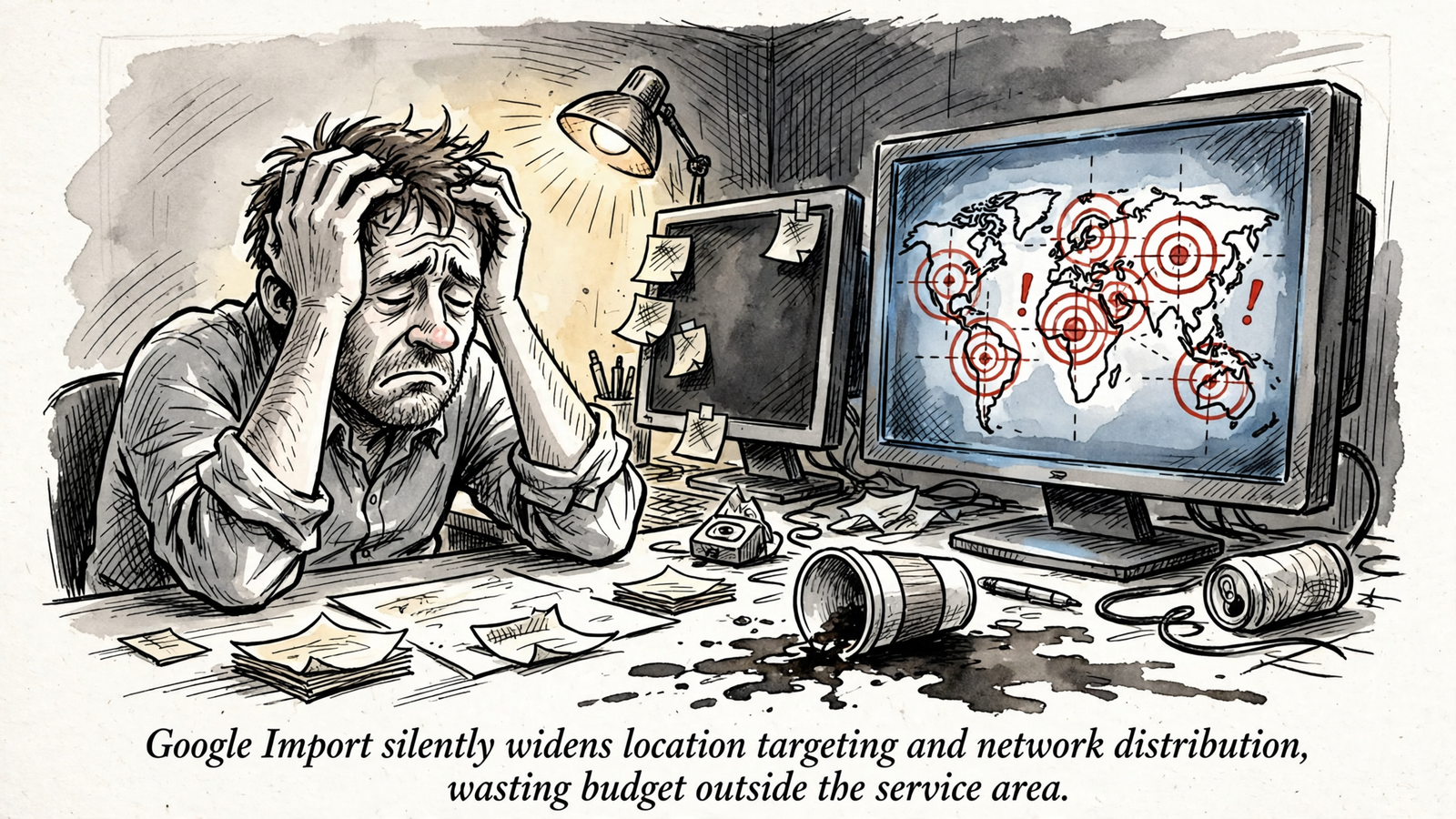
A fresh build lets you enter bids, bidding, locations and networks cleanly once, with each choice documented. A repair gets you to the same checks by correcting what imported. Neither route excuses pasting Google bids into Microsoft and calling the campaign ready. Judge the settings you launch with, not the neatness of the campaign shell.
3. Tracking: a new campaign does not fix a blind one
Tracking is the repair that decides whether bidding can work at all. Only eligible tag-based destination goals created in Google Ads come across; GA4-imported goals, custom events and Google call tracking do not. Without a separate UET tag on the relevant pages, imported campaigns run blind. Run an imported goal alongside a new UET goal for the same lead and you can double-count it instead.
I check the UET tag and conversion goals page by page, turn on auto-tagging so traffic reports as bing/cpc, and make sure redirects preserve the msclkid. I also expect some reporting difference because Microsoft reports on click date while GA4 reports on event date. I investigate rather than assume the systems will match exactly, escalating if the gap stays above about 25%.
Consent can keep the problem alive after every other setting is fixed. UET Consent Mode became mandatory on May 5, 2025 for EEA, UK and Switzerland traffic. When consent is denied, Microsoft does not offer modeled conversions to fill that gap. I have seen agencies rebuild twice and still miss the broken banner, because the new campaigns inherited the same measurement problem.

A fresh build needs the same UET, goal, auto-tagging and consent work as a repair. It starts with new campaign shells, not new measurement by magic. If Microsoft cannot count conversions cleanly, do not let anyone sell you a rebuild as the tracking fix.
4. Time: pay for the faster route only when it stays fixed
A sound imported foundation can be repaired and live in days. That advantage disappears when every layer needs untangling. A fresh build takes more work up front: new campaign shells, locations checked against the map, networks restricted, negatives rebuilt where needed, and conversion goals validated before launch. It can take one to two weeks to go live, followed by two to three weeks on Manual bidding while signals build. A clean change log is useful, but it does not make that wait free.
Both routes also leave the same ongoing job. Review search terms weekly, check publishers monthly, and keep re-import off or narrowly selective. If someone prices a rebuild but leaves those tasks out, you have bought a cleaner-looking version of the same stall. The cheaper route is the one that reaches a defensible launch without paying twice for identical fixes.
The head-to-head, on one page
| What decides the choice | Repair the Google Import | Build fresh Microsoft campaigns |
|---|---|---|
| Structure and signals | Keeps useful themes, ads, negatives and early Microsoft signals; wins when the imported structure still fits. | Starts with clean structure but no early campaign signals; wins when the old structure no longer fits. |
| Tracking | Validate UET, goals, auto-tagging and consent; remove duplicate counting. | Do the same tracking work. A new shell cannot compensate for broken measurement. |
| Spend controls | Correct bidding and bids, tighten locations and networks, and review Microsoft search terms. | Enter settings cleanly and document them, rather than repairing import residue. |
| Time to launch | Can be live in days when the foundation is sound; slows down when every layer is broken. | Allow one to two weeks to launch, then two to three weeks of Manual bidding while signals build. |
| Ongoing work | Weekly search terms, monthly publisher checks, and re-import off or selective. | The same reviews, with a clean change log from day one. |
My verdict: repair first, unless the structure has lost its case
For the agency owner who already imported Google campaigns and got stuck, I pick repair in roughly four cases out of five. Keep the themes that still match the offer. Fix bids, bidding, locations, networks and UET. Then judge the campaign on traffic and conversions you can actually trust. Tracking and consent work follows you into a rebuild anyway, so paying to replace a sound structure does not remove the hard part.
Who should pick the loser? Pick a fresh build when the offer changed, the Google structure was bloated beyond saving, or the audit finds more broken layers than keepers. It also makes sense when you need a clean change log to hand to a client and can afford the slower start. Everyone else should repair first and spend the saved hours on search terms and publisher exclusions, where Bing CPA is actually decided.
Before a white-label partner gets access, require a verdict
Do not brief a fulfillment partner with “fix Bing.” Ask for a one-page repair-versus-rebuild recommendation before execution. I want to see what they would keep, what they would change, and how they will prove the work succeeded. The page should name the UET and conversion-goal setup, bid and bidding changes, location map check, network restriction, and search-term and publisher review cadence. If their answer is “rebuild,” they should identify the structure that cannot justify staying.
That is the standard I would put to a white-label Microsoft Ads partner: execution under your brand, reporting you can put in front of a client, and a clear account of the work rather than a vague promise to optimize. Check account and data ownership, pricing, and terms before committing; white-label PPC services are not a reason to stop asking what you are buying. If a partner cannot put the route in writing, they can bill you for a reset you did not need.
If you want fulfillment behind the agency rather than another monthly account review, I would put groas there. It pairs continuous execution and logged changes with a named strategist responsible for direction and accountability. Its scope covers the work here: repairing imports, rebuilding when justified, and managing bids, budgets, keywords and publisher exclusions. Check the account-service pricing and minimums in its five-unit minimum breakdown before promising fulfillment to a client.
Send the partner the import, the GA4-versus-Microsoft conversion gap and the service-area map. Require the repair-or-rebuild page back before granting access. No written verdict, no account access.


