

 LinkedIn

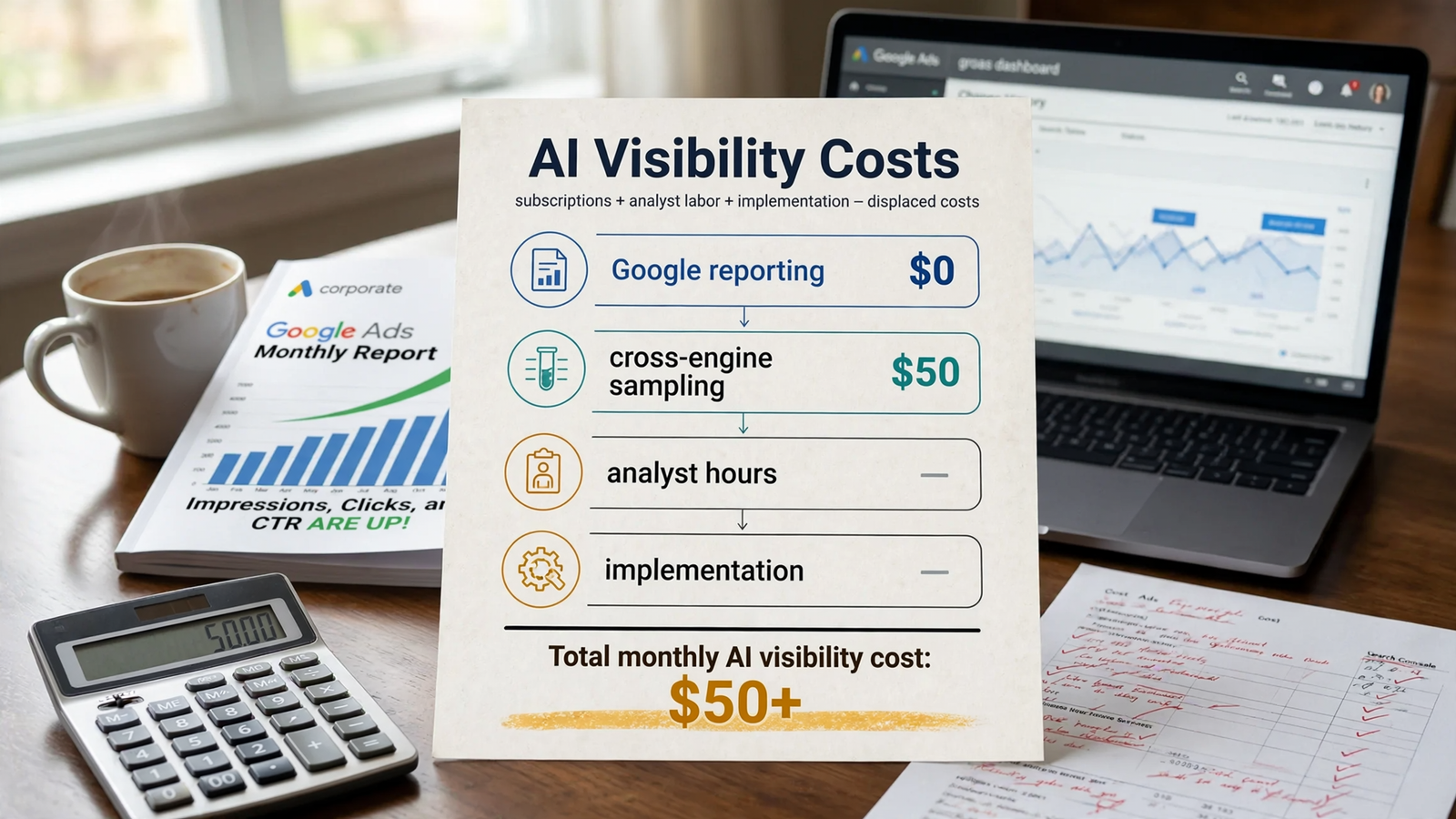
Your starting bill is $0 extra for Search Console, around $50 a month for a cross-engine sampler, and 3 to 5 analyst hours—not a second SEO department. The entry-level monitoring examples below range from $29 to $99 a month, but coverage differs. Implementation is a separate purchase, not something to hide inside that total.
If you already employ an SEO analyst, the new label AI visibility does not justify buying the same measurement work twice. Google includes AI Overviews and AI Mode activity in Search Console’s Web performance reporting. What that does not give you is evidence from ChatGPT, Gemini, or Perplexity.
That is the gap to price first. Then price the person who interprets the evidence and the people who ship the fixes. A dashboard is the smallest bill. Labor and implementation are the bill.
| Line item | Recurring cost | One-time cost | Source or basis |
|---|---|---|---|
| Google reporting through Search Console | $0 extra | Analyst time to check dashboard logic | Search Console reporting breakdown |
| Cross-engine sampling: HubSpot AEO example | $50/month, or $45/month billed annually | Not included in this estimate | HubSpot AEO review |
| Analyst setup and interpretation | Assumed 3–5 hours/month × internal hourly cost | Assumed 4–6 hours for setup | Planning assumptions, not vendor prices |
| In-house implementation | Internal delivery time | Depends on the work required | Your backlog and payroll |
| External implementation | Separately quoted scope | Any onboarding or setup in the quote | Delivery proposal, not a dashboard price |
| groas Done For You | From $5,000/month | Confirm in the proposed scope | groas service pricing |
Those analyst hours are illustrative. Replace them with your own. An existing salary can mean no new cash outlay, but it does not mean unlimited spare capacity.
Line 1: Google reporting costs $0 extra. Count it once.
Search Console already includes AI Overviews and AI Mode within its main Performance reporting under the Web search type. That gives your analyst Google evidence without another reporting subscription. It does not make Search Console a cross-engine AI visibility monitor.
The distinction matters because “Google reports AI activity” can sound like “Google gives me a clean, separate AI acquisition report.” Those are different promises. Blended Web reporting is not a standalone account of every AI answer, its triggering prompt, and the business it generated.
My first instruction to the analyst is simple: check what the report actually measures before putting an AI label on a chart.
- Keep Google Web performance as the Google reporting baseline.
- Document whether a metric represents impressions, clicks, mentions, or citations.
- Do not add AI exposure already included in Web totals back onto those totals.
- Do not publish an AI impression-share calculation unless the underlying data actually separates the numerator.
An AI label does not create an additional impression. If the same exposure appears in a total and a subset, adding them together produces a bigger number, not more visibility.
There is no Search Console surcharge to pay. A vendor can charge for interpretation, integration, or reporting labor. I want that work named on the invoice, rather than presented as access to Google data I already have.
Line 2: buy cross-engine sampling, not a universal visibility score
Search Console tells me nothing about appearances in ChatGPT, Gemini, or Perplexity. A monitoring subscription fills that gap by sampling answers to a chosen prompt set. The operative word is sampling.
One reference point is HubSpot AEO at $50 a month, or $45 a month billed annually. The cited review describes 25 prompts run daily across ChatGPT, Gemini, and Perplexity, with roughly 2,500 answers per month. It reports visibility, sentiment, competitor share of voice, citations, and prioritized fixes.
It excludes Google AI Overviews, AI Mode, Claude, and Copilot. That is not a footnote if those are the surfaces the business needs to monitor.
Other listed entry plans show why the sticker price is not enough:
| Monitoring example | Listed price | Coverage or billing detail to check |
|---|---|---|
| Otterly Lite | $29/month for 15 prompts | ChatGPT, Perplexity, AI Overviews, and Copilot; Gemini listed as a $9 add-on |
| Semrush AI Visibility Toolkit | $99/month per domain, billed annually, for 25 prompts | Names ChatGPT, Perplexity, and Gemini |
| Peec Starter | $95/month for 50 prompts | Choice of 3 models |
| Ahrefs Brand Radar Basic | $50/month for 2,500 checks | A check is one prompt × one platform × one location; Claude answers use 8 checks |
Sources: monitoring-tool comparison and Ahrefs check-based pricing.
These are reference prices, not interchangeable baskets of work. Prompt counts, engine coverage, locations, and check allowances change what the subscription buys. Annual billing changes the commitment, too.
If buyers ask Claude and the plan does not monitor Claude, the cheaper plan is the wrong plan. I would compare coverage first, usable sampling allowance second, and price third. Prompt selection and competitor cleanup still need an owner at every tier.
Line 3: the analyst hours hiding behind the score
A $50 subscription does not choose useful prompts by itself. Someone has to distinguish a buying question from a head term, remove irrelevant competitors, inspect answers, and turn the result into a decision.
That work also explains why two tools can return different visibility scores for the same brand. They can use different prompts, engines, retrieval indexes, and scoring methods. Answers vary between runs. A blended score compresses all of that into one tidy number. Tidy is not the same as comparable.
The explanation of why AI visibility tools disagree makes the underlying problem clear: the sample and methodology affect the result. A single run should not become a confident trend line just because the dashboard draws one.
I would budget the work in two buckets:
One-time setup: an assumed 4 to 6 hours
- Select prompts around buyer intent rather than broad head terms.
- Segment them so different stages of demand do not disappear into one average.
- Clean the brand and competitor lists.
- Record which engines, locations, and answer types the subscription covers.
- Define what counts as a mention, a citation, and a useful change.
Recurring interpretation: an assumed 3 to 5 hours a month
- Review repeat checks rather than treating one answer as a verdict.
- Inspect the answers behind meaningful score changes.
- Keep Google reporting separate from cross-engine sampling.
- Clean up competitor matches and prompt coverage.
- Turn findings into a short implementation queue.
Monthly analyst cost = assumed hours × internal hourly cost. These are planning assumptions, not a benchmark every business must meet.
The distinction between a mention and a citation deserves particular attention. A source can be cited without the answer naming the brand. The citation research discussed here illustrates that gap. Neither metric should quietly become “qualified visits” in the next slide.
If the analyst is already on payroll, much of this capability already exists. The purchasing question is whether there is time to do it—not whether the job title contains “AEO.”
Line 4: implementation is a different purchase
A recommendation is not a shipped fix. Monitoring can identify a missing page, a weak answer, or a citation gap. Someone still has to write, publish, fix templates, and pursue mentions.
That is where dashboard-versus-retainer comparisons fall apart. They put a measurement subscription beside a delivery service and pretend the price difference is markup.
The HubSpot AEO review makes the distinction concrete. It describes the $50 tier as tracking-only. Turning a recommendation into a draft requires Marketing Hub Professional at $800 a month on annual billing or $890 monthly, plus $3,000 onboarding. Each article uses 1,000 Credits, listed as $10.
Those are separate cost categories:
- Recurring platform access: the subscription needed for the workflow.
- One-time onboarding: a setup bill, not an ordinary monthly fee.
- Usage: credits consumed by individual outputs.
- Delivery labor: the work required to turn an output into something published and maintained.
A draft is still not the whole implementation job. I want the quote to say who owns publication, technical changes, and outreach—not merely which button generates text.
For the broader implementation budget, see What It Costs to Get Cited by AI.
The same separation applies to groas. The $19-a-month infrastructure and Done For You, from $5,000 a month, are different purchases. One is the infrastructure for running the work; the other is a managed service. Neither belongs in a cost comparison as though it were simply another price for a $50 monitoring subscription.
If the analyst has capacity and the team ships fixes, keep execution in-house. If the backlog never clears, price delivery. Judge a delivery quote by the work it takes off the queue, not the number of dashboards included.
Build one cost sheet, with setup outside the monthly total
The recurring formula is straightforward:
Monthly cost = subscriptions + internal labor + external implementation − displaced costs.
Then put one-time setup beneath it. Do not bury onboarding in the first month and use the cheaper second month as the headline without saying so.
For illustration, the recurring sheet might contain $50 for sampling, 4 analyst hours at the business’s internal rate, and no external implementation fee because the existing team ships the fixes. That last zero does not make implementation free. Its labor still belongs in the internal cost calculation.
If delivery moves outside the business, add the quoted scope. Subtract only costs that actually disappear:
- A tracker that gets canceled.
- Duplicated reporting hours that stop being spent.
- Freelance briefs no longer commissioned.
Do not subtract an analyst’s salary unless the role goes away. Moving someone’s Tuesday afternoon to a more useful task is valuable, but it is not a canceled payroll bill.
Before adding anything, list every visibility subscription, every recurring reporting task, and every implementation supplier. The overlap usually becomes easier to see when it is no longer spread across three proposals.
If two subscriptions cover the same engines and prompts, keep the one that fits the work. If the engine lists differ, establish whether that extra coverage matters before calling either subscription redundant. Where Google AI Overviews versus ChatGPT and Perplexity citations pay off first helps frame that decision.
My operating rule is one sampler, one owner, one cost sheet. Add another tool only when it fills a named gap.
The buying decision: evidence first, execution when capacity runs out
A business with an existing SEO analyst already owns useful analytical skills and access to Google reporting. It does not automatically own evidence from other engines, and it does not automatically have time to act on that evidence.
I would make the purchase in this order:
- Audit existing coverage. Establish what the current tools and reporting already provide.
- Buy the missing evidence. Choose one sampler covering the engines buyers actually use.
- Assign the interpretation. Give the analyst a defined prompt set, a monthly review, and time to inspect the answers.
- Price the delivery bottleneck. Buy implementation only when the existing team cannot clear the work.
That keeps the decision attached to a problem. It also prevents a familiar absurdity: buying another score because the team has not shipped the fixes identified by the first score.
A managed scope should be judged on pages briefed and published, technical changes shipped, mentions pursued, and movement on the prompts named upfront. groas Done For You belongs in that delivery conversation, not in a comparison pretending every service is a tracker. If current headcount clears the backlog, keep execution in-house.
Pay for the gap, not a second stack. Existing skills are an asset. Existing overload is a constraint. The cost sheet needs to recognize both.
No package can guarantee rankings, citations, or leads
No vendor can promise a citation, a mention, or a lead from an AI answer. Answers vary, retrieval differs by engine, and monitoring tools sample different prompt sets. The score can move when the sample moves even if the website does nothing.
Visibility and pipeline are different claims, too. A citation does not necessarily name the brand, and a mention does not necessarily produce a visit. I would buy sampling to understand the chosen prompts and implementation to ship the work intended to improve those answers. Then I would judge shipped changes and movement over 60 to 90 days, without pretending that window guarantees an outcome.
Buy defined work and useful evidence, not guaranteed presence. A reporting contract does not become an outcome contract because the sales deck says “AI.”
The cheapest mistake costs $0: counting the same Google exposure twice and calling the bigger total growth. Fix the dashboard logic before planning a budget around it.
The most expensive mistake is buying capacity already sitting inside the business. That can mean a managed service when the team has time to ship, or a second tracker when the first already covers the relevant engines and the real queue is unpublished briefs and unfixed templates. Pay for the missing line only: Google reporting already available, the sampling actually needed, analyst time honestly counted, and implementation when the work will not ship without it.


