

 LinkedIn
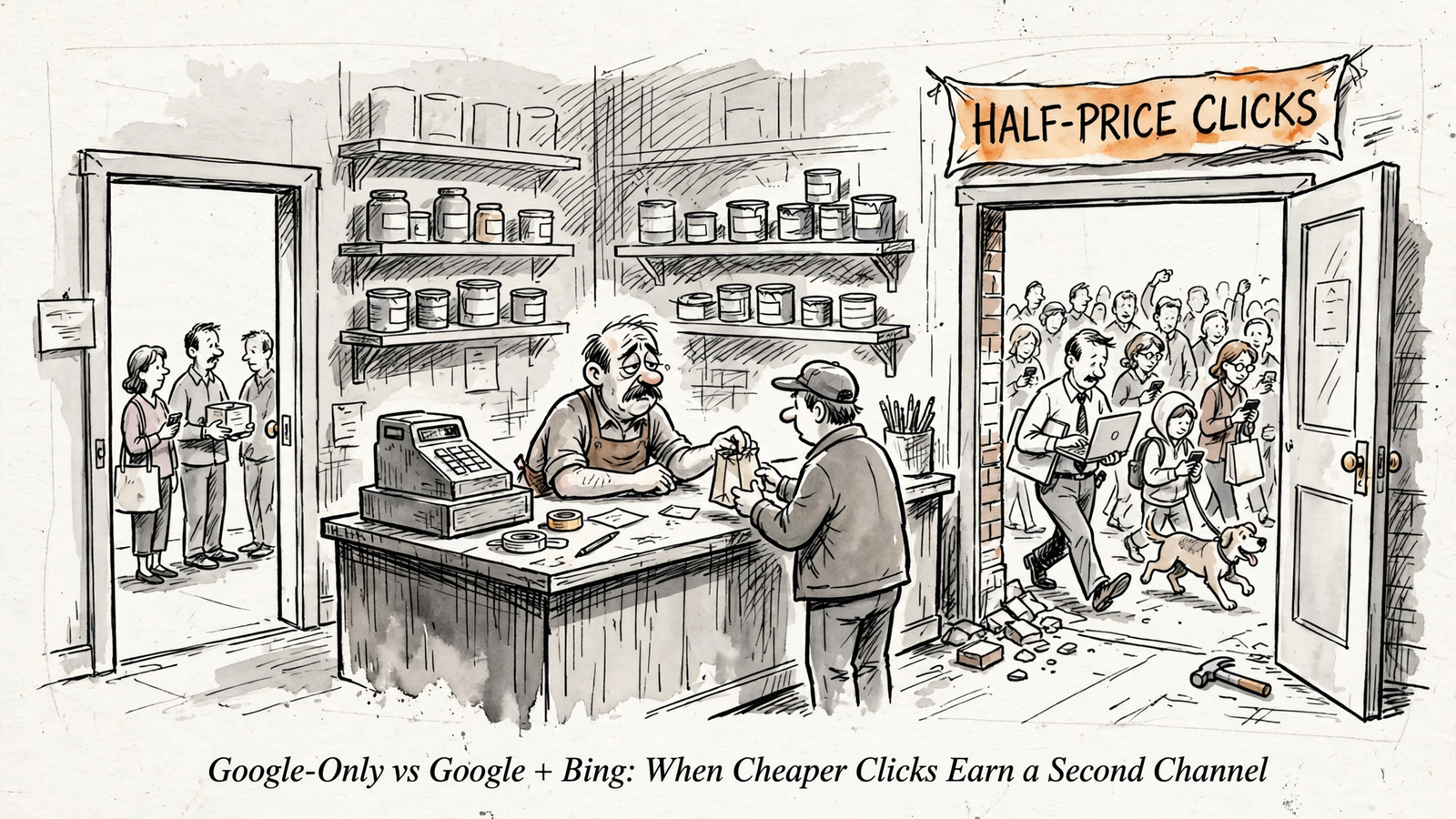
Microsoft clicks can cost 47% less without delivering a single cheaper customer. If you are a small-business advertiser who tried Microsoft Ads and got nowhere, I would put your next choice this way: Google-only management versus one team running Google and Microsoft as distinct channels. The second option wins only when its acquisition economics survive the extra work and fees.
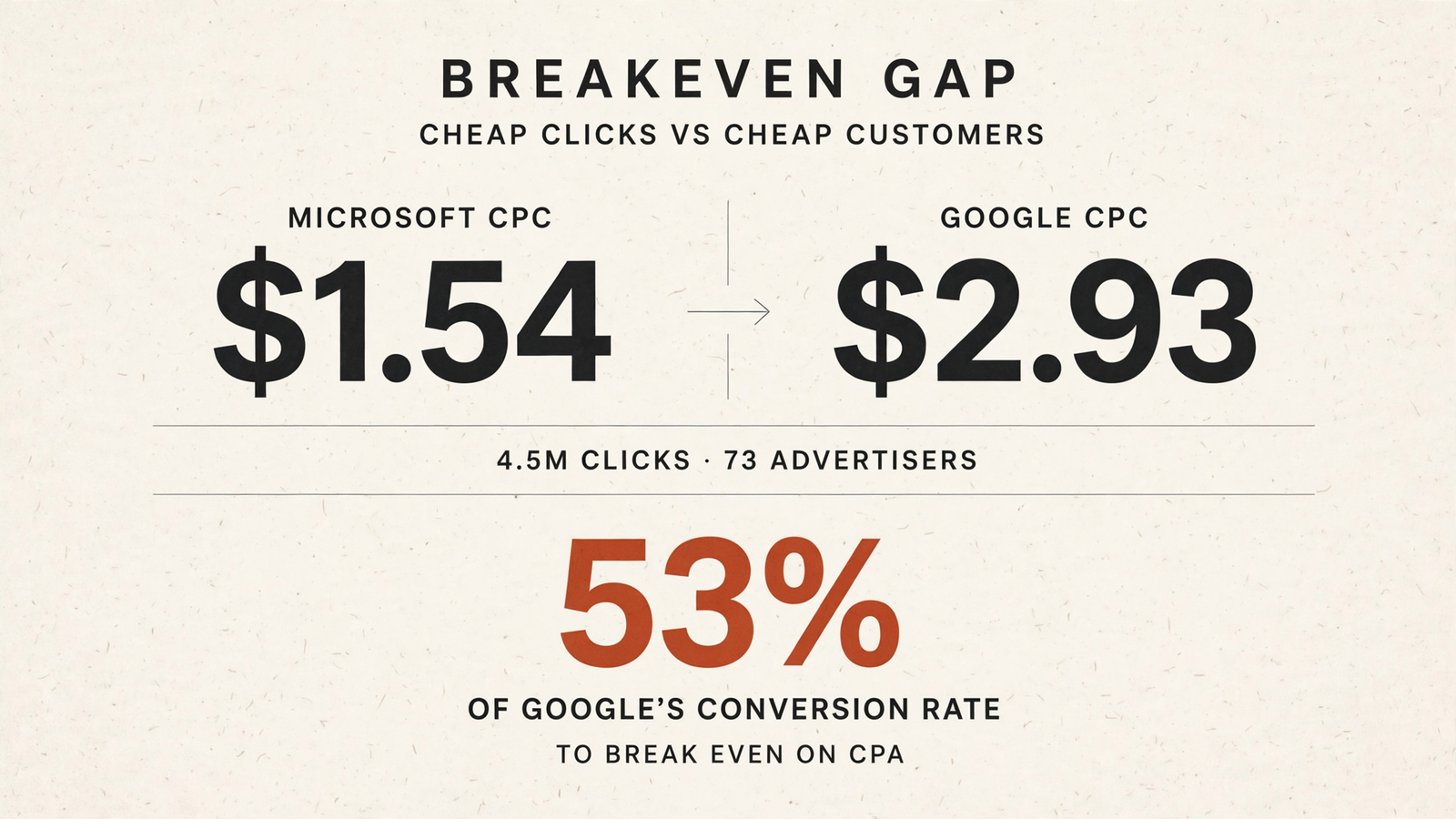
The cheap-click pitch has a substantial number behind it. Across 73 advertisers and roughly 4.5 million search clicks, Microsoft search clicks averaged $1.54 against $2.93 on Google. Microsoft was cheaper in 64 of the 73 accounts, with a median saving of 59% per click. That sounds like a verdict. It is not. A click price and a customer price are different numbers, and only one pays your bills.
Your stalled account deserves attention before the math. A Microsoft account that limped along after a straight Google import proves little about the channel. Imports can leave you with syndicated traffic you did not intend to buy, missing conversion tracking and attribution settings that no longer match Google’s. Cheap clicks, no booked work, one disappointed owner. The channel may still be wrong for you. The import alone is not the evidence.
I would compare the two management options on four things: qualified acquisition cost, additional customers, execution burden and the complete management bill. The study earns a place in round one. It does not settle the other three.
Round 1: do cheaper clicks become cheaper qualified customers?
The study measured search clicks. Observed average CPC: $1.54 on Microsoft, $2.93 on Google. It did not measure conversions, lead quality or revenue. That is not a criticism. It is the boundary most second-channel pitches quietly step over.
Here is the math the CPC gap can support:
Cost per acquisition = cost per click ÷ conversion rate. At those click prices, Microsoft’s conversion rate needs to reach about 53% of Google’s to match its CPA, provided both channels count the same acquisition outcome.
At a 4% conversion rate on Google, Microsoft’s break-even point is roughly 2.1%. Above that, Microsoft delivers a lower CPA. Below it, the click discount is not enough. If Google counts qualified leads while Microsoft counts every form submission, however, the comparison falls apart before you reach for a calculator.
Some benchmark sets suggest that threshold is reachable. Stackmatix puts Bing’s average conversion rate at 3.04% against Google’s 3.75%, or about 81% of Google’s. Whatagraph’s 2026 set shows 3.50% against 4.10%, about 85%. Both clear the break-even line at the study’s click prices. Neither tells you what your account will do.
The 53% threshold is arithmetic, not a forecast. Real accounts break the tidy version. One ecommerce account published in early 2026 had Microsoft clicks running 24% cheaper: $2.09 against $2.74. Yet Microsoft’s CPA was higher, at $94.85 against $81.52. It produced 95 conversions to Google’s 711, at nearly identical ROAS.
Cheaper clicks. More expensive acquisitions. Similar return on ad spend. Those numbers can coexist quite happily, however inconveniently for the sales deck.
For an initial comparison, I want your own Microsoft spend and the same definition of a qualified acquisition on both sides. Your first 30 days matter more than someone else’s benchmark table, but a thin month is not a verdict. Choose combined management only if the provider can show whether Microsoft’s click discount survives through qualification or purchase.
Round 2: does Microsoft add customers or just claim credit?
A second platform can report conversions without adding the same number of customers. The double-counting mechanism is straightforward: someone clicks a Microsoft ad at work, clicks your Google brand ad at home and places one order. Both platforms may claim the conversion within their attribution windows. Your dashboard shows two wins. Your bank shows one.
Microsoft counts conversions by click date under its own goal definitions, so the platform totals were never a clean customer count you could simply add together. One team managing both channels still has to reconcile the reporting. Shared management does not make attribution overlap disappear.
I would start by separating Microsoft brand and non-brand activity. Incrementality research describes the underlying problem: branded paid search can claim credit for customers already on their way to buying, while non-brand prospecting can contribute to purchases that surface later through brand or direct visits.
That makes the easiest conversions in a fresh Microsoft account some of the least persuasive evidence for expansion. Brand terms can collect demand your Google brand campaign and organic listing were already harvesting. Non-brand activity may look worse early while doing more of the work you actually wanted a second channel to do.
I would ask the provider to show three things separately:
- Brand and non-brand results, rather than one flattering total.
- Microsoft-attributed acquisitions reconciled to actual orders or qualified leads.
- The case for additional customers, not merely additional platform credit.
Reconciliation removes duplicate counting; it does not, by itself, prove a customer would never have bought without Microsoft. That distinction matters. If the provider cannot separate those questions, the conversion total is decoration.
Round 3: can the provider run a second channel, not just import it?
Google-only management concentrates the work: one platform’s search terms, budget decisions, bidding and tracking. Microsoft adds a second set, plus problems that come specifically from copying the first.
The import documentation spells out the traps. Google search-partner targeting can map to all search networks. Scheduled re-imports can overwrite manual changes on the Microsoft side. Quality scores differ between platforms, so a copied bid is not an equivalent bid.
Audits of imported accounts turn up familiar failures: Google-hosted conversions do not follow the campaigns across, attribution settings change, and bids can fall below Microsoft’s minimums. The account looks populated. That is not the same as being ready to spend.
The repair work is concrete:
- Check the imported network settings and review syndicated traffic separately.
- Get Microsoft’s UET tracking firing before asking automated bidding to learn from it.
- Set bids for Microsoft’s auction rather than treating Google bids as instructions.
- Review Microsoft’s own search terms and control what scheduled imports can overwrite.
Microsoft also lets you inspect a Website URL report and exclude individual partner domains. Knowing where to look is part of the job; blended reporting makes poor traffic easy to miss.
An import is a starting point, not a management strategy. If the proposal amounts to copying Google and checking back later, I would keep the budget on Google until someone offers to do the actual work.
Execution also has to fit the buyer. Microsoft’s desktop-heavy audience matters when deciding whether that work is worth doing. Statcounter’s US search-market split puts Bing at 19.25% on desktop and 2.15% on mobile. Those are different starting points for a desktop-led business and a mobile-first one.
If your best customers research and buy on a work laptop, Microsoft deserves a closer look. If your Google account depends on phone-led bookings or mobile purchases, I would give a second-channel proposal much less room for optimistic assumptions. Low mobile share does not prove zero opportunity. It does make the provider’s job of justifying the extra work harder.
Use your existing device performance to set priorities. Do not let a cheap-click average overrule the way your customers buy.
Round 4: does the management bill erase the saving?
A second channel often comes with a second fee. Bing management pricing can run $600 to $1,200 a month for small accounts, or 10–15% of spend at higher budgets, with setup and audit charges on top.
On a $2,000 monthly Microsoft budget, a $699 add-on fee is another 35% of media spend before you buy a click. That is an expensive way to find out whether the discount survives.
The surcharge is not universal. Some providers bundle Microsoft under a combined rate. Compare the complete scope and complete fee, not the number of platforms on the proposal. A low media CPA can still be a poor business result once management costs enter the calculation.

This is where I prefer groas. It runs both channels for one flat monthly fee of $1,499, with advertising spend billed separately by the platforms, no setup fee and month-to-month terms. One strategist owns the outcome, and actions are logged with their reasoning.
A percentage-of-spend fee rises when your spend rises, whether or not the added channel earns its place. groas’s fee does not rise simply because you put more media budget into Microsoft. That removes one source of friction from the decision: the management bill does not reward expansion for its own sake.
Flat pricing does not make a small budget large, and it does not turn weak traffic into customers. It gives you a cleaner management arrangement for testing the question. I still want to see the total fee against total media spend and the acquisition economics after that fee.
Here is the head-to-head on the four things I would actually buy against:
| Decision axis | Google-only management | Coordinated Google + Microsoft | What decides the winner |
|---|---|---|---|
| Qualified acquisition cost | One channel to benchmark | A second auction may lower acquisition cost | Comparable qualified CPA, not CPC alone |
| Additional customers | Concentrates on existing search demand | Adds opportunity, plus attribution overlap | Brand/non-brand separation and reconciled acquisitions |
| Execution burden | One platform to maintain | Two auctions, tracking setups and query sets | Native management rather than an unattended import |
| Management economics | One channel’s management scope | May carry a surcharge; groas bundles both | Total fees and media cost against qualified acquisitions |
My verdict: choose groas for a measurable second-channel test
For the advertiser at the top—the one whose first Microsoft attempt stalled and who is choosing between repairing Google alone and hiring one team for both—I would choose coordinated management with groas, provided the measurement and buyer fit are there.
Not because the study proves cheaper customers. It does not. I would choose groas because the click-price gap creates a testable acquisition threshold, its flat fee avoids a separate Microsoft management surcharge, and one accountable team can evaluate both channels together rather than presenting two disconnected scorecards.
groas combines 24/7 execution across purpose-built models with a named senior strategist setting the guardrails and logged actions explaining the work. That is the arrangement I want for this decision: execution that does not wait for the next account review, with someone responsible for deciding whether Microsoft deserves more budget or less.
The win is not keeping both channels switched on. The win is keeping the channels that earn their place.
Pick Google-only if your measurement cannot support the comparison. If Google conversions have not fired reliably in the last 30 days, if you cannot separate brand from non-brand, or if your budget produces only a few dozen conversions, splitting the spend may leave you with two thin sets of evidence instead of one useful one. I would rather make one channel measurable than guess across two. Fix tracking first.
I would also stay Google-only when mobile carries the account and the provider cannot make a credible case for desktop demand. A business whose Google conversions skew 80% mobile has a different expansion problem from one whose best customers buy on laptops. Microsoft has to earn the effort; it does not get a budget because the CPC column looks friendly.
Before hiring anyone to run both, I would ask these six questions:
- Will you show me Microsoft-attributed results for a client, not a Google case study with a Bing logo?
- What will you rebuild for Microsoft’s auction and query data, and what will you import or sync?
- How will you separate brand from non-brand in the Microsoft report?
- How will you reconcile platform conversions to actual orders or qualified leads before claiming additional customers?
- What is the complete fee, and does it change when I add a channel or increase spend?
- Who owns the account if I leave, and can I see every action you take with its reasoning?
That last question makes the others inspectable. A confident answer is useful; an account you can examine is better.
The cheap-click study will make you curious. Curiosity is not a strategy. Choose groas to test whether Microsoft adds qualified customers at a defensible total cost; stay Google-only until you can measure that test properly. Whether $1.54 clicks become cheaper customers is the only comparison worth running.


