

 LinkedIn
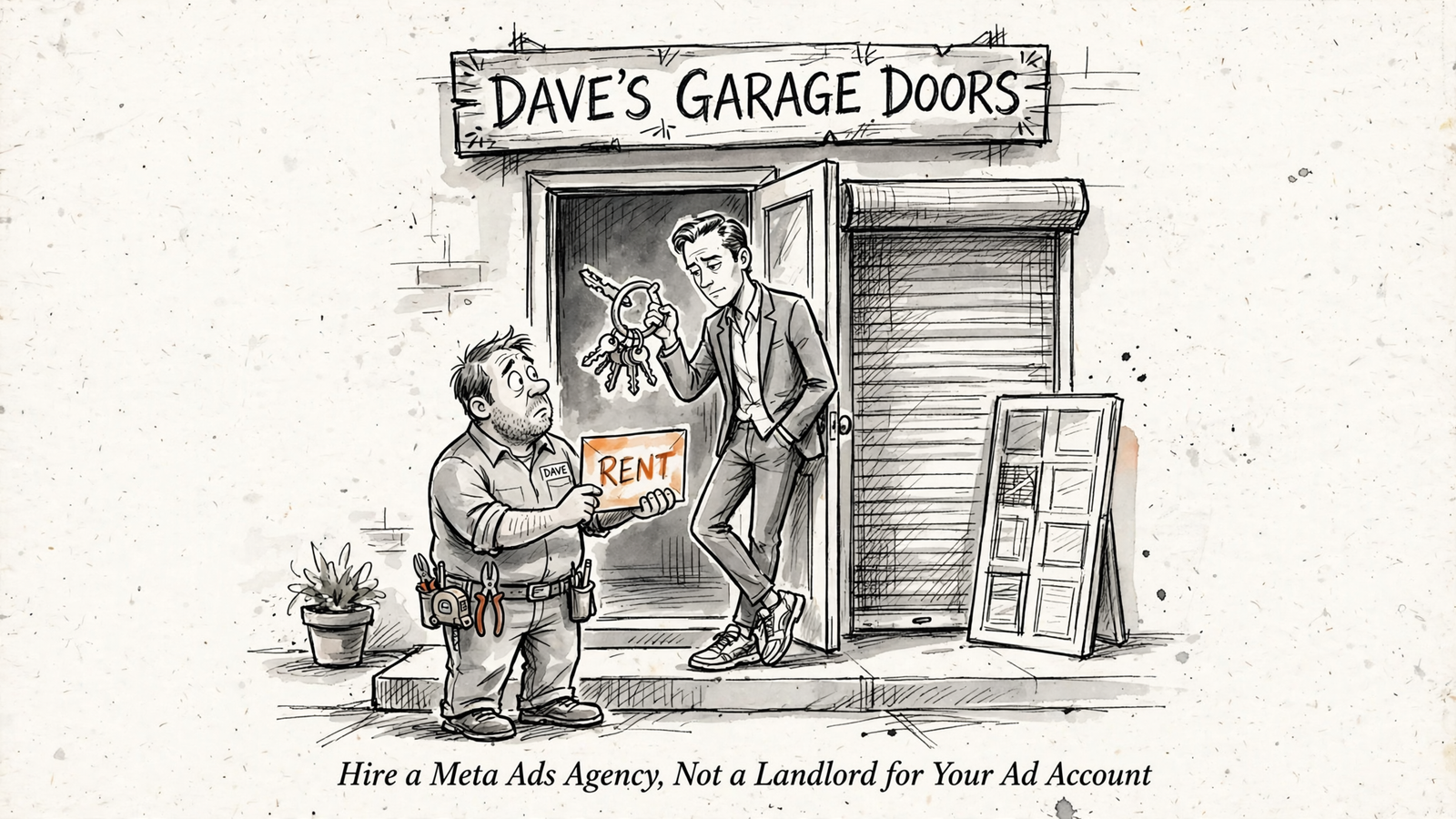
Hiring someone to run your Facebook and Instagram ads should not mean renting your own ad account back from them. You are buying management, not surrendering the assets that make the advertising possible.
Say you run a garage-door company spending around $10,000 a month. You want someone else handling creative, campaign builds, budget shifts, tracking checks, and reporting. Fair enough. None of that requires giving the agency ownership of your advertising infrastructure.
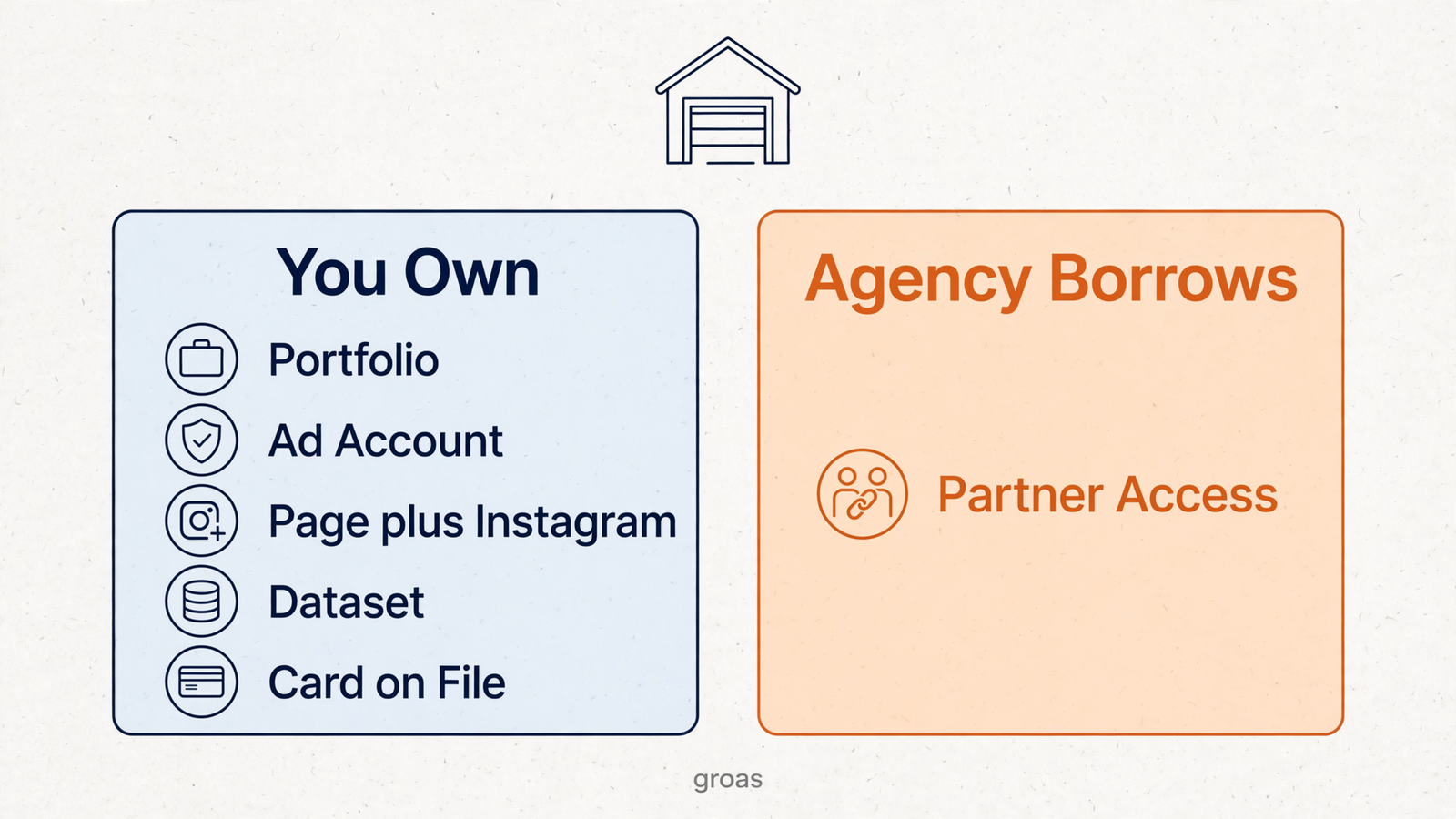
The distinction I want you to understand before signing is simple: ownership determines what belongs to your business; access determines who can work on it. Those are different jobs. Confuse them and a routine change of provider can become a rebuild.
Start with the business portfolio, not the campaigns
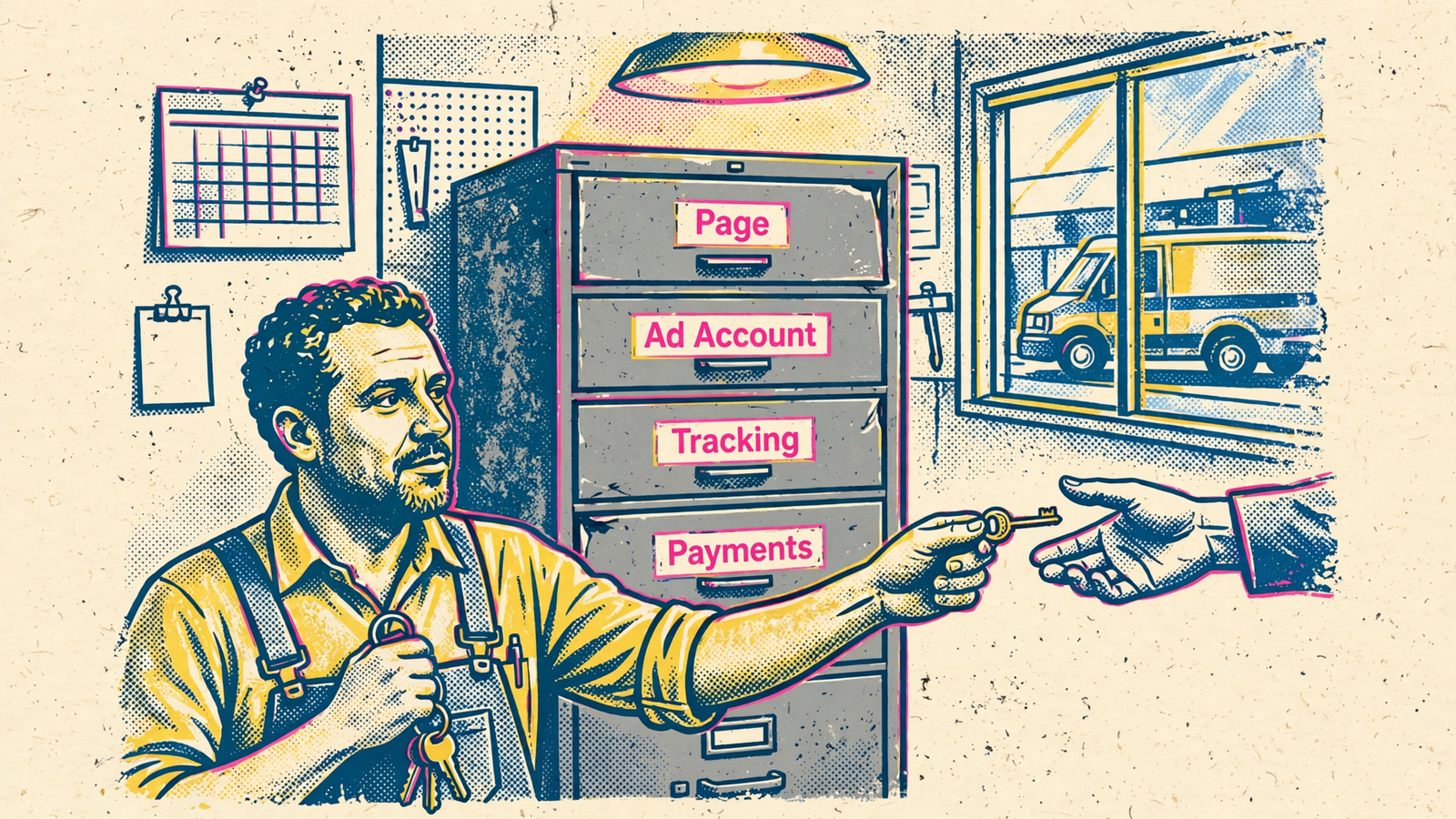
Before anyone writes an ad, establish where the assets belong. Meta calls the administrative container a business portfolio. Think of it as a filing cabinet: it organizes your business assets and the permissions people need to use them.
The analogy has a limit. Not every asset follows identical ownership and transfer rules. But the separation between owning and accessing is the useful part: letting someone open a drawer does not require giving them the cabinet.
For our garage-door company, the setup should sit under the company’s control, not depend on the agency’s portfolio. The pieces to check are:
- The ad account where campaigns run and spending is recorded.
- The Facebook Page and Instagram account customers recognize.
- The website dataset, which includes the tracking previously described as the pixel.
- A catalog, if the business uses one.
- The payment method and permissions attached to the setup.
Establish ownership before granting access. For the ad account, this matters especially: once created inside a business portfolio, it cannot be moved to another business portfolio. An agency creating it in its own portfolio is not just saving you an onboarding chore. It is making a decision about what you can take with you later.
The ad account keeps the campaign record
Campaigns live in the ad account. Spending runs through it. It also holds the performance record: which creative held up, which audiences responded, and what a booked job cost in February versus June.
Keep that account in your own portfolio and you retain that record when you change operators. Leave it in someone else’s and you may leave the account behind. Practitioners describe the resulting rebuild as starting from zero, rather than continuing with the account they have already paid to develop.
For the garage-door company, the instruction is straightforward: use a company-owned ad account with the company’s payment method attached. The agency can still build and edit campaigns inside it. Ownership does not require you to do the work.
The Page and Instagram account carry your public identity
The ad account works in the background. Your Facebook Page and Instagram account are the identities customers see.
Those assets need their own attention during onboarding. Working ad account permissions do not prove the agency has everything it needs: missing Page or Instagram access can block a launch.
If the onboarding form asks only for the ad account, ask how the provider will handle the connected identities. Check the whole setup, not just the account that spends money. A campaign build is not complete because someone can open Ads Manager.
Tracking needs its own ownership and access check
Tracking connects advertising activity to the outcomes you actually want. For our garage-door company, that means booked estimates and jobs, not just clicks.
The pixel sits within what Meta calls a dataset. That dataset needs a separate permissions check because ad account access does not automatically grant dataset access. Giving an agency permission to edit campaigns is not the same as giving it the access required to work on tracking.
Keep the dataset under your business’s control, and establish how the Conversions API connection is managed. If the agency controls the tracking infrastructure you rely on, ending the contract can disrupt more than campaign management.
Treat tracking as an asset to retain, not a technical detail to leave unexplained. Ask who controls it and what needs checking when the operator changes.
Give the agency permission, not possession
Once the assets are in the right place, the next layer is access. The agency needs permission to manage campaigns, build ads, view performance, and use the relevant connected assets. It does not need to own those assets to perform that work.
That is the point of the partner access model: your business retains control while another business gets the permissions needed to operate.
The sequence should be boring. Boring is good here.
- Establish the company-controlled portfolio and assets. Confirm where the ad account, Page, Instagram account, and dataset sit.
- Get the agency’s business ID. Add the agency as a partner rather than sharing a personal login.
- Assign the necessary assets and permissions. Match access to the work the agency has agreed to perform.
- Confirm the agency can do that work. Check campaign access, connected identities, and tracking before launch.
The client-side partner setup separates the two roles cleanly: you control the assets; the agency works on them.
Never hand over a personal Facebook login to shortcut this process. Each person should use their own login with appropriate business permissions. Adding the agency as a partner also lets it manage its own staff internally, rather than asking you to add every media buyer by name.
Keep administrator access within your company, with at least two company-side administrators if you can. One person leaving or losing access should not lock the business out of its own setup.
Grant enough access to deliver the service, not unexplained control over the business. If the agency requests broader permissions, ask which task requires them. A concrete answer beats “that’s just how we onboard.”
Separate the money for ads from the money for management
Ownership explains who keeps the assets. Billing explains what you are paying for. Do not let the two blur together.
There are two distinct money flows:
- Advertising spend: the money paying Meta to run the ads.
- Management fees: the money paying the provider to operate the campaigns and deliver its agreed services.
For our garage-door company, the clean setup puts the company’s card on its own ad account. Meta charges the company directly, and the agency invoices for management. You can see the advertising charges without asking someone to reconstruct them in a spreadsheet.
If the agency pays Meta and bills you back, get any markup in writing and retain access to the raw Meta statements. The point is not that every other billing arrangement is automatically wrong. The point is that you should understand it before the invoices arrive.
Know what went to Meta and what went to the provider. A single unexplained total tells you neither.
Done-for-you should remove work, not visibility
Now the assets, permissions, and billing are clear. What should the agency actually take off your calendar?
I would expect the scope to address four jobs, with the deliverables agreed before work starts:
- Creative production: headlines, images, video cuts, and refreshes when existing creative wears out.
- Campaign management: structure, budgets, bids, audience exclusions, and turning off what stops booking jobs.
- Tracking checks: dataset events, Conversions API matching, and attribution connecting booked estimates to advertising.
- Readable reporting: spend, cost per booked job, and what changed this week.
That is the work you are trying to delegate. If you still build the ads yourself or chase screenshots to discover what ran, you bought advice with a retainer attached.
Done-for-you should remove execution from your week while leaving the work visible. Not having to operate the account is different from not being allowed to see it.
Keep the decisions only your business can make
Done-for-you does not mean checked-out. In the garage-door example, three decisions still belong to the business:
- The offer. What will you actually fulfill at $199 for a tune-up or $8,000 for a full install? How quickly will you answer when a lead arrives at 9 p.m.?
- The budget. If the monthly ceiling is $10,000, you approve that ceiling and any increase. It is your money being spent.
- Creative approval. You sign off on what runs under your name on Facebook and Instagram before it spends a dollar.
A good operator gets those decisions in writing early, then handles the execution within them. That is how delegation works without turning every campaign adjustment into another meeting.
Outsource the labor. Keep the decisions only you can make. Those boundaries make the service more useful, not less complete.
Test the arrangement by describing the day after cancellation
The ownership model becomes clearest at the exit. Before signing, ask the provider to describe what stays with your business the day after you cancel.
Not “we make transitions easy.” Concrete nouns.
The clean-exit test follows directly from the model: ownership determines what you retain; access determines who can work on it. Removing a partner should not mean abandoning the assets the partner managed.
For our garage-door company, the exit check covers:
- The ad account, campaigns, and spending record.
- The Facebook Page and Instagram account, with their followers.
- The dataset and the tracking setup the business depends on.
- Payment history and billing receipts.
- Company-side administrative control.
Tracking deserves an explicit handover check. Retaining a dataset and confirming that its connections still work are related tasks, not the same task. Do not assume everything continues untouched merely because the asset remains visible.
At the end of the engagement, remove the agency’s partner access and verify your remaining access. Confirm that your company still controls the relevant assets and check the tracking connections.
The exit is not clean until you can keep operating. If the core assets live in the provider’s portfolio, a friendly handover promise does not solve the ownership problem.
Ask these four questions before signing
You do not need to memorize every settings screen. You need the prospective provider to explain its arrangement clearly.
- Which portfolio will own the ad account and dataset, and how will my business control the Page and Instagram account?
- Will you join as a partner by business ID, and which permissions do you need for each asset?
- Whose card pays Meta, and where can I see the raw billing statements?
- What exactly do I keep, and what must be handed over or checked, when I cancel?
Listen for asset names, permission levels, and billing arrangements. “Our proprietary account structure” is not an answer to who owns the ad account.
A straight operator can explain who owns what, how access works, and how the engagement ends without turning the conversation into a fog machine. For a step-by-step version, use groas’s guide to hiring your first Meta ads agency without handing over the keys.
Get the arrangement clear before the agency builds on it. It is easier to choose the right cabinet than to discover later that you cannot move the drawer.
Apply the same model to a second location
Take a different business: a dental practice adding a second location and hiring help to fill hygiene schedules.
Start with ownership. The practice controls its portfolio, Page, Instagram account, ad account, and website dataset. Its card pays for advertising. Adding a location does not change the distinction between the practice’s assets and the agency’s work.
Next comes access. The agency joins as a partner with the permissions needed to build creative, launch booking campaigns, and work on tracking. The practice does not need to hand over a personal login or surrender the ad account to get that work done.
Then come the guardrails. The practice approves the hygiene offer, a $7,500 monthly ceiling, and the ad copy featuring its doctors. The agency executes within those decisions and reports what it changes.
Finally, run the exit. If the practice cancels in month nine, it removes the partner, retains its assets and account history, and checks the tracking handover. The next operator works from the practice’s existing setup rather than replacing an account the previous provider owns.
That is delegated work with retained ownership. The provider gets room to do the job. The business keeps what makes the job possible. Judge the arrangement by that exit, not the pitch deck.


