Autonomous Ad Budget Allocation: Cost and How It Works FAQ
Wasting ad budget and can't optimize fast enough? How real-time AI budget allocation works, what autonomous setup costs, and what to use at scale.
September 28, 2026
•
min read


A page cannot earn a citation if an AI assistant cannot retrieve a passage that answers the question. That matters more than the length of your guide, the polish of your brand deck, or the number of times you say “AI visibility.”
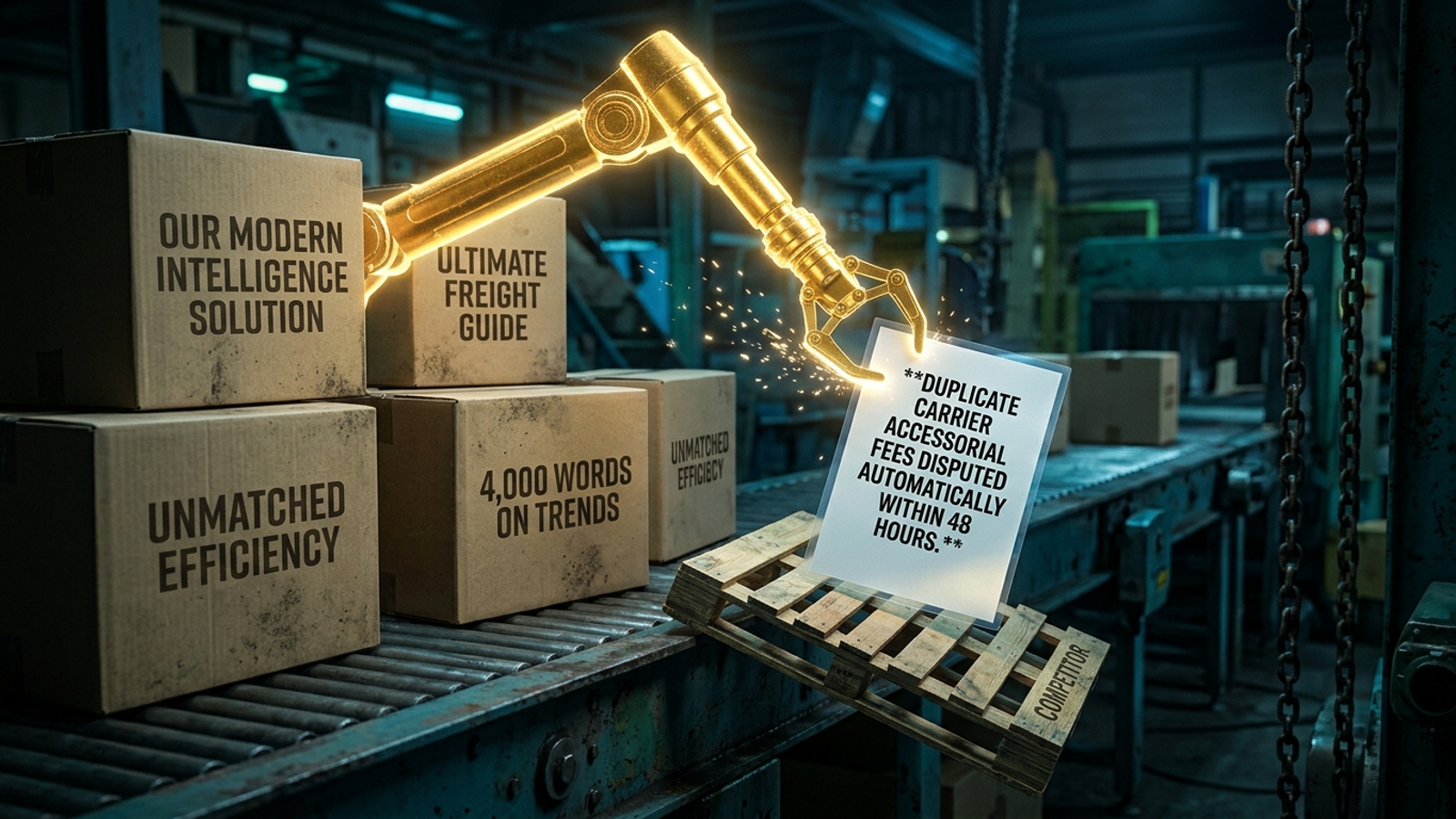
Say you sell freight audit software. A buyer asks ChatGPT, “Which freight audit software automatically disputes duplicate carrier accessorial fees?” Your agency has published a 4,000-word guide to freight auditing. A small competitor has a plain documentation page explaining exactly how its dispute workflow works. The competitor’s page may be the one the assistant cites.
The useful question is not, “How do I make my brand look more important to AI?” It is: Can the system find, read, and use a specific passage that supports its answer? I’ll build that question from the ground up, then use it to diagnose a second case.
A buyer wants an answer about a capability. The assistant may need current information that its underlying model cannot reliably supply from memory, so a search-enabled answer can draw on retrieved material. A citation points the reader back to material used to support part of the response. It is not an award for the best overall website.
That distinction changes what you optimize. Your freight audit homepage might have a strong reputation and beautiful design. Neither tells a retrieval system whether your software detects duplicate accessorial charges or submits disputes automatically. A short, explicit passage might.
I use four stages to reason about what happens between the buyer’s prompt and a visible citation. This is a diagnostic model, not a claim that ChatGPT Search, Perplexity, and Google AI Overviews run identical internal software:
The order matters. A perfect specification hidden behind an unreadable page fails before its wording gets a chance. A readable page full of “modern efficiency” may reach retrieval and still give the assistant nothing concrete to cite. Let’s take the freight audit question through each stage.
Before an assistant can use your description of automated disputes, something has to fetch it. Marketing teams often mix up three different activities: gathering material for model training, indexing pages for search, and fetching a page in response to a user’s request. Those activities do not necessarily use the same crawler or obey the same access decision.
OpenAI lists separate user agents: GPTBot for training-related crawling, OAI-SearchBot for search discovery, and ChatGPT-User for user-triggered visits. Perplexity likewise documents PerplexityBot and Perplexity-User. If your security policy is meant to govern one kind of access, check what it actually blocks. A blanket Disallow: /, a bot rule in your Web Application Firewall, or a 403 response can keep a relevant page out of reach. Blocking a search crawler is not the same decision as blocking a training crawler.
Then there is the page itself. Googlebot’s ability to render JavaScript has trained many teams to assume that any crawler sees what a human sees after a single-page application loads. That is a bad assumption here. An analysis of AI crawler fetches found that the crawlers it examined did not execute client-side JavaScript. If your freight audit page returns little more than <div id="root"></div> and a script bundle, the interactive feature table a buyer sees may not be present in the HTML the crawler receives.
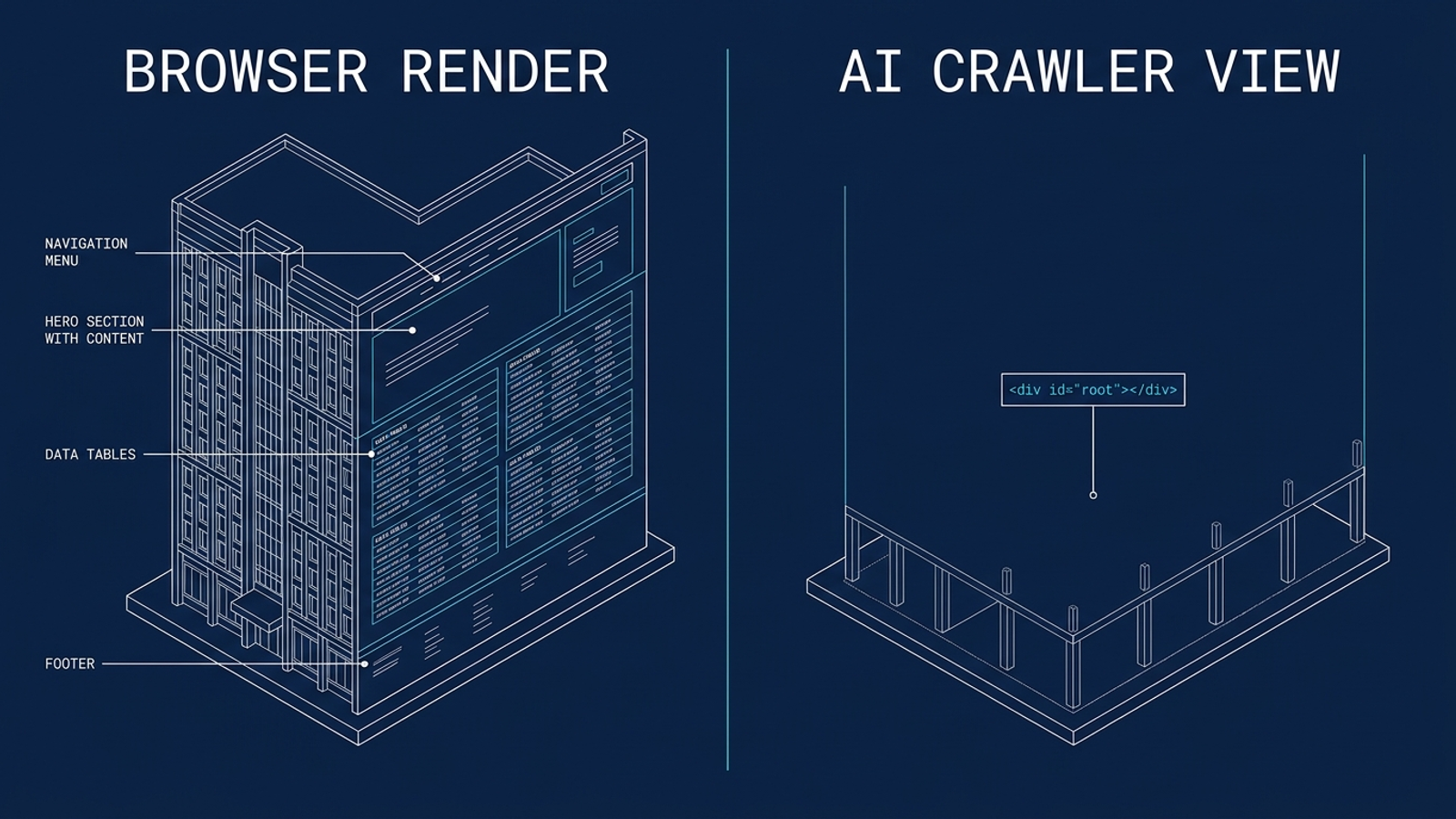
You can inspect the first problem without buying an “AI visibility” audit. Run curl -A "OAI-SearchBot" https://yourdomain.com/your-product-page and read the response. Repeat with Perplexity-User. Are your specifications, pricing details, and integration descriptions there as text? Do you get an access-denied message or mostly scripts? This is a fetch test, not proof that an assistant has indexed or cited the page. It tells you whether the material you expect it to read is actually in the response you inspected.
For our freight audit platform, the first fix is straightforward in principle: make the dispute workflow available in accessible page text, and check that crawler rules and security controls do not unintentionally shut out the search traffic you want. Do that before commissioning another guide.
Now assume the crawler receives readable HTML. The next problem is not whether your site contains somewhere a reference to carrier fees. It is whether a useful passage is likely to surface for this buyer’s specific question.
The buyer asked about three things at once: freight audit software, duplicate accessorial fees, and automatic disputes. A search system may pursue related sub-queries rather than rely on the buyer’s exact wording; this account of ChatGPT Search’s retrieval process describes that kind of query fan-out. Retrieval then has to choose among candidate pieces of text. In that setting, a page’s general theme is less useful than a passage that connects the requested capability to its mechanism.
Compare two passages:
Our modern freight intelligence solution transforms dispute processing with unmatched efficiency.
The platform ingests EDI 210 invoice files, identifies duplicate accessorial charges through rule-based validation, and submits dispute claims to carrier portals within 48 hours.
The second is an illustrative specification, not a verified description of a product in this article. It works as an answer because a reader can tell what goes in, what the software checks, and what it does next. The first passage could describe almost anything. It asks the assistant to supply the missing facts itself.
This is where the sprawling ultimate guide often works against its owner. If the answer to “Does it dispute duplicate fees automatically?” sits between paragraphs on supply-chain trends and the history of freight billing, it is harder to lift out as a self-contained response. I am not arguing for a magic word count or for deleting every useful explanation. I am arguing for one clear job per passage. Put the capability, the conditions, and the mechanism together. Give that passage a heading that tells a human what it answers.
A study of 7,534 Perplexity Sonar citations across 380 software categories found that many cited domains sat outside highly ranked domain lists. That does not mean reputation never matters. It does mean a small site can appear in an answer, and a large site can miss it. The practical lesson is to check the text the engine can use, not just the authority metrics in your monthly report. A page that reaches an engine’s reading cache still needs an answer worth retrieving.
For the freight platform, I would give the dispute workflow its own plainly titled section. I would keep the EDI input, duplicate-charge check, and submission step close enough to make sense together. If those details are true of the product, they do more work than another paragraph promising efficiency.
Retrieval puts a passage in front of the assistant. Grounding asks whether that passage supports the sentence the assistant is about to write. Those are different tests.
Suppose an assistant plans to say, “This platform automatically submits duplicate-accessorial disputes.” A retrieved paragraph that calls the product “modern” does not establish that claim. A paragraph describing the detection rule and submission workflow can. If the page says only that the platform flags charges for a person to review, it should not be used to support a claim of automatic submission. Wording matters because the capability matters.
Google Cloud’s check grounding API documentation offers a useful illustration of the distinction: it evaluates how well supplied passages support generated claims and exposes a citation threshold. That documentation describes a particular tool. It does not give us permission to assign its default threshold to every live answer engine, or to pretend we know the hidden score on a competitor’s page. The principle is enough: a passage that merely sounds favorable is weaker support than one that states the relevant fact.

This is also where specificity has a cost worth paying. “Automatically submits disputes within 48 hours” is useful only if the product actually does that under the conditions the page describes. Do not add a protocol, timing promise, fee-code count, or integration standard because it looks machine-friendly. State what you can stand behind. If your product identifies duplicate charges but leaves submission to the customer, say so. You may lose a citation for a question about automatic submission; you will avoid winning one for the wrong answer.
For our running example, the edit is not “add more AI-friendly language.” It is: replace adjectives with accurate, checkable product behavior. That gives the assistant a supported claim to make and gives the buyer a reason to trust the link.
A passage can be accessible, relevant, and supportive without appearing as a visible citation. The assistant still has to produce an answer a person can read. If several pages support the same sentence, not all of them will get a link.
Imagine that your product page, a software directory, and two comparison articles all say your platform accepts EDI 210 files. Repeating that specification across four sources does not make four citations necessary. A short answer may use one link for that point and spend its remaining space on the dispute capability the buyer actually asked about. I would rather have the original product page state the capability clearly than depend on a directory’s compressed version of it.
Do not expect a citation on one platform to guarantee a citation on another. An analysis of 27,924 citations across 3,600 queries reported low overlap among the platforms it examined. That finding is a reason to test the same buyer question in the places your buyers use. It is not a map of secret rules that says one engine always loves documentation while another always loves fresh pages.
The stage-four takeaway is less glamorous than a new dashboard: publish the clearest original account of the fact you want cited. Then check the answer itself. If a directory wins the link, look at what it states plainly that your own page makes hard to find.
The four stages give you an order of work. Without that order, teams spend money improving prose on a page the crawler cannot read, or monitor citation share of voice without learning why they are absent.
That is a troubleshooting sequence, not a promise that following five steps buys a citation. It does something more useful: it tells you what to investigate before you spend another month publishing around the problem.
Now take a commercial HVAC automation platform. A buyer asks Perplexity, “Which BMS gateways support BACnet IP to Modbus RTU translation with sub-second polling?” An obscure open-source project gets cited instead of the commercial product.
Start at stage 1. The commercial gateway page is a React single-page application. If the HTML available to the crawler contains the marketing shell but not the technical details, the funding and domain rating of the company cannot put those missing details into the response. The open-source project’s documentation, rendered as readable HTML, clears that first hurdle.
At stage 2, compare the passages. “Transforming smart building efficiency” does not answer a question about BACnet IP, Modbus RTU, and polling. A documentation section that names the translation and describes a 250-millisecond polling cycle does. At stage 3, that specific description can support a claim about sub-second polling, provided it accurately describes the project. At stage 4, if the answer has room for one supporting link on that point, the documentation is a strong candidate. The citation is not a prize for being open source. It follows from the information available to support this particular answer.
That reasoning also shows what the commercial platform should do next. First check what its page returns. Then, if the product genuinely supports the requested translation and polling behavior, explain those specifications in accessible, focused text. If it does not, the open-source project deserves to win that question. No amount of passage formatting should change the product’s capabilities.
This is the work I want search teams paid to do: find the failed stage and fix the underlying page or access problem. A monthly PDF of citation charts cannot do that by itself. It is also why we built groas around continuous search execution rather than waiting for a quarterly check-in. The buyer’s question is specific. Your answer should be reachable, unambiguous, and specific too. Let a competitor keep the longer guide.