

 LinkedIn

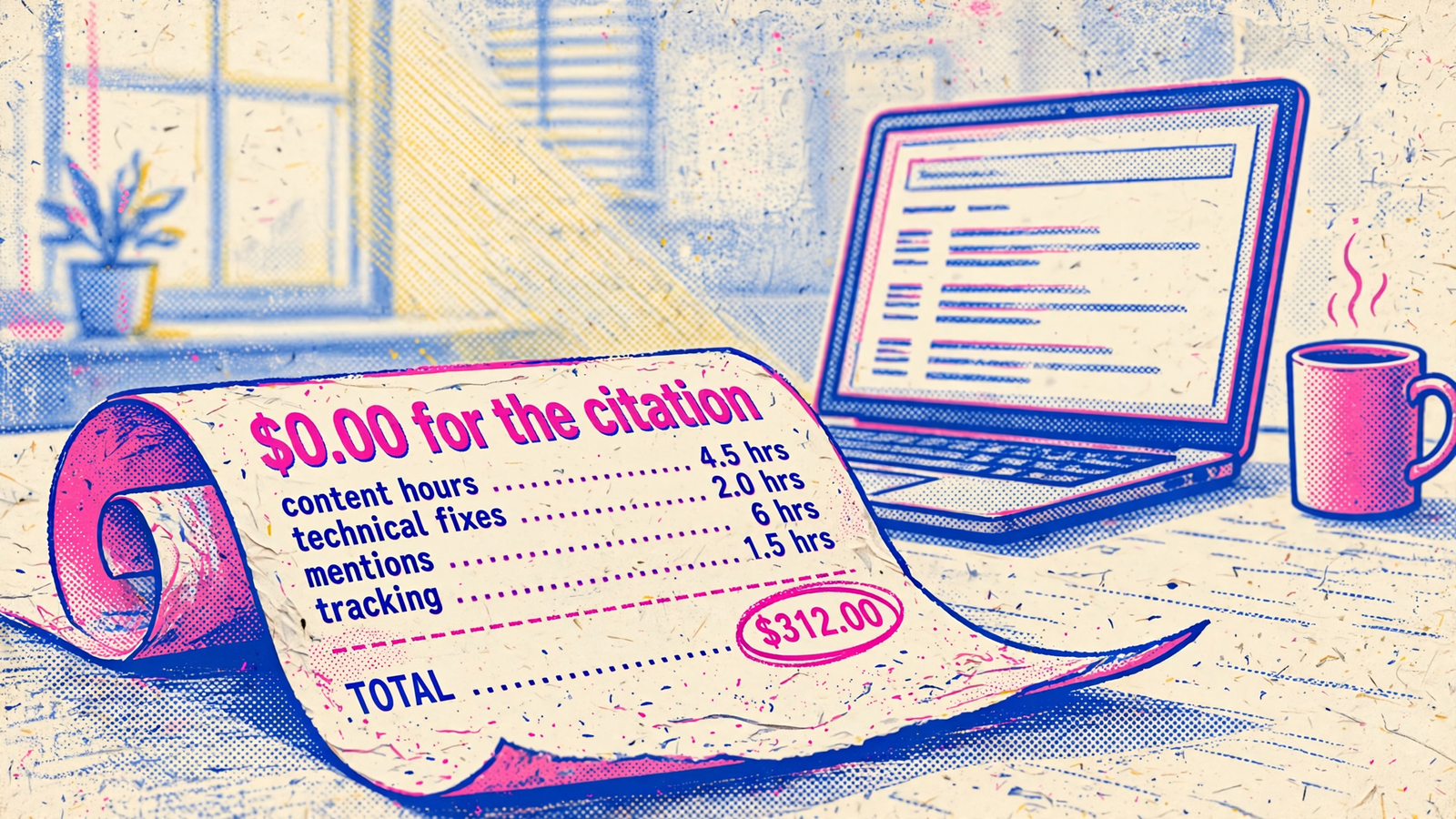
Google charges $0 for an organic AI Overview citation. The working budget starts at $19 a month with your own AI through groas, versus about $3,200 a month for an average agency arrangement. Neither figure is an all-in ceiling: your review time, outside work, one-off projects and any ad spend sit outside that comparison.
That is the distinction I would put at the top of every proposal. Google does not sell the organic slot. You pay for the work around it: making pages useful enough to cite, fixing technical obstacles, earning corroboration elsewhere and checking whether anything changed. Buying an ad is a separate purchase, not a shortcut into the source list.
The bill at a glance: listed costs before hidden work
Here are the starting prices and reference bands. They describe different ways to buy the work, not a shopping list you need to purchase in full.
| Line item | Listed cost or reference band | Billing pattern | Source and scope |
|---|---|---|---|
| Organic AI Overview citation | $0 | No placement fee | Eligibility overview: no extra fee or special markup; indexing and Search snippet eligibility do not guarantee selection |
| Freelance SEO work | $100–$150 per hour | As needed or ongoing | Most common freelance hourly band in a survey of 439 providers, not a quote for a particular page |
| SEO retainer | $500–$1,000 per month | Recurring | Common retainer band in the same survey; scope varies |
| Agency SEO engagement | About $3,200 per month | Recurring | Agency average in the pricing survey, not an AI Overview-only package |
| SEO project | $2,501–$5,000 | One-off | Most common project band in the pricing survey; deliverables determine the quote |
| Separate SEO suite and starter AI tracker | $158–$234 per month | Recurring | Combining the suite prices and tracker prices below; labor is extra |
| Your own AI through groas Unlimited | $19 per month | Recurring | groas: flat team price, with every feature and all the data included; your review time is extra |
The first procurement question is not “What does AI SEO cost?” It is “Which of these jobs am I actually buying?” A subscription buys access. An hourly fee buys time. A project should buy defined deliverables. None buys Google’s decision.
The $0 citation has four jobs behind it
When an AI answer handles the question on the results page, the reader has less reason to click through. That is why visibility and traffic are not interchangeable. In click tracking across 900 adults and 68,879 searches, people clicked a traditional result on 8% of visits with an AI summary, versus 15% without one (click-tracking data).
The citation is free the way a storefront window is free after you pay rent, stock, staff and cleaning. The bill is for making the source worth choosing, not reserving the space.
Four jobs sit behind it:
- Content: rewrite pages around buyer questions, clear definitions, useful tables and facts that can stand on their own.
- Technical cleanup: address crawling, indexing, page speed, schema and internal links on the pages you want considered.
- Third-party corroboration: earn relevant mentions through outreach and digital PR rather than relying entirely on what your own website says.
- Tracking: check which queries show an Overview, which sources it cites and where your pages are close but missing.
Those jobs do not all recur at the same rate. A technical repair may be a one-off project. Tracking continues. Content needs another pass when the offer or answer changes. Outreach takes actual work, not a box ticked during onboarding.
I would make a vendor separate those costs before discussing the total. Otherwise, a “monthly optimization” line can conceal a one-time cleanup followed by a very punctual report.
One-off work: buy a defined fix, not a vague project
The $2,501–$5,000 project band is a general SEO pricing reference, not a tariff for getting into AI Overviews. It cannot tell you what your technical fixes, content rewrites or outreach should cost without knowing the scope.
The useful cost drivers are concrete:
- How many pages need work, and how much rewriting does each require?
- Are there crawl or indexing obstacles, or mostly page-level edits?
- Does the work require a developer?
- Are there useful third-party mentions already, or does outreach start from scratch?
- Who implements the recommendations after the audit arrives?
That last question matters. A list of broken things and a repaired website are different deliverables. Ask which one the proposal includes.
Third-party mentions are especially easy to hide inside a broad project fee. A review roundup, a supplier list or a Reddit discussion that AI answers cite is not something a vendor can price cleanly by the citation. The work is outreach, digital PR and participation; the result is not a guaranteed source slot.
The pricing survey’s discussion of sub-$500 packages is a useful warning: a low monthly fee may cover reports or software access rather than content plus links. If a proposal promises citations, ask what work earns the corroboration. “Our proprietary process” is not a line item.
Recurring software: the subscription is only half the price
Separate tools can make checking easier. They also leave you responsible for joining the data and deciding what to do next. Price the handoff as well as the dashboard.
| Tracking option | Listed price | What to check before buying |
|---|---|---|
| Ahrefs Lite | $129 per month | Listed allowances include 1,000 credits, 750 keywords tracked weekly and 100,000 crawl credits (suite comparison) |
| Semrush SEO plan | $139 per month, or $117.33 per month with annual billing | Listed allowance covers 5 sites and 500 keywords tracked daily; extra seats across these suites run $40–$45 per month (suite comparison) |
| Otterly Lite | $29 per month | About 16 prompts in the tracker comparison |
| Yozigo Solo | $39 per month | 30 prompts in the same comparison |
| Peec Starter | $95 per month | 50 prompts across 3 models in the same comparison |
| Scrunch Starter | $300 per month | 350 prompts in the same comparison |
| Profound | Custom enterprise quote | No public price in the comparison; do not treat the missing number as a budget |
An SEO suite at $129–$139 plus a starter tracker at $29–$95 produces the $158–$234 monthly software range. That is before anyone rewrites a sentence or fixes an internal link.
Prompt allowances also matter more than the entry price suggests. Do not assume a starter pack covers your full query list, every domain and every engine you want to check. Expansion changes the bill according to the plan, not a neat universal price per query.
The hidden cost is being the join key: export rankings from one tool, paste prompts from another, match the pages, decide the fix, then implement it. The chart can be excellent. The page remains untouched.
What changes when your AI does the work through groas
With groas Unlimited, your own AI is the brain; groas supplies the hands and data. Connect ChatGPT, Claude, Cursor, Gemini or another agent over MCP, connect your ad accounts and website once, then ask in plain English.
groas collects data an AI cannot get alone, around the clock: competitors’ ads on Google and Meta, the landing pages and funnels behind them, customer discussions on Reddit, how AI answers talk about you and whom they cite, plus SEO data from Semrush and Ahrefs.
The price is $19 a month flat for the whole team, with unlimited teammates, ad accounts and websites, every feature and all the data included. Agencies pay the same across their clients. That replaces the separate software stack above without leaving your AI stranded at the reporting stage.
I would start with this:
List our pages that rank top 10 for queries with an AI Overview but are not cited, and propose the smallest change for each.
Your AI uses the rankings and collected AI-answer data to identify gaps and propose edits. Review the recommendations, then ask it to make the changes on the page. Every change is logged with its reason, and any change can be undone in one step. Autopilot stays off until you switch it on.
That sequence matters: find, propose, review, change. A useful workflow does not end when a chart turns red. It gets the work onto the page and leaves a record you can inspect.
The $19 price does not make your judgment free. It changes what you spend that judgment on: reviewing decisions instead of reconciling exports.
Ads are a separate bill, not a citation fee
Ads inside or around an AI Overview use normal Search ad pricing, with no extra charge for the AI placement (pricing explanation). Google does not break those clicks out separately in reporting, so there is no clean AI Overview-only CPC in these benchmarks.
| Paid advertising reference | Figure | What it actually describes |
|---|---|---|
| Average cost per click | $5.26 | Search benchmark across 16,000+ US campaigns, not an AI Overview-specific rate (2025 benchmarks) |
| Average cost per lead | $70.11 | The same broader campaign dataset, not a promised acquisition cost (same benchmarks) |
| Industry CPC examples | $1.60 for arts and entertainment; $8.58 for legal | Examples from that dataset, not a floor and ceiling for every advertiser (same benchmarks) |
Budget ads according to the auction and what a lead is worth to you. Do not add an invented “AI placement premium,” and do not count the spend as progress toward an organic citation.
Google generates the organic answer independently. Paying to sit beside it does not buy a place inside its source list.
A monthly budget you can actually compare
For a planning example, take 50 queries where an AI Overview appears and your page ranks in the top 10 without being cited. Start with two pages to rewrite, plus titles and internal links where needed. That is a bounded job, not permission for a site-wide rewrite.
The hours below are illustrative planning allowances, not measured results or service commitments. The labor rate comes from the provider pricing survey. Page complexity and the amount of technical work determine whether those allowances fit.
| Monthly line item | By hand | Separate tools | Your AI through groas |
|---|---|---|---|
| SEO data and AI tracking | $0 in this manual-checking example | $158–$234 for the starter stack above | $19 flat, with the included data |
| Working-time allowance | 8–12 hours to check and make the scoped edits | 3–5 hours for reconciliation and edits | Allow review time; no fixed duration promised |
| Labor at $100–$150 per hour | $800–$1,800 | $300–$750 | Depends on the time you spend reviewing |
| Monthly total before ads and outside projects | $800–$1,800 | $458–$984 | $19 plus your review time |
An agency engagement is a different buying model: the survey average is about $3,200 a month, with the actual scope negotiated. Do not treat that as the price of the exact task above.
Keep one-off technical projects, outreach and paid media outside this table until they are scoped. Otherwise, a cheap-looking monthly number becomes a very creative invoice.
What no budget can buy
No tool can promise an organic citation, including groas. Google chooses the sources. Query type, freshness and corroboration affect what it selects; a good edit is not a reservation.
What you can pay for is narrower: eligibility, clearer answers, technical access, relevant corroboration and a repeatable way to check and improve the pages. If a vendor guarantees the citation, ask for the refund terms in writing. The answer will tell you plenty.
The cheapest mistake is buying a $29 tracker, feeling informed for a week and changing nothing. The page still ranks, the Overview still cites a competitor, and the report gets prettier. The tool did its job. Nobody did the next one. That is the trap separate tools leave you in: you become the join key between the finding and the fix.
The most expensive mistake is paying about $3,200 a month, or accepting an enterprise quote with no public price, for work that amounts to the same list of pages and the same unmade edits. A PDF and a call are not implementation.
Google still charges $0 for organic inclusion either way. Budget it straight: $19 flat to groas if your own AI will do the checking, proposing and page changes, your review time on top, and any genuinely necessary outside work priced separately. Start with the uncited pages. Fix the smallest thing first. Do not keep paying to admire the problem.


