Last week I asked ChatGPT for the best returns app for a Shopify store doing about $20k a month. It named three tools, linked two comparison pages and quoted pricing from a Reddit thread. It did not name the tool my friend sells, even though his product does the same job for less money.
The model did not pick the best product. It picked an answer it could support. I used to tell clients SEO was about ranking their own pages. I was wrong, at least when it comes to recommendations in ChatGPT, Perplexity, Gemini and AI Overviews. You need a clear brand identity, proof beyond your own site and a page the model can quote without doing extra work. Here is how I would build those from scratch.
Chatbots assemble an answer, not a ranking
Traditional SEO trained us to think in positions. Page one wins, page two starves. A chatbot recommendation is a different kind of result: it draws on available sources and turns them into an answer. Your homepage can explain what you sell. A Reddit thread, a YouTube review, a comparison page and a help document can make that description easier to corroborate. Your site alone cannot supply the independent proof your recommendation needs.
I learned that distinction running Google Ads for a home services client. We had the best landing page in the market and almost no third-party footprint. Google ranked us third. ChatGPT did not mention us at all. A Yoast analysis of AI citations found that only about 38% of cited sources ranked in the top 10; a Search Engine Journal breakdown looked at 6.8 million citations. Those numbers do not give you a recipe. They are a useful warning against assuming that a decent Google position makes your brand an obvious chatbot recommendation.
The practical question is not just, ‘Can someone find my page?’ It is, ‘If a buyer asks for a recommendation, what else can the chatbot find that confirms my page?’ If your brand only exists on your domain, start there.
Make your brand easy to identify
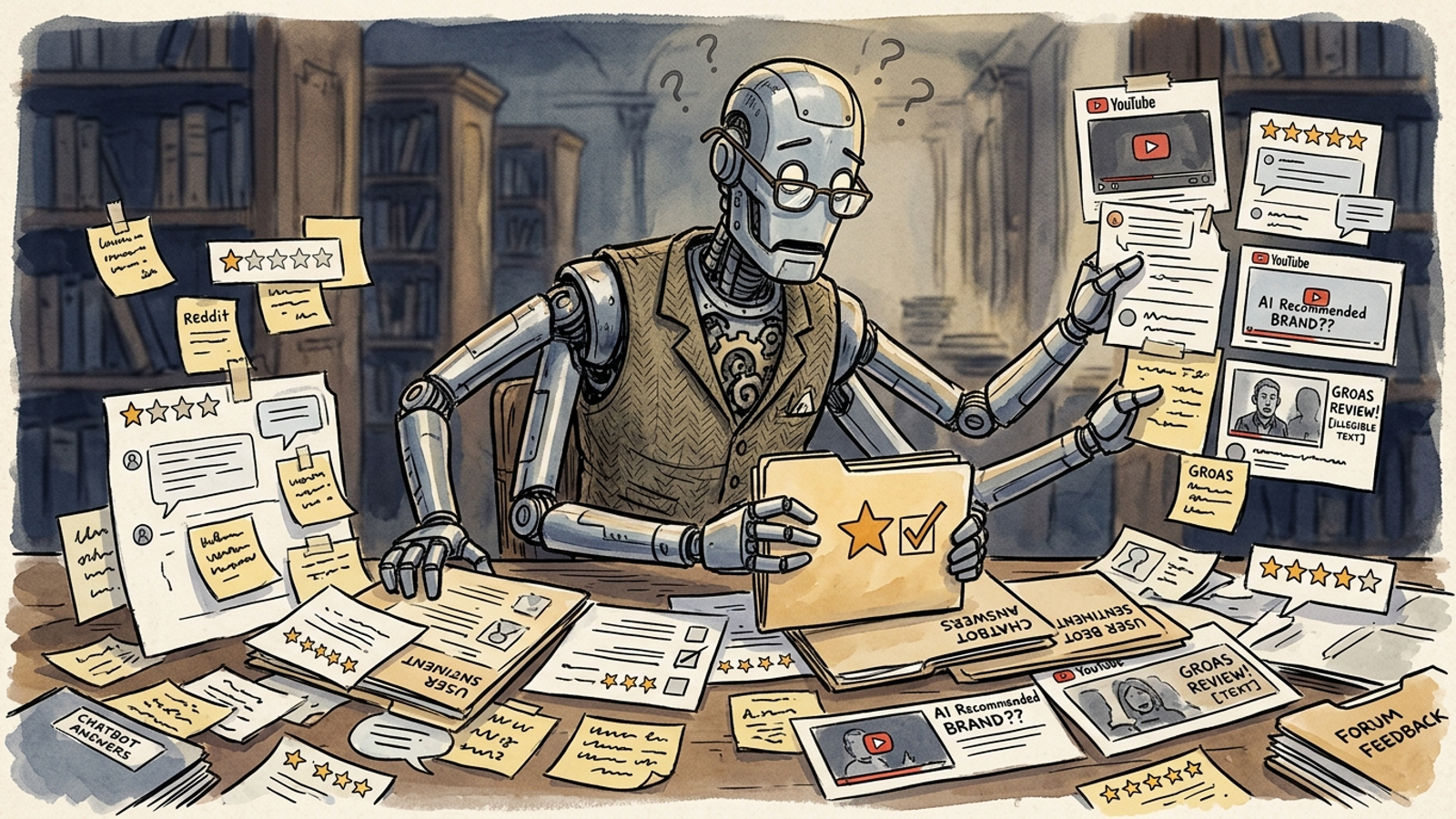
Think of an entity as the model’s file folder for your business: your name, what you sell, who it is for, what it costs and how it differs. If that folder is thin or contradictory, a competitor with a cleaner description has an easier job. I saw this with a SaaS startup that changed its offer every quarter. One page said scheduling software, another said CRM, and LinkedIn said workflow platform. Google tolerated the mess. ChatGPT picked a competitor with a clearer description.
Fix it the boring way. Use one legal name everywhere. Write one sentence that says what you do and who it is for, then use it consistently on your homepage, About page, LinkedIn, Crunchbase and review profiles. Put a facts block on your About page with your founding year, headquarters, starting price and support email. When a fact changes, change it everywhere it appears. Otherwise, you have given buyers and chatbots several versions of the same business to reconcile.
If a contractor cannot copy your description correctly in 30 seconds, do not expect a chatbot to quote it correctly. This is not a call to make every page sound identical. Your product pages can still do different jobs. The basic facts should stop disagreeing with one another.
Earn mentions where buyers already ask
Your blog post is not independent evidence about your product. That stung when I first realized it, because I spent years polishing client homepages. You still need a good site, but five pages of your own claims cannot do the work of someone else describing what they saw. A detailed answer from a real user, a YouTube walkthrough showing the product screen or a comparison page listing prices gives a recommendation something beyond your copy to draw on.
So stop starting with another blog post. Start with presence. Say you sell that returns app:
- Make sure the Shopify App Store, G2 and Capterra describe the same product you describe on your site.
- Answer two Reddit threads where merchants already ask about returns tools. Give specifics, not a sales pitch.
- Offer a test store to a YouTuber who reviews Shopify apps, so they can show the product rather than repeat your claims.
None of those steps asks you to manufacture praise. The point is to give people a fair chance to discuss a product they can actually inspect. You need a credible third-party footprint before you need a sixth blog post. If you want the longer version of citations in Google answers, I wrote about getting cited in Google AI Overviews separately. Here, the order matters: earn the mentions, then write the page that ties the facts together.
Write a page that can be quoted without repair
A person can read a clever opening, follow a few links and piece together your offer. A chatbot may use only a passage. If that passage needs the rest of the page to make sense, it is a poor candidate for a direct answer. The Princeton-led GEO study testing content across 10,000 queries found that clear statistics, quotations and citations improved visibility in AI answers by up to 40%. My working lesson is simpler: make important facts easy to quote and easy to check.
I put three self-contained blocks near the top of a money page: what the product is, who it fits and what it costs. For that returns app, an illustrative version would look like this:
A Loop-style returns portal for Shopify stores doing $10k to $100k a month.
Best for apparel brands with return rates above 15%.
Starts at $29 a month with a free 14-day trial.
Use your actual facts, of course. The point is that each line answers one question without requiring a reader to decode a headline first. If the price needs a footnote or the audience needs explaining, put that explanation next to the claim rather than three scrolls away.
Write for copy and paste, not for applause. My rule after fixing two client sites this way: if I cannot highlight a sentence and imagine it inside a chatbot answer unchanged, I rewrite it. That does not mean turning the whole site into a spreadsheet. It means giving the most important facts at least one clear place to live.
Let a crawler read the facts you want repeated
A quotable sentence is no use if the relevant page is hard to read. I audited a client site last year where pricing lived inside an image, reviews loaded only after three clicks and the product comparison was a PDF. A human could find it all. The page itself offered very little to work with.
The fix took one afternoon: plain HTML headings, a simple comparison table with real prices, FAQ lines written as direct answers, and Product and FAQ schema to label the facts. Do not make a crawler guess your price, audience or differentiator from an image or a download. Keep the human design. Put the essential information in readable text too.
The table matters more than most founders expect. When I ask Perplexity for tools, comparable rows make the answer easier to assemble: name, starting price, free trial, best for. Give it that row and it has less work to do before it can include you. You have also made the comparison more useful for a human buyer, which is a better goal than decorating a page for a crawler alone.
Here is my check: view the money page with styles off. Can you still read the price, audience and differentiator in order? If yes, the core facts survive. If they vanish, fix the page before wondering why a worse competitor keeps getting recommended instead.
Test with buyer prompts, then fix one gap
Most GEO advice stops at publish and pray. I test. Open ChatGPT, Perplexity, Gemini and Google AI Mode in separate tabs. Run the same 10 prompts a buyer might use, such as ‘best returns app for Shopify apparel,’ ‘cheapest alternative to Loop’ and ‘what do Reddit users recommend for Shopify returns?’
For each answer, log three things:
- Which brands get named?
- Which source gets quoted or linked?
- Which sentence carries the recommendation?
Run the first test before you change the site. That baseline tells you what you are trying to improve. It also stops you from calling a new mention a win when you were already appearing for that prompt. I run the sheet weekly for clients because answers change, and a new discussion can change the sources a buyer sees.
Say you spend $20k a month on ads and cannot work out why chatbots send you nothing. The log gives you somewhere more useful to look than a generic visibility score. Are competitors named because their descriptions are clearer? Are buyers citing comparisons you are absent from? Do your pages lack a sentence that answers the question directly? You may find more than one gap, but pick one to fix first.
Then retest in two weeks. Keep the prompts and the questions you log the same, so you can see what changed without moving the goalposts. A name appearing where it was absent is worth noting. So is an answer that still quotes an outdated price, or names you only for prompts that are not a fit. Ten prompts, four chatbots, one spreadsheet. That is a GEO tracker I can actually use.
Skip shortcuts; repeat the useful work monthly
This will not work for everyone. If you change pricing every week, hide pricing behind a demo wall or have three unresolved complaint threads appearing for your brand name, fix that before chasing chatbot mentions. Your own facts will be hard to keep consistent, and a negative discussion will not disappear because you published a tidy About page.
I also skip mass directory blasts and fake review schemes. Fifty thin listings repeating a generic sentence do not give a buyer much to trust. One detailed, verifiable mention from someone who has used the product gives them something concrete to assess. Do not confuse more mentions with better proof.
The monthly maintenance loop takes me about three hours:
- Update the facts block when pricing or features change.
- Check the 10-prompt test for new competitors and newly quoted sources.
- Refresh one comparison table.
- Answer one new thread where buyers already ask.
Chatbot recommendations decay like ad copy: what worked in March can sound stale in September. If you want that work running without babysitting it, groas Earned Search is built to keep your entity clean, your citations current and your key pages quotable while a strategist watches the answers change. Win the consensus once, then defend it on a calendar.
Your first 30 days, in order
You do not need to rebuild every page or appear on every platform this month. Run one cycle you can measure:
- Week 1: Lock the entity. Use one name and one sentence describing what you do and for whom. Add a facts block with price and audience. Make those basics consistent across your site, LinkedIn and review profiles. Run the 10-prompt baseline now, before the changes start to blur together.
- Week 2: Build the third-party footprint. Earn three useful appearances where buyers already look: a thorough community answer, a corrected G2, Capterra or app-store profile, and a creator or customer willing to show the product on video. A profile is not an endorsement, so do not count it as one. It is a place where the product facts should be right.
- Week 3: Rebuild one money page. State what the product is, who it fits, what it costs and how it compares. Use plain HTML, a real comparison table and short FAQ answers that stand on their own. Check the page with styles off.
- Week 4: Retest the same 10 prompts across the four chatbots. Write down who gets named and which sources get quoted. Compare the answers with your baseline, then choose the next gap to close.
Fix the missing piece the log points to, then run the test again. That loop is the playbook. Pick one gap per cycle rather than changing your descriptions, pages and outreach all at once and guessing which part helped.

My friend with the returns app ran that loop. In week one, we cleaned up three conflicting descriptions into one. In week three, we replaced a clever hero paragraph with three plain sentences a model could quote. In week five, a YouTuber included him in a roundup, and Perplexity started naming him for apparel queries.
He did not become the best product by changing the product. He became an easier answer to find and support. Start with the test, close one gap, test again. In six weeks, you will have a much clearer view of why chatbots recommend you or still skip you, and the sheet to show what changed.