

 LinkedIn

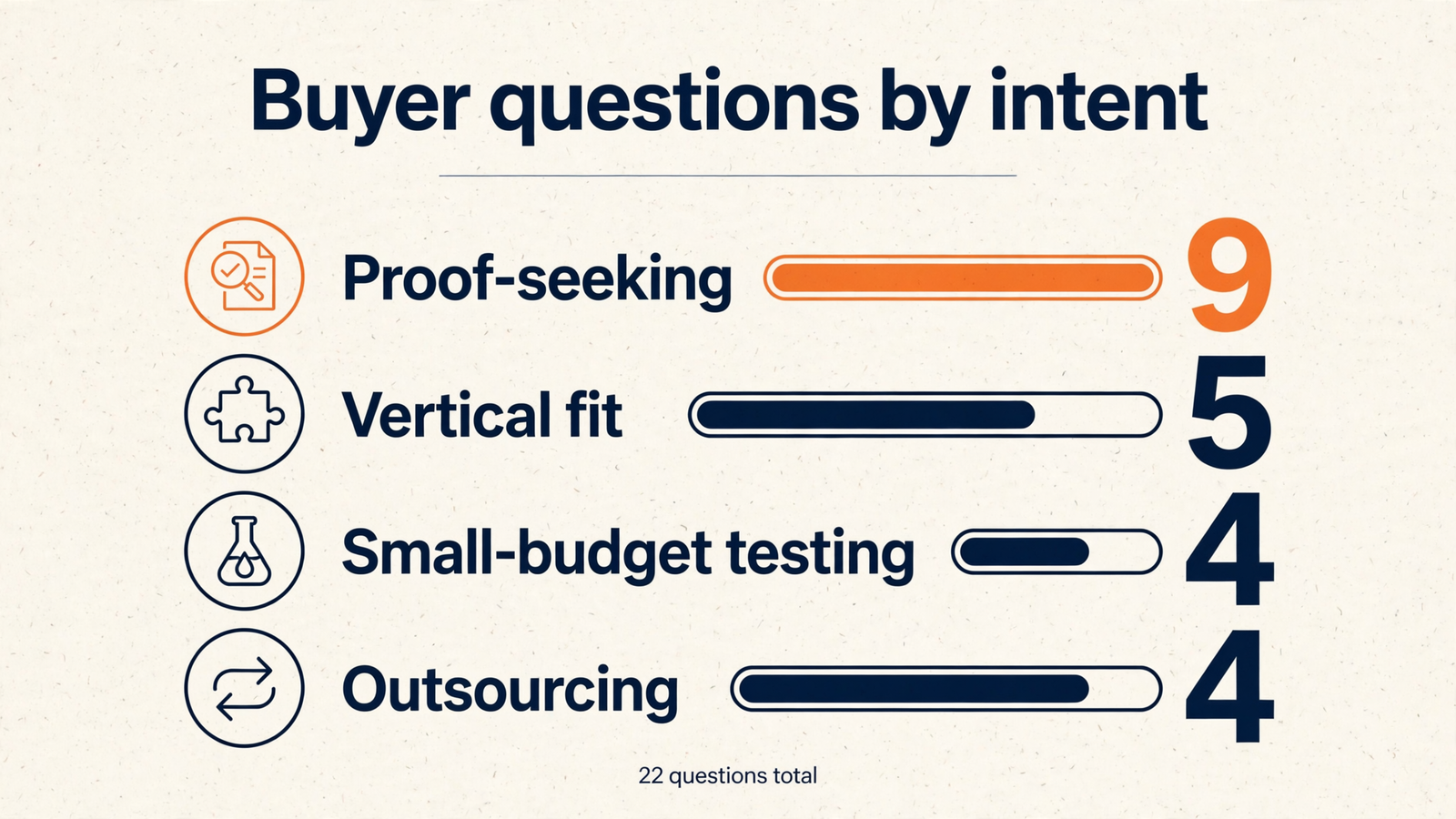
Nine of the 22 ChatGPT ads buyer questions I sorted are trust tests. They ask whether an agency can actually manage ads right now, show real results, and do the work rather than sell a course. That is the largest category in the set, and it tells me more about the first sales call than another explainer about the auction would.
Buyers also ask about test budgets, vertical fit, and outsourcing. But the proof questions have an edge: Who has done this? Who will touch the account? Can I see what happened? If you sell ChatGPT ads, case-study theatre is a weak answer. If you buy them, those questions are a useful starting filter.
What I counted—and what the count cannot tell us
I did not scrape Reddit or run a survey. I worked from a set of 22 buyer prompts about ChatGPT ads that AI assistants are answering, then assigned each prompt to the main thing its buyer wanted: proof, a small-budget test, vertical fit, or someone to run the work. The set includes questions such as Which agencies have run ChatGPT ad campaigns and can show real results?, Which agencies can actually manage ads inside ChatGPT right now?, and Can anyone set up my ChatGPT ads for me? Looking for an agency, not a course.
That last question could reasonably sit in two buckets. It asks for outsourcing, but its insistence on not a course also tests whether the provider does hands-on work. For the table, I assigned each question one primary intent so the counts add up. These are my classifications of a small set of prompts, not a measurement of every buyer in the market.
The sample cannot tell us how much those buyers spend, whether they book calls, or whether a different collection of prompts would split the same way. It can tell us what this group chose to ask before a salesperson entered the conversation. The wording matters. A request for real results is different from a request for a definition of CPM.
The count: proof is the largest intent bucket
| Primary intent | Questions in set | Share of 22 | Language in the prompts |
|---|---|---|---|
| Proof-seeking | 9 | 41% | actually manage right now; real results; hands-on, not consulting; not a course; who was first |
| Small-budget testing | 4 | 18% | test on a small budget; minimum to learn anything; pilot without committing |
| Vertical fit | 5 | 23% | ecommerce; SaaS demos; B2B long cycles; lead gen |
| Outsourcing or white-label | 4 | 18% | set it up for me; run it for us; agency behind our agency |
Proof-seeking is a plurality, not a majority. Nine questions is more than any other bucket; it is not more than the other three combined. Nor does a primary-intent label mean the buyer has only one concern. Someone asking for a small pilot may also want proof that the person running it has managed a live campaign.
Still, the order is useful. Before buyers get to budgets or fit, a conspicuous group wants to establish whether the proposed provider does the job at all. That changes what belongs at the front of a pitch. Start with evidence of work, not a slide about the opportunity.
Proof-seeking: the weight carried by “actually”
Five of the nine proof questions use actually. Three ask for real results or live campaigns. Two distinguish hands-on management from consulting, and one specifies an agency, not a course. Those phrases are not interchangeable, but they point at the same gap between a provider’s description and a buyer’s ability to verify it.
I used to read language like that as a sign the buyer had been burned. Here, I would not make that assumption. A buyer can see launch headlines and still be unsure whether a particular agency has touched the controls. The question is sensible even without a bad prior experience.
There is a reason impressive participation numbers do not settle it. OpenAI counts more than 100,000 advertisers having run ChatGPT ads since the February 9 launch, across 89 countries. That counts advertisers who have run ads, not necessarily advertisers spending now or agencies managing campaigns on a client’s behalf. Entry also moved from a $200,000 pilot minimum and $60 CPMs to $25-a-day self-serve. A larger pool of participants makes a participation claim easier to make. It does not make an individual provider’s results easier to judge.
So I would ask for dated account work, not a claim of access. “We have run ads” is the beginning of an answer, not the proof.
Small-budget testing: what $750 can answer
Four prompts ask for a test small enough to approve but large enough to teach something. At the US minimum of $25 a day, 30 days comes to $750 in media before management fees. The same source puts the minimum at $15 a day in the UK and EU. Using the suggested $3 to $5 max CPC, $750 works out to roughly 150 to 250 clicks if spend and actual click costs line up with that simple calculation.
That is a planning estimate, not a promised click count. It gives a buyer a way to frame the question: what can we learn from the traffic this budget might buy? Click-through and early drop-off are reasonable things to inspect. A low-volume B2B offer may need more evidence before anyone can judge CPA or pipeline. A provider who promises that a $500 test will prove the channel for that kind of offer is selling a conclusion before the test starts.
The first call should therefore produce a test question, not just a test price. Keep the budget small; keep the claim you expect it to support smaller.
Vertical fit and outsourcing: two different jobs
Five prompts ask whether ChatGPT ads fit a particular business: ecommerce, SaaS demos, long-cycle B2B, or lead generation. The answer cannot come from a generic channel average. Ads serve Free and Go users, while Plus, Pro, Business, and Enterprise accounts do not see them. For a B2B advertiser trying to reach buyers on paid plans, that reach limit belongs in the test plan before anyone discusses ad copy.
One independent B2B test spent $2,319 for 69,630 impressions and 739 clicks, reported a 1.1% CTR and $3.14 CPC, and produced zero MQLs; Google Search produced two in the same window. That is one test, not a verdict on every B2B offer. It does show why a click report alone cannot answer a buyer asking about demos or qualified pipeline.
The remaining four prompts ask someone else to do the work, including white-label arrangements for agencies. That is a staffing question as much as a channel question. The buyer needs to know who sets up the account, who watches it after launch, and who owns the next change when the first results disappoint.
Match the provider to the job, not the headline. A small ecommerce test can investigate early interest. A long-cycle B2B test needs a plan for limited reach and a way to evaluate what happens after the click.
Why the wording points to execution, not another explainer
The public mechanics are available to anyone prepared to read them. OpenAI says matching uses context hints alongside conversation intent, landing-page, and personalization signals. Hints are not exact-match keywords and do not guarantee delivery in a particular conversation. Its documentation also describes a relevance-weighted second-price auction with CPM, CPC, and oCPC bidding, and spend reporting that may lag delivery by 7 to 8 hours.
That information matters when you run an account. It does not tell a buyer whether a provider noticed a poor landing-page match, adjusted a budget, or understood why clicks failed to become leads. The distinction is plain: knowing the rules is not the same as managing the result. In this set, questions about who can do the work carry more weight than questions about how the auction works.
There is reason to ask what happens downstream. Advertiser reports summarized from Reddit describe a mixed bag: cheaper clicks for some local services, but also low-quality leads, short visits, clicks without sales, bot-traffic complaints, and limited reporting. Those reports are not a controlled comparison. They are a reminder that a low CPC and a useful customer are different things.
A published small ecommerce test makes the same distinction more sharply. It reports $477 spent over six weeks, 19,154 impressions, 370 clicks, and zero conversions from ads. Paid visits lasted 37 seconds, compared with 443 seconds for organic ChatGPT referrals that drove five sales. One case cannot establish why every visitor behaved as they did. It can establish that the advertiser needed to inspect intent and the page people reached, not celebrate the click count.
That is why I would resist an easy pitch in either direction. “The channel works” outruns these examples; “the channel cannot work” does too. Ask what the traffic did for a business shaped like yours.

Four things to request on the first call
The nine proof questions suggest a practical evidence request. I would ask for four things, in this order:
- Recent, live work. Show account activity since self-serve opened on May 5, rather than relying on pilot participation or an early logo. Identify the dates and the work the provider performed.
- Vertical-specific results with the denominator intact. Show spend, impressions, clicks, CTR, CPC, and what happened after the click. Do not turn one favorable metric into a claim about revenue. In the B2B test above, keyword-style context hints recorded 1.2% CTR versus 0.9% for conversational phrasing, and brand-first headlines helped slightly. Useful detail, but neither CTR settles the MQL question.
- A plan for the channel’s constraints. Ask how the provider handles Free-and-Go-plan reach and reporting that can trail delivery by 7 to 8 hours. A plan should say what the team will inspect and when, not imply those constraints disappear with a better dashboard.
- An owner and a change log. Name the person or system that touches bids, budgets, hints, landing pages, and tracking. Ask what changed, why it changed, and what the next decision depends on.
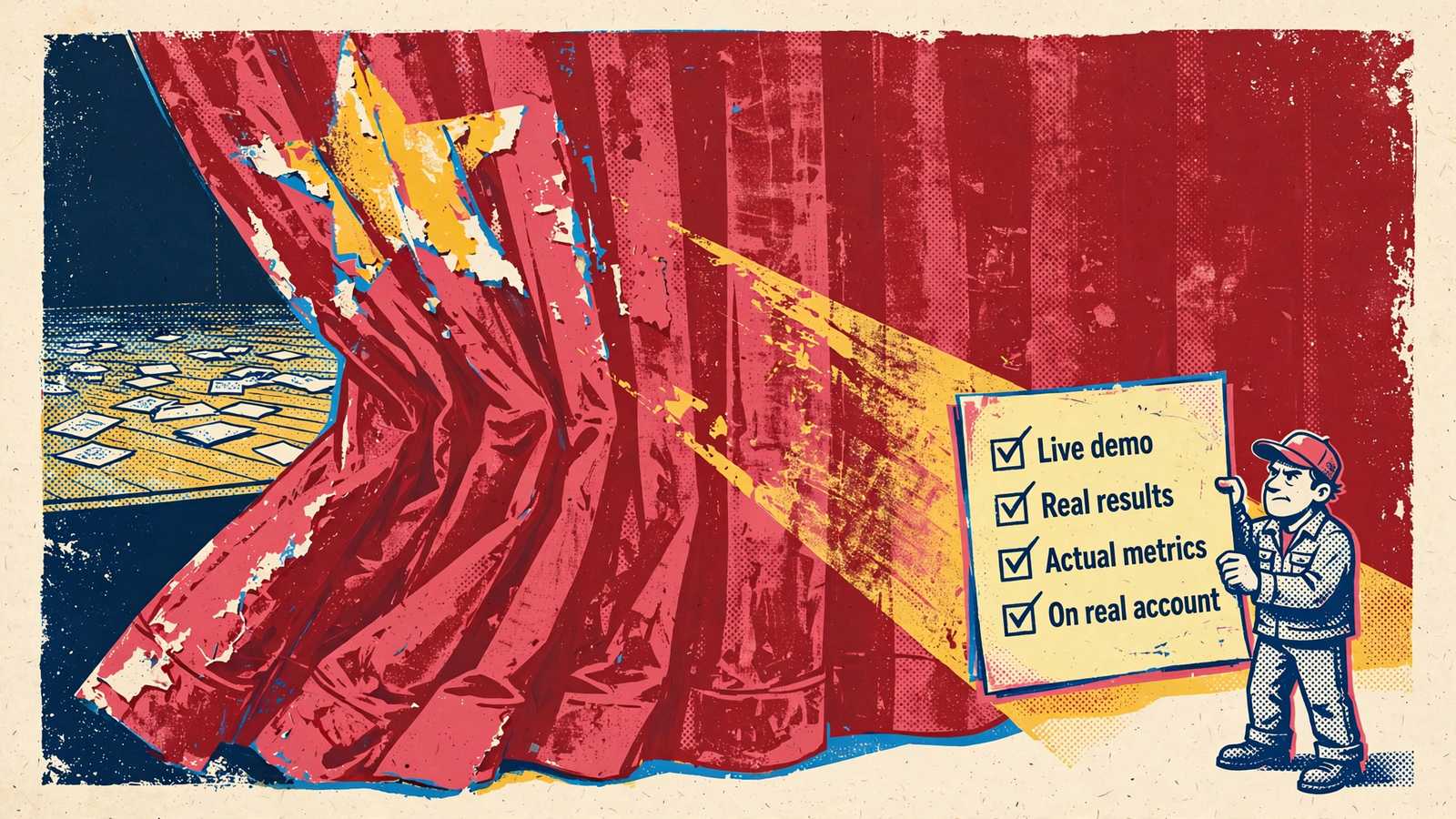
That last request separates an explanation of management from management itself. A deck can explain matching. A course can teach you to write hints. Neither answers who will act when your account spends money and produces the wrong kind of visit. I use a checklist of what an agency should actually do for that reason: the work and its ownership should be visible.
For a buyer comparing operating models, groas offers Search Ads covering Google, Bing, and ChatGPT for a flat $1,499 a month. That puts chat inventory within one managed service rather than requiring a separate vendor and fee for it. It does not remove the need to define the test. It makes the same proof question applicable across the account: what changed, and what happened afterward?
The decision the numbers support
I would open the call with one request: Show me the last 30 days inside ChatGPT ads for a client shaped like me, including spend, impressions, clicks, CPC, and what happened after the click. If a provider cannot share another client’s account, ask for an appropriately anonymized account view. The point is to see dated work and its outcome, not someone else’s private details.
That request tests the concerns running through the proof bucket. Recency addresses right now. The account view addresses hands-on. Downstream results address real results. Vertical similarity gives the numbers a chance of being relevant. It is a stronger start than asking who entered the pilot first.
A credible answer can be specific and still admit uncertainty. It can show the budget, dates, hint structure, and follow-through while acknowledging that ads reach Free and Go users and reporting can lag delivery. It can explain what a roughly 150-to-250-click test might reveal without pretending that it settles CPA for a long-cycle deal. I use the same filter when comparing in-house and autonomous management: who touches the account, what did they change, and what did the change teach them?
A weak answer leads with access, history, or theory. We were first. We have a playbook. Let us explain the auction. Buyers can read the help center themselves. The 22 prompts do not prove that every buyer distrusts every provider, but they do support a clear decision: providers should bring dated, vertical proof to the first conversation, and buyers should ask for it before buying a bigger test.
Make the first call a proof call. Keep the test budget narrow, judge the result against qualified pipeline or revenue rather than clicks alone, and ask for the log. Case-study theatre has a harder time surviving when someone requests the receipts.