YouTube Ads Won’t Get Fewer: Six Calls to Check by 2027
October 1, 2026
•
11
min read


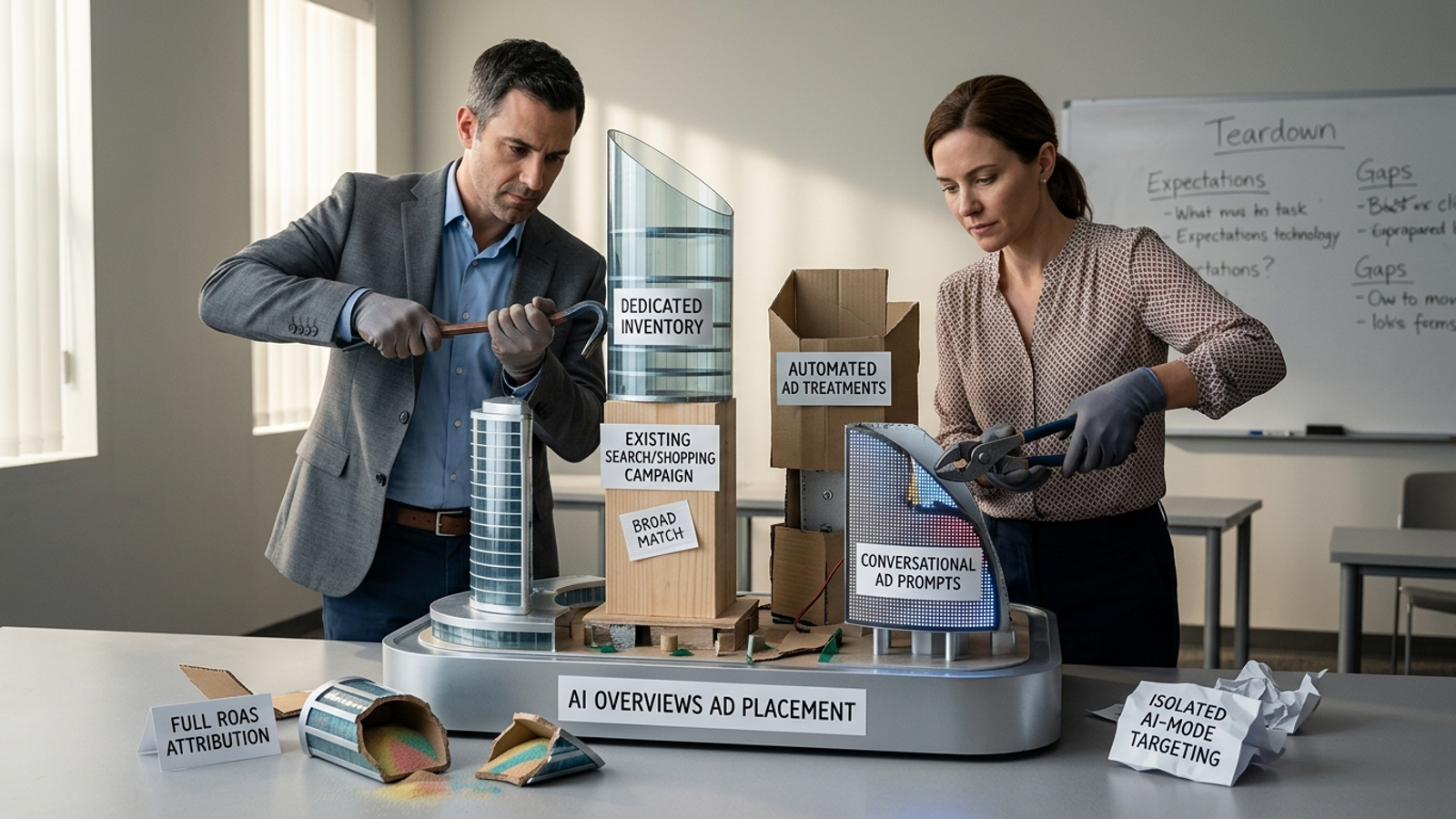
A DTC founder forwarded me a 14-slide agency deck asking for a dedicated $15,000 monthly test budget to put ads in Google’s AI answers. The pitch was confident. The controls it promised were another matter.
The deck, titled Monetizing the AI Search Era: How to Win in AI Overviews & AI Mode, is the artefact for this teardown because it bundles the claims an advertiser is likely to hear in one tidy PDF: dedicated inventory, early-mover access, conversational creative and placement-level attribution. I’ll take those claims in the order the deck presents them and separate the ad placements that exist from the management services built around them.
This distinction matters. A change to Google’s results page can create a real advertising opportunity without creating a new campaign type, a new targeting switch or a new report. Agencies and vendors have every incentive to blur those lines. The advertiser paying the bill does not.
Slide 3 shows a conversational search about running shoes for high arches. Google’s Gemini summary evaluates three biomechanical profiles, and a Shopping ad marked “Sponsored” sits beneath the synthesized bullets. It looks plausible because ads can appear around AI Overviews. The mockup establishes that an ad may appear; it does not establish that this agency can reserve the spot.
Slide 4 makes that leap: “Google has introduced dedicated advertising inventory inside AI Overviews and AI Mode. By securing an early-allocation test flight, our agency will position your brand directly inside the generative answers before your category competitors wake up.” The slide cites Google Marketing Live announcements, projects click-through rates that look like 2012 desktop search numbers, and quotes a $3,500 monthly management retainer on top of spend.
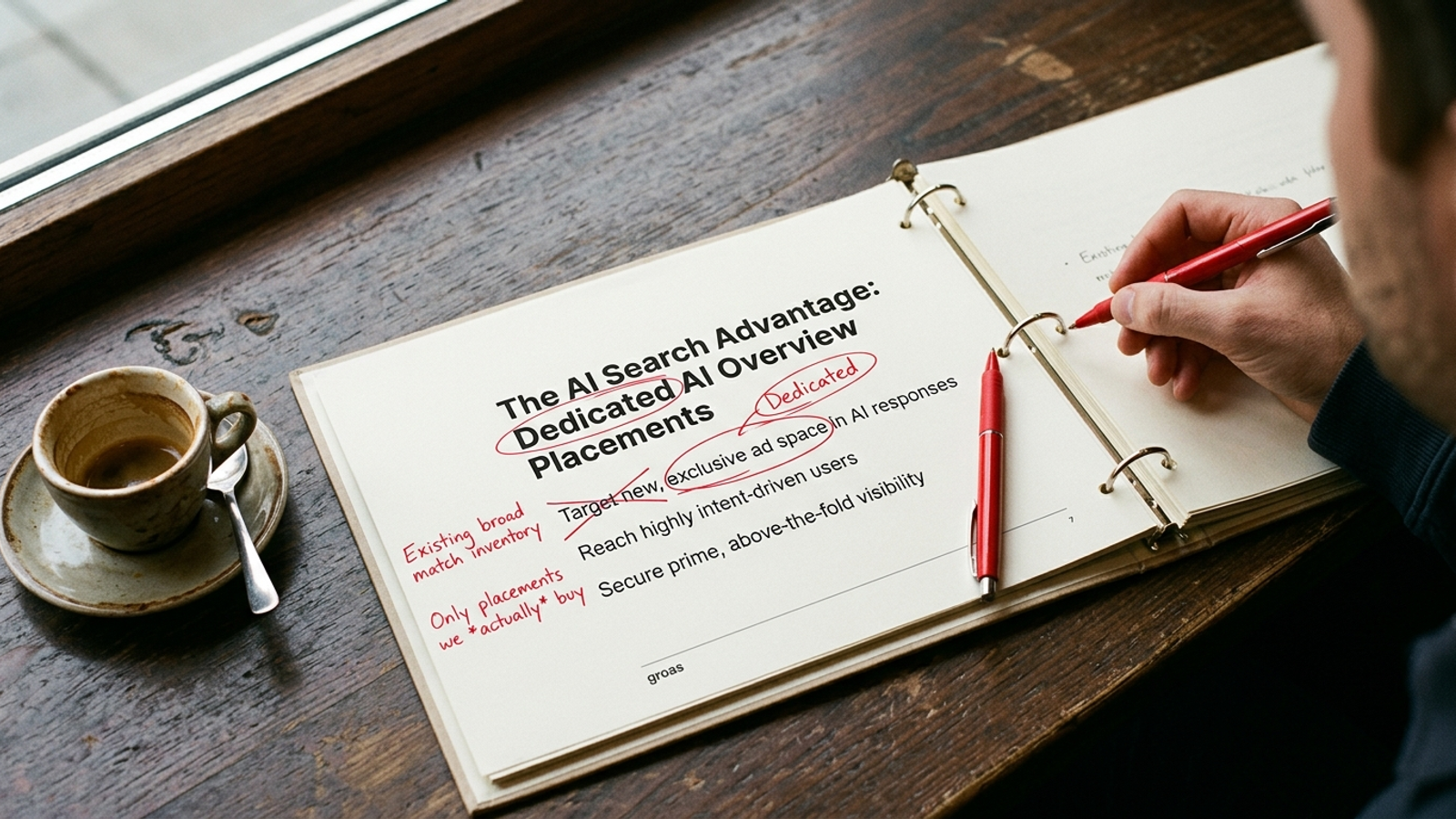
Slide 5 adds a timeline in which traditional Search campaigns supposedly give way to “AI-native placements” across the top half of the screen. The story is familiar: get in early, buy cheap inventory, make the competition look slow. The verdict on these opening slides is that they sell access before showing a way to control it. The rest of the deck needs to prove that an advertiser can buy, shape and measure the placement it depicts. It does not.
The deck treats AI Overviews as a new ad product you can turn on and fund separately, like YouTube Shorts or Demand Gen. That is the first operational failure. There is no dedicated AI Overview campaign, placement checkbox or billing line item. According to Google Ads Help, ads appearing in or around AI Overviews draw from existing Search, Shopping and Performance Max campaigns. The auction decides where an eligible ad appears.
Google’s AI Overviews FAQ puts the targeting problem plainly: “Can I target ads only to serve within the AI Overviews? No, you can't directly target ad placements in the AI Overviews.” It also says advertisers cannot opt out of serving ads there. No separate AI Overview bid, isolated ad group or bespoke copy field appears to support the deck’s “early-allocation test flight.”
That makes the proposed $15,000 budget an accounting label, not a dedicated media buy. The money would enter existing campaign pools; Google’s auction would decide whether the resulting ads appear in an overview, elsewhere on the page or not at all. An agency can choose how much to spend on its broader test. It cannot earmark impressions inside the mockup on slide 3.
Nor does appearing near an overview guarantee the premium position shown there. Bïrch’s SERP layout analysis describes ads above the summary, embedded within it and below it. A conventional text ad or Shopping carousel may also retain the top position on a transactional query. The layout changes with the query; the sales deck presents one attractive layout as though it were an inventory specification.
The pitch has a further omission: Google restricts ads within AI Overviews in sensitive categories. For advertisers in affected areas, the question is not whether the agency can secure an early allocation. It is whether the ad can appear there at all. Before approving a dedicated test budget, ask what, exactly, the budget buys that an existing campaign cannot.
Slide 7 promises an interactive canvas: “AI Mode represents a new ad surface where we can target users during active conversational evaluation.” It describes an outcome an advertiser might want, then quietly skips the route to getting there.
The Threadgill Agency’s Google Marketing Live breakdown describes conversational-auction eligibility through broader or keywordless approaches such as AI Max and Performance Max, paired with conversion-based Smart Bidding. That is a very different proposition from selecting “AI Mode” in a placement menu. You are expanding the campaign’s matching and automation, not buying an isolated conversational audience. For an account built around exact and phrase match on commercial queries, that trade-off belongs in the proposal, not in the small print after the signature.
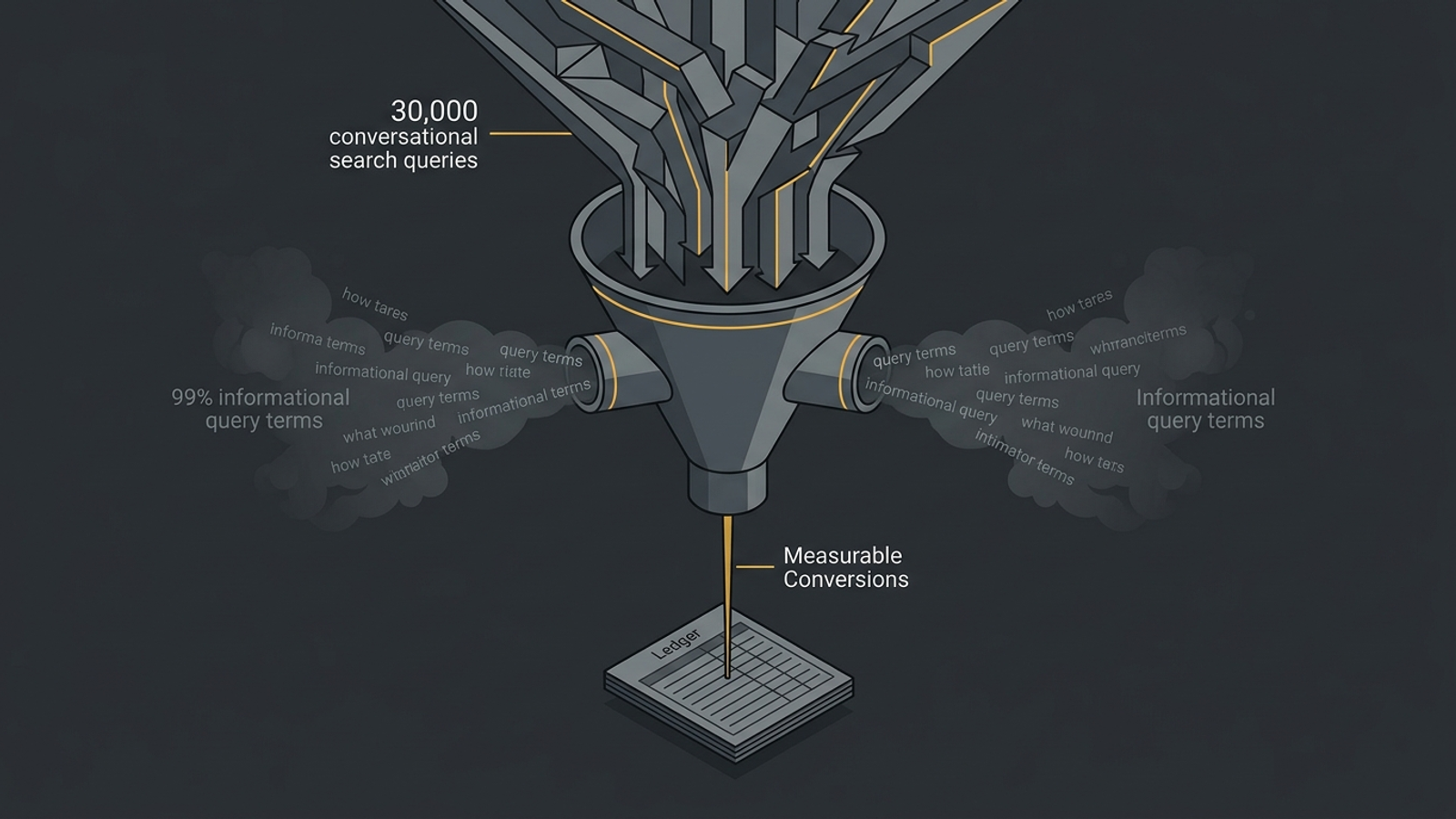
Broader matching can expose the account to more informational searches. The deck gives that cost no space. One Adalysis audit discussed by Google Ads practitioners examined 30,000 queries generated under AI Max and conversational matching and found that 99% of the resulting impressions yielded zero conversions. That finding is a warning about the queries in that audit, not a forecast for every account. Either way, a screenshot of an AI-surface ad tells you nothing about whether the wider matching paid for itself.
Slide 8 shifts to creative: “Our copywriters will tailor conversational ad prompts that interact naturally with the AI synthesis.” Here the service being sold is even harder to locate. As Humblytics’ measurement breakdown explains, advertisers do not write a dialogue for AI Mode. Google can append automated explanatory text to standard Responsive Search Ads or synthesize conversational material from a product feed. Those are automated treatments of existing inputs, not prompts an agency copywriter places in the answer.
There may still be useful work in improving those inputs. That is not the slide’s promise. The verdict on slides 7 and 8: broader auction participation is real; direct AI Mode targeting and bespoke conversational dialogue are not controls the agency can hand over.
Slide 10 offers the reassurance a buyer would reasonably demand after the first eight slides: “Our proprietary dashboards isolate AI Overview interactions, giving you full attribution down to CPA and ROAS.” If that were available, the agency could distinguish a useful placement from an expensive experiment. The problem is the underlying data.
The Google Ads reporting described in the deck does not provide a dedicated AI Overview or AI Mode placement dimension for isolating those impressions, clicks and conversions. A dashboard can reorganize available account data. It cannot turn a missing placement breakdown into observed placement-level CPA. If an agency presents a discrete AI Overview ROAS figure, the buyer should ask which platform field supplies it and which parts are modeled.
This is where the earlier budget label becomes consequential. Say an advertiser spends $50,000 a month across its campaigns and sets aside $15,000 on paper for the agency’s AI test. Without placement-level reporting, it cannot use a dashboard to verify that $15,000 ran in AI Overviews or calculate a CPA for those placements alone. It can assess the performance of the campaigns it changed. That is useful, but it is a different claim.
The uncertainty also complicates optimization. If informational impressions increase while strong commercial queries continue to drive sales, blended search metrics become harder to interpret. Treating a lower blended click-through rate as proof that the AI placement worked, or failed, would overread the data. Judge the campaign changes against downstream results; do not pay for a level of attribution the underlying reporting does not supply.
Slide 12 makes the deck’s neatest switch: “We will restructure your on-page copy so Google’s AI models select your product as the cited authority inside sponsored answer units.” It takes a defensible organic-search service and gives it a paid-media outcome.
Google Search Central’s guidance on AI features concerns how content can appear in AI search experiences through Google’s search systems. Clear, useful, indexable pages matter to organic visibility. Paid ads, meanwhile, enter through an advertising auction. A content rewrite is not a lever for securing a sponsored slot.
I would keep page improvements in the scope if the pages need them. I would reject the proposed mechanism. An agency can work on the information Google may find and cite organically, and it can manage the campaigns from which ads may be drawn. Calling those two jobs a single sponsored-citation strategy makes the service sound more precise than it is.
With the slides read in order, the pattern is clearer. The deck starts with a genuine change in search behavior and attaches controls the buyer cannot inspect. Here is the short version of the verdict:
| Pitch-deck claim | What the advertiser actually gets | Verdict |
|---|---|---|
| “Dedicated AI Overview ad campaigns” | Eligible ads can be drawn from existing Search, Shopping and Performance Max campaigns. | Not a dedicated product. |
| “Target conversational AI placements specifically” | Broader campaign matching and automation, without an AI Overview placement switch. | Not direct targeting. |
| “Tailored conversational copy and prompts” | Automated treatments of existing ad or feed inputs. | Not bespoke dialogue. |
| “Full attribution and discrete CPA reporting” | Campaign reporting without the promised isolated AI-surface breakdown. | Not observable as pitched. |
| “On-page rewrites secure sponsored slots” | Organic content work, separate from the paid auction. | Two services conflated. |
| “Search behavior is changing” | Buyers can use conversational answers while researching products. | Real, and worth planning for. |
That last row is why I would not throw the whole deck away. The agency noticed a real change. Its mistake was converting that observation into a menu of purchasable controls before demonstrating that those controls exist.
I would not approve a separate AI Overview management retainer on the strength of these slides. If the business wants to test broader participation in conversational auctions, I would put three conditions on that test:
What would I keep from the 14-slide deck? Its central observation: buyers increasingly encounter generative answers while researching a purchase. I would keep the mockup as a reminder to watch the search page, too. I would not keep the leap from “an ad can appear here” to “we can reserve, write for and attribute this placement.”
That leaves plenty of real work. Someone still has to catch wasted queries, improve the pages buyers reach, enforce budgets and connect campaign decisions to revenue. groas takes that work on with continuous autonomous execution and a named human strategist accountable for direction and results, rather than adding a retainer for a channel an advertiser cannot separately buy. Keep the observation. Cross out the imaginary controls.
Can I buy ads that only appear inside Google AI Overviews?
No. Google does not offer a dedicated AI Overview campaign, placement checkbox or billing line item. Ads that appear in or around AI Overviews are drawn from existing Search, Shopping and Performance Max campaigns, and the auction decides where an eligible ad shows. You also cannot directly target AI Overviews or opt out of them.
Do AI Overview ads always show in the same position on the page?
No. Ads can appear above the AI Overview summary, embedded within it or below it, and a conventional text ad or Shopping carousel may still hold the top position on transactional queries. The layout changes with the query, so a single mockup is not an inventory specification.
Is AI Mode a separate ad surface I can target in Google Ads?
No. There is no placement menu where you select AI Mode. Eligibility for conversational auctions comes through broader or keywordless matching approaches such as AI Max and Performance Max, paired with conversion-based Smart Bidding. This expands the campaign's matching, which can expose the account to more informational searches.
Can an agency write conversational ad copy that gets placed inside Google's AI answers?
No. Advertisers do not write a dialogue for AI Mode. Google can append automated explanatory text to standard Responsive Search Ads or synthesize conversational material from a product feed. Those are automated treatments of existing inputs, not prompts a copywriter places in the answer.
Can I get attribution showing conversions from AI Overview ads separately?
Not from the reporting described in agency pitches. Google Ads reporting does not provide a dedicated AI Overview or AI Mode placement dimension for isolating those impressions, clicks and conversions. A dashboard can reorganize available account data, but it cannot turn a missing placement breakdown into observed placement-level CPA or ROAS.
Will restructuring my website pages get my product cited in sponsored AI answer units?
No. Google's guidance on AI features concerns how content appears in AI search experiences organically through its search systems, while paid ads enter through an advertising auction. A content rewrite is not a lever for securing a sponsored slot. Page improvements can still be worthwhile for organic visibility, but as a separate service.
Should I approve a dedicated test budget for AI Overview ads?
Be cautious. Ask what the budget buys that an existing campaign cannot, and have the agency name the campaign setting, bid adjustment, creative field and reporting dimension it would manage. If you test broader matching, monitor search terms and exclude irrelevant queries, and judge the test on qualified leads, revenue, acquisition cost and margin-adjusted ROAS rather than reach.