

 LinkedIn
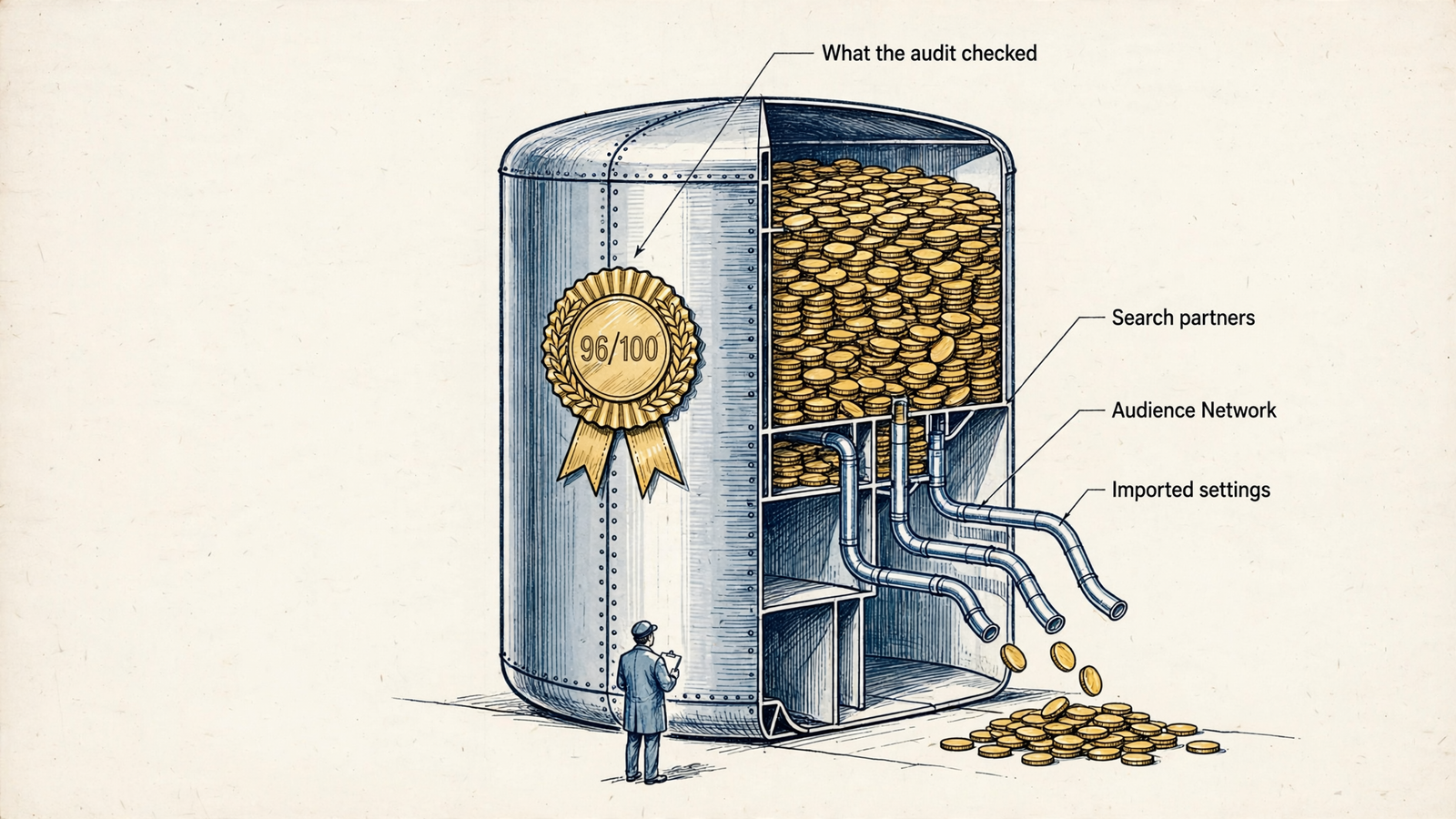
A free Microsoft Ads audit can give you a score out of 100 without showing where a dollar of your Bing spend went. I’m tearing down a composite 12-section takeover audit because its familiar sequence, from account score to management proposal, exposes the problem: most of these documents are Google Ads audits with the logo swapped.
The pages grade Quality Score, bid strategy labels and ad extensions. The checks that could explain spend without conversions are harder to find: imported settings, search partners, Audience Network, conversion goals, Shopping feed sync and, for B2B accounts, LinkedIn profile targeting. I’ll follow the document in the order a prospective client would read it and give each page a verdict before moving on.
The cover and score: polished, but pointed at the wrong problem
The composite opens with a cover page, an account score and clean screenshots. Then come bid strategy, keywords, ad copy, extensions, locations, tracking and Shopping. Recommendations fill the final pages, followed by a proposal to take over the account. I chose this artefact because that sequence makes a takeover feel like the obvious answer before the audit has established what is wrong.
The cover is not the problem. A clear account inventory helps a reader understand what was reviewed. But a score is not a diagnosis. Before accepting its grade, I want to know what Google import changed, which networks received the clicks and which actions the account counted as conversions. Those answers determine whether the proposed management work addresses the account at all.
The tell appears on the score page. It grades expected CTR, ad relevance and landing page experience on a 1-to-10 scale, then treats the result like a lever for auction cost. Microsoft uses those inputs in Quality Score too, but its score is described as historical rather than an auction-time factor. Improving a weak ad or landing page may still be sensible. The number alone does not explain why this account spends without converting.
Verdict: keep the inventory; bin the score as an explanation of wasted spend. The next page should investigate the settings behind the spend. Instead, it grades their labels.
Bid strategy: a label is not an import review
The bid page lists Manual CPC, Enhanced CPC or Maximize Conversions and recommends a more advanced-sounding option. It reads like progress because each label sounds more automated than the last. What it does not show is where the current bids and budgets came from.
Google Ads import can bring settings into a different auction, and imported bids and locations need review. A practitioner guide recommends pausing scheduled auto-imports before reviewing bids. That is the starting point I want documented: is a schedule still running, when did it last change the account, and which bids, budgets and negatives were checked afterward? Changing a strategy label without answering those questions can leave the underlying problem intact.
I used to treat import as a head start. It can be one, but only if someone checks what arrived and what keeps arriving. Verdict: no import check, no bid review worth keeping.
Keywords and match types: the broad-match recommendation has no search terms behind it
The next page counts exact, phrase and broad keywords, then suggests more broad match to capture volume. That recommendation needs evidence from this account. Microsoft broad match deserves its own search-term review before anyone copies a Google campaign across; PPCHero cautions against copying Google broad match straight into a new Microsoft campaign.
The missing work is concrete. Segment search terms by match type, identify broad keywords brought over by import, and compare what those terms matched against what the advertiser meant to buy. If broad needs a test, isolate it where bids and budget can be controlled. If exact and phrase have not proved useful yet, adding broad for the sake of a fuller-looking keyword chart is a poor substitute for investigation.
Verdict: the count may be accurate, but the recommendation is unearned. Show the matched queries before asking for more reach.
Ads, extensions and locations: three pages I would keep
The composite moves through ad copy, extensions and location targeting. These are the rare pages that can earn their space without pretending to solve everything.
An extension review can catch call or location assets that failed to carry over as intended. A location review can catch settings copied from Google without checking their fit in Microsoft. An ad-copy review can expose thin imports that leave useful ad space unused. Each finding still needs to name the affected campaign or asset; a generic warning that extensions could improve is not much of a finding.
Verdict: keep all three checks, with account-specific evidence. They are legitimate work, not proof that the score page was right. The larger omission comes next, where the audit treats traffic as one undifferentiated line.
Search partners and Audience Network: the missing traffic split
A campaign can look healthy in a total-spend chart while weaker inventory consumes part of its budget. The composite reports clicks and impressions but never separates core search traffic from search partners or Audience Network. That makes its performance verdict impossible to test.
For search partners, I want the network split and the Website URL publisher report. Those views let the reviewer compare spend and conversions, then inspect placements rather than assuming every click came from the same search experience. High CTR without conversions, click spikes without conversion lift and odd-hour non-brand traffic are reasons to look closer, not reasons to declare every partner bad. If a placement is wasting budget, list it and the proposed exclusion.
Audience Network needs its own answer. The audit should show how much traffic it received and whether the account has an intentional bid adjustment. A Decrease by 100% Audience ads bid adjustment at ad-group level is described as a bid exclusion rather than a simple off switch. Keeping that inventory can be a choice; failing to identify it cannot. If the plan is selective exclusions instead, show the publisher report and the exclusions.
Verdict: fail. Before approving a takeover, demand the network split. Otherwise, the proposal can promise to improve campaigns without saying where their clicks came from.
Conversion tracking: a firing UET tag is not an audited goal
The tracking page displays a green check next to UET and moves on. That proves too little. A tag can fire while the goals attached to it count the wrong action, count the same action twice or miss a key page. Imported goals and UET goals need to be inspected together, with their sources and count methods written down.
The audit also needs to explain its comparison with GA4. Microsoft can report a conversion against the click date while GA4 reports against the conversion date. A difference between the two views is not, by itself, proof that tracking is broken. It is a reason to reconcile the dates before using either view to judge CPA.
I want the goal list, tag status on the relevant pages, the ID in use, any consent-related blockage and a note on duplicate actions. Verdict: a UET checkmark is a starting observation, not a tracking audit. If the conversion count is wrong, every bid recommendation built on it becomes suspect.
Shopping: product titles are not feed health
For an ecommerce account, the composite reviews titles and images and calls Shopping covered. It never opens Microsoft Merchant Center. That misses the point at which a Google Merchant Center import becomes a Microsoft catalog with its own sync and approval state.
Microsoft’s import can use a one-time or scheduled feed sync, as feed guides describe. The audit should show the last sync, its errors, the SKU count approved in Google and the SKU count approved in Microsoft. Domain verification, GTINs, prices, images and feed diagnostics belong in the review too. Click growth cannot tell a retailer whether the intended products are eligible to serve.
Verdict: surface check. Keep the title and image notes, but do not call the page a Shopping audit until it shows what is in the Microsoft catalog and what failed to get there.
LinkedIn profile targeting: the B2B page that never appears
In a B2B account, this is where a Microsoft-specific review should become obvious. Microsoft Ads offers LinkedIn profile dimensions including company, industry and job function; a modifier-first setup and those dimensions are outlined here. The audit should establish whether the account uses relevant profiles, how their performance is segmented and whether any modifier has a reason behind it.
That does not mean every B2B advertiser must turn profile targeting on. It means a takeover proposal should not claim to have reviewed targeting while ignoring a Microsoft option that could affect who sees the ads. The composite supplies no profile settings and no performance split. It cannot say whether the account has made a deliberate choice or simply inherited the absence of one.
Verdict: missing. For a B2B takeover, show the company, industry and job-function review before proposing new bids.
Recommendations: quick wins without a change history
The last analysis pages offer quick wins: tidy conversion goals, resolve negatives, create more ads. Some might be useful. The problem is that the recommendations page never distinguishes a proposed change from one the platform may already have applied or suggested automatically.
Microsoft offers auto-apply controls, so I want to see which types are enabled and what the change history shows. This overview describes Microsoft’s auto-apply recommendation types. Without that history, an agency can take credit for a generic suggestion while missing an account change that deserves review. The page should name the setting, the affected campaigns and why the action follows from the evidence already presented.
Verdict: keep the list as a set of questions. Delete its conclusions until the account history supports them. A takeover proposal is next, but the missing work should be visible before anyone signs it.
Before takeover: the 14 checks I would require
The composite’s final page asks for management access. I would ask for these 14 checks in writing, with account evidence instead of a score. They follow the gaps exposed above; an item that does not apply should be marked as such, not silently skipped.
- Google auto-import status and last overwrite date — paused or still scheduled.
- Imported bids and budgets reviewed for Microsoft, not accepted because they came from Google.
- Bid strategy after import — including any fallback that changed the intended setup.
- Broad-match search terms segmented by match type and imported broad keywords identified.
- Core search versus search-partner spend, conversions and CPA shown separately.
- Audience Network spend and ad-group bid adjustments — exclusion or intentional use explained.
- Website URL publisher report and proposed placement exclusions — show the report, not a summary.
- UET status on key pages — correct ID and any consent-related blockage checked.
- Conversion goals and count methods reviewed for duplicate actions across imported and UET goals.
- Microsoft click-date and GA4 conversion-date reporting reconciled before comparing CPA.
- Tracking templates and attached negative lists checked after import.
- Shopping sync errors and approved SKU counts in Google and Microsoft, where Shopping applies.
- LinkedIn profile settings and reporting segments reviewed for B2B accounts.
- Auto-apply settings and recent change history recorded before recommending further changes.
The item I would be least willing to waive is 7, the Website URL publisher report. Skip it, and partner or audience placements can keep taking budget while the audit grades a Quality Score instead of examining the traffic.
Send the agency these five questions
The checklist is the standard; these questions make the handoff harder to bluff. Ask for the account view behind each answer, not a promise to investigate after the contract starts.
- Is Google auto-import on or paused, and when did it last change this account?
- How did core search, search partners and Audience Network compare on spend, conversions and CPA?
- What does the Website URL publisher report show, and which placements would you exclude?
- Which conversion goals count each key action, and how did you reconcile Microsoft and GA4 reporting dates?
- For B2B, what do the LinkedIn profile settings and segments show? For ecommerce, what are the Merchant Center sync errors and approved SKU counts?
An answer can be “we checked, and this setting is not the problem.” That is useful. “We will optimize it once we take over” is not an audit finding.
Overall verdict: keep the useful pages, reject the score
I would keep the composite’s extension, location and ad-copy checks. I would also keep any account-specific finding from its other pages that survives a look at the settings and reports. But I would bin the score and refuse the leap from generic recommendations to a management contract. The missing import history, network split, publisher report, conversion-goal review, Shopping sync and B2B profile check are precisely where this Microsoft Ads audit needed to do its work.
That is the standard I would bring to a takeover, including one through groas Search Ads: Google Ads, Bing Ads and ChatGPT Ads managed together for a flat $1,499 a month, with bids, keywords and budgets worked around the clock and a dedicated manager accountable for the result. No percentage-of-spend fee, no setup fee, month to month. The commercial terms do not replace the audit. They make it more important to show the work. If your Bing campaigns spend without converting, do not sign on the strength of a polished score. Demand the checks, then decide who should run the account.


