How to Automate Brand Visibility Reports Across AI Assistants
October 5, 2026
•
6
min read


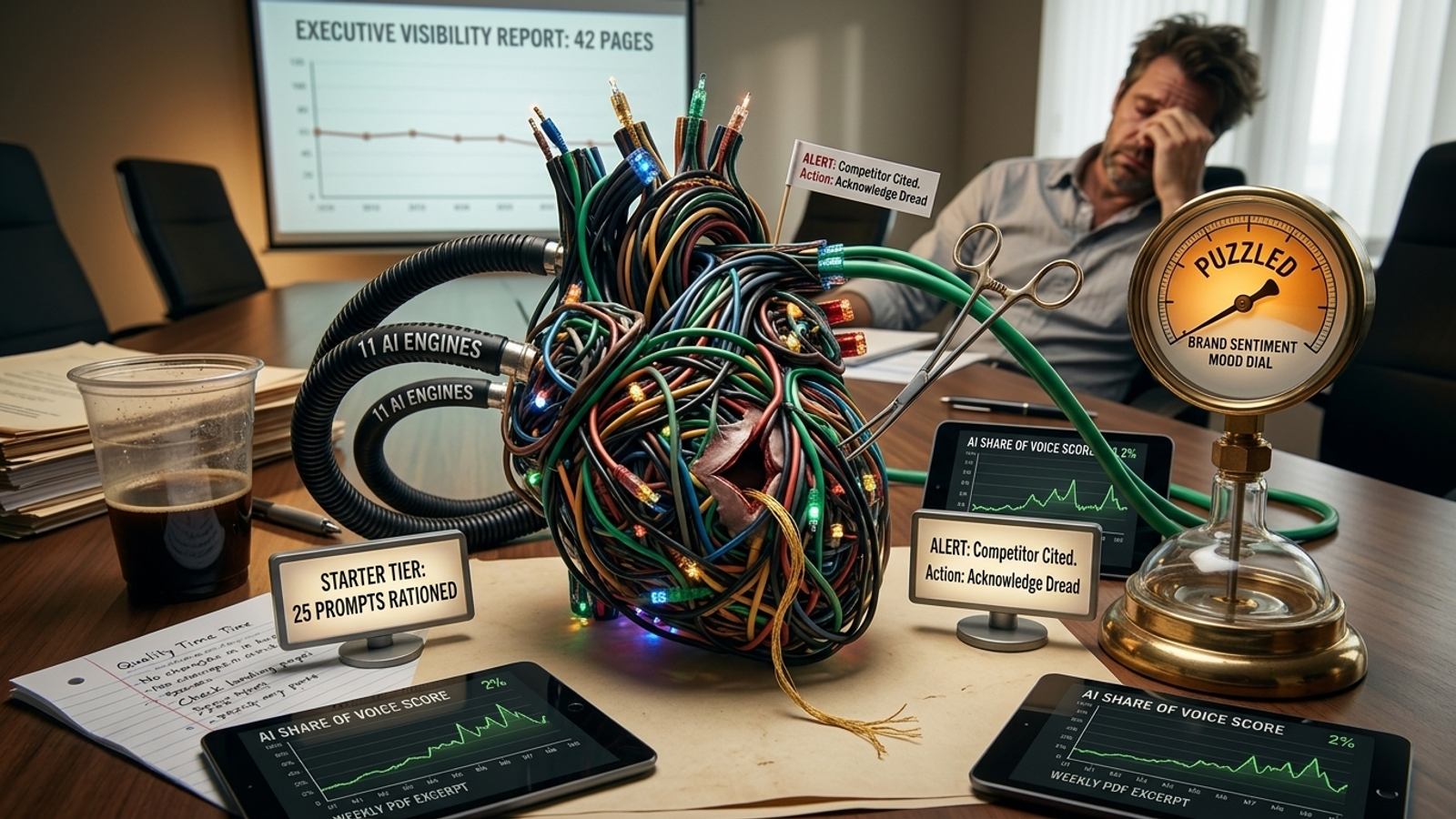
Your competitor appeared in a ChatGPT recommendation. You did not. By the time you had pasted the answer into a slide deck, three vendors were ready to sell you a dashboard showing the same thing in amber.
Good morning, product leads and performance directors. For eighteen months, software sales reps have warned you about Answer Engine Optimization. They have told you the search bar is dying, that roughly 60% of searches end without a traditional organic click, and that unless you buy an AI telemetry suite, your company will vanish into the synthetic ether before the next fiscal quarter. We heard your concern. We also noticed that screenshots pasted into Google Slides have terrible margins.
Today, I am proud to automate that entire cycle of executive grief. Instead of wondering whether an AI assistant mentions your brand, you can pay $499 a month to watch yourself not get cited across eleven engines, with sub-second latency, custom SVG line charts and a weekly PDF. Please welcome VisibilityPulse Pro. It changes nothing on your site. It changes everything about how often you are reminded.
Our crown jewel is the AI Share of Voice Score. In the old days of performance marketing, finding out why an account was bleeding margin meant inspecting query logs, landing page paths, conversion tracking and bid ceilings. That required work. We have removed the inconvenience of root-cause investigation by distilling your organic reputation into a proprietary number from 0 to 100.
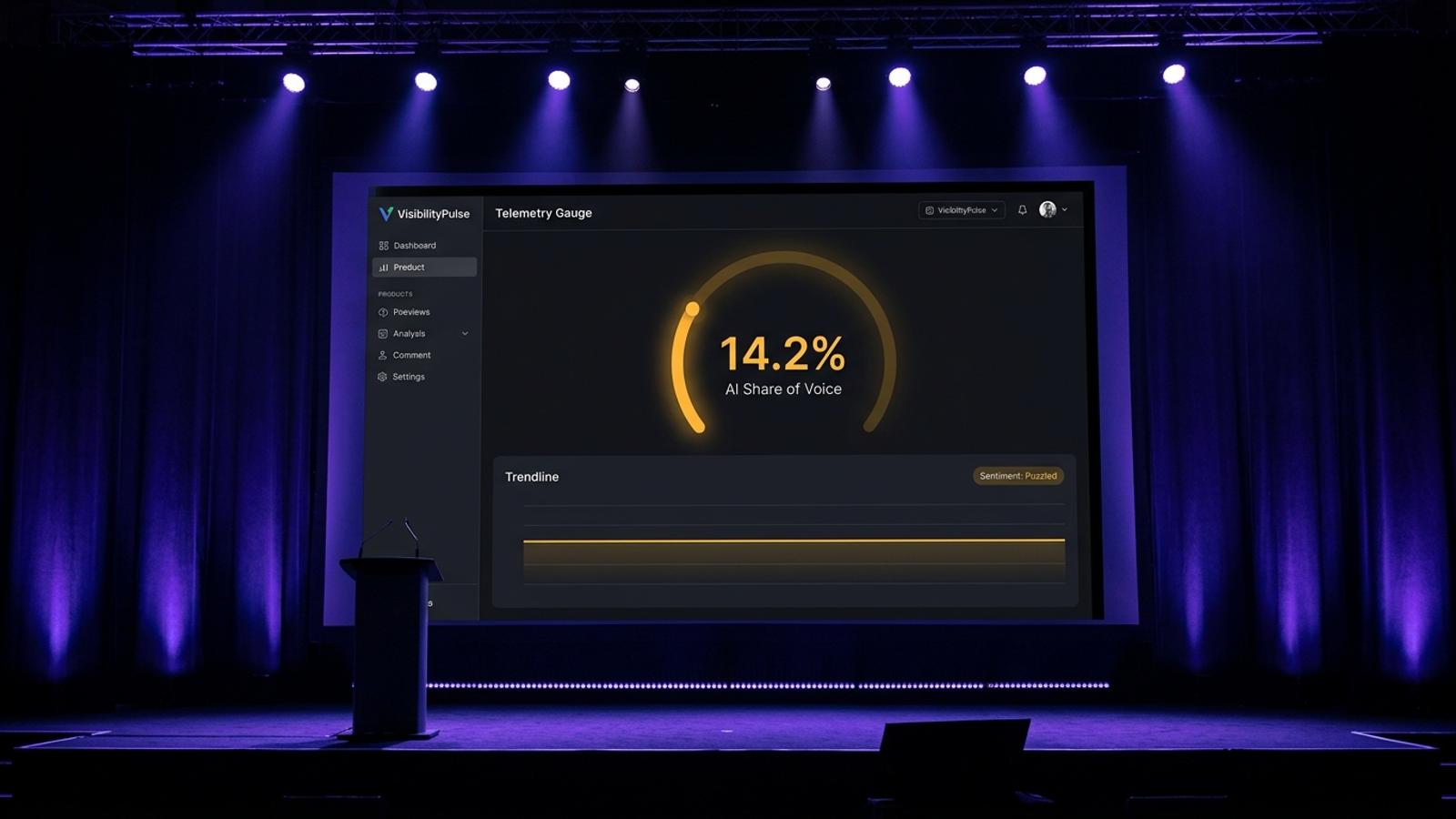
Our algorithm combines mention frequency, citation share and synthetic sentiment into a composite AI Visibility Score suitable for an executive presentation. Is a crawler having trouble reaching your pages? Is an AI answer repeating an unhelpful description of your product? Is a competitor appearing in commercial answers where you are absent? You will not need to bring those uncomfortable questions to engineering. You will receive a dignified answer: 14.2%.
The decimal place matters. It gives the number the appearance of laboratory precision while sparing everyone in the room a discussion of what, exactly, was sampled. For those who prefer colour to arithmetic, the adjacent Brand Sentiment Mood Dial reads Cautiously Ambivalent in a soothing shade of amber. Forty charts provide further opportunities to inspect the same feeling from different angles.
If the format feels familiar, it should. A decade ago, free Google Ads graders ran surface-level audits, displayed a failing grade in bold crimson and generated an alarming PDF about wasted spend to encourage an advisory call. A grade did not add a negative keyword, repair a conversion tag or rebuild an ad group. We have brought that distinction between identifying work and doing it to the generative era. Measurement is the product. The fix is a separate meeting.
In paid search, an operator might examine hundreds of query variants to understand intent. In AI visibility software, we have chosen a more disciplined philosophy: scarcity. We saw entry plans with 15 to 25 tracked prompts and recognised a valuable principle. The fewer questions you ask, the more manageable your absence feels.
Our Starter tier includes 25 prompt slots. That leaves room for your brand name, four common misspellings, the CEO’s social handle and a handful of commercial searches on which you would rather not see your competitor. You can also reserve a slot for the question your sales team says buyers ask most often, provided nobody else in the company has already used it to track whether ChatGPT likes your slogan.
What happens when someone proposes a 26th prompt, perhaps an actual product comparison? You upgrade to the Growth Add-On for another $150 a month and receive 15 more. The slots arrive carefully metered, like clean water in a drought, while the underlying inference call costs roughly one-third of a cent. You may export your prompt list. We encourage you to admire its selectivity.
A flat trend chart can be overlooked. A notification in the company Slack channel cannot. That is why VisibilityPulse Pro includes Opportunity Alerts, inspired by Action Centers that catalogue articles to rewrite without making the code or copy changes.
When an AI answer recommends your competitor, our webhook posts a high-priority card to your general channel:
Alert: Competitor X cited for commercial query. Recommended fix: Get cited instead.
Underneath sits one interactive button: Acknowledge Dread. Pressing it records that somebody has seen the problem. This is an important step in the workflow because the next step belongs to somebody else.
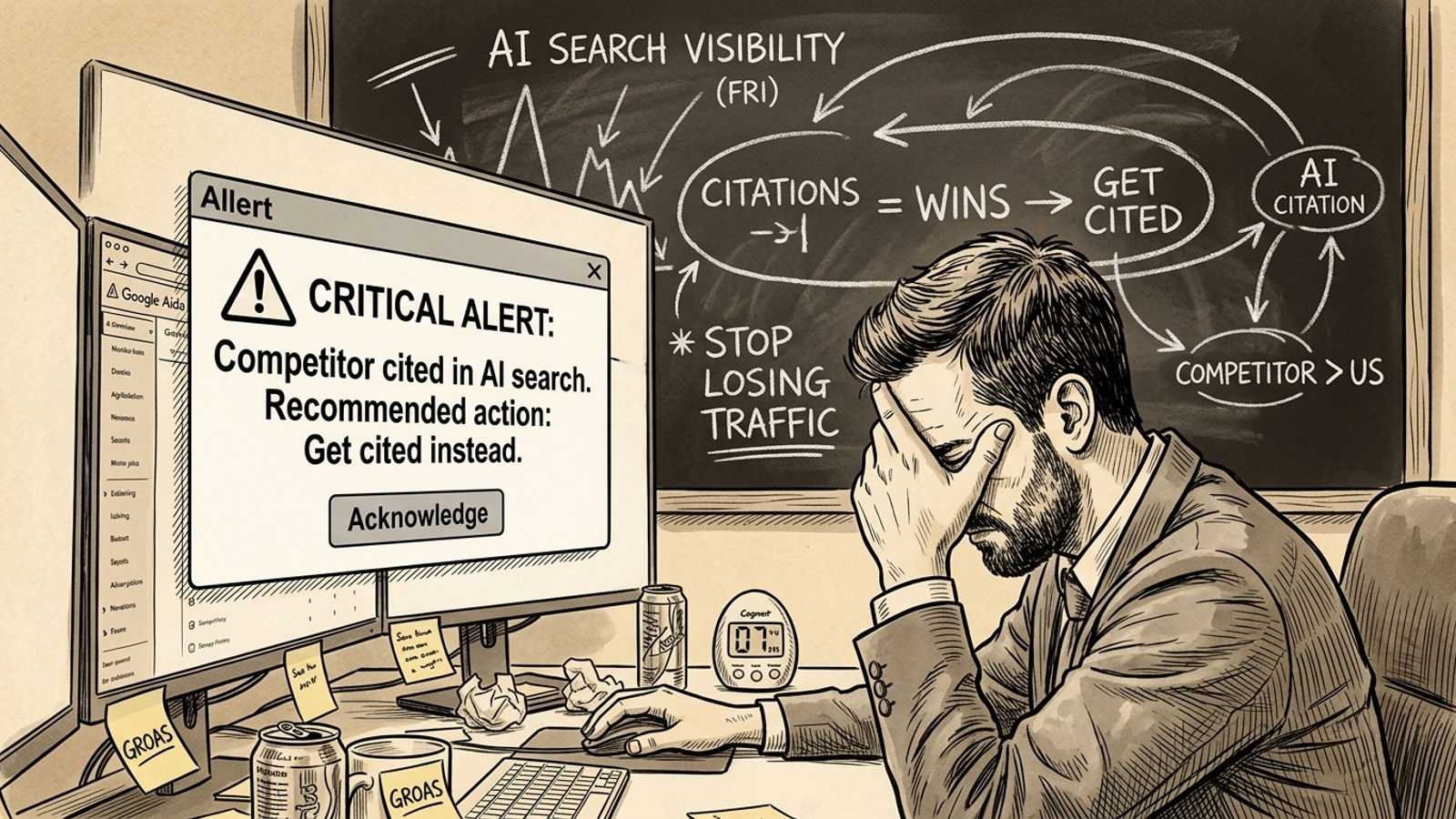
Our alerts do not build landing pages, add schema, publish copy or diagnose bot access. They ensure that the entire executive team experiences the emotional weight of losing ground at the same time. If the notification sounds uncomfortably familiar, see our note to the founder who saw a rival in ChatGPT. Buying a digital thermometer has never cured a fever, but it does let you schedule a recurring meeting about the temperature.
Every Monday at 6:00 AM, our background workers compile a 42-page Executive PDF and send it to your leadership team. The report contains multicoloured radar charts showing 0% visibility in Perplexity, 0% in Gemini Pro and 1.8% in Meta AI, based on a lone Facebook group comment from late 2021. It also contains a title page substantial enough to survive being projected onto a conference-room wall.
Why 42 pages? Because a thin report invites questions. A thick one fills a 30-minute agenda item. You can compare this week’s line with last week’s line, ask why the amber has moved slightly to the left and commission a closer look at the underlying chart. The report offers no way to change any of the numbers. It does, however, look excellent printed in colour.

Our launch deck includes two testimonial templates. They are not attributed to customers; that would require customers. They are ready for your team to adapt after the first weekly report arrives:
“Before VisibilityPulse Pro, we suspected AI answers were leaving out our product. Now six SVG charts document our exclusion before breakfast. We are much better prepared to sit quietly in executive meetings.”
“We used to spend time debugging structured data and rewriting comparison tables. Now we look at a sentiment dial that says Puzzled. The board appreciates the clarity.”
The second quote is particularly important. It identifies the hours we are giving back: hours previously spent changing things.
We rejected utility-based pricing in favour of the familiar AEO packaging model, where vendors can charge $2,000 or more a month for scheduled LLM checks. Our tiers scale with the breadth of the problem you can see, not the work the software performs.
All tiers include the Brand Sentiment Mood Dial. Its amber setting is available at no additional charge.
Before we open the virtual breakout rooms, I want to answer the questions our sales team has placed on the FAQ slide.
Can I automate AI visibility reporting without hiring an agency? Absolutely. VisibilityPulse Pro replaces the screenshot collection, slide assembly and Monday-morning distribution. Agencies may spend time discussing page copy, crawler access and technical changes with your team. We bypass that friction by delivering the evidence of your absence directly to leadership. No junior account manager learns on your budget; no one edits your site either.
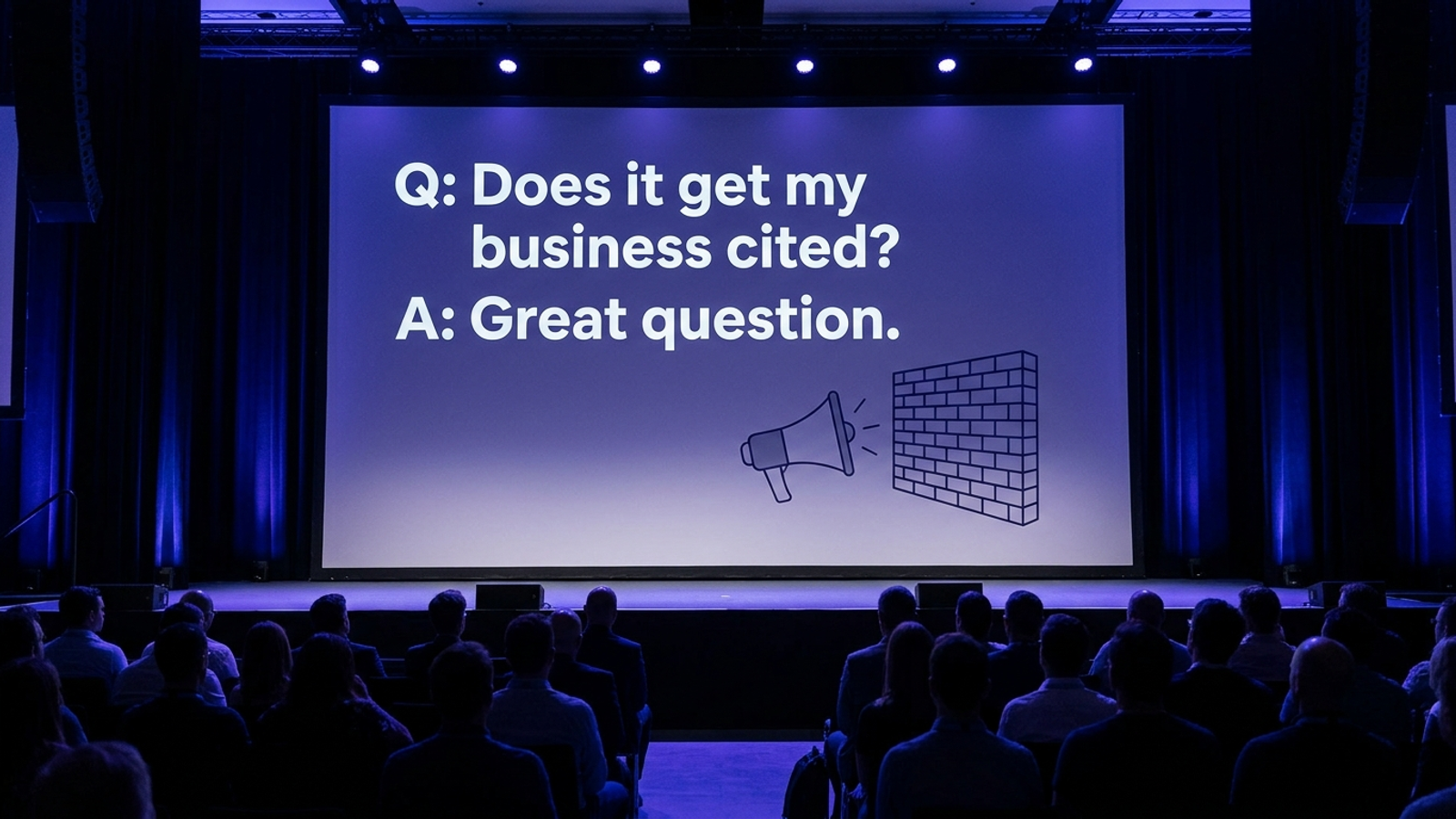
Does it help my business get featured in Google AI Overviews, rather than just monitored? Great question. Getting featured can involve rewriting product comparisons, making pages accessible to crawlers, fixing canonical tags, developing entity references and testing copy against commercial search intent. Those activities are messy. They involve publishing, checking what changed and deciding what to try next. Our product philosophy is pure: we monitor the bleeding and leave the surgery to you.
Will another chart explain why a competitor keeps appearing? It will show you when, where and how often the competitor appears within your tracked prompts. It will not tell your engineering or content team which change to make, make that change, or check whether it affected qualified pipeline. For those functions, we recommend assigning the PDF to an owner and highlighting the relevant page numbers. Please note that highlighting is not included in the Enterprise tier.
A launch presentation would be incomplete without a procurement aid. If you are comparing tools for getting featured in Google AI Overviews, not just monitoring them, use the following checklist before you sign. Each item names a function you may have mistaken for something included with VisibilityPulse Pro; only the reporting functions described above are in your subscription.
groas takes the other side of that bargain: specialised models execute paid-search and organic-visibility work continuously, while a named human strategist owns the direction, guardrails and results.
No. VisibilityPulse Pro only monitors how often your brand appears in AI answers; it does not publish pages, fix tags, add schema or make any other changes to your site. Measurement is the product, and any fixes are left entirely to your own team.
It is a composite number from 0 to 100 that combines mention frequency, citation share and synthetic sentiment into a single figure suitable for an executive presentation. It does not show which page is unreachable or which description an AI answer is repeating; those questions are not surfaced.
The Starter tier includes 25 prompt slots. If you need a 26th prompt, you upgrade to the Growth Add-On for another $150 a month and receive 15 more slots, even though the underlying inference call costs roughly one-third of a cent.
They post a high-priority card to your Slack channel saying the competitor was cited and that the recommended fix is to get cited instead. Pressing the Acknowledge Dread button only records that somebody saw the alert; the alerts do not build landing pages, add schema, publish copy or diagnose bot access.
It is a 42-page report compiled every Monday at 6:00 AM, containing multicoloured radar charts of your visibility per engine, plus a substantial title page. It lets you compare this week's line with last week's, but it offers no way to change any of the numbers it reports.
Observe costs $299 per month for 25 prompts across two search surfaces, Observe+ costs $899 per month for 100 prompts across five engines, and Observe Enterprise costs $3,400 per month for 250 prompts across eleven engines. Every tier includes zero execution on your website.
Check prompt and engine caps, whether publishing changes actually reach production, whether crawlers can read your pages, what extra prompts cost, and whether the vendor logs deployed changes and their outcomes. Most importantly, confirm who actually updates code, copy and pages, since observation without execution can cost $20,000 to $40,000 a year documenting the same unresolved gap.