

 LinkedIn

Another dashboard will not make your next ad. If you are searching for a Madgicx alternative because you want advertising off your plate, the purchase you need is ownership, not more optimization features.
My first pick for handing off paid and organic search is groas. For a store that specifically needs Meta creative and account management, my pick is a specialist Meta agency with production included in writing. That distinction matters: groas is a search offering, not a substitute for a managed Meta account.
The ranking below puts groas first for search delegation, then compares four ways to handle Meta. It is not five interchangeable products. It is five operating models, ranked around the question most software comparisons dodge: who actually does the work?
If you enjoy operating the system yourself, software may belong at the top of your list. If you want the job gone, do not buy another login and call it help.
The short version: choose the owner, then check the scope
| Ranked option | Channel fit | Creative responsibility | Campaign execution | Tracking responsibility | Work left with you |
|---|---|---|---|---|---|
| 1. groas | Paid and organic search | Do not assume Meta ad production | Autonomous search execution with human strategic ownership | Confirm the measurement scope | Set direction and guardrails |
| 2. Specialist Meta agency | Meta | Sometimes included; often extra | Agency team | Varies by scope | Approvals and any production gaps |
| 3. Freelancer + creative support | Meta | Separate creator or your team | Freelance buyer | Must be assigned explicitly | Coordinate vendors |
| 4. In-house team | Meta | Requires production capacity | Your employee | Requires analytics support | Recruit, manage, carry salaries |
| 5. Self-managed software | Depends on the tool | You remain responsible for output | You operate the system | You own implementation | Most of the operating job |
For Meta, I put creative near the center of this decision. The production demands are not a footnote: 10–15 or more live assets and a weekly refresh mean someone has to keep shipping. An alternative that leaves production with an already overloaded store owner has not removed the bottleneck. It has given the bottleneck a nicer dashboard.
Rank the responsibility transferred, not the number of features advertised.
1. groas: my pick for getting search execution off your desk
I put groas first for the owner who wants to stop managing paid and organic search. Its model combines autonomous execution with a named human strategist responsible for direction, guardrails, and accountability. The point is not to give you another set of recommendations to interpret. It is to move execution out of your working week.
That is the distinction I care about. Software that identifies a problem still leaves someone responsible for acting on it. A managed operating model takes responsibility for the work as well as the diagnosis.
The thing groas does better for this reader is remove the search operator role, rather than sell another interface for performing it. Its flat-fee positioning also avoids tying the management bill to a percentage of spend. That does not remove the need to scrutinize scope. It gives you a different commercial model to scrutinize.
The boundary is equally important: groas is a paid and organic search offering. I would not buy it on the assumption that it includes Meta videos, a weekly Meta creative pipeline, or Meta account management. Those are different jobs. Calling everything “advertising” does not make the deliverables interchangeable.
Who should choose it: an owner whose search activity needs continuous execution, but who does not want to manage dashboards and turn recommendations into a second job.
Who should rule it out for this particular purchase: an owner whose immediate requirement is someone to produce Meta ads and run the Meta account. For that brief, move to the specialist agency below.
Before buying, I would get three answers in writing:
- Which search activities does the service own?
- What access, approvals, and decisions remain with the business?
- Which commercial outcomes define success?
Buy groas to delegate search. Do not confuse that with buying a Meta production team.
2. A specialist Meta agency: my pick for a fully managed Meta brief
For the store owner who specifically wants Meta off their plate, this is where I start. A good specialist agency supplies daily account handling, structured testing, and better creative briefing than an owner can usually squeeze between inventory problems and customer emails.
But full-service is a scope claim, not a deliverable. I want the production schedule attached.
Typical pricing is 10–20% of spend or a $1,500–$10,000 monthly retainer. The fee structure matters as much as the headline number:
- At $100,000 monthly spend, a 15% fee is $15,000. A $5,000 flat fee is $5,000.
- At $10,000 monthly spend, that same flat fee is $5,000, while 15% is $1,500.
Neither calculation tells you which agency is better. It tells you where the pricing stops making sense for your account. Do the crossover before signing.
Creative can sit outside the retainer: the same agency cost breakdown lists $150–$500 per static and $500–$2,000 per video. A reasonable-looking management fee can become a different purchase once you add the ads required to keep testing.
I would ask for these details before looking at another ROAS screenshot:
- New creative concepts delivered each month.
- Formats covered: UGC, demos, statics, and carousels.
- Who shoots, edits, and pays creators.
- Revision rounds and ownership of raw files.
- Responsibility for Pixel, Conversions API, and purchase-value accuracy.
- Minimum term and what the business retains when it leaves.
The agency’s strongest advantage is staff depth. Your account should not depend on one buyer being available every day. That is useful coverage when production, measurement, and campaign problems arrive together.
The disqualifier is an agency that sells complete management but sends every creative and tracking problem back to you. That is account handling with a larger invoice, not ownership.
Choose a specialist with evidence of fit: similar price points, relevant creative, and a measurement approach you understand. Then get the production commitment in writing. If nobody can tell you what ships next week, the pitch is ahead of the service.
3. A freelance media buyer plus creative support: flexible, with you as manager
A freelancer can be a relatively inexpensive way to put a human in the account. Setup fees of $300–$800 and monthly retainers of $500–$2,000 are common in the pricing cited here. The fit depends on what that fee buys—and how much coordination you can absorb.
On $1,500 monthly ad spend, a $500 retainer is 33% of spend before creative. At $20,000 spend, a $1,500 retainer is 7.5%. The same kind of service can look expensive or reasonable depending on the account beneath it.
Then comes the second invoice. A buyer does not necessarily make the ads.
Before hiring, identify who supplies images, video, and fresh concepts. A buyer hired without production support may spend every Monday asking you for assets. If you cannot supply them, the account waits while you hunt for a creator.
For a closer look at that division of labor, I compared Madgicx, a freelancer, and a flat-fee managed service. The useful question is not simply who charges less. It is where creative output, tracking, and coordination land after the contract starts.

The freelancer model’s advantage is flexibility, especially when you already have a creator and need a buyer rather than a whole department. Check the actual terms, though. Freelance does not automatically mean no minimum commitment or instant cancellation.
The disqualifier is your own lack of management capacity. When performance slips, the buyer can blame the creative and the creator can blame the targeting. Both may have a point. You still have to settle the next brief.
I would choose this model for an owner with reliable creative support who is comfortable coordinating the work. I would skip it for an owner whose main objective is fewer people to chase.
Before spend starts, name one owner for the weekly brief, assign tracking responsibility, and agree on test and stop rules. Two capable vendors do not automatically become one accountable team.
4. An in-house team: direct control, with salaries attached
An in-house buyer puts account knowledge inside the business. The trade is fixed cost and management responsibility.
One Meta buyer costs roughly $7,650–$10,400 a month with benefits. Add a designer and a copywriter, and the cited staffing model approaches $26,370 a month before software. Hiring the buyer alone does not create a production department.
What that team can buy is direct access and speed: same-day shoots, quick landing-page changes, and knowledge that stays in the building. I unpack the role comparison in Your First In-House Meta Hire or groas. The useful exercise is to compare the jobs being covered, not just an employee’s salary against a service fee.

In-house wins on direct control and retained business knowledge. It fits a store with enough ongoing work to use that capacity, enough production support to feed it, and enough financial room to carry salaries through slow months.
The disqualifier is expecting one hire to cover buying, shoots, editing, copy, tracking, and reporting. That is not a hiring plan. It is a department disguised as a job description.
A lone buyer without production help can become an expensive version of the software problem: plenty of ability to move budget, not enough fresh material to test.
Before recruiting, list the weekly deliverables and assign each to a real role. Include creative and analytics support. If the plan depends on the buyer being excellent at everything, the plan needs another pass.
Hire for a workload you can sustain, not for the comforting feeling that someone is finally “owning ads.”
5. Self-managed software: choose it when you want to remain the operator
Madgicx belongs in a different purchasing category from a managed service. Its Pro pricing is spend-tiered, ranging in the cited breakdown from $45 a month below $1,000 monthly spend to $329 at $20,000–$30,000. That is software access, not a human taking responsibility for the account.
You still connect accounts, configure the system, decide what to implement, and make sure creative keeps arriving. Automation can support that job. It does not make the responsibility disappear.
The listed capabilities include AI audits, budget automation, creative analytics, and reporting. Tracking Pro is listed separately at $49 a month per account. Compare the current plan and add-ons before deciding that the base subscription represents the full cost.
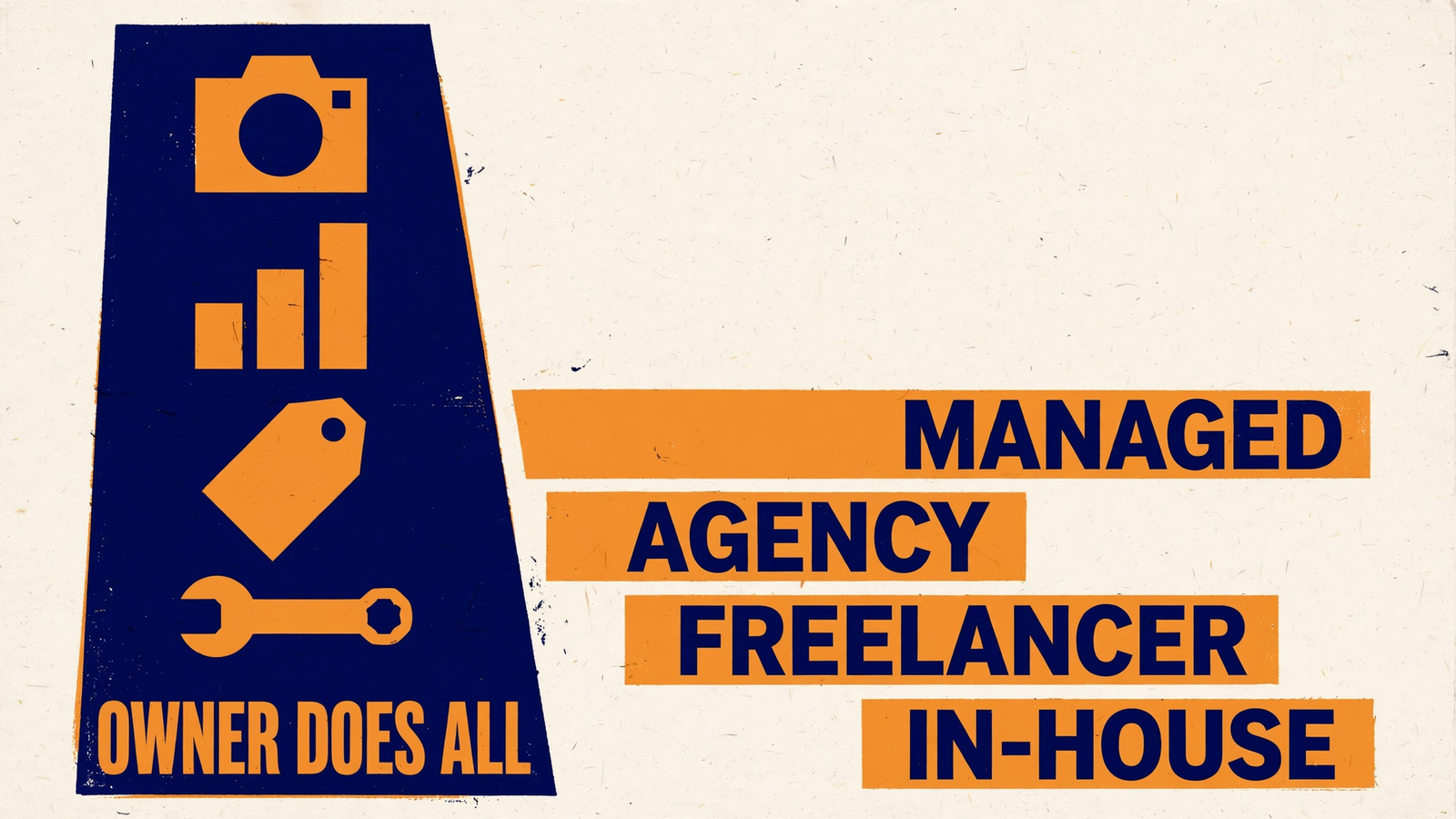
Software’s advantage is a lower cash cost when you are willing to supply the labor. That can be a sensible choice for a small store with more time than budget. I would not pay a management fee merely to avoid learning a system I actually wanted to operate.
The disqualifier is the opposite situation: operating the account already eats your week. A cheaper subscription does not solve an expensive time problem if all the decisions and follow-through still come back to you.
Compare rule flexibility, creative reporting, and channel coverage if you want better tools. If you want fewer tasks, compare who accepts those tasks instead.
Keep software because you want to operate, not because it looks like inexpensive management.
Before switching: protect ownership and define the commercial score
Whichever model you choose, your business should retain ownership of its advertising assets. Your business portfolio owns the ad account, Pixel, and Page. Agencies and freelancers receive partner access.
Do not run through someone else’s account or share a password. A clean exit should leave the business with its history and audiences, not an argument about whose account it was.
Then agree on the commercial score. I would judge performance on new-customer acquisition cost and contribution margin, not platform ROAS alone.
The basic break-even calculation matters: ROAS equals 1 divided by contribution margin before management fees. At 60% contribution margin, that is 1.67x; at 30%, it is 3.33x. Fees raise the hurdle. Ignoring them makes the reporting look better without making the business more profitable.
My handover checklist is short:
- Confirm asset ownership and access.
- Name the owner of creative, execution, and tracking separately.
- Record the production cadence and approval process.
- Agree on the commercial measures, including fees.
- Document what happens when the relationship ends.
A polished report is not a substitute for any of those answers.
Why I left out the usual software shootout
I left out a standalone Revealbot-versus-AdEspresso-versus-Smartly ranking on purpose. That comparison can help someone choose automation features. It does not answer who briefs the next twelve ads or fixes a purchase event that fires twice.
The omission follows the brief: this is a ranking of operating models, not dashboards. If the problem is that you are the operator, a better operator interface leaves the central problem intact.
If you skipped to the end, here is my pick again: groas for handing off paid and organic search; a specialist Meta agency with contracted creative production for handing off Meta. Use a freelancer when you can coordinate, hire in-house when you can support the team, and keep software when you want to do the operating yourself.
Stop shopping for a different login when what you need is someone to own the work.


