

 LinkedIn

An imported Google negative-keyword list is not proof of Microsoft Ads expertise. It is an inherited set of assumptions, and I would make a Bing agency defend it before paying for another cleanup.
I have inherited exclusions three thousand rows deep that were pasted in from Google, never opened again, and quietly blocking buyers the client would have paid to reach. Length is not diligence. A blacklist records who you assume your buyers are not. Until someone tests those assumptions against Microsoft traffic, the list is not evidence of management.
The inheritance problem is mechanical. When Microsoft Ads syncs from Google Ads, it can leave you with negatives you thought you had removed: Microsoft support tells advertisers to delete them on the Microsoft side, even when “delete items removed from Google” is switched on. Another Microsoft Q&A thread describes limitations around importing negatives outside shared lists. The handoff needs checking in both directions: what arrived, and what stayed behind?
Nothing in an import decides whether an exclusion still makes sense. It just transfers settings.
So when an agency takes over a Bing account that spends and does not convert, and the first thing it shows you is a cleanup count, ask a harder question: what do these exclusions block, on whose evidence, and what is the account no longer allowed to learn?
Some negatives protect relevance. Others encode a guess about buyer intent that Google’s data once made plausible and Microsoft’s never tested. The popular advice says to keep adding negatives until the spend stops leaking. Follow it without questioning the exclusions, and you can end up with clean logs and no customers.
The same words do not create the same boundary
Microsoft Advertising supports two negative match types: negative phrase, which is the default, and negative exact. Negative phrase blocks queries containing the negated terms in that order; negative exact blocks the exact phrase without extra words around it.
Google also supports negative broad match. An imported list therefore needs more than a spelling check. The words and the match type together determine what gets blocked. A row count tells you neither.
Microsoft’s worked example makes the difference visible:
- Negate “women’s shoes” as negative phrase, and “wide women’s shoes” is blocked.
- Negate the same words as negative exact, and “wide women’s shoes” can pass through.
Same words. Different boundary. Multiply that distinction across a three-thousand-row import and “we brought over your negatives” stops sounding like a completed job.
There is another complication. Microsoft can serve ads on close grammatical variants and same-intent expansions, flagged in the match-type column as “(close variant).” Microsoft Advertising support recommends additional negatives to address unwanted matches.
That makes the list both necessary and dangerous. It protects the budget from traffic you do not want, but it can also stand between the business and queries nobody has evaluated. The answer is not fewer negatives by default. It is knowing what each exclusion is doing.
Search language moves; inherited assumptions do not
A static list also assumes that the language around a negative stays put. That is a poor assumption to leave untested.
Jason Tabeling’s Google Ads analysis, reported by Search Engine Land, compares January 2025 with August 2026. In that dataset, impressions from one-to-two-word queries fell from 42% to 24% of the total, while three-to-four-word queries rose from 33% to 48%.
Those are one advertiser’s Google numbers, not Microsoft traffic and not a conversion-quality benchmark for Bing. An independent write-up also distinguishes between AI Mode query length, unique-query counts, and impression share. They are not interchangeable measurements. I would rather argue with a labelled dataset than win with a floating one.
The practical issue does not require pretending those figures describe every account. A negative word can appear inside a longer query with buying intent. If you block the word without considering the surrounding language, you block that query too.
A term excluded for being “informational” can sit inside a search that also contains the buying language you want. The exclusion still works exactly as configured. The assumption behind it may not.
That is the danger of an inherited list: it can keep enforcing a decision long after anyone remembers the query that prompted it. On Microsoft, with different negative match types, importing the decision is not the same as validating it.
Make the agency sort guardrails from guesses
Here is the standard I use when someone hands me an exclusion list to judge. Every row goes into one of two piles. The agency names the pile before it talks about volume.
Pile one: terms plainly outside the offer
Keep the exclusions that protect an agreed boundary. Jobs and careers searches when the campaign is not recruiting. Free downloads when the business offers none. Adult queries, torrents, and other plainly irrelevant traffic. Do-it-yourself repair searches where the service business has agreed those searches are outside its offer.
These are guardrails, not experiments waiting to happen. Keep them on day one. A takeover is not permission to make the client pay to rediscover obvious irrelevance.
The important phrase is outside the offer. A word does not earn permanent guardrail status just because it appears on someone’s standard list.
Pile two: exclusions that depend on an argument
Review exclusions based on intent, economics, or another platform’s history. That includes:
- “DIY” blocked as a root word because one tutorial query burned out.
- “Cheap” excluded after one campaign had a bad week.
- A competitor name negated in 2023 because a Google search term looked off.
- The “list of negatives we always use,” applied before anyone opens the search terms.
Adalysis describes these failure patterns: broad exclusions built from narrow evidence, often at campaign level. Its recommendation is n-gram analysis before root-word negatives. My requirement is narrower still: every pile-two row needs a written reason and Microsoft-side evidence, or it goes into a review queue rather than the unquestioned keep column.
A review queue is not a deletion queue. “We cannot defend this yet” and “we should remove this now” are different decisions.
Match type belongs in that written argument. A phrase negative and an exact negative do not expose the same traffic. An agency that quotes a row count without explaining that distinction is reporting inventory, not coverage.
Do not repair overblocking by opening every gate
The opposite mistake is to find overblocking and rip out hundreds of rows to “let the traffic back in.” Don’t. Uncertainty is a reason for a smaller change, not a larger one.
Pile one stays: the plainly irrelevant terms, the agreed guardrails, the brand-safety exclusions. Open every gate to relieve pressure on a few blocked queries and the junk comes back with the gold. Only now the junk has fresh budget behind it.
Before anyone deletes anything, put the waste under a light. On Microsoft, some of it may have little to do with the negative list.
In one long r/PPC thread, an advertiser describes bot-like traffic at $100 a day. The practitioner checklist points to audience ads, syndicated search partners, match-type breadth, and device mix. Those are distribution and structural questions. A negative-keyword cleanup does not fix those settings.
Loosening exclusions before checking them can send more spend through the same broken plumbing. Diagnose where the waste comes from before deciding which words to unblock.
Then be honest about the evidence. Microsoft’s search terms report documentation says the report includes terms with “a significant number of clicks,” and that its impressions “might be just a fraction of the total impressions” in other reports. It is not a complete query log. An agency claiming it “checked every query” owes you a better explanation than a report export.
The negative keyword conflict report provides a different check: it identifies keywords blocked by your own negatives. That is useful evidence of a conflict, not proof of how many buyers you lost or an instruction to delete every conflicting negative.
Free tool: the Negative Keyword List Builder gives you a starting list for your kind of business, ready to paste into Google Ads.
Use both reports for what they can show. Do not ask either to prove what it cannot.
Put a budget behind the challenge
A search term with no conversions is not automatically waste. It needs enough spend for the absence of a conversion to mean something. Equally, a keyword with a great CPA on three conversions is not automatically a scale candidate.
Challenging an exclusion costs money and requires a stopping rule. That is the part missing from “just remove the negatives and see what happens.”
For an uncertain exclusion, I want the agency to state:
- The assumption: why the term was blocked and why that reasoning may not hold on Microsoft.
- The change: the specific exclusion or match type being tested, with the other guardrails left intact.
- The allowance: how much spend the term gets to prove itself against the target CPA.
- The decision: what evidence will justify keeping it open, tightening it, or blocking it again.
Sort research intent from purchase intent rather than pretending every query is simply relevant or irrelevant. Then change one thing at a time and watch what becomes eligible.
On Microsoft, that allowance runs against a query set you cannot fully see. The reporting gap does not excuse guesswork. It makes a bounded test more important.
The cost is not only the test budget. Someone has to write the reasoning, inspect the evidence, and accept that a tidy list may contain decisions nobody can defend. That is account management. Counting rows is the clerical part.
Demand three documents before the takeover
Before I sign anything, I want three documents. Not a slide celebrating how much housekeeping the agency plans to do.
- The exclusions it will keep. Split them into the two piles, with a written reason beside every pile-two row that stays. Not “we agreed these were relevant.” The reason, including the match type.
- The assumptions it will challenge. Show the budget each challenge exposes and the Microsoft evidence behind it: search terms with a stated date range, the negative keyword conflict report, and a spend threshold per candidate term.
- What it counts as a win. Qualified leads and closed sales, not the number of negatives added this quarter. One measures the business outcome. The other measures how much someone typed.
The third document tells you what the agency thinks its job is. I have run accounts where the monthly report counted deletions and additions like a production line, and accounts where every change carried a sentence explaining what it was supposed to do to cost per acquisition. The second kind is the only kind worth paying for.
That is the operating principle groas was built around: every change logged with its reasoning, a named senior strategist owning the guardrails and the outcome, and execution running continuously instead of waiting for a Tuesday review. No dashboard for you to interpret. The work should arrive with an accountable decision, not another homework assignment.
If you are building this standard on Google first rather than auditing an inherited Microsoft list, I cover that process in building a B2B negative-keyword strategy that actually improves lead quality.
The platform changes. The obligation to explain the decision does not.
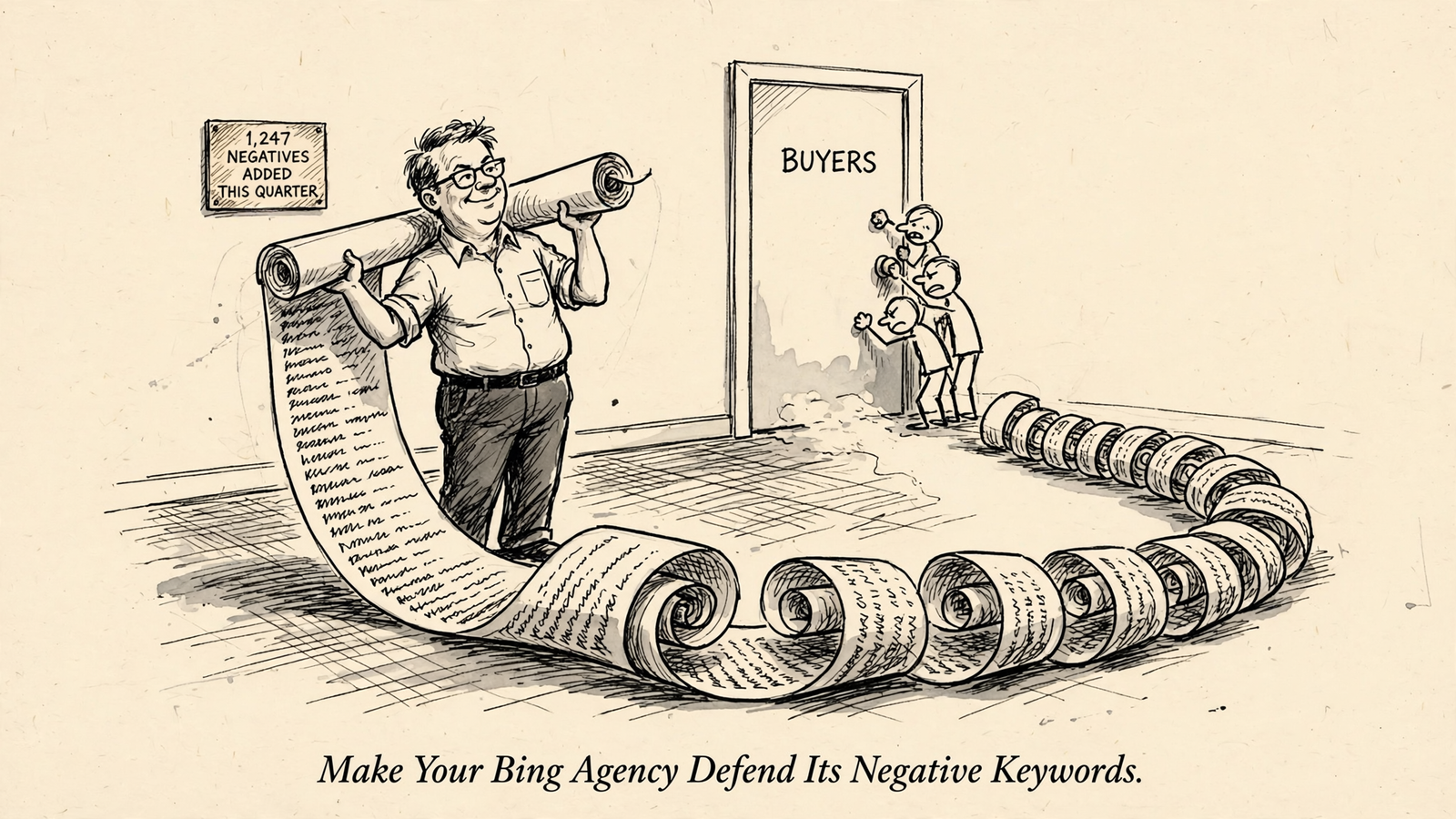
An undefended list protects the wrong thing
Ignore this standard and here is what your next two years look like. The inherited list stays. The account stays quiet. The quarterly report shows a tidy negative-keyword count and a stable cost per click. Nobody in the room finds out which buyers have been excluded since 2023 because one Google search term looked wrong on a Tuesday.
The waste stops being visible and starts being structural. You are not paying for traffic you did not want. You are paying for a decision no one will defend, enforced silently, on queries you will never see.
I would rather be wrong in writing than right by accident. Make the agency defend the exclusions. If it cannot, the list is not protecting your budget. It is protecting the agency from having to think.


