

 LinkedIn

Three white-label AI search proposals can promise the same thing and sell three different deliverables. I have read AI visibility in enough decks to know the problem: a brand mention, a source citation and a website visit are not interchangeable. A provider can count the first without producing the second, then present the chart as though the third followed.
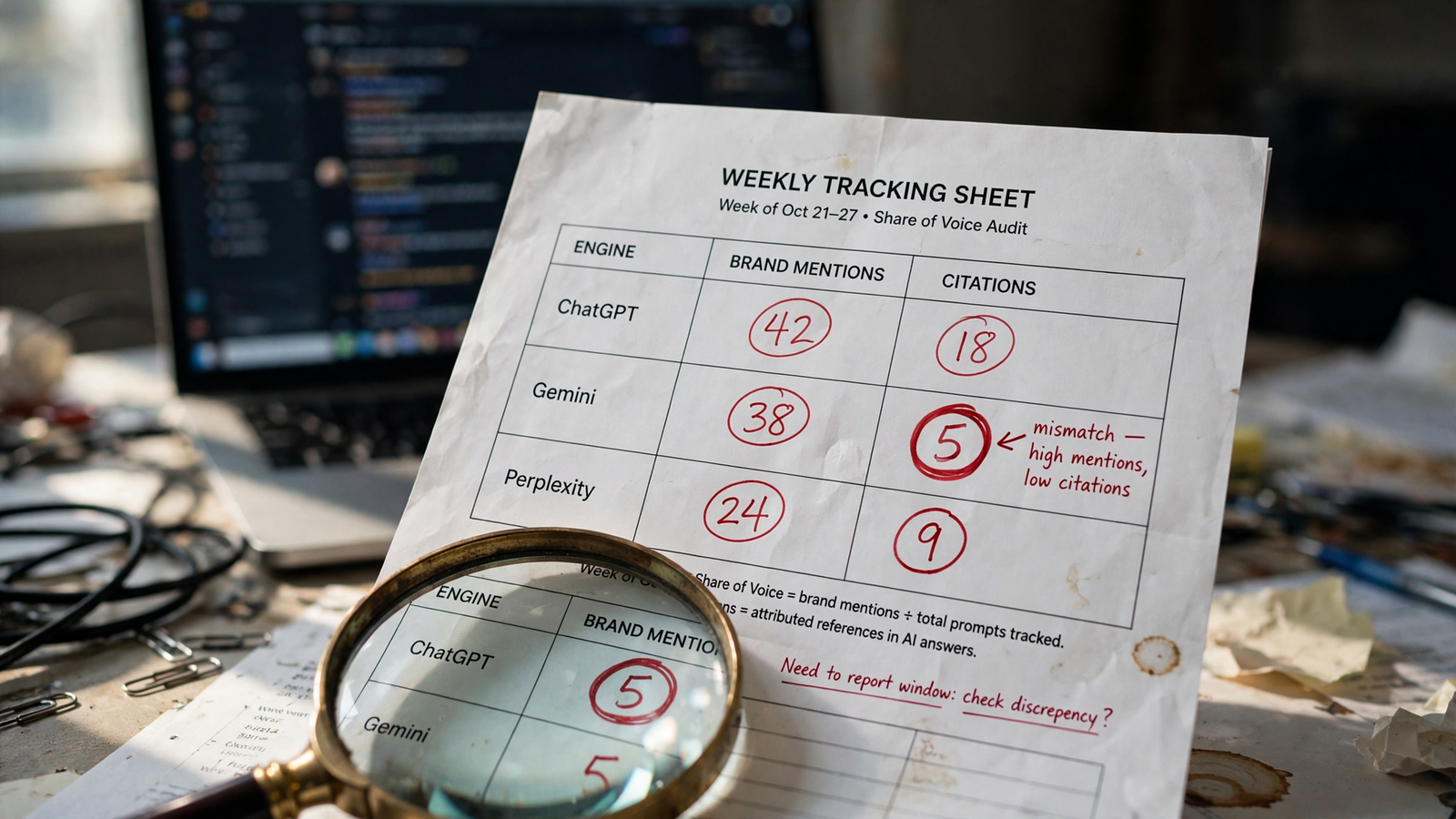
Semrush ran 20 buyer prompts through Gemini and found Asana named in 14 answers, while asana.com was cited as a source in only one. The name appeared in the answer; the link usually did not. Neither count tells you whether someone visited the site. That gap is the shortlist test. Before you compare prices, make the proposals say what they will actually deliver and how you will verify it.
SEO, AEO and GEO
SEO aims to earn a place in classic search results; AEO aims to supply a direct answer; GEO aims to earn a place in a longer generated answer. In practitioner use, AEO covers short-answer surfaces such as AI Overviews, snippets and read-aloud results, while GEO targets answers from ChatGPT, Perplexity and Gemini. White label means a specialist does the work under your agency brand and invoice, as practitioners split the terms.
I used to tell clients AEO was just SEO with shorter paragraphs. I was wrong. SEO needs a page that can be crawled and indexed and has links pointing to it. AEO needs a fact the system can extract cleanly. GEO may need that fact corroborated elsewhere before a model trusts it enough to cite. The work overlaps, but the labels do not describe one identical job.
That is why I mark a proposal that lists all three acronyms but only ships blog posts as a fail. Ask which pages get built, which technical fixes ship and which third-party sites will repeat the claim. If the answer is a dashboard, you bought reporting.
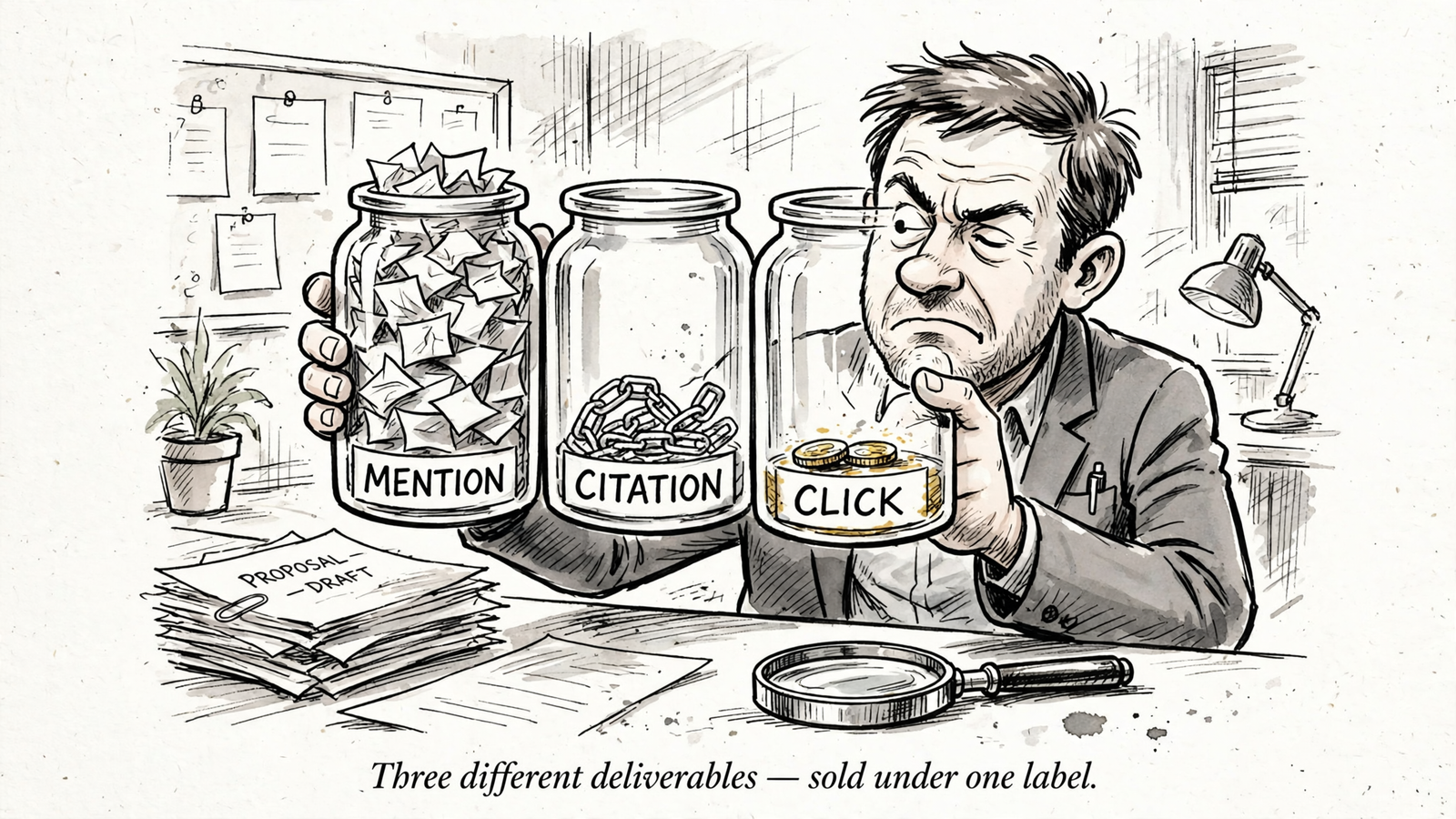
Brand mention, recommendation and source citation
A brand mention puts your client’s name in an AI answer, a recommendation presents them as a good choice, and a source citation links to a page used as evidence. They are separate deliverables, even when a report puts them under one cheerful heading. An engine can recommend your client while citing only third parties. It can also cite your client’s page without naming the brand in the answer.
The distinction matters most when someone calls every appearance a win. Gemini names brands in 83.7% of appearances but cites them in only 21.4%, while the figures given for ChatGPT run the other way: 20.7% mentions against 87% citations. In one October 2026 index, 70% of ChatGPT citations pointed at the recommended brand’s own site, against 27% for Gemini and 21% for AI Overviews. A mention count cannot tell you which site got the link.
This is where a provider’s choice of metric changes the story. If your client appears in a Gemini answer but the citations go to roundups, reviews or communities, the brand got exposure without a source link to its site. That may be worth knowing. It is not the same deliverable. Demand mention, recommendation and citation counts separately, per engine. Never accept a blended score as a substitute for them.
Referral traffic, lead and attributable revenue
Referral traffic is a visit from an AI answer to your client’s site, a lead is a contact that comes from a visit, and attributable revenue is a closed deal you can tie back to it. Each step needs its own measurement. A mention is not a session; a session is not a qualified call; a qualified call is not a sale.
Visibility without a click is normal, which is why a visibility report cannot stand in for commercial measurement. Pew counted 68,879 searches where an AI summary coincided with traditional clicks of 8% against 15% without a summary. Ahrefs tied AI Overviews to 58% lower CTR for the top result across 300k keywords, and Conductor puts average AI referrals at about 1.08% of traffic. The mechanism is plain enough: if the answer satisfies the question on the results page, fewer people need to leave it. Your client can be named often and visited rarely.
I would not throw away mention data. I would put it in the same table as referral sessions, qualified calls and revenue, with the gaps visible. Ask how the provider connects an AI referral to what happens after the click. If the proposal stops at appearances, it stops before the client outcome you need to explain.
Prompt set, share of voice and reporting window
A prompt set is the fixed list of buyer questions you test; share of voice compares your mentions with a defined competitor set; the reporting window states when and how often you ran those tests. Without those details, a percentage is difficult to compare from one proposal to the next, never mind from one month to the next.
Ask for the questions, engines, competitors, sample sizes and collection dates in writing. A useful starter looks like 50 prompts run across 4 engines against you and five named competitors, counted separately per engine. If a provider can change the questions between reports, it can improve the chart without improving your client’s position on any question that matters.
AI answers also change between runs. Of prompts where a brand is mentioned, 20 to 55% change week to week, and one large test of 2,961 repeat runs found that fewer than 1 in 100 produced the same brand list and fewer than 1 in 1,000 produced the same order. Sell a roofer client on one screenshot from Tuesday and the order could flip by the next Tuesday. That alone is not progress or failure. It is noise.
Require repeated runs against an identical prompt set before you call a movement meaningful. Put the reporting window beside the score so nobody has to guess what was tested. For a repeatable panel, use How to Measure AI Search Visibility Without Trusting One Screenshot.
White-label report versus white-label fulfilment
A white-label report puts your logo on the numbers; white-label fulfilment ships the audits, pages, fixes, content and authority work those numbers are meant to track. A provider can sell either, or both. The trouble starts when your agency buys one and tells the client it bought the other.
Real fulfilment includes audits, content, technical work and links rather than dashboard-only reporting. What a deck calls a white-label platform, I split into three levels:
- Level 1: A branded PDF that reports the numbers.
- Level 2: A live dashboard on your domain.
- Level 3: Full resell fulfilment, where the provider publishes and fixes the work under your brand.
Levels 1 and 2 can help you explain performance. Neither, on its own, changes a page. The familiar failure mode goes like this: the agency forwards a clean report showing mentions climbing, and the client asks what shipped this month. The answer is another report. Nobody wrote the comparison page Gemini keeps citing, fixed the blocked product pages or earned the third-party mention the model trusts. The provider was hired to measure, so it measured.
Before you sign, verify client-contact rules, implementation ownership and access requirements. Then compare line items in A White-Label AI Search Proposal, Line by Line: What Ships and What Just Measures. Your logo on a dashboard does not tell you who publishes or fixes anything. Get that answer in writing.

Account-service unit, minimum purchase and monthly fee
The account-service unit is what one client costs you wholesale, the minimum purchase is what you must commit to buying, and the monthly fee is a flat amount rather than a share of ad spend. Those terms decide your agency margin before any AI metric enters the conversation.
Wholesale white-label SEO runs about $300 to $5,000+ per client per month, with $500 to $1,500 as the standard band. Resellers typically mark that up 50 to 200% to hold a 40 to 60% margin. But a low unit price can conceal a larger commitment. A $399 unit with a five-client minimum costs $1,995, while a $1,499 flat fee with no minimum costs $1,499. Compare what the whole portfolio requires you to pay, not the smallest number in the pricing table.
Say you run ten local clients spending $20k a month on ads between them. A manager charging 15% of spend costs $3,000 before a single page ships. With groas, Search Ads work is $1,499 a month for Google, Bing and ChatGPT together, with no cut of spend and no setup fee. That flat-fee structure matters for white label: you can quote your own retainer without recalculating a percentage whenever spend changes.
It does not erase the need to check scope. Run the one-vendor against two-vendor math in One SEO + AI Search Partner or Two Vendors? The Agency Margin Test before you sign. Two minimums stack, and two reports still need explaining to the same client. Circle the minimum, multiply it, then compare the portfolio commitment.

White-label AI search proposal
A white-label AI search proposal is the written offer that should say what your agency will receive, what will be done and what each reported result means. Put two or three proposals side by side and run every line through the definitions above. When one says AI visibility, write named, cited or clicked in the margin. When a chart climbs, add the prompt set, engines and dates. I use a pen for this because providers count on you skimming PDFs.
The pen makes the differences harder to miss. Proposal A might sell 40 new pages and technical fixes. Proposal B might sell a dashboard watching 40 pages someone else has to write. Proposal C might sell both but charge a percentage of spend. Those are not equivalent offers just because the cover slides use the same phrase.
Score each proposal on five checks:
- Separate counts. Are mentions, citations with links and referral sessions listed per engine rather than folded into one score?
- Fixed panel. Are the buyer questions, competitor set, run count and reporting window in writing?
- Shipped work. Which pages, fixes and third-party placements ship each month, and who logs in to publish them?
- Commercial link. How does referral traffic connect to calls, qualified pipeline and closed revenue?
- Portfolio math. What is the unit price times the minimum commitment, plus any spend percentage, against your resale price?
A blank line is a promise you will have to defend on a client call. Mark every undefined metric and unsupported promise before you sign, then ask for the missing detail in writing. The partner you can resell will fill it in. The other one will send another screenshot.
AI visibility
AI visibility is the umbrella term I would retire because it does not say whether a brand was named, cited or clicked. It lets three deliverables share one label and one price. Then the agency in the middle carries the risk when the client asks what actually happened.
I no longer want that phrase as the answer on a proposal call. I want the three counts, the prompt list and the shipped-work log. A useful answer also names the engines and dates, shows what happened after a referral reached the site, and makes the wholesale commitment legible. If a partner cannot fill that table, I do not care how visible its chart says my client is.
Keep this glossary open when you compare partners. The one worth reselling will survive the pen test: separate numbers per engine, a fixed buyer panel with dates, pages and fixes you can point a client to, and portfolio math you can mark up without apology. The rest are selling the same word for different work. Retire the word, keep the three receipts, and sign the partner who can show the work behind them.
If you want the exact email, send this: list our 30 buyer questions; show mentions, citations and referral sessions separately for ChatGPT, Perplexity and Gemini, with dates and run counts; list the pages and fixes that ship in month one; and state the wholesale unit times the minimum. The answer is your shortlist. A table tells you what you can resell. A call to walk you through the dashboard does not.