

 LinkedIn

If your Meta ROAS halves on Tuesday and ChatGPT is already where you work, my first pick is ChatGPT with groas MCP. I want to see what changed in the account and approve one response in the same conversation, not spend the afternoon moving numbers between tabs.
One advertiser described the moment in a thread about sales dropping after two strong days: sales fell, and the advice he kept getting was to increase the budget. That’s one account owner’s report, not evidence that Meta broke something platform-wide. But I recognize the reflex. You see a bad number, somebody says “scale,” and before you know what changed, you’re paying more to find out.
I write for the groas blog, so check my ranking the way you’d check any vendor comparison. I rank these tools by the distance between a checkable account observation and a controlled response. That’s not the same as ranking them by how fast they can change a budget. An assistant that gets to the wrong edit faster hasn’t saved me any time.
Here’s what I look for:
- Traceable data: Can I point to the account, dates, and rows behind the answer?
- Useful breakdowns: Can I separate a shift in spend or costs from a change in conversion rate or recorded value?
- Plain uncertainty: Does the answer distinguish what moved from why it might have moved?
- Control over execution: Can I see the proposed change before I decide whether it happens?
- Manual work: What do I have to export, reconcile, or click myself?
Hootsuite’s roundup gets the buying question right: which gap are you filling? A sudden ROAS drop is a reporting and workflow problem before it’s a creative or optimization problem. Take the March 2026 change to Meta’s click-through attribution: only link clicks count toward click-through attribution for website conversions, while likes and shares move to engage-through. Reported performance can look worse without anything changing in the auction. Before I pay to reach more people, I want to know whether I’m measuring the same thing.
1. ChatGPT + groas MCP: my pick for diagnosis and action in one chat
Who it’s for: I’d pick this if ChatGPT is where you already work and you want to investigate a drop without exporting CSVs at midnight. Connect the account through groas MCP, and ChatGPT can pull current campaign, ad-set, and ad results. Say you spend $20,000 a month and ROAS halves on Tuesday. I can ask what moved without first deciding which numbers to copy out of Ads Manager.
What it does best: it keeps the evidence and the proposed edit together. I ask for spend, costs, conversion rate, and recorded value, then look at placement, age, or region breakdowns where available. I used to see ROAS fall and blame the creative before checking whether delivery had shifted or conversions were being recorded differently. A live read doesn’t tell me the cause on its own. It does let me check those explanations against the account, then ask what, if anything, the assistant would change.
That last bit matters. “This ad set spent more and recorded less value” is an observation I can check. “Pause it” is a decision I have to own. I want the proposal to name the ad set, explain why it’s the one to touch, and stop there until I approve it. If the evidence points to an attribution discrepancy instead, I want the next check, not a budget edit dressed up as a diagnosis.
What rules it out: If you can’t or don’t want to connect the account, this route is out. Even with a connection, I wouldn’t use it as a substitute for judgment. It won’t guarantee a diagnosis or tell me when ROAS will recover. I leave autopilot off during the investigation, approve one bounded pause or budget edit if the evidence supports it, and check the reason in the change log afterward.
Budget, bidding, audience, and creative edits can reset learning. That’s why I leave days between edits instead of treating a bad afternoon as permission to change four things. Some changes can’t be cleanly undone. I can reverse a decision without getting back the conditions I started with. If I’m going to delegate beyond a single approved edit, I start with the rules in ChatGPT + groas Autopilot: Set the Rules Before Ads Run Alone.
groas Unlimited is $19 a month flat, with assistant costs separate where applicable. For this job, I’m paying to avoid the manual handoff between the account data and the change, with competitor and market context available alongside my own numbers. I still have to name my break-even ROAS and decide whether the proposed fix is worth making. Use this route when you want the numbers and the decision in the same chat, not when you want the decision made for you.
2. ChatGPT + Ads Manager exports: my pick for a one-off check
Who it’s for: I’d start with exports if you don’t want another subscription, you’re comfortable with a spreadsheet, and you need to answer one question: what changed in my numbers? I used to tell clients exports were enough. I was wrong for recurring work, but I still think they’re enough for a single, bounded investigation.
I export matched reporting periods, attribution settings, campaign and ad IDs, spend, conversions, and recorded value. I leave customer rows and other sensitive data out of the file entirely. ChatGPT can work with what I give it, but it can’t fill in a missing breakdown by looking at the account. If a key column is missing, I’d rather know that before I ask it to explain the drop.

What it does best: it lets me get a second read without granting account access. I can check the answer against the file, and ChatGPT can’t change anything in Ads Manager. If I decide to pause an ad or edit a budget, I do the clicking. For one investigation, that’s a fair trade: no incremental tool cost, and no ambiguity about who made the change.
What rules it out: I wouldn’t choose it if I need to check the account every day. Every refresh means another export. If the first pass points to a placement shift and I left placements out, I’m back in Ads Manager. Then I have to make sure the new file covers the same dates and settings as the old one. The cost here isn’t the CSV. It’s doing the same handoff every time I have a follow-up question.
That’s the distinction the connector vendors are selling: scheduled refreshes instead of a static CSV that needs re-exporting. If you want an export-first walkthrough, start with Audit Wasted Ad Spend With Claude Before You Buy a Connector. I’d use exports for one clean read, not build a daily response around them.
3. Madgicx: a dashboard for people who want to work outside ChatGPT
Who it’s for: I’d consider Madgicx if you want a separate workspace for audits, creative, and budget prep. Its advantage in this lineup is the dashboard itself. If that’s where you want to spend your day, the workspace is the thing to evaluate. Check its current reporting, diagnostic, and automation capabilities before paying for them. I wouldn’t buy it on the strength of the AI label.
What rules it out: it adds a handoff to a ChatGPT-first workflow. The evidence lives in Madgicx. The actions happen there or back in Ads Manager. If I want ChatGPT to check the evidence, I have to move it myself. That puts me back in the business of checking dates, carrying over IDs, and making sure the thing I’m asking about in the chat matches the thing I’m looking at in the dashboard. It also puts the action outside the conversation where I asked for the diagnosis.
Madgicx prices Pro Complete by trailing spend, with Tracking Pro priced separately per account. I’d check the tier that applies before comparing it with groas’s flat price. But price isn’t why I rank it third. Even if I want the dashboard, it doesn’t remove the handoff I’m trying to get rid of. Pick Madgicx for its own workspace. If you intend to do the investigation in ChatGPT, I’d connect the account or start with a clean export instead.
Which handoff is worth paying to remove?
I left out AdCreative.ai, the kind of creative generator that turns up in broader Meta Ads tool roundups. If the account is stable and I need more variants, I can see the point. When ROAS drops and I don’t know why, producing more ads answers a question I haven’t asked yet. I’ve watched advertisers spend a week testing hooks while the problem sat in attribution settings. Prove what moved before you make more assets.
Meta’s own AI connectors entered open beta in April 2026, with an MCP server and CLI for reading and editing campaign data. So a live read isn’t, by itself, enough to decide the ranking. I care what I can do after that read: see the proposed edit, decide whether it goes through, and check the logged reason afterward. That’s where groas earns the top spot for this reader.
| Route | Evidence I can check | Where I control the fix | What I still do by hand | Cost to know |
|---|---|---|---|---|
| 1. ChatGPT + groas MCP | Current campaign, ad-set, and ad results; breakdowns where available | Approve one bounded edit in chat and inspect the logged reason | Set break-even ROAS, review the evidence, approve the change | $19/month flat for groas; assistant costs separate where applicable |
| 2. ChatGPT + exports | A snapshot that’s only as fresh and complete as the file | Make every edit myself in Ads Manager | Re-export, pull missing breakdowns, make the edit | No incremental tool cost |
| 3. Madgicx | Reporting in its own dashboard; check current capabilities | Work in Madgicx or Ads Manager | Move evidence into ChatGPT if I want it checked there | Pro Complete varies by spend; Tracking Pro costs extra |
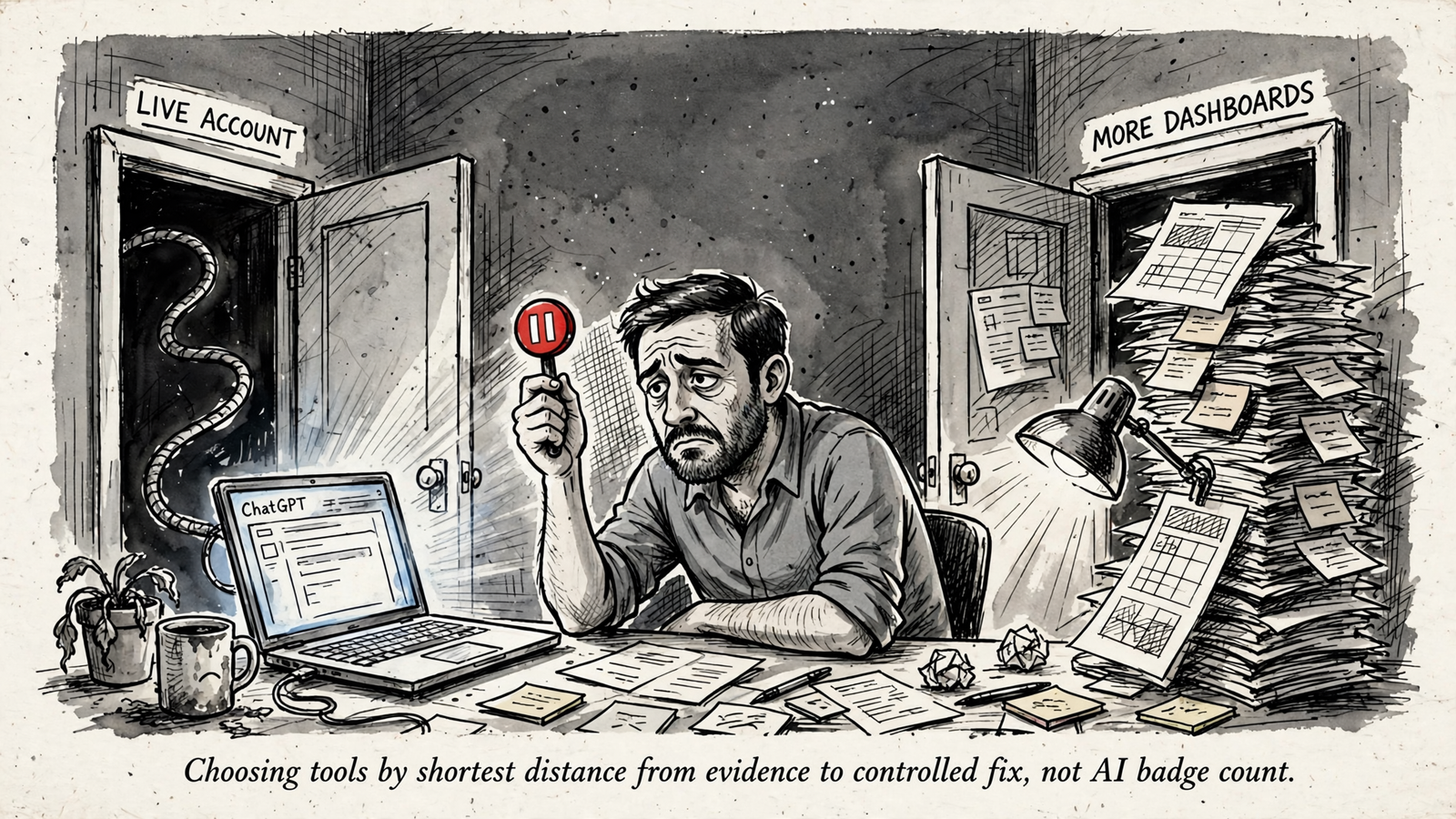
Before I pay for anything, I write down break-even ROAS and compare the drop with that number, not last week’s high. A fall from 4.2 to 2.8 feels like a cliff. If break-even is 2.5 and two ad sets are eating 60% of spend with zero recorded value, I have a narrower question than “How do I get back to 4.2?” I want to know what happened in those two ad sets before I touch the rest of the account.
Here’s the prompt I’d use before anyone tells me to scale:
Compare the last 7 days with the prior 7 days for [campaign, ad-set, and ad IDs]. Check the attribution settings and the March 2026 link-click change first. Break down the ROAS change by spend, CPM, CTR, conversion rate, and recorded value. Tell me what moved, what’s uncertain, and which single check would resolve the most uncertainty. Don’t make any budget changes without my approval.
If you skipped to the end: for a sudden Meta ROAS drop, my pick is ChatGPT with groas MCP. Use exports if you need one checked answer and don’t mind doing the clicking. Choose Madgicx only if its dashboard is where you want to work. I want the shortest route from numbers I can check to one change I can defend. I don’t want to pay more to learn less.


