

 LinkedIn

Most agencies won’t tell you this: your $40 leads and someone else’s $90 leads can come from the same audience, creative, and budget. The difference is what you told Meta to find. I used to tell clients cheap CPL meant the account was healthy. I was wrong.
Here is the fact everything else follows from: Meta learns from the success event it can see. If that event is “form submitted,” delivery looks for people likely to submit forms. Not people likely to answer the phone, pass your qualifying questions, or book the job. Just people likely to tap submit.
A $40 lead can cost more than a $90 lead
Say you run an HVAC business in one metro. You spend $2,000 last month and get 50 leads at $40 each. Your team calls all 50. Twelve pick up. Three book a diagnostic. That is about $667 per booked diagnostic.
Your competitor pays $90 per lead and books one in four. Her cost per booked diagnostic is $360. Her CPL looks worse on a screenshot. Her schedule tells a different story.
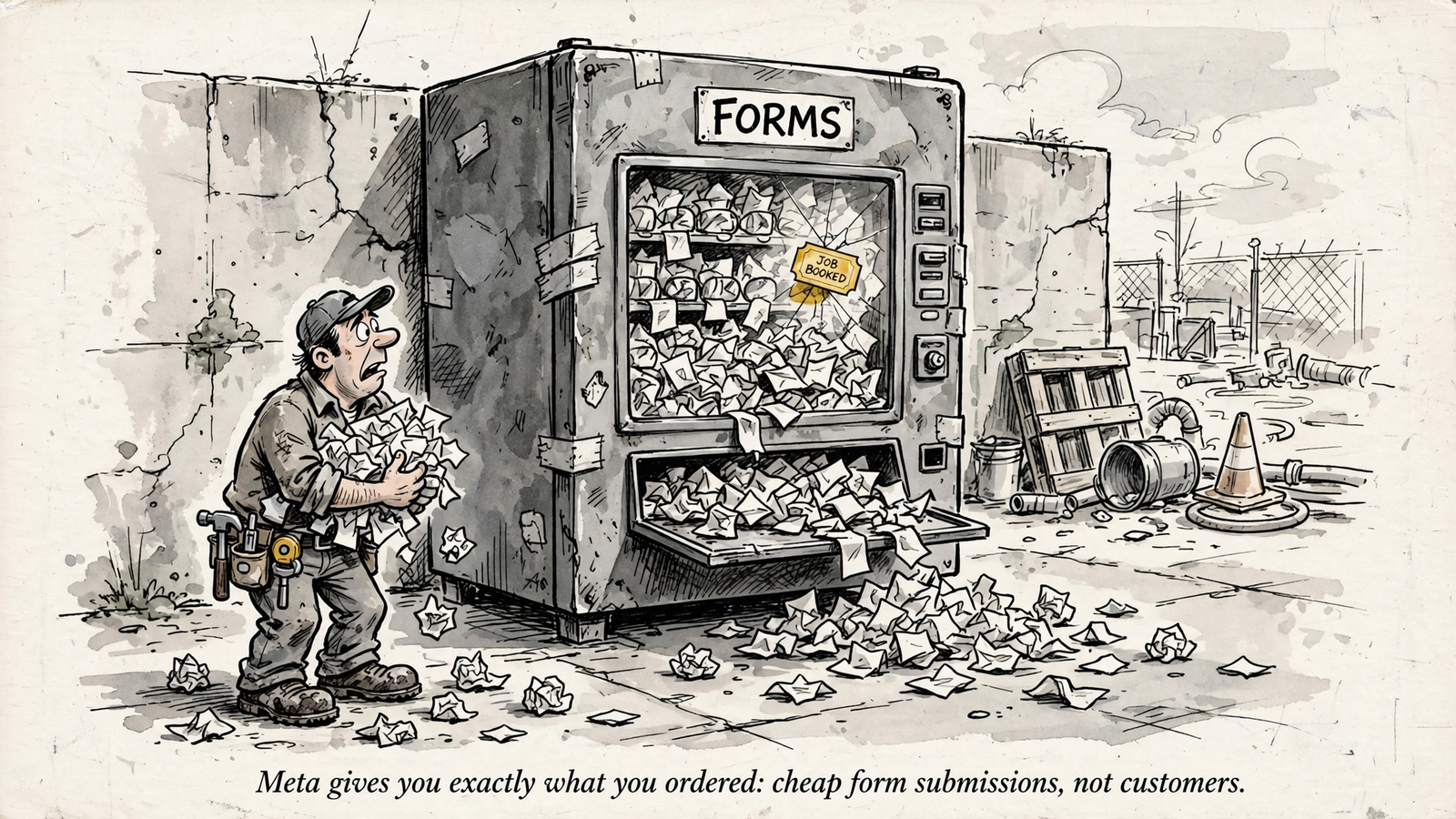
That gap is not necessarily bad targeting. Meta optimizes toward the event it can see. If it receives only form submissions, it learns who submits forms, not who qualifies or books. Every submission looks like a win unless the later stages get back into the system.
The machine did its job. You ordered form fills, and form fills arrived. To get a different result, start with what counts as a win.
First, separate a submission from a customer
When you choose Leads and Instant Forms, a completed submission gives Meta a clear signal. Someone likely to submit is not necessarily likely to answer, meet your criteria, or purchase. Your CRM may know that distinction. Ads Manager does not know it unless you send the information back.
Imagine 100 people see the HVAC ad and eight submit the form. The system records eight successful actions and looks for patterns among the people who took them: how they have responded to ads, when and where they saw this one, and how they interacted with the creative. The exact mix matters less than the definition of success. If all eight submits count equally, a person who books a diagnostic teaches the system no more than a person who never answers the phone.
That is why a sales team’s complaint that “these leads are junk” does not change delivery. The complaint has not entered the learning loop. Nor does moving a few audience settings tell Meta which of those eight people were worth finding again. If qualification stays in your CRM, form completion stays the algorithm’s goal.
For the HVAC shop, I would put the 50 submissions beside the 12 answered calls and three bookings before touching an audience. That is where the account’s actual result becomes visible.
Next, see why delivery favors easy completers
Meta’s auction weighs bid, estimated action rate, and ad quality. For a lead ad, the action rate concerns the event you selected. If the system estimates that one person is more likely than another to finish the form, it has a reason to show that person the ad. Repeat that process across delivery, and spend moves toward people likely to complete the form at an attractive cost.
The system cannot quietly substitute “likely to book an HVAC diagnostic” for “likely to submit.” Those are different outcomes. One is available immediately; the other happens after someone calls, qualifies the prospect, and books a slot.
Some frequent form-fillers make that first outcome easy. Their contact details arrive prefilled, they tap quickly on mobile, and they keep scrolling. Sales then encounters the familiar mix: wrong numbers, bouncing emails, and prospects who barely remember filling anything in. Not every weak lead is fraud. Often the form made submitting easier than seriously enquiring.
A low CPL can mean you bought efficient submissions, not efficient bookings. In the HVAC example, the $40 figure hides the cost until you follow the lead through the call and into the calendar.
Then, account for the friction in the form
Instant Forms remove steps: contact details can arrive prefilled, and the person can submit without leaving the app. That helps an interested homeowner enquire while the problem is on their mind. It also helps someone submit without much thought. The feature does not distinguish between them on its own.
A website form asks for a context switch to your site, some loading time, and more typing. Those steps can deter a casual submitter before your team spends time calling. They can also deter a genuine prospect who does not want to complete a longer form on a phone. That is the useful limit of the friction argument: friction changes who finishes, but more friction is not automatically better. Comparisons of instant forms and landing pages show the volume-versus-qualification tradeoff.
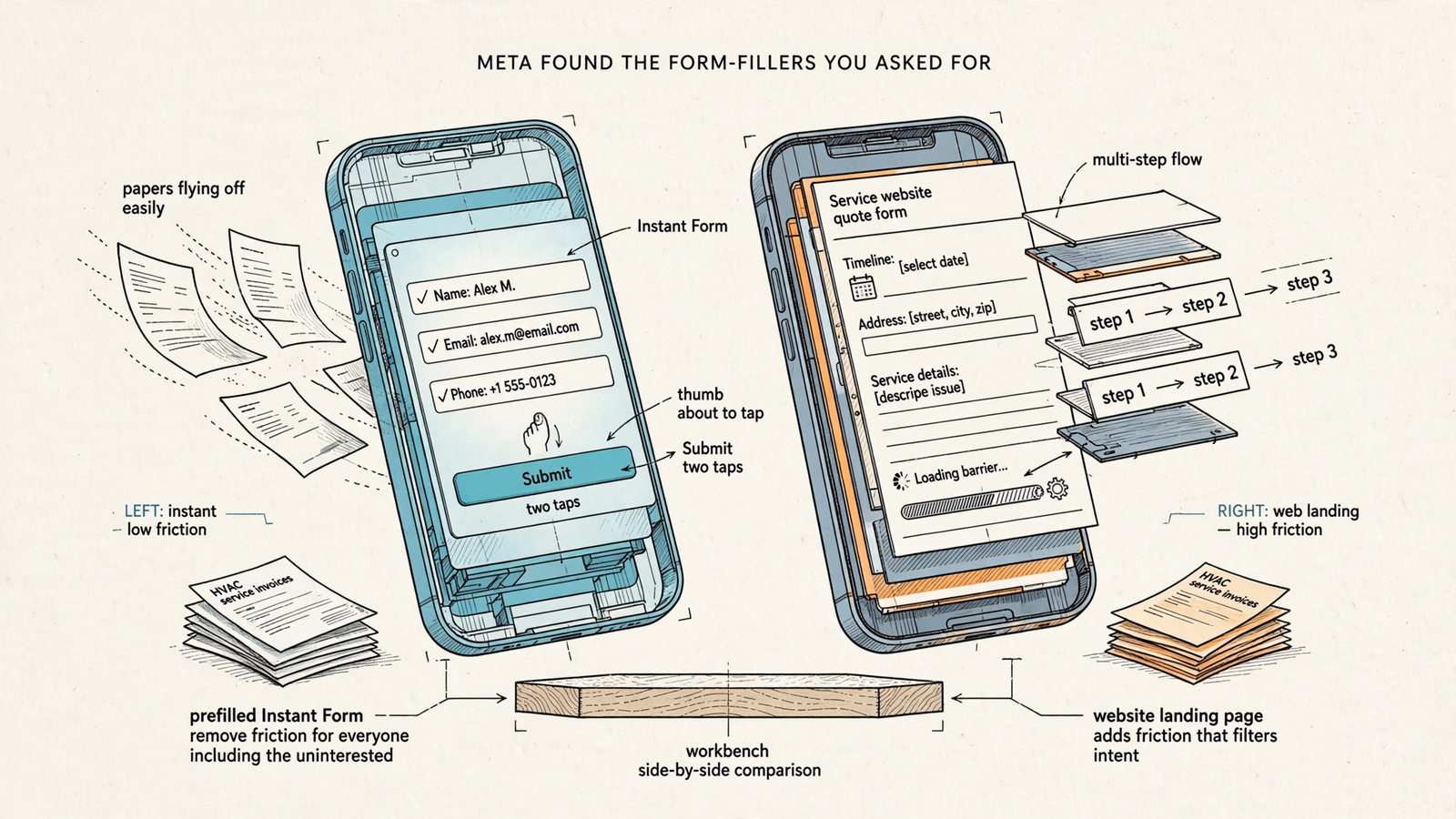
If the HVAC team can call promptly and qualify on the phone, an Instant Form may suit its follow-up. If it needs a ZIP, service type, and timeline before assigning a call, a website form gives it room to collect those details. Neither choice fixes a team that does not call the leads. The form determines what arrives; follow-up determines what the business learns about it.
If you keep Instant Forms, use the available brakes deliberately. Higher Intent adds a review-and-confirm step, slowing accidental submissions and giving people a chance to correct details. It trades volume for that extra check, and its placement options are narrower than More Volume. You can also ask one or two questions that change what happens next: service needed, timeline, or ZIP. Phone verification can help when a working number is essential.
Each step asks the prospect for something. Keep the steps that help you route or qualify the enquiry; cut the ones that merely make the form look serious. For the HVAC shop, “What service do you need?” earns its place if it changes who calls back. An extra question nobody uses does not.
Now teach Meta which leads were worth finding
Form design filters the leads that come in. It does not, by itself, tell the delivery system which submissions became good business. For that, the outcome has to travel back from the CRM.
The sequence is straightforward, even if the setup takes work:
- Keep the submission tied to its lead ID so the later outcome can be connected to the original form fill.
- Define a stage the team records consistently, such as qualified lead or booked diagnostic. “Good lead” in someone’s notes is not a useful event definition.
- Send those outcomes back through Conversions API for CRM and, when the account has enough signals, optimize toward the qualified stage.
- Judge the result at that stage. Keep CPL on the report, but compare cost per qualified lead and cost per booked diagnostic before calling the change a success.
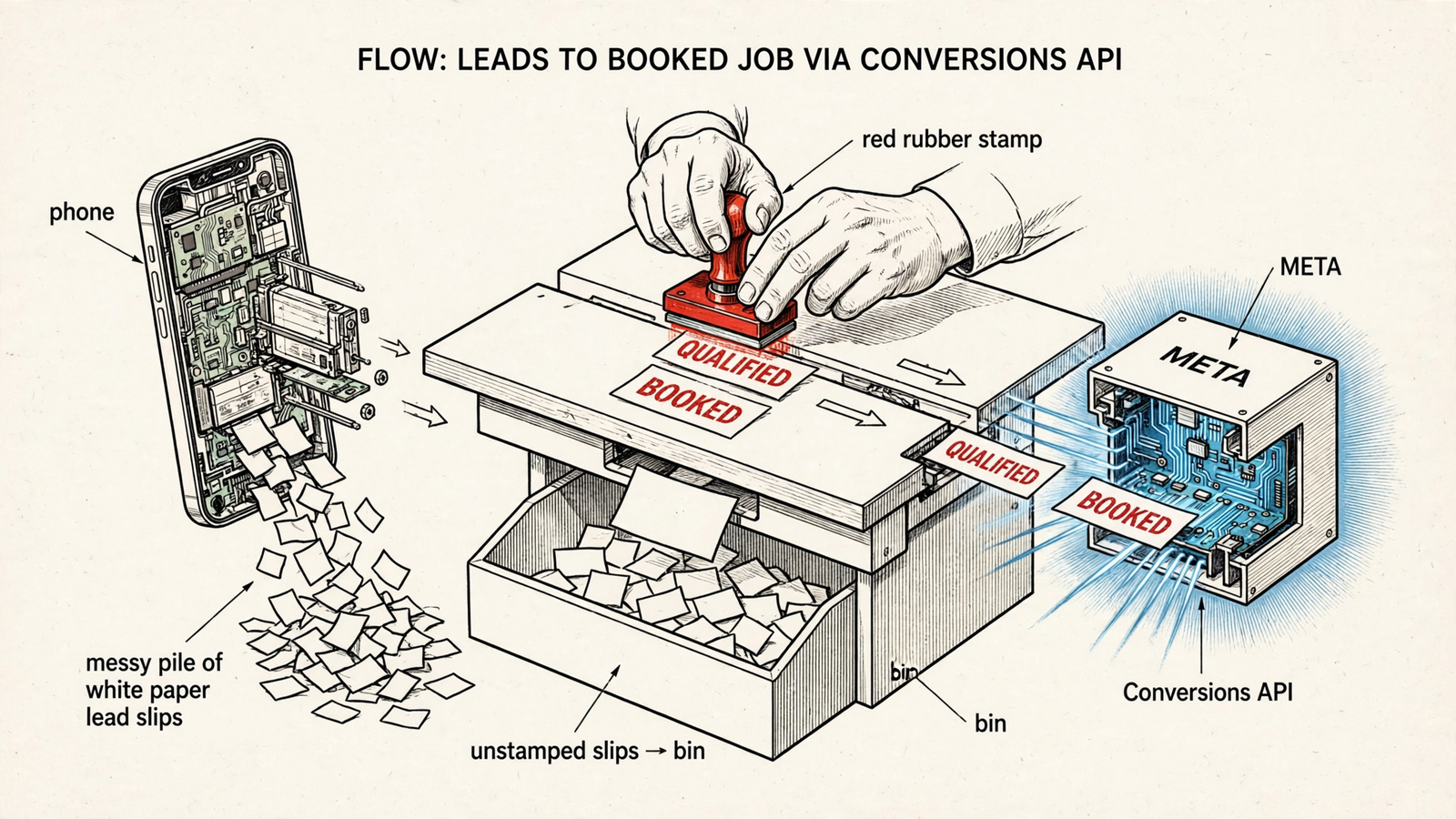
For the HVAC shop, that means the three booked diagnostics no longer vanish into a spreadsheet after the 50 submissions arrive. Meta receives a different lesson: these submits led to bookings; the others did not. That gives delivery a reason to look beyond the people most likely to tap the form.
This is plumbing, not magic. Conversion Leads needs Instant Form lead IDs stored, regular CRM uploads, and enough outcome volume to learn. Changing the optimization event also restarts learning, so CPL may rise before cost per qualified lead improves. If the first higher CPL sends your manager back to the old setup, they have chosen the screenshot over the booking calendar.
Check whether the deeper event happens often enough
There is a constraint here that a polished pitch can hide: you cannot teach a system much with an outcome it rarely sees. Meta’s general learning benchmark is about 50 optimization events per ad set per week. Conversion Leads guidance also calls for roughly 200 leads a month, regular uploads, and a target stage reached by a share of those leads within 28 days.
Suppose a service business gets 60 leads a month and books six jobs. Switching straight to booked jobs gives the system only six monthly examples of the outcome you want. I would not treat that as a clever upgrade to a cheaper-lead campaign. I would expect the thin signal to make learning difficult.
In that case, keep working on the parts you can observe and control. Use a website form or a Higher Intent Instant Form if that better filters the enquiries. Ask questions that affect routing. Fix slow follow-up. Record answered calls, qualified leads, and bookings so you know where the drop-off sits. Then revisit the optimization stage when there is enough volume to support it.
The principle is not “always optimize for the deepest possible event.” It is use the deepest meaningful event you can supply consistently and often enough. A booked job may be the cleanest measure of value and still be too scarce to guide delivery today.
Test the model against a different sales cycle
The same reasoning applies when the conversion is not an HVAC diagnostic. A roofer might care about qualified on-site estimates. A dental clinic might care about consultations that people attend. A B2B business with a 90-day sales cycle may use a sales-accepted lead or attended demo rather than wait for closed-won revenue. The qualifying stage changes; the question does not: which event says more about a valuable prospect than a form submission, and can you send it back often enough to learn from?
That is also the question I would put to anyone pitching cheaper leads. I use four checks when an owner asks me to sense-check a proposal. They are more revealing than a slide about audience interests, and they get past the usual promise of lower home-services lead costs:
- What event will you optimize toward first, and what would justify changing it? “Form submit” can be a starting point. It should not be the only definition of success.
- Why use an Instant Form or a website form for this team’s follow-up? Listen for the tradeoff between easy submission and the information needed to route a real enquiry.
- How will qualified outcomes get back to Meta? Listen for stored lead IDs, a defined qualification stage, and regular Conversions API uploads where the setup calls for them.
- What happens if CPL rises? A change in optimization restarts learning. The answer should point to qualified leads and bookings, not promise that every number improves at once.
Now take the garage-door shop I have seen versions of too often: 40 leads a month, two booked installs, and an owner ready to kill Meta entirely. Run the model on it. Two booked installs are a valuable outcome, but too few signals to make an immediate switch to booking optimization a convincing plan.
Start earlier in the chain. Try a website form or Higher Intent form with ZIP, need, and timeline. Call quickly. Record which leads answer and which placements produced them; Audience Network is worth checking when contact rate collapses. Track the booked installs, too. Once the shop has enough qualified outcomes to feed back regularly, it can ask Meta to learn from that deeper stage. The small account follows the same mechanism as the larger one. It just cannot skip the volume constraint.
Cheap leads were never proof of bad luck, and they were not automatically proof of bad targeting. You asked for submissions, so the system found people likely to submit. Qualify with friction that matters, return the outcomes you can reliably measure, and judge the work by what reaches the calendar. That is the work groas offers for Meta Ads at a flat $1,499 a month, with tracking and ongoing decisions included rather than billed as extras. Ask for forms and you will get forms. Ask for customers, and teach the machine what one looks like.


