

 LinkedIn

Meta’s AI media buyer is still in testing. I chose the WBzard Labs breakdown of the October 6 announcements, updated October 24, for this teardown because its table separates what the headline blurs: a video generator advertisers can use and an agentic buyer they should not assume they have.
Those are different products, with different stakes. Static image-to-video inside Advantage+ Creative is listed as generally available. The assistant that plans campaigns and changes targeting and budgets through conversation is listed as testing. One makes assets. The other promises control over spending inside Meta’s ecosystem. My bias is plain: I would rather run my own AI assistant through groas across platforms, under rules I set, with every change logged and undoable in one step.
The availability table: generation is live; execution is testing
Meta’s wording, as quoted in Selzee’s check on October 26, is careful: the company is beginning to test capabilities where soon you will be able to plan and create a campaign, generate creative, update targeting and change budgets, with previews, approvals and controls.
“Beginning to test” is not a general launch. I used to tell clients that a feature described that way was at least one quarter away from their account. I was often optimistic.
Kampaignlab’s first look at the assistant in Ads Manager reinforces that distinction. It describes an analyst, not an operator: the assistant recommends, but the advertiser still implements changes by hand. Campaign execution is marked “not here yet.” In that first look, the part that saves the clicking is still missing.
The other half of the table is available. Static image-to-video generation inside Advantage+ Creative became generally available on October 6 and free inside Ads Manager, alongside AI music, dubbing and background generation. Meta takes an uploaded still, adds motion, extends the background and times it to a template. That creates video assets without a shoot. For a small ecommerce brand running, say, $20k a month with 40 tired statics, that is useful output.
Useful is not the same as safe to ignore. MetaMaxd warns that several enhancements are on by default and can generate and serve variants without review. The distinction matters: approving an original asset is not necessarily approving everything the system makes from it.
My verdict on the table: keep the two availability labels attached to the two capabilities. Before celebrating free video, open Advantage+ Creative and turn off anything allowed to publish without approval.
The execution promise: fewer clicks, but whose objective?
Execution is the part of account work that eats time. Finding the wasted query, pausing the tired ad set, shifting $500 from prospecting to retargeting: this is the mechanical work agencies have long billed a percentage of spend to do. When Meta promises campaign creation and budget changes through conversation, with previews, approvals and controls, I pay attention. That is a real job worth automating.
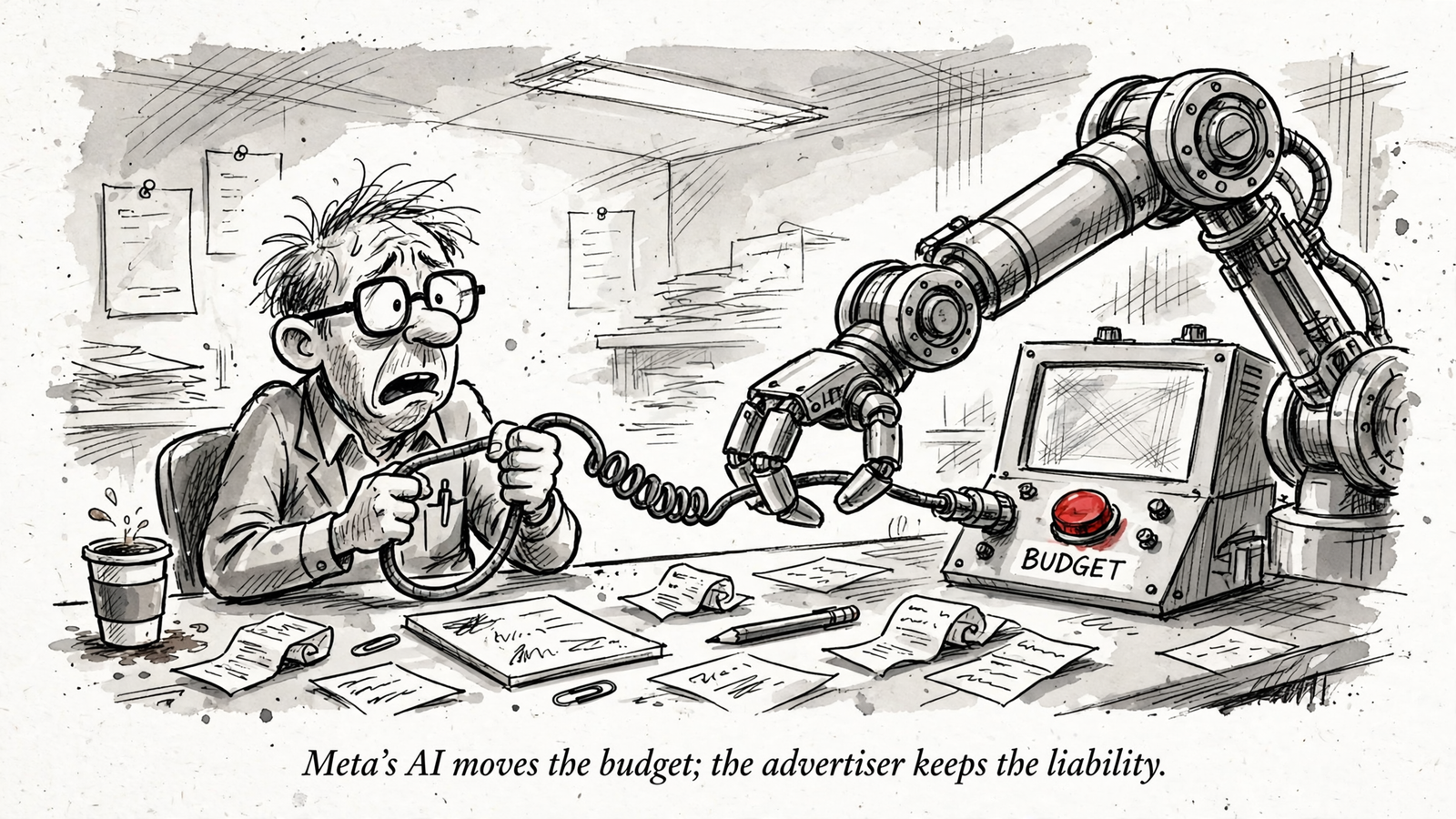
But the controls deserve as much attention as the conversation box. Gradezilla’s reading of the new AI Features terms, via Adweek on October 22, says advertisers remain solely responsible for what Meta AI creates or changes, including features Meta switches on itself. Its account says the terms take effect October 30, 2026, and continuing to run ads counts as acceptance.
Delegating the action does not delegate the accountability. If an assistant changes a budget, the advertiser still has to answer for the spend. Before granting write access, I want the objective, the daily cap and the approval rule settled. “Make it perform better” is not a budget policy.
Then comes the question I ask before any tool touches money: what happens when the signal lies?
Say a pixel double-fires after a site update, or a SaaS offer pauses while the old campaign keeps running. If the assistant treats the reported conversions as reliable, bad tracking can look like good performance. A conversation interface does not fix that. Someone still needs to compare the platform’s answer with the CRM and the current offer.
Kampaignlab’s first look makes the broader point: a Meta-native assistant optimizes toward Meta ecosystem signals, while platform-reported ROAS can look rosier than independently measured acquisition cost. That does not establish that every recommendation is wrong. It establishes why I want an independent answer key.
My verdict on execution: the promised work is valuable, but it stays inside Meta’s operating environment. I would not confuse a faster way to change a campaign with an independent reason to make the change.
The creative promise: a finished file is not an approved ad
A generated video proves the machine can fill frames. It does not prove the opening claim is legal, the offer is current or the landing page matches.
The bookseller case reported via Marketing Junkies shows the failure mode. An automated account update reportedly opted the business into a generative feature that added AI illustration to human-made ads without its knowledge. The brand then turned off all Meta AI ad features.
Generation is cheap. Judgment about what should run is the product. I would separate those jobs in the account, not just in the strategy deck:
- Generation makes a candidate asset.
- Approval checks the claim, offer and brand fit.
- Testing decides whether that asset deserves more spend.
A 15-second motion version of a winning static is still a hypothesis. I want it tested against the static with the same budget, audience and landing page, then judged on checkouts or qualified calls. More movement is not a business result.
That is also why I treat Meta’s 5% number as a lab note, not a forecast. The WBzard breakdown reports Meta’s claim that assistant users see 5% more conversions at the same cost per conversion, while noting that Meta published no methods (WBzard Labs breakdown). Without the method, I cannot tell whether the lift came from better decisions, easier budgets or friendly attribution. I cannot turn it into a forecast for another account.
My verdict on creative: keep the generator if the output is useful, keep automatic publishing off, and let a controlled test promote an asset from experiment to workhorse. Do not let the convenience of making the file decide whether it runs.
The missing evidence: sales quality and actual account access
The testing language does not establish how the assistant handles downstream sales quality. That is the number I care about when the platform dashboard and the business stop telling the same story.
A recorded conversion is not necessarily a qualified lead, an attended appointment or a paid invoice. In home services, a slow response to a lead can break the connection between an apparently healthy campaign and money collected. If an optimization system does not receive that downstream outcome, it cannot use it to correct the decision.
I would judge the buyer on qualified pipeline or revenue, not platform conversions alone. The announcement does not settle that question. It leaves the advertiser responsible for deciding which outcome counts and checking whether the system can see it.
There is a second unknown: access. Testing does not mean nobody has the feature. It also does not mean the capability described in an announcement is available in the account sitting in front of me.
Before planning around it, I would check Ads Manager and record:
- Whether the assistant entry point is present.
- Whether it can draft, recommend or actually publish.
- Which ad account, page role and region I checked.
- What approval and undo controls are available for an executable change.
That is less exciting than announcing that the media buyer has arrived. It is also the difference between planning around software and planning around a headline.
My verdict on the omissions: neither downstream measurement nor execution access should be assumed. If I cannot verify the action and the way back, I do not count it as delegated work.
The buying decision: pay for ownership, not just activity
For the native route, I would keep a named owner attached to the automation. One person signs off on the objective in plain English, sets the cap and kill rule, and checks the tracking before anyone talks about scale.
On a small account, I keep the routine deliberately boring: a conversion event that matches money, a budget limit per campaign, and a weekly 15-minute comparison of Meta-reported purchases with Shopify or the CRM. Agreement is useful evidence. A split is a reason to investigate, not a reason to ask the assistant for a more confident explanation.
The owner’s job is to challenge the input, not admire the output. No testing announcement removes that responsibility.
Hiring an agency does not remove it either. The pricing described in this paid-social hiring guide is a flat retainer or 10% to 20% of monthly ad spend, usually with a minimum, with media spend paid to Meta on top. Under the percentage model, the fee rises as spend rises without necessarily increasing the work in step.
I billed that way once. It paid me more when clients spent more. That is an awkward incentive to call alignment.
Before signing, I would ask the provider to name the person who owns a bad decision, explain how quickly they can reverse it, and show what they measure besides platform ROAS. If the answer is clicks and a PDF, I would keep walking.
That is where groas sits on the other side of this comparison. Meta’s assistant operates inside Meta. My own assistant through groas can work across Google Ads, Meta Ads, Bing Ads, ChatGPT Ads, SEO and AI search visibility from the same chat. groas supplies the hands and the data under the AI I already use; it is not asking Meta’s buyer to become independent of Meta.
I connect the accounts and website once. groas collects rival ads and funnels, Reddit conversations and AI answers around the clock. I set the goals, budget and voice rules. My assistant can then use that infrastructure to act across the connected platforms, with changes logged alongside their reasons and undoable in one step.
That is the mechanism I care about: broader information, my instructions and a visible record of the action. The log is the difference between delegation and abdication. For a first-hire decision, I would compare those responsibilities in your first in-house Meta hire or groas, rather than compare job titles with software labels.

Before handing over write access, I would keep four controls explicit:
- The objective: written in money terms, not “more engagement.”
- The spending limits: daily and account caps, with a clear rule for increases.
- The publishing rule: what needs approval before it goes live.
- The recovery path: who owns a mistake and how the change gets undone.
Those controls are the buying criteria. A chat window is not a substitute for any of them.
Overall verdict: keep the generator, keep the thinking outside Meta
The WBzard table earns its place because it keeps two announcements from collapsing into one story. I would keep that distinction, the useful image-to-video capability and the insistence on checking what is actually available in the account. I would not treat a testing label as a launch or an asset generator as an independent media buyer.
My choice is my own AI through groas, with autopilot off until I switch it on under rules I set. groas Unlimited is $19 a month, flat for the team. More important to this decision, it puts cross-platform work under my instructions, with a reason attached to every change and a one-step undo when the decision misses.
Keep the free video generator. Keep a hand on the budget cap. Keep the thinking outside Meta. A landlord’s buyer still works inside the landlord’s property; I want mine able to work across platforms and answer to my number. That is the buyer I would trust with my account.


