

 LinkedIn

You get seven days, one Meta campaign, and no budget increase to find out why it won’t spend. If you set $50 a day and watch it spend $14, then $18, then $12 while leads stay flat, adding money is not a diagnosis.
An unspent budget can mean Meta is doing exactly what you told it to do. You set a cost control or a tight audience, and the system holds back rather than buy expensive, low-odds auctions. Or delivery is fine and your tracking is missing the results. Those are different problems. Paying someone to scale them before you know which one you have is an expensive way to stay confused.
More delivery is not the goal. More acceptable customers within the existing budget is. Here is the order I use to separate a delivery block from a measurement failure or math that never worked.
1. Set the terms: seven days, one campaign, budget frozen
Cost: one week of patience and one spreadsheet. What it buys: a test you can actually interpret.
Pick your worst underspender and leave its daily budget exactly where it is for seven days. Do not duplicate it into a fresh campaign. Do not add another campaign to do the spending this one refuses to do. The budget constraint applies to the test, not just the number in one box.
Before touching anything, write down:
- The campaign’s daily budget.
- Last full week’s spend against seven times that daily budget.
- The bidding strategy and any cost control.
- Actual enquiries, booked jobs or orders from your CRM or store.
Use the full-week view rather than judging isolated days. Meta can spend more on one day and less on another. A quiet Tuesday does not tell you whether the whole week is underspending.
Set a loss ceiling in writing, too. If break-even is $40 per qualified lead, you might accept $45 during diagnosis and stop if two days clear $60. Whatever your numbers are, decide before the results arrive. Otherwise, every expensive lead becomes an investment in learning.
What gets cut: budget bumps, duplicate campaigns and several simultaneous fixes. I used to tell clients to add 20% to force delivery. I was wrong. That could hide the block and burn cash without explaining anything.
An unspent allowance is not money you owe Meta. Keep it available, not compulsory.
2. Day 1: check whether the missing results are real
Cost: 30 minutes and zero ad edits. What it buys: protection from fixing the wrong problem.
Open the campaign, ad set and ad levels. Read the Delivery column, then check status, rejection reasons, billing, schedule and account spending limits.
Work through the obvious blocks before you invent an auction theory:
- Is the ad still in review or rejected?
- Is a failed payment stopping delivery?
- Is the campaign paused or outside its schedule?
- Has an account spending limit been reached?
A failed card is not a bidding problem. Neither is an ad that cannot run. Record the block; do not start changing audiences to compensate for it. If there is a clear administrative block, that becomes the candidate for your single intervention later in the week.
Then put Ads Manager beside reality. Count actual enquiries, booked jobs or Shopify orders for the last seven days and compare them with reported leads or purchases.
If the store shows sales Meta never logged, you have a measurement problem to resolve. That does not prove delivery is healthy; it means reported results cannot yet tell you whether the spend is working. Keep those questions separate.
This check sounds basic. It is also cheaper than asking a bidder to solve missing data. If measurement prevents a fair test, move toward the pause-and-repair decision in Step 6 rather than forcing a delivery experiment.
3. Day 2: name the constraint before touching it
Cost: one read-only hour. What it buys: a short list of suspects instead of a shopping list of tactics.
Start with the control you set yourself. A cost-per-result goal targets an average cost, while a bid cap puts a ceiling on auction bids. Both can restrict delivery. Highest Volume or Highest Value instead aim to use the available budget.
If you have a restrictive cap and Meta spends a third of the allowance, the system may be obeying you. That is a useful finding, not permission to remove the cap immediately.

Next, check whether your structure gives the campaign enough room to work. Look for stacked interests, a tight radius, overlapping ad sets and too many places for a small budget to go.
Meta can flag Learning Limited when an ad set is unlikely to reach about 50 optimization events in the week after its last edit. Treat that as a diagnostic clue, not a universal minimum-budget formula or an instruction to spend more.
The arithmetic still matters. At a $27.39 lead cost, 50 leads cost roughly $1,370. A $30-a-day campaign cannot buy that volume at that price. But the answer under this constraint is not to manufacture a bigger budget. It is to identify whether fragmentation, targeting or the chosen optimization event makes the existing budget harder to use.
Finish Day 2 with one sentence: “The most likely block is ___, because ___.” If you cannot fill both blanks, keep the campaign unchanged. Uncertainty is not a reason to click more buttons.
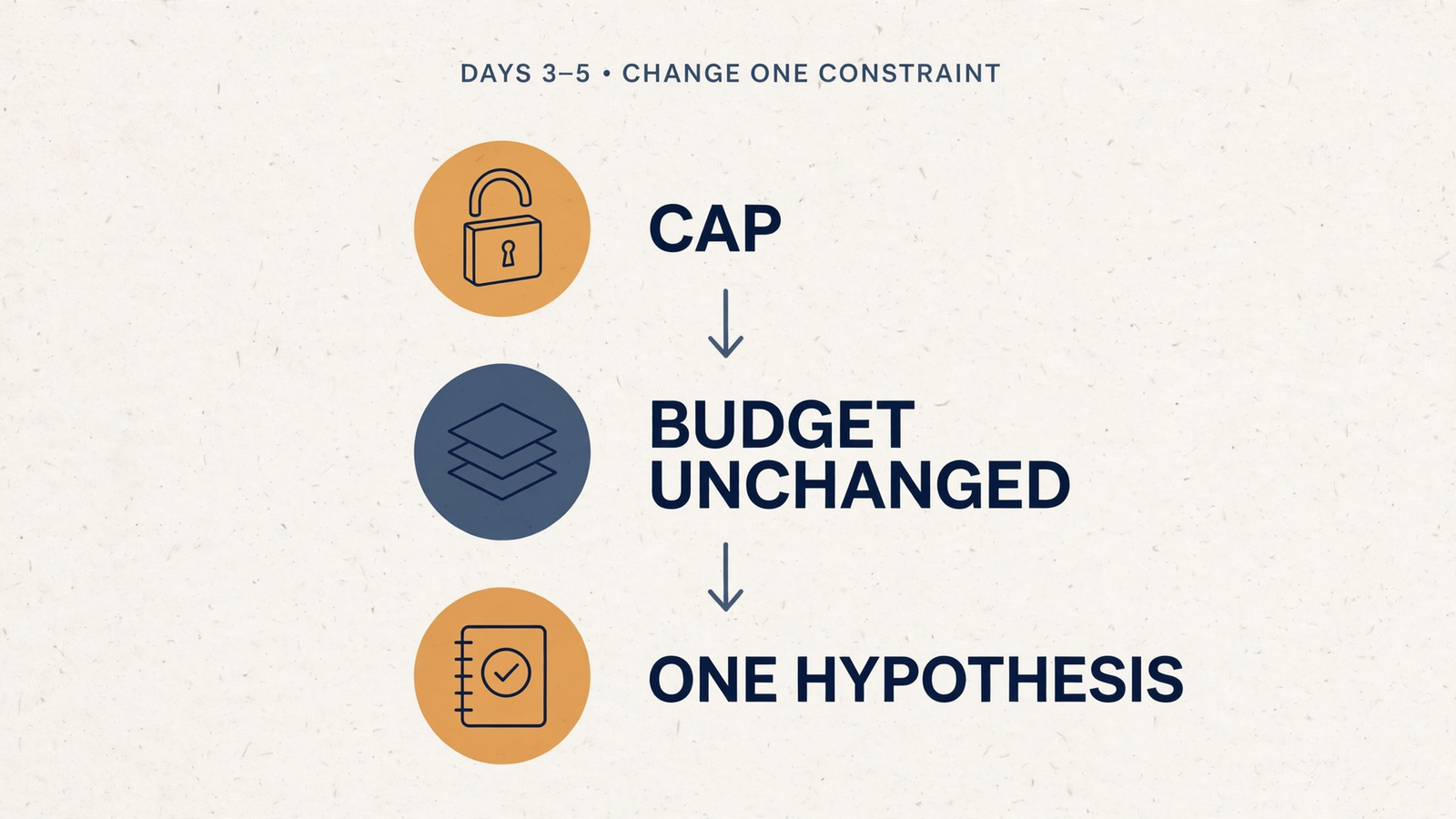
4. Days 3–5: make one change, then leave it alone
Cost: one documented intervention. What it buys: a signal you can read without guessing which edit caused it.
Make the change on Day 3 and use Days 4–5 to observe it. This is the only edit window, not an invitation to make a fresh adjustment every morning.
Write the hypothesis before touching the account. For example:
If I remove the bid cap, delivery should rise within 48 hours while qualified-lead cost stays inside my diagnostic ceiling.
That is a test, not a promise. Screenshot delivery, spend, CPM, frequency and the change log before the edit. Keep the budget untouched.
Choose the intervention that matches the evidence:
- Administrative block: address the identified billing, status or scheduling issue. Do not bundle it with targeting changes.
- Restrictive cap: test a cap adjustment rather than adding budget.
- Audience restriction: test broader targeting rather than changing the bid at the same time.
- Fragmented structure: choose consolidation as the intervention, not consolidation plus new creative plus a new optimization event.
The delivery fixes include adjusting caps, broadening audiences and consolidating restrictive structures. They are options, not a checklist to complete in one sitting. Stay inside the selected campaign and its existing budget.
If spend rises but economics break, stop according to the ceiling you wrote down. Say your diagnostic ceiling is $45 per qualified lead and two days print $68 with tire-kickers. That is not momentum. It is Meta finding expensive opportunities the old control may have kept out.
Revert the tested change if that is the appropriate stop action, and log what happened. The extra delivery was available, but it did not meet your price. You have learned something without raising the budget, even though the campaign may have spent more of its existing allowance.
One change, one expected signal, one stop rule. Anything more turns the test into account maintenance with a better name.
5. Days 6–7: score delivery and economics separately
Cost: one final review, with some conclusions left provisional. What it buys: a decision that is not based on whether the spend bar looks fuller.
I use two scores. Neither gets to hide behind the other.
Delivery: did the campaign use more of its allowance?
Compare the test’s seven-day spend with seven times the unchanged daily budget, alongside the previous full week. Check the Delivery column and note whether its status changed.
Keep the timing honest: only part of this week follows the intervention. The weekly total gives context; the before-and-after record helps you see the response. Do not pretend all seven days tested the new setting.
A cleared warning is useful evidence, not the business result. Delivery can improve without the campaign becoming worth running.
Economics: did real customers stay inside the ceiling?
Calculate cost per real enquiry or purchase from your CRM or store, not just the platform’s reported total. Note conversion lag and allow three to seven days for late conversions where relevant.
That creates a limit on this playbook: Day 7 can produce a provisional verdict, not magically mature every conversion from Day 5. If lag leaves the economics unresolved, write “unresolved.” Do not replace missing results with optimism.
Volatility guidance recommends reconciling Ads Manager with store data and judging a longer window rather than one bad day. That is a reason to distinguish signal from noise, not a reason to extend a losing test past your stop rule.
If delivery rises from 35% to 80% of budget but qualified-lead cost breaks your ceiling, fuller delivery is not a win. If delivery stays low and the customers remain profitable, low spend is not automatically a failure.
Write both scores down before Day 7 ends. Memory will improve the story by Day 10.
6. Day 7: choose the cheapest defensible next move
Cost: one decision, not a new spend commitment. What it buys: a clear boundary between maintaining, repairing and paying for help.
Maintain when the economics work and volume is enough
If your $50-a-day campaign spends $32 and brings two qualified enquiries at $16 each against a $40 break-even, the economics work. If you do not need more volume, leave it alone.
Do not hire someone merely to force the other $18 out the door. That is exactly when a good manager leaves budget unspent on purpose: spending more would break the average you asked the system to hold.
Keep the margin. Full spend is not a deliverable.
Pause when measurement or the offer prevents a fair test
Pausing costs you the campaign’s immediate opportunity to produce results. It also stops you paying for a test you cannot judge.
If your CRM shows sales Meta never logged, repair measurement. If the landing page or offer is the block, repair that rather than asking the bidder to compensate. No human or machine can make an unreadable test informative by spending harder.
Pause and repair before paying for a scaling pitch. A tracking failure and a weak offer need different repairs, but neither benefits from pretending the only problem is underspending.
Price help before committing to it
Help costs real money. During this seven-day test, evaluate it; do not add a management commitment that breaks the no-extra-spend constraint.
Small-business management commonly runs $500 to $2,000 a month, separate from media spend. If you spend $1,200 on ads and add an $800 fee, that fee adds roughly two-thirds to the cost you must justify. “Better performance” is not enough of an answer. Ask how much better, measured against what.
Some larger specialists have ad-budget or project minimums around $5,000. Agency rankings also emphasize creative volume and often leave pricing behind discovery calls. What the deck calls full-funnel scale may simply be a fee your budget cannot carry.
If your log shows clean tracking, an offer that converts and a specific delivery block, a narrow diagnosis may justify its cost once the constraint lifts. Ask for month-to-month terms and a free audit rather than a 6-to-12-month commitment tied to spend.
I prefer a fixed monthly model like groas over a percentage-of-spend arrangement that pays the provider more when you spend more. The provider still has to explain the work. A fee structure is not a substitute for a diagnosis.
Before anyone pitches scale, get four answers in writing:
- Which score failed: delivery or economics, and what number proves it?
- What single constraint would they change first, and what signal would they expect within 48 hours?
- How did they reconcile Ads Manager with your CRM or store, including conversion lag?
- What do the fee and exit terms leave available for media?
If they cannot read your seven-day log back to you, keep your dollars.
7. When the constraint lifts: earn the budget increase
Cost: more budget only after the economics justify it. What it buys: a scaling test instead of a rescue attempt.
When tracking is clean, the offer converts and the single intervention improves delivery while holding your loss ceiling, you can consider spending more. Wait for lagged results if they are still unresolved. The calendar does not make an incomplete test complete.
Once that evidence is in, raise the daily budget by 20–30% in one step and hold for another full week. No new ad sets or new audiences in the same move. Keep the next test as readable as the first.
If delivery stays low but economics stay good, keep the budget where it is and bank the margin. Full spend was never the prize. Paid customers at a price you can repeat were. That is what the seven days bought you.


