

 LinkedIn
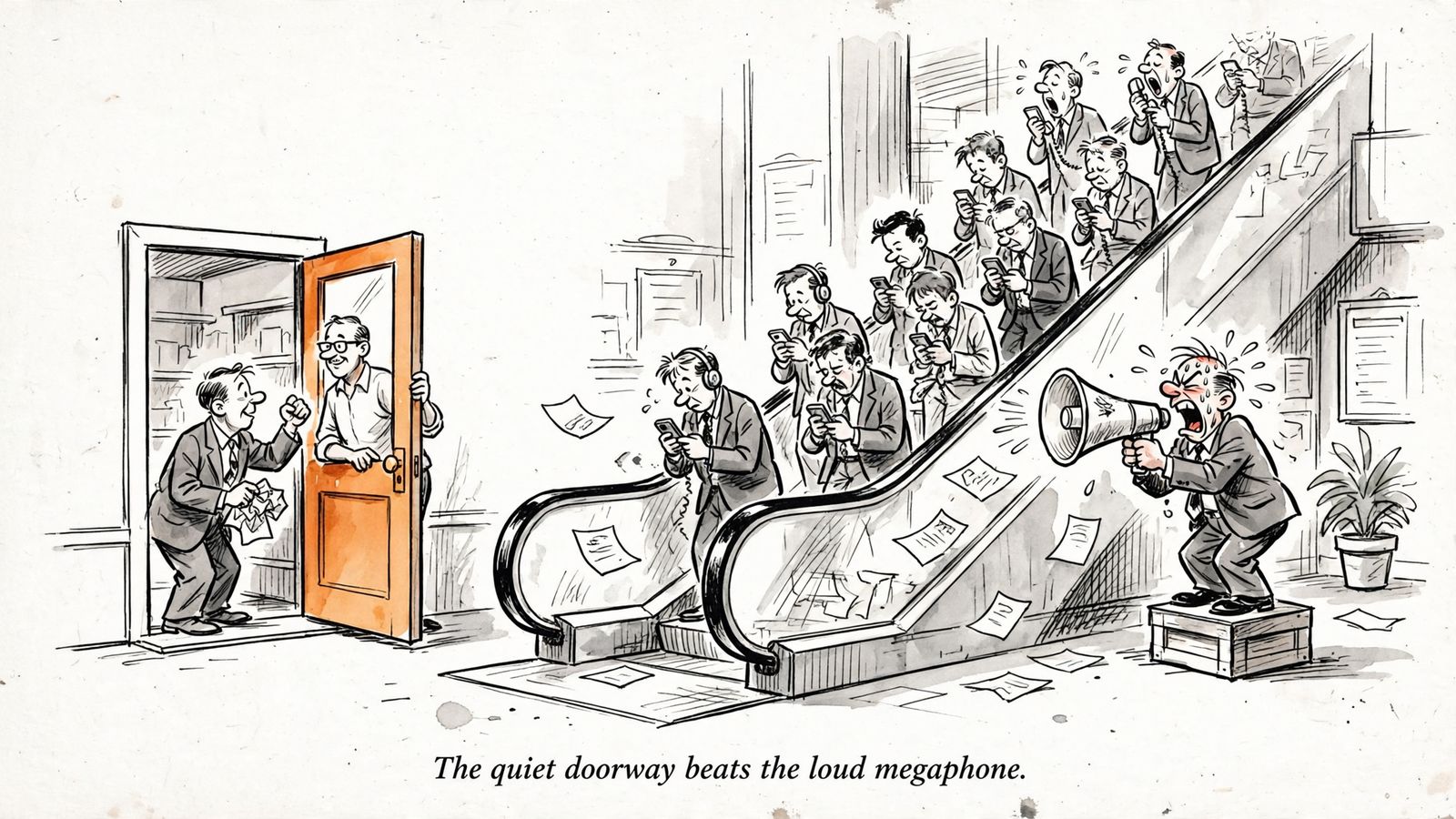
A buyer types the problem into Bing. Another scrolls past your ad on LinkedIn. If you run SaaS or B2B marketing and need qualified pipeline from your next $10k, that is the choice: Microsoft Ads search with LinkedIn profile targeting or LinkedIn Ads proper.
My verdict: if buyers search for what you sell, fund Microsoft first. You can weight a search bid toward the companies and roles you want while the buyer is already looking. LinkedIn earns the first dollars only when nobody is searching yet. Paying feed prices for a profile you could reach on a search click is a strange way to buy intent.
What you buy on each platform
Microsoft Ads sells the query first, then lets you adjust the bid for the profile. It is the only ad platform outside LinkedIn itself with LinkedIn profile targeting by company, industry and job function, available across search, dynamic search, shopping and audience campaigns. You choose keywords as usual, add the LinkedIn dimensions, and set bid adjustments for the profiles you want. Company lists cap at 1,000 companies per campaign or ad group. That limit matters if your account-based marketing list is large.
LinkedIn Ads sells access to the person. Sponsored Content and Lead Gen Forms let you filter by exact title, skills, groups and seniority, then put creative in front of that audience while they scroll. Lead Gen Forms convert around 13%, versus about 4.7% for landing pages, helped by pre-filled fields. Easier submission is useful. It does not mean the prospect was shopping for your product.
The difference is not whether LinkedIn data is involved. It is whether the buyer asks a question before seeing your ad.
Axis 1: the query beats the interruption
Someone types “soc 2 compliance software for startups” into Bing at 9am because an audit landed on their desk. That query carries timing no ad creative can manufacture. On LinkedIn, you interrupt someone reading a product launch post and ask them to care about your demo.
One comparison puts Microsoft search with a LinkedIn layer at $2 to $6 per click, against $8 to $15 or more on LinkedIn. The useful point is not that every auction clears at those prices. It is that a search click can arrive with both a stated problem and a lower price. In the accounts I have managed, the click after a typed question has been easier to turn into a sales conversation than the click after a scroll.
If relevant searches exist, buy them before you buy interruptions. Timing can do more qualifying than another audience filter.
Axis 2: LinkedIn filters; Microsoft weights
LinkedIn native lets you draw a box around exact titles, skills, groups and seniority. Someone outside that box does not see the ad. Microsoft search does not offer that kind of exclusion through its LinkedIn layer: the targeting is Bid only and does not narrow the search audience. Everyone eligible for the keyword can still see your ad. You bid more when a profile matches.
That distinction changes the plan. You cannot use this layer to show search ads only to VPs at software companies. You can buy the commercial query from everyone and pay a premium for your ideal customer profile. Microsoft’s 1,000-company list cap per campaign also makes a large, manually entered ABM list awkward.
There is more detail available than company and function alone: job seniority targeting across 10 levels, from Entry to CXO, is available for Search and Audience. It still is not the exact-title filter you get in LinkedIn native. Microsoft’s harder Target and bid filtering applies to Audience campaigns, not to the search click at the center of this comparison.
Use Microsoft to favor the right buyer in a search auction. Use LinkedIn when everyone else must be excluded. Confusing those jobs is how a promising Microsoft test turns into an expensive surprise.
Axis 3: compare the cost of learning, not just the CPC
Microsoft puts you in a search auction for a keyword. Fewer B2B advertisers manage Bing seriously, so the click can clear cheaper even after a +40% or +60% bid adjustment for a matching profile. LinkedIn puts you in an auction for the profile itself, alongside other SaaS companies trying to reach the same VP of Ops. Good creative helps; it does not remove the crowd.
The price of that crowd is visible in the benchmarks. Across 153 B2B advertisers and $57.6M in spend, Metadata found LinkedIn averages of $9.39 CPC, $63.19 CPM and $202 CPL. Lead-gen forms came in at $193 per lead, versus $346 for clicks sent to a landing page. A separate $700k spend study put LinkedIn prospecting at $13.94 CPC against $12.48 for non-branded Google Search, with LinkedIn lead-gen objective clicks at $31.29. The Google comparison is a reminder that the auctions will not always behave like a neat ‘search is cheap’ slide.
I used to tell clients $3k a month could test LinkedIn. I was wrong for most B2B teams now. I would plan $3k to $5k minimum to learn and $10k or more to scale; a Microsoft search test can often learn on half that spend. Neither budget buys a verdict if the queries or follow-up are bad. It does buy enough room to see what is happening before one costly audience consumes the test.
Axis 4: a form fill is not a sales conversation
LinkedIn can produce more leads per click and fewer worthwhile conversations per lead. The pre-filled form is the mechanism: once someone opens one, about 82% finish it because name, title and company are already there. The same study found forms at $58 CPL versus $74 for landing pages, while website leads won on SQL rate. Low friction raises volume. It also lets casual interest reach your CRM.
I have watched this pattern stall pipeline reviews: marketing celebrates 140 LinkedIn leads at $193 each, while sales says nobody remembers downloading the whitepaper. That is not a reason to ban Lead Gen Forms. It is a reason to stop treating every submission as a request to speak with sales.
Microsoft search reverses the trade-off. A prospect types a commercial query, chooses an ad, lands on a page, and fills out the form without LinkedIn doing it for them. Fewer people finish that route. The friction helps filter out curiosity before it reaches sales.
Use forms for content and remarketing pools; use landing pages for demos and high-ACV offers. Grade both channels on SQLs and pipeline, not whichever CPL looks best in a meeting.
Axis 5: search hits a volume ceiling; feed ads hit a fatigue ceiling
Say you sell AP automation for NetSuite users. Google might have 4,000 relevant searches a month and Bing 400. Microsoft can give you cheaper clicks from the right profiles, but it cannot invent the other 3,600 searches. Raising bids after you have captured the available demand may just pull in broader queries.
LinkedIn has the opposite problem. You can draw an audience of 40,000 VPs and directors and keep spending, but that does not mean quality scales with budget. Push $15k into a 20,000-person cold audience and frequency rises, CPMs climb, and sales keeps seeing the same accounts engage.
The work differs, too. Microsoft asks for keyword structure, negatives, a landing page that matches the query, and reviews of which LinkedIn segments deserve higher bids. I have kept settled B2B builds running on roughly two hours a week. LinkedIn needs fresh creative every two to three weeks, tests across documents, video and single images, form-versus-page splits, and audience rotation. Skip that cadence and CTR can slide under 0.5% while your $63 CPM buys indifference.
Microsoft runs out of volume before it runs out of efficiency. LinkedIn runs out of efficiency before it runs out of volume. Know which limit you are paying to reach.
Where Microsoft fails: nobody searches yet
If you invented the category, bid adjustments cannot create demand. Say you sell AI contract redlining for Series A startups. Monthly Bing volume for your core terms might be 200 searches, half from students. You can layer company and seniority perfectly and still spend only $800 of a $10k budget. Teams sometimes raise bids to force volume. What they get instead is broader, weaker queries.
If Bing impression share is above 80% and spend still will not pace, stop trying to force the channel. That is a ceiling, not a failure to manage it hard enough.

Where LinkedIn fails: the same cold audience sees you again
A 15,000-person audience of directors at logistics firms looks precise. Then you run $8k through it, frequency hits 6, CTR falls to 0.4%, and sales asks why the same 40 people liked three ads but never booked. With CPMs near $63 and lead-gen clicks above $30 in competitive segments, narrow plus cold plus expensive can mean paying to annoy your total addressable market.
Document ads at around $142 per lead can soften the cost of content distribution. They cannot fix a demo ask nobody wants yet.
The scorecard: which constraint can you live with?
| Axis | Microsoft Ads + LinkedIn layer | LinkedIn Ads |
|---|---|---|
| Intent | Buyer typed the problem | You interrupt the scroll |
| Targeting | Bid weighting by company, industry, function and seniority | Hard filters, including exact title, skills and groups |
| Cost of learning | Often cheaper search clicks and a smaller test budget | Higher click costs and more budget needed to learn |
| Lead quality | Fewer hand-entered forms; stronger commercial signal | More pre-filled forms; qualify beyond CPL |
| Scale and effort | Search-demand ceiling; keyword and bid reviews | More available reach; creative and audience fatigue |

Put the next budget where the buyer already is
Established category with search demand: Microsoft first. If you sell expense software or managed IT in the US mid-market, build exact and phrase match around commercial terms. Add company, industry, job function and seniority as bid-only layers. Let non-matching searchers convert at a lower bid instead of assuming they have no value. I have seen this structure deliver SQLs at half the LinkedIn CPL because the query does part of the qualifying. LinkedIn can then handle remarketing and account warming rather than carry the lead engine.
Category-creating SaaS: LinkedIn first. When nobody searches yet, use document ads and short video to teach the problem. Use lead forms for content volume and landing pages for the demo ask. Watch branded and problem-search lift in Bing and Google within 60 days. When those searches appear, build the Microsoft capture campaign. LinkedIn creates demand; Microsoft catches the buyers who start asking for it.
Long sales cycle: give each channel a job, then measure pipeline. If a deal takes 90 days and involves five stakeholders, Microsoft can capture the hand-raisers while LinkedIn warms the wider account. Run Microsoft Ads as its own channel, not a Google copy, and judge the combination on meetings held and pipeline created. Marketing may complain Microsoft produces fewer leads. Ask sales which leads show up to the call.
What I would demand from the Microsoft manager
Most weak Microsoft builds start with a Google import and end with someone calling it expansion. I would ask for a separate structure:
- Commercial-intent keywords, not every term that worked elsewhere.
- Company, industry, function and seniority bid layers reviewed weekly.
- Negatives mined from Bing search terms, not just copied from Google.
- Landing pages matched to the query and the offer.
That is where groas earns its keep for the B2B teams I talk to. Search Ads covers Google, Bing and ChatGPT for one $1,499 flat monthly fee, with bids, keywords and budgets worked around the clock and a landing page for every ad group. Microsoft gets managed for its own auction instead of inheriting Google’s leftovers.
The verdict: buy intent first
If buyers search your category, put the next budget into Microsoft search with LinkedIn bid layers before you pay LinkedIn feed prices. You get the problem at the moment the buyer types it, plus a way to bid harder for the profiles you want. Microsoft wins for the B2B team with real search demand.
Pick LinkedIn first if you need to create that demand because nobody searches yet. Use it to warm stakeholders in a long cycle, too. But do not call a pre-filled form a win until sales sees a conversation. Grade both channels on SQLs and pipeline, as one in-house team did when fixing lead quality without raising budget. Capture first, create second, and never let a form-fill count stand in for revenue.


