

 LinkedIn

By December 31, 2027, any Google Ads lead-gen contract worth signing will quote two CPA numbers: cost per tracked lead and cost per booked job. Managers selling a lower platform CPA without showing what booked will lose ground.
Here is why I am making that bet. A mobile mechanic sets a £6 CPC cap. Traffic stabilizes. The dashboard looks calmer. Then he looks at the shop diary and actual calls are reportedly down by roughly half. The cap constrained the price of the click. It told him nothing about whether he bought a customer.
Contractors are already being told to demand both numbers, with booked-job CPA calculated as ad spend divided by the product of leads and close rate. That math is the argument in one line. Platform CPA measures the event you told Google to count. Booked-job CPA measures the outcome that puts work in the diary.
I used to tell clients a tight max CPC would force Google to bring us cheaper traffic. I was wrong about what it guarantees. A max CPC caps a click, not an outcome. It says nothing about conversion rate, and a cap set too tight may stop clearing Ad Rank thresholds rather than produce useful savings. It constrains a bid. It does not certify a customer.
That distinction matters because Google counts the tracked action you ask it to count. Without downstream feedback, it does not know whether a call booked, came from outside the service area, or never got called back. A calmer dashboard and an emptier diary can coexist quite comfortably. Only one of them pays the bills.

Prediction 1: By late 2027, serious buyers will ask for two CPAs on every quote
The mechanism is simple: once a buyer sees that cheaper leads can produce more expensive bookings, the cheaper lead stops being a convincing sales pitch.
I want the two numbers shown separately, with their denominators visible:
- Cost per tracked lead: ad spend ÷ tracked calls or forms.
- Cost per booked job: ad spend ÷ jobs actually booked.
When calculating from lead volume and close rate, the second formula is ad spend ÷ (leads × close rate). For businesses that separate contact from booking, the working version is CPL divided by the product of contact rate and booking rate among contacted leads.
The evidence today is not that every buyer already asks for this. It is that contractors are being shown exactly why they should. One worked example makes the point: a $65 lead source at $125 per booked job beat a $38 lead source at $261 per booked job. The cheaper lead source produced the more expensive work.
Call-duration filters do not close that gap. I used them for years, usually 60 or 90 seconds, and they felt rigorous until I listened to what actually passed. Google now says duration alone does not always reflect lead quality. A long call can still be a wrong number or robocall.
Its newer AI-qualified call leads evaluate recordings for intent signals, such as asking about services or scheduling, with duration as a fallback. Recording is limited to the US and Canada. That helps distinguish intent from elapsed time. It still does not establish that a job landed in the diary.
What would prove me wrong: most late-2027 proposals still quote platform CPA alone, and buyers keep accepting it. What would support the prediction is both numbers appearing by default, not as an extra report an irritated owner has to request.
My takeaway: ask what counted as a conversion before arguing about what each conversion cost.
Prediction 2: Bid caps will be sold as cost control, not lead-quality fixes
A CPC cap constrains what a manager can bid for a click. It cannot identify which caller will book. That signal lives downstream, in the phone system and the diary, until someone connects it to the advertising data.
That is why I read a proposal promising better leads from a CPC ceiling alone as a cost story wearing a quality costume.
Cost stories are useful. In 2026 benchmarks covering 13,000+ US search campaigns, average CPC sat at $5.42, with a $66.69 cost per lead. Home Improvement ran hotter at $8.33 a click. At those prices, bid discipline matters. It just does not prove that the remaining callers are people the business can invoice.
A cap can constrain cost; it cannot certify quality. A CPA target is not a hard ceiling, either. Neither is evidence, on its own, that the account is buying better demand.
My rule before crediting a bidding change is to fix the join first. By the join, I mean the connection between the ad interaction, the lead, and the eventual booking or sale. Without it, the manager sees one end of the transaction and the owner sees the other. Both can produce a spreadsheet proving they are right.
The practical work starts with storing the GCLID alongside the lead in the CRM and uploading booked and sold outcomes. The stages used to teach bidding should predict revenue, such as a booked estimate or sold job, rather than merely repeat the raw-lead count.
The plumbing matters. Check click-ID capture and the relevant 90-day import limit and conversion-window setting. An upload is not useful evidence if the outcomes do not count.
That is the distinction I expect better proposals to make explicit: the cap controls auction exposure; booking data tests whether the demand was useful. The groas local service lead generation guide covers realistic CPA expectations and call-tracking setup before the conversation gets lost in bids.
What would prove me wrong: through late 2027, buyers still accept a CPC ceiling alone as proof that a manager has fixed bad leads. If I am right, the stronger proposals will separate the cost intervention from the downstream evidence.
Before crediting the cap, check the bookings.
Prediction 3: Contracts will name who feeds qualification back—and by when
This is the boring prediction that decides whether the first two happen.
Many agency reports stop at cost per lead because the data join does not exist. The ad platform, call tracking, and CRM job data sit apart. Nobody connects the clicks to the invoices.
I have lived that gap. The manager blames close rate. The owner blames lead quality. Neither has agreed who marks a lead as contacted, booked, or sold, or when that status gets back into Google Ads. The argument becomes a recurring calendar event. The measurement remains unfinished.
The mechanism behind my prediction is accountability: reporting booked-job CPA requires someone to maintain the booking data. Asking for the number exposes the missing owner. A contract that promises the metric but assigns nobody to the feed has not solved the problem. It has added a column.
My version of the split for 2027 looks like this:
- The manager owns measurement and execution: click-ID capture checks, conversion setup, outcome imports, and campaign changes based on the agreed signals.
- The business owns accurate lead dispositions: contacted, booked, no-show, quoted, sold, or dead, with dates attached.
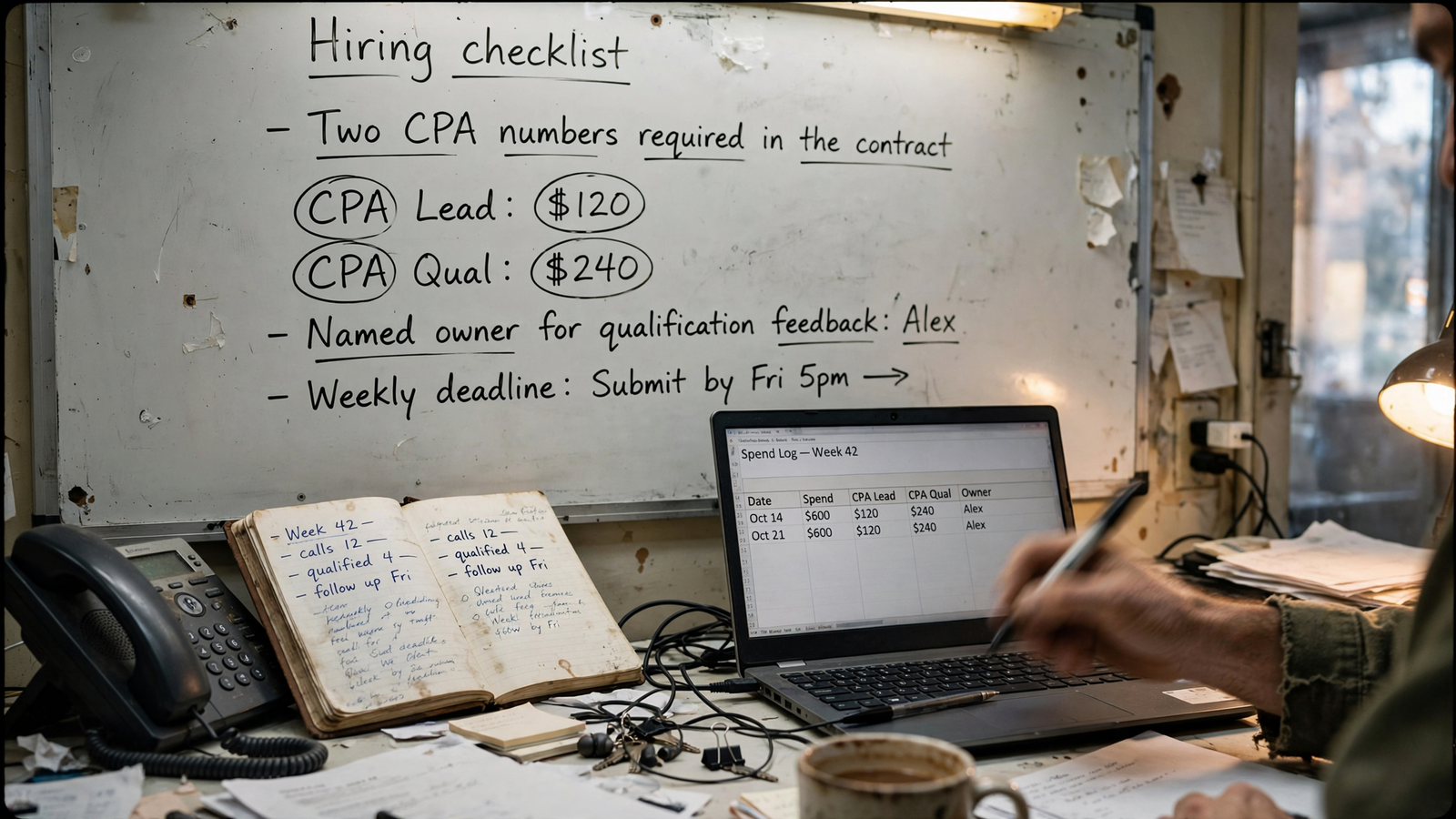
- The contract names a weekly deadline: who sends the updates, who checks them, and who answers when the feed breaks.
The evidence today is that the missing join already explains the reporting gap, while the tools to send outcomes back already exist. A B2B team making the same move from tracked events to downstream outcomes addressed its pipeline problem by changing what it optimized for. That is evidence for the mechanism, not proof that phone-first contracts have already changed.
Without qualification feedback, bidding keeps learning from the tracked events it receives, whether or not those events become useful work. Reporting a booked-job CPA after the fact is helpful. Feeding the outcome back is what lets the system learn from it.
What would prove me wrong: late-2027 contracts still leave qualification updates to an unnamed person doing them whenever they remember. If I am right, ownership and timing will appear beside the reporting promise.
Put the feed in writing. A booked-job CPA without reliable dispositions is a wish, not a metric.
How I will score these bets in Q4 2027
Predictions without a scoring rule are just posture. Here is mine.
Build a baseline file of five to ten dated lead-gen proposals from early 2026, using proposals received or available publicly. Keep the provider names and screenshots of the reporting pages. Then score each proposal on three questions:
- Does it quote platform CPA and booked-job CPA side by side, with the formulas shown?
- Does it describe bid caps as cost controls rather than proof of lead quality?
- Does it name who marks leads as booked or sold and give a weekly deadline for sending those outcomes back?
Recheck the same providers in Q4 2027. Score each prediction separately. If most still report platform CPA alone, still sell caps as the fix for bad leads, and still leave the feedback feed unowned, I lose all three bets. I will say so.
I have not measured the market flipping yet. The pressure for two numbers and the availability of offline-conversion tooling are why I am betting this way. Whether contracts actually change is the part to count.
Save the proposals, not just the promises.
What I would put in the contract before anyone touches bids
If I were hiring for a phone-first business tomorrow, I would require four things:
- Report both CPAs every week. Show cost per tracked lead and cost per booked job, with the math visible and contact rate and booking rate underneath.
- Name the feedback owner. Specify who marks each lead as booked, sold, or dead, and set a weekly deadline for uploading those outcomes with the relevant click IDs.
- Separate cost controls from quality promises. State what a CPC ceiling or bidding target is intended to control. Prove lead quality separately in the booking data.
- Name one human accountable for the outcome. Someone must explain what happens when tracked CPA falls while booked-job CPA rises.
That last line matters more than it sounds. I have fired agencies that sent a fine monthly PDF while three different juniors made changes nobody could explain.
What I want now is continuous execution I can audit and a strategist who can say plainly: tracking is clean, spend bought this many tracked calls at this platform CPA, the diary shows this many bookings at this booked-job CPA, and here is the next change with the reason attached.
That is why groas fits this kind of account better than a percentage-of-spend manager. It combines always-on work on bids, budgets, negatives, and tracking checks with logged actions and reasoning, plus a named senior strategist responsible for direction inside the agreed guardrails. The flat monthly fee carries no percentage markup. The bill does not rise simply because ad spend does.
What groas cannot do—and no honest manager can—is guarantee booked jobs. Booking depends on answer speed, service area, price, and how the business dispositions leads. groas can make that visible and optimize toward it once the outcomes are fed back. It cannot close the job for the business.
That is the useful division of labor: continuous execution, clear strategic ownership, and booking feedback from the people who know what happened after the phone rang.
If I am right, I would not wait for 2027 to act like a 2027 buyer. Start with the last 90 days and calculate both numbers:
- Ad spend ÷ tracked calls or forms = platform CPA.
- Ad spend ÷ jobs actually booked = booked-job CPA.
If they point in different directions, stop arguing about the CPC cap and fix the join first: store click IDs with leads, update dispositions weekly, and send the agreed booked and sold stages back to Google. That feed changes what Smart Bidding can learn.
Then make every prospective manager answer three questions in writing before signing:
- Will both CPAs appear every week, with the formulas shown?
- Will the manager describe caps as cost control and prove quality separately in the booking data?
- Who owns the feedback feed, by what day, and who answers when tracked CPA falls while booked-job CPA rises?
A proposal that cannot answer those questions is selling the cheaper number. Get a full audit and bring both numbers. The audit is worth more when it is clear which one actually needs to fall.


