

 LinkedIn

By November 2027, at least six of the ten ChatGPT marketing apps I’m naming today will advertise live ad account access and outside evidence as core features. The account connection gets an app on the shortlist; the evidence it brings from outside the account gets it bought.
I’m writing this on November 28, 2026, after most of a decade running Google Ads by hand for small ecommerce brands and home services clients. I stopped trusting fluent answers years ago. A confident paragraph about why CPA rose tells me nothing until I see the dates, the campaigns that moved, and what changed outside the account. Cause first, then the number.
That’s the buying rule behind the bet: buy the evidence, not the wording. I want to know what competitors are running, what customers say about the problem, and which pages AI answers cite when they recommend someone else. A prompt library can help me phrase the question. It can’t give the assistant evidence it doesn’t have.
Prediction 1: Six of ten apps will sell outside evidence alongside live account access
I’m freezing the shortlist now so I can’t move the target next November: groas, Superscale AI, Pipeboard, Optmyzr, Windsor.ai, Adzviser, Supermetrics, Ryze AI, Madgicx, and Composio. I’ll use the same test for all ten. To count, an app has to advertise a live read of an ad account and at least one outside evidence source on its pricing or features page. The outside source has to be one of these:
- Competitor advertising
- Customer research
- Tracked citations in AI answers
A blog mention doesn’t count. Generic web browsing doesn’t count. Neither does a prompt library, however nicely the prompts are organized.
The mechanism is already visible in how these tools are compared. One comparison looks at whether a single plugin can read Meta Ads, Google Ads, and Shopify, check competitors’ public ads, and leave edits waiting for publication. Meta’s official MCP is the Meta-only alternative in that comparison. Account coverage tells me where I can use a tool. Competitor evidence tells me whether it can answer a question the account can’t. Those are different reasons to buy, and the second becomes more important once I can get the first in more than one place.

What proves me wrong: Fewer than six qualify in November 2027. Even if six clear the feature count, I’ll have overcalled the buying shift if connector counts and prompt libraries still lead the sales pitch and outside evidence sits in a side tab. For now, I’d make each app show me what it can bring to the account review, not just which accounts it can open.
Prediction 2: Account-only reports will lose their say over budget moves
I used to tell clients the account held the answer if we segmented hard enough. I was wrong. The account records the click and the conversion it can see. It doesn’t necessarily record the AI answer that shaped the shortlist or the call or chat where the deal moved. When the buying path splits like that, more detail inside the account doesn’t fill in the missing steps.
In a survey of 451 US marketers, only 19% said they could send AI-agent conversion data back to ad platforms. Only 26% could tie an agent conversation to the campaign and keyword that started it. And 74% said they couldn’t fully track a lead from first touch to conversion. That’s how an app can give me a clean CPA report and still leave me with a bad reason to move money.
The IAB’s AI-Era Attribution Blueprint, published November 12, 2026, separates sales into Human-Owned, AI-Assisted, and AI-Executed based on who created intent and who closed the sale. Comparing AI journeys with traditional ones was the top challenge ad buyers cited, at 45%. Another 44% said they used branded search or direct as a proxy for influence they couldn’t track. The blueprint spells out the problem: click and referral evidence is thinning, AI-influenced sales often get reported as search or direct, and much of the proof sits inside AI platforms.
What proves me wrong: By next November, the ad account can routinely tie agent conversations back to the campaigns and keywords that started them and show how those leads converted. If I can see the path in the account, I don’t need an outside source to reconstruct it. Until then, I want the evidence behind the budget move, not just the report that prompted it.
Prediction 3: Rankings alone will stop settling budget arguments
In that same survey, 44% of marketers said AI answer engines produced their most qualified leads, ahead of Google Local Services at 40%, organic search at 39%, paid social at 37%, and paid search at 36%. That doesn’t make a rank report useless. It makes it a report about one surface. It can show me where a page ranks. It can’t show me whether ChatGPT, Claude, or Gemini put a competitor on the shortlist or which page the answer cited to make its case.
AI visibility tools already track that other layer. They run buyer-phrased prompts on a schedule and log mentions, citations, and which competitors appear. In one June 2026 baseline covering 101,574 sites, ChatGPT accounted for 74.78% of measured AI referral traffic. Referral traffic shows me the visits that made it through. The answer itself shows me what the buyer saw before deciding where to click.
That’s how I read the November 20 small-business discussion about whether SEO has become a different game. The owners aren’t writing an obituary for SEO. They’re asking why rankings no longer line up with leads they can measure. I’d start with the pages worth citing, not another report, which is the point I made in Stop Buying AI Visibility Reports Before Your Pages Are Worth Citing.
What proves me wrong: By November 2027, checking who gets cited and which pages earn those citations doesn’t change the page or budget decisions I’d make from rankings and account results alone. If the extra report never changes the call, I don’t need it. Until then, I want an app to show me both the account results and the citations before I decide where to spend.
Three prompts that separate evidence from a fluent guess
I run the same three checks on any app that claims to work inside ChatGPT. They take five minutes. The first asks what happened in the account. The next two ask what the account can’t tell me. If the answer has no dates and no source, it fails. My sibling forecast is about editing ads in ChatGPT becoming standard. This test is about whether I’d trust the recommendation enough to make the edit.
1. Ask for the account records behind the recommendation
For [campaign name] over the last 30 days, show spend, conversions, cost per conversion, and conversion rate by campaign, with dates and source records. Flag any missing conversion data.
Through the groas MCP server, ChatGPT can pull from live Google Ads, Meta, and Bing accounts instead of guessing from training data. What I look for is boring and specific: a table with dates, named campaigns, and a warning where tracking is thin. A missing conversion record isn’t the same as zero conversions. If the app can’t show me where the number came from or admit what it can’t see, I don’t let it touch budget.
2. Ask what outside evidence supports changing the message
For [product or offer], show three to five live competitor ads with hooks and landing page offers, plus what customers say on Reddit about this problem. Separate what you observed from what you infer.
This is where a ChatGPT setup that relies on generic browsing falls short. I don’t want a few pages it happened to find. I want the rival ads and the funnels they lead to. Connected through groas, ChatGPT can query competitor ads on Google and Meta, the landing pages and steps behind them, and Reddit discussions collected around the clock.
I want two columns back. The first lists the ad, the hook, and the price or claim. The second says what the assistant thinks it means for my offer. A competitor leading with flat pricing is an observation. Saying I should lead with flat pricing is an inference. If the app blurs the two, I discard the recommendation.
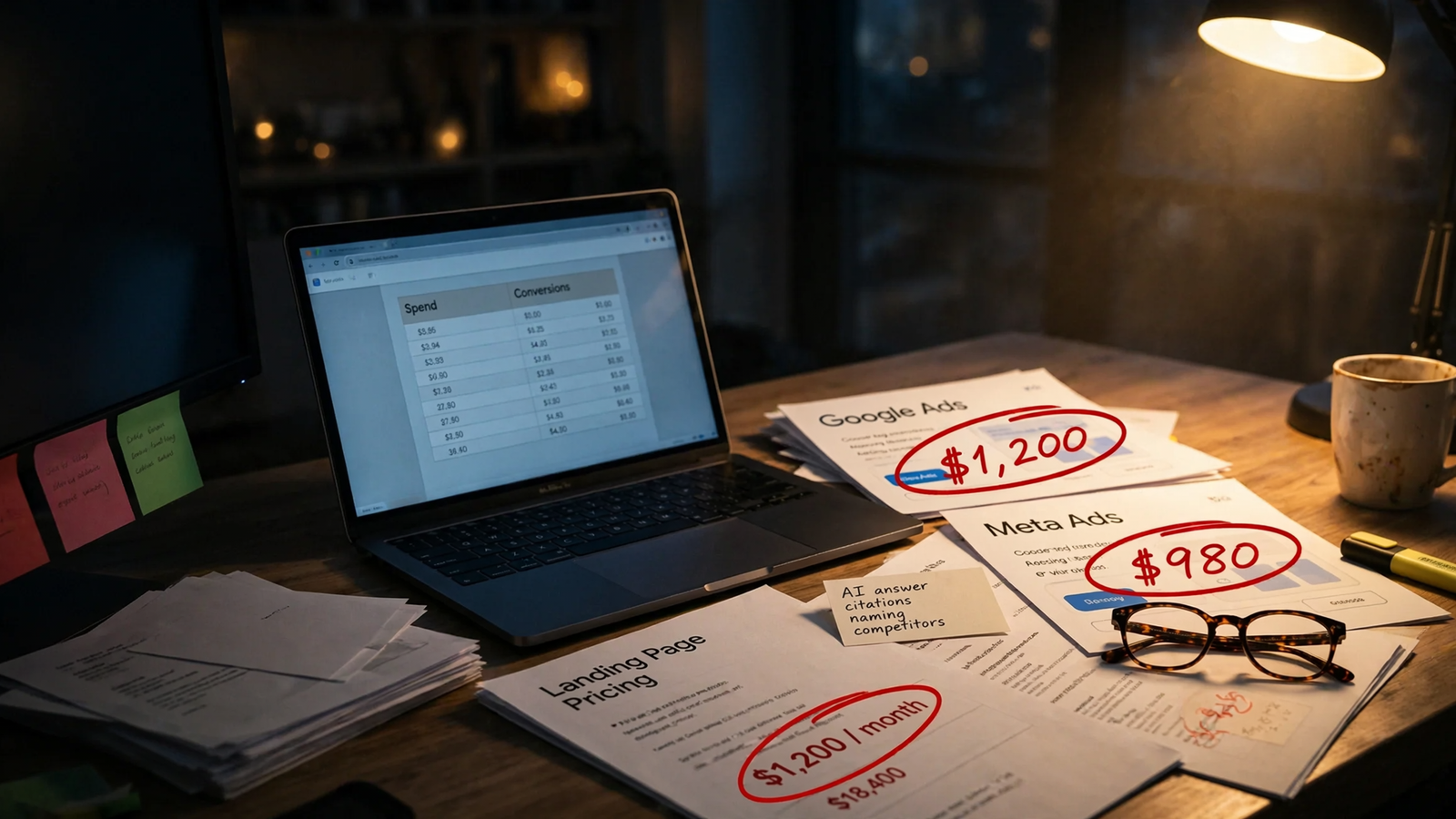
3. Ask where AI answers recommend someone else
For [buyer-phrased query], show where our brand appeared in tracked AI answers in the last 30 days, which sources were cited, and which competitors appeared instead.
Groas tracks how AI answers talk about a brand and whom they cite, alongside SEO data from Semrush and Ahrefs. That gives ChatGPT something I can check: the prompts tested, the dates, and the pages cited. It doesn’t give the assistant grounds to claim a mention produced revenue.
Say I’m spending $20k a month and an answer names my brand twice without a citation. I have a reason to look at the page. I don’t have a new input for the ROAS calculation. A citation is evidence about the shortlist, not a sale.
Use the evidence to approve one next step
When those checks give me something worth acting on, I ask for a draft, not an edit:
Propose one campaign change and one page change from the evidence above. Give me the scope, budget cap, and dates, then wait for my approval.
Say Google Ads shows a search campaign at $68 CPA against a $45 target for 21 days. Rival ads lead with flat pricing, and tracked answers cite a competitor’s pricing page. The draft might suggest pausing the worst ad group, moving $500 to the tighter exact-match campaign for seven days, and adding a pricing block to my page. The account shows me where to look for wasted spend. The outside evidence gives me a page change to consider. Neither proves that copying the competitor will fix CPA.
I approve the scope before anything runs, then check the log after the change. With groas, autopilot stays off until I switch it on, and changes are logged with a reason and can be undone. Before I approve, I want the campaign name, the dollar limit, and a reason tied to both the account record and the outside evidence. “Best practice” isn’t a reason. Neither is “expected uplift” with no source.
What I’d do before next November
I’ll check the same ten names against the same rules in November 2027. If fewer than six qualify, I’ll retire the claim in public. A forecast without a kill condition is just a slogan with a date on it.
In the meantime, pick one decision that costs money and run the three prompts before you make it. Maybe it’s whether to pause the search terms bleeding $400 a month. Maybe it’s whether to rewrite the pricing block when AI answers keep citing a competitor’s page. Keep the app that returns dates, named campaigns, and cited pages you can check. Cancel the one that returns fluent paragraphs.
Groas is one working example today: live account actions, competitor evidence, and tracked AI answers in the same ChatGPT session, with changes logged. Whether my six-of-ten bet lands or not, I’d rather pay for the evidence behind a budget decision than for a better-written guess.





