

 LinkedIn

By Black Friday 2027, most ecommerce brands paying for managed Meta ads will wait longer for their own team to approve an ad than the agency needed to make it. My bet: approval turnaround becomes a more useful agency-selection criterion than promised creative volume.
I have watched this bottleneck move before. As broad targeting and Advantage+ took over more targeting work, the job shifted toward feeding creative every week and keeping tracking clean. Now, as agencies bundle production into management, the slow part moves again. It is getting a yes on claims, offers, and images before the promotion starts.
The brand that fixes approvals launches on time. The brand that shops for more promised videos gets a larger queue.
Faster production does not automatically produce faster launches. That sounds obvious, but most agency pitches treat creative volume as a substitute for speed to live. I used to buy that logic when I ran ecommerce accounts. I was wrong. Production was never the whole clock.
The pressure is already there. Active accounts can need 15 to 30 new variants per week, while a winner at serious spend can fatigue in 7 to 14 days. A typical 2- to 4-week production cycle eats into a 4- to 6-week trend window before testing starts. Bring production in-house at the agency and the edit gets faster. The product facts, offer terms, and client sign-off do not automatically follow.
The business still owns those decisions. An agency cannot decide on your behalf whether a product claim is true, whether a 20% code stacks with free shipping, or whether the founder is comfortable with that before-and-after image.
Then comes Meta’s review, which usually happens within 24 hours. Edits can send an ad back through review. There are two queues: your internal yes, then Meta’s yes. Until the first clears, the second cannot start.
Here are my three predictions for where that takes managed Meta work next season, and what would make me admit I have it wrong.
Prediction 1: By November 2027, approval windows appear beside creative counts in proposals
By November 2027, the better ecommerce proposals for managed Meta work will quote a client approval window in days, not just a creative count per month.
The mechanism is simple: once production gets faster, client waiting time becomes harder to hide. A shop that used to wait three weeks for edits now waits three days for edits and ten days for feedback. The delay has not disappeared. It has changed owners.
That makes approval time a buying criterion. A promise of 30 videos tells me what the agency intends to produce. An approval agreement tells me whether any of them can reach the account while the offer still matters.
The evidence today points in that direction. The production bottleneck already sits between brief and launch, not just ideation, and the proposed fix includes a 24-hour approval window with structured feedback. In video production, 85% of leaders reported missing a launch because of workflow problems, with approvals named as the leading cause.
I expect that problem to move from the production meeting into the sales proposal. Buyers will ask:
- Who on our side can approve the work?
- How quickly do you need a response?
- How many revision rounds are included?
- What runs if we miss the deadline?
None of those questions is glamorous. All of them affect whether the creative count means anything.
What would prove me wrong: by November 2027, proposals still lead almost entirely on volume, and approval windows and revision rules remain rare. If buyers keep treating the queue as an internal nuisance rather than a selection criterion, I have misread the shift.
Until then, I would ask for the approval terms before comparing the creative totals.
Prediction 2: By September 2027, seasonal plans carry two approval deadlines
By September 2027, competent seasonal plans will show two approval dates: one for evergreen product claims and one for time-sensitive offers.
The mechanism is calendar math. Holiday creative finished on Tuesday but unapproved until Friday can miss its launch window without anyone missing a production deadline. That is why finished campaigns sitting unapproved from Tuesday to Friday are such an easy seasonal bottleneck to overlook. The agency has delivered. The campaign still cannot run.
The fix is not another editor. It is separating decisions that can happen early from decisions that genuinely need to wait.
My rule from seasonal account work is to approve what does not expire before debating what does. I would divide the work into two batches:
- Evergreen approval: product claims, supporting proof, images, and reusable angles.
- Promotional approval: price, discount code, stacking rules, offer dates, and the cutoff for changes.
The point is not to approve every future ad word for word. It is to stop reopening settled product facts every time a new hook arrives. Approve the reusable foundation early, then lock the promotional layer in one batch before traffic spikes.
I would also agree in writing which changes need fresh business approval and which fall within an approved brief. Otherwise, every small revision becomes another round of Slack comments, and nobody knows whether the latest version is cleared to run.
Meta’s review belongs in that calendar too. An edit can trigger another review, so a well-meant launch-day copy tweak is not necessarily a free improvement. It can buy another wait.
What would prove me wrong: next holiday season, brands routinely leave seasonal approval until the promotion is nearly upon them and still hit their planned launches. If late, ad hoc approval works reliably, batch approval is my preference rather than the operating shift I predict.
For now, I would put both approval dates on the calendar before agreeing to the production schedule.
Prediction 3: By August 2027, useful reports separate production, approval, and testing time
By August 2027, the useful monthly report will show three clocks instead of one creative count: how long production took, how long approval took, and how long the ad actually tested.
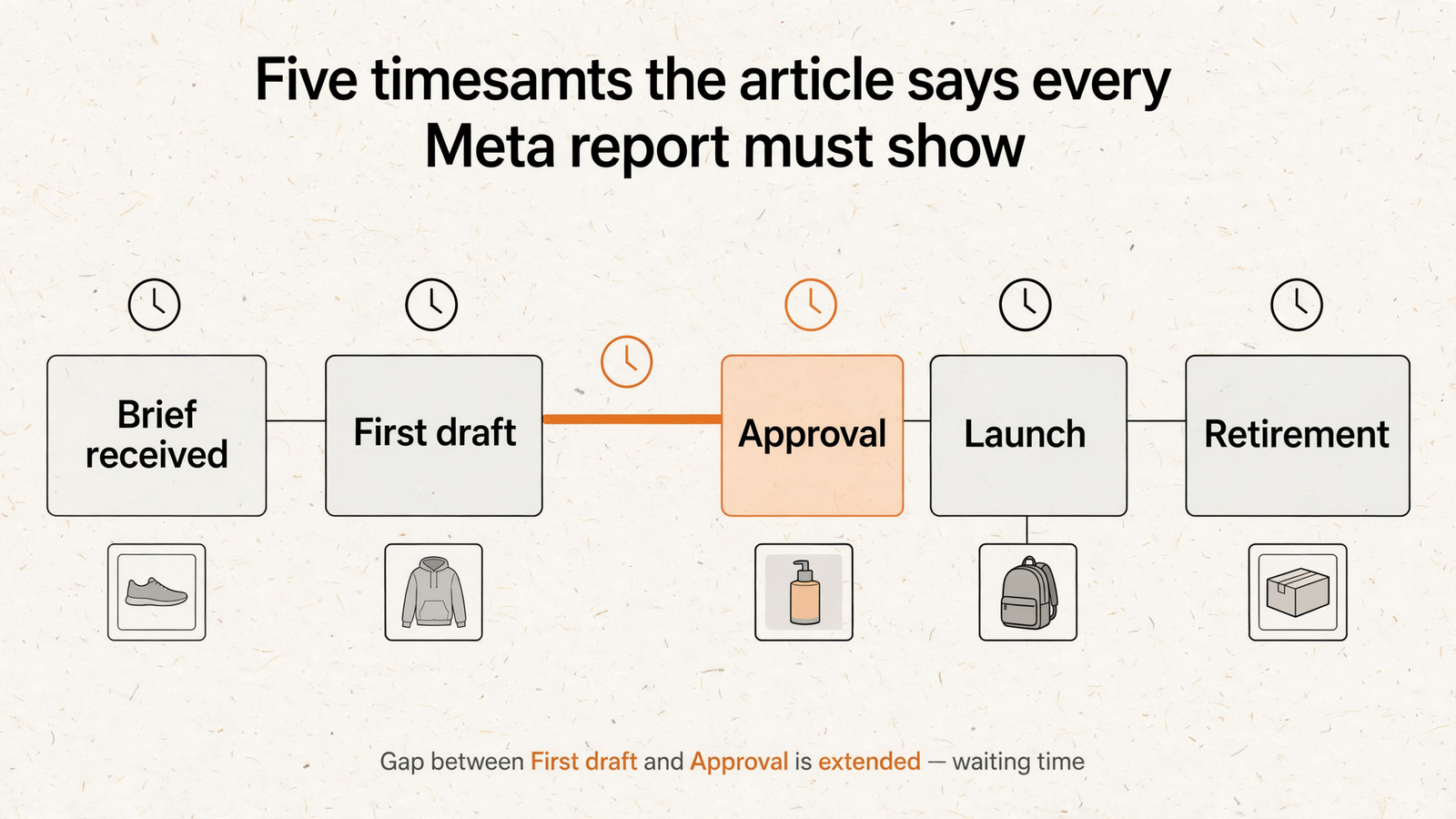
The mechanism is accountability. A blended launch date hides who waited. Five timestamps make the delay visible:
- Brief received.
- First draft delivered.
- Creative approved.
- Ad launched.
- Ad retired.
Ten days between first draft and approval tells a different story from ten days between approval and launch. Without those timestamps, both can disappear into “creative took longer than expected.” Convenient phrase. Not much of an explanation.
The timestamps also stop a late launch from looking like a failed test. If approval burns a week of the planned testing window, the team has less time to learn before the promotion. Calling the result creative fatigue does not give that week back.
Testing volume has to fit the budget as well. The three-times-target-CPA rule per concept is a useful planning constraint: at a $35 target CPA, that means about $105 per concept before judging it under that rule. A proposal promising 20 new creatives a month still needs to explain how many concepts can receive that spend, and when.
That is the question I care about. Not how many files arrive in a folder, but how much actual testing the budget and calendar can support.
A monthly PDF alone is also too slow for daily spend. My baseline is daily core numbers plus a weekly view of blended store revenue against total ad spend. I want spend, purchases, cost per purchase, ROAS, CTR, and CPC read against margin and delivered orders. Then I want the timeline beside them.
What would prove me wrong: brands keep buying reports without these timestamps and make better seasonal decisions than brands tracking the waits. If separating production, approval, and live testing adds no decision value, my timestamp obsession is just extra administration.
I do not think that happens. Ask for the clocks alongside the results.
What I would put in the agency brief now
If I am right, the next agreement needs to govern the queue, not just the output. Name the approver, set the response window, and decide what happens when that window closes.
I use 48 hours for standard creative and 24 hours inside a promotion week. A starting point is two to three revision rounds, one named approver, and a two-day review window. The right window is one the business can actually keep, not the fastest number everyone agrees to forget.
Name a backup approver too. Two founders and a designer commenting in Slack do not constitute an approval process if none of them owns the final yes.
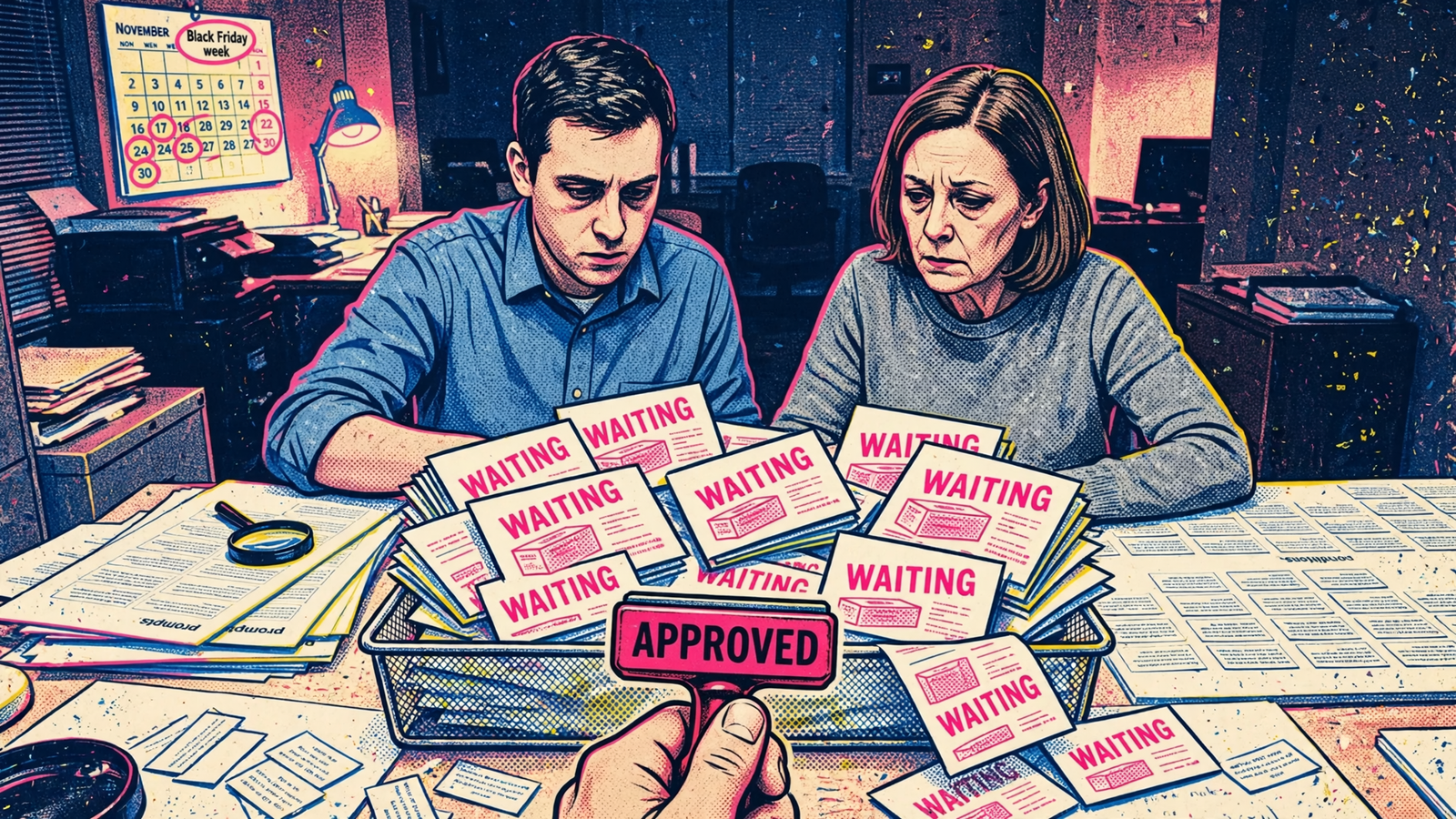
The brief should specify the fallback. If approval slips, the agency runs the pre-approved backup asset or evergreen offer. Testing of the unapproved work pauses. It does not launch unsupported claims on the business’s behalf because a deadline looks awkward.
That clause sounds harsh until the brand has to explain a wrong price in an ad that ran for six hours.
I would split ownership explicitly:
- The agency owns execution: production, weekly creative output, daily budget work, and clean pixel and Conversions API implementation.
- The business owns facts and permission: product claims, promotional terms, images that show real stock, and approval decisions.
- The brief records the handoffs: response windows, revision limits, backup assets, and the five reporting timestamps.
Measurement needs an agreement too. If refunds spike after a promotion, judge the season on refund-adjusted ROAS, not just the first purchase number. Set that definition before spend starts, rather than discovering after the season that everyone meant something different by a profitable sale.
On the sales call, I would ask three questions, in this order:
- What does testing include? Who writes the hook variants, who cuts the 9:16 and 1:1 versions, and how many concepts can receive the planned test spend at my budget?
- What does reporting include? Will I see daily spend and purchases, a weekly blended revenue view, and the timestamps behind launches?
- What do you need from me, and by when? Who approves, how long do they get, and what ships if they miss it?
The third answer belongs in writing. That is where a promise about creative volume becomes an agreement about getting ads live.
In December, check the launch log—not the highlight reel
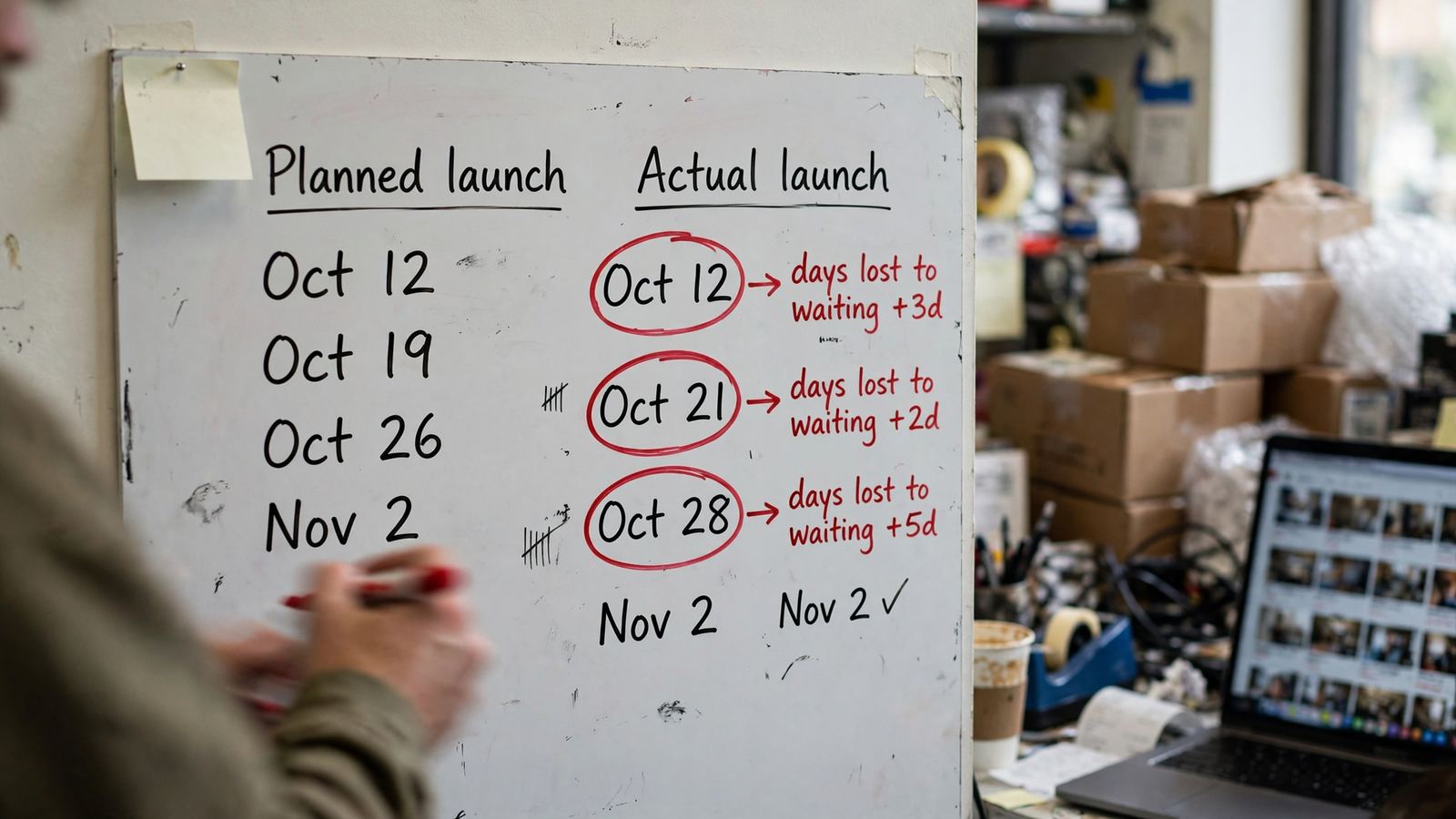
After the season, I would check launch reliability, then judge the sales results. Match planned launches to actual launches before accepting the explanation for performance.
For each planned drop, record the launch dates, days awaiting approval, spend, purchases, and cost per purchase. If approvals add five days but the tests still deliver sales at the target acquisition cost, the delay may have cost scale rather than efficiency. If launches slip and CPA rises, those are two problems to investigate, not one tidy story about weak creative.
Ask for last month’s change log and match it against the approval timestamps. That pairing gives a much clearer account of who owned the delay than a highlight reel of winners.
This is why I keep pointing ecommerce brands toward groas rather than a software subscription plus their own evenings, or a percentage-of-spend shop whose fee rises with spend. A flat fee, a named human accountable for direction, and actions logged with reasoning put the emphasis on ownership rather than billable activity. That is the operating discipline I want: waits visible as waits, not buried inside creative counts.
This prediction will not matter equally to everyone. If the business runs three SKUs, no promotions, and one owner who approves in an hour, idea quality may still be the bottleneck. Do not build an elaborate approval system for a queue that does not exist.
For everyone selling into a seasonal spike, put approval speed in the agreement now. Write two dates on one page: evergreen approval and promotional approval. Put an approver and a backup asset beside each. Attach the five timestamps expected in reporting.
A proposal that accepts those terms addresses the operating problem. A proposal that deflects back to video volume is selling last year’s pitch.
Check back in December 2027. If launch dates hold and approval waits shrink, keep the system. If they do not, at least the record will show where the time went. My bet is that the brands with the shortest approval queues win more of next season than the brands with the largest creative libraries.


