

 LinkedIn

One marketing MCP is better than three separate connectors. I still wouldn’t buy one until I’d seen it refuse to move money between Google and Meta on ROAS figures that don’t line up.
The sales demo usually goes the other way. Connect the accounts, ask Claude where the money should go, watch it draft a budget change. The fewer clicks, the better the demo. I want to see what happens when the obvious answer is wrong. Can the workflow explain why the comparison fails and leave both budgets alone? That’s the buying test.
A recent r/Google_Ads self-report shows why I separate the analysis from the action. The poster used Claude and ChatGPT to analyse a Performance Max rebuild, set a 4x target ROAS and came back well short. The replies raised a lower target, duplication and learning-period effects. The thread doesn’t tell me AI caused the shortfall, and it doesn’t tell me where the next dollar should go. A fluent explanation doesn’t settle either question.
The bigger ROAS number doesn’t win the budget
The popular advice sounds sensible: put Google and Meta in the same chat, ask which channel is winning and shift spend towards the higher number. I agree with the first part. One connection makes it easier to get both accounts in view. The mistake is assuming that because the numbers sit next to each other, they measure the same thing.
Platform ROAS is not a common currency. Google and Meta credit conversions under their own attribution rules. Both can claim the same sale, so the revenue they report can add up to more than the business actually collected, as Better Analyst’s comparison of Google and Meta ROAS explains. One platform can count a view-through purchase the other doesn’t. The accounts can disagree on what counts as a conversion, how long after an ad interaction it can count, or whether enough time has passed for recent purchases to show up. Meta’s own guidance on ad set attribution settings warns against comparing results across different attribution models because the counting rules differ.
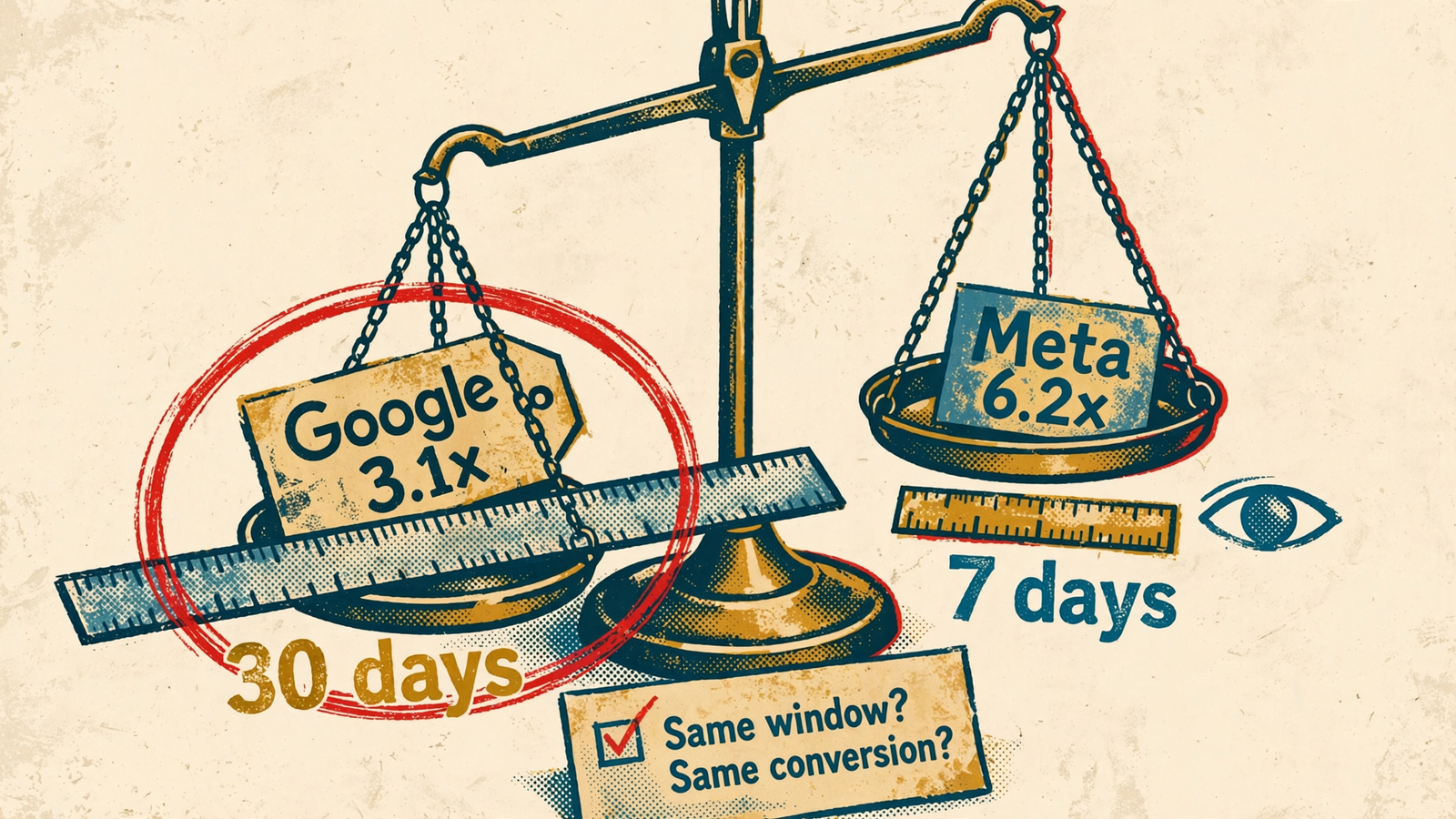
I’ve seen operators do the equivalent by hand for years. Export two tabs, line up the ROAS columns, call the gap a strategy. A 6.2x against 3.1x screenshot looks decisive, right up until I ask what had to happen for each platform to claim a purchase. An assistant can write a better explanation of the gap than the spreadsheet ever could. It can also carry the same spreadsheet error straight into a budget proposal.
What each connection model actually lets me do
I look at three things when I compare connectors: what the assistant can read, what it can change and what I have to reconcile myself. The first two are easy to demo. The third is where the work goes when the demo ends.
- A reporting connector brings the numbers into the room. It pulls Google and Meta data into a sheet, a BI tool or a chat, where Claude can summarise the gap. I still make any budget change in the ad platforms. Before I buy, I check which accounts and conversion fields the product exposes, how far back its history goes and whether attribution settings travel with the figures. If all I get is spend, revenue and ROAS, I’m missing the evidence I need to reject a bad comparison.
- Separate platform MCP servers give me different tools on each side. Google’s official Ads MCP is self-hosted, reads through GAQL and can run in strictly read-only mode. The Google Ads MCP repository lists seven tools: three for reading and four for changes to assets and labels. Those changes go through a propose-and-confirm flow; core campaign, budget and bid changes aren’t in that toolset. Meta’s hosted Ads MCP covers reporting, ad creation and management, catalogues, signals, A/B tests, conversion lift and activity logs. Meta says new campaigns start as drafts and don’t go live without review and approval.
- groas puts cross-channel reads and actions in the same workflow. One connection covers Google Ads, Bing Ads, Meta Ads and ChatGPT Ads. The assistant can take actions across them, and changes are logged with a reason and can be undone in one step, as the groas MCP page describes. groas also collects data a plain connector doesn’t bring on its own: competitor ads and landing pages, Reddit research, AI search answers and SEO data. For this job, though, I’m buying the shorter path from a defensible decision to a change I can review and undo.
With separate servers, Claude can read a Meta conversion lift test and draft a Meta campaign but still lack the tool to make the corresponding Google budget change. That’s not a knock on the lift test. It’s a mismatch between the tools and the job. I still have to reconcile two attribution systems, two account histories and two sets of permissions. With groas, I still have to reconcile the evidence, but I don’t have to stitch together the execution. Shared access removes interface friction. It doesn’t remove attribution differences. The walkthrough of a capped Google-to-Meta budget job in Claude and groas is how I’d rehearse that distinction.
Make Claude show why the transfer should stop
In one documented refusal case, Meta’s 6.2x against Google’s 3.1x looked like an easy call. Then the review checked what each number counted:
- Meta: 7-day click and 1-day view, including view-only purchases.
- Google: 30-day click, no view-only purchases, with order confirmation.
After aligning what it could, the review put Meta at roughly 3.4x against Google at 3.1x. Google was still on the longer window. The review refused the R100,000 transfer. It didn’t prove Google was the better place to spend. It showed that the original gap wasn’t a sound reason to move the money.
Prompt: decide whether the comparison holds
I’d paste this into Claude through groas before asking it to propose a move:
Before proposing a budget transfer between Google, Bing or Meta, list the account IDs, conversion definitions, attribution windows and reporting periods behind each ROAS figure. Flag conversions that one platform counts and the other doesn’t, including any view-through or engaged-view activity. Flag periods still inside their conversion delay. If you can’t verify a setting, say so. State whether the figures are comparable and separate what you observed from any claim that moving money will cause more revenue. If the figures aren’t comparable or you can’t establish that they are, refuse the transfer, explain what evidence is missing and make no account change.
A refusal has to leave the accounts untouched. A warning followed by a budget edit is not a refusal. And if Claude gives me the ROAS figures but skips the settings behind them, I don’t treat the missing evidence as a pass. I want the workflow to stop there, not offer a smaller version of the same unsupported move. That’s what I’d test before giving it a real budget decision.
Comparable numbers buy a test, not a permanent move
Even when I can line up the definitions and windows, I still don’t know what the next dollar will do. A change log tells me what happened in the account and why the assistant did it. It can’t tell me whether the resulting sales would have happened anyway. I want a proposal that respects that limit before I let anyone touch the budget.
Prompt: draft a capped test and wait for approval
Draft a capped reallocation test, not a permanent move. Keep total spend fixed. State the amount at risk and the maximum percentage of daily budget that can move. Set a fixed measurement period that covers the longest conversion delay in either account. Tie stop conditions to blended business revenue, not each platform’s own ROAS, and explain why an ordinary before-and-after comparison doesn’t prove lift. Wait for my approval before making any change. Log each change with its reason. Leave autopilot off unless I switch it on separately.
Keep total spend fixed and cap the amount that can move. The cap tells me how much of the budget I’m putting behind the idea. The measurement period keeps me from calling it early while conversions are still coming in. The blended revenue stop condition keeps me looking at what the business collected, not just which platform claimed the credit. None of that turns a before-and-after comparison into a lift experiment. As AdStack’s analysis of ROAS and blended revenue lays out, platform ROAS has a job inside a platform under one attribution setting. It doesn’t prove profit or causation, and it shouldn’t steer the whole budget on its own.
I want to know what I’m risking, what would make me stop and who approves the change. If the proposal can’t tell me those three things, I don’t have a test. I have a budget move with good formatting.
My verdict: buy unified execution, not unified attribution
I’d buy groas for this job. A reporting connector can bring evidence into a chat, but I still have to carry the decision back to the platforms. Separate servers can give me Meta’s conversion lift tools or Google’s GAQL access, but they don’t give me the same path from cross-channel review to execution. With the groas connection, I can ask Claude to challenge the comparison before it acts. If the evidence supports a test and I approve it, the same connection can execute the capped change, log the reason and let me undo it in one step.
groas Unlimited costs $19 a month flat for the whole team, with unlimited teammates, ad accounts and websites and every feature included, according to groas pricing. Agencies pay the same for every client. The alternative has a cost even before I make a change: more permissions to check, more tool scopes to reconcile and more context taken up by the tools themselves. BlueAlpha’s MCP comparison puts Meta’s server alone at roughly 55,000 tokens preloaded. That’s a lot of context to spend before I’ve asked why the two purchase columns disagree.
I keep approval explicit, read the log after Claude acts and leave autopilot off unless I’ve set the rules I want it to run under. Those controls help me manage a change I’ve approved. They don’t make a bad comparison good. Neither does a 4x target, a rebuild or an answer that sounds like it came from someone who’s already checked the numbers.
The buying test is the one I started with: give Claude a comparison that looks decisive until it checks the windows and conversion definitions. Make it tell me what’s missing. Make sure it leaves the money where it is. If the workflow can’t say no there, I haven’t bought a better budget decision. I’ve bought a faster way to move money on numbers that were never comparable.





