

 LinkedIn

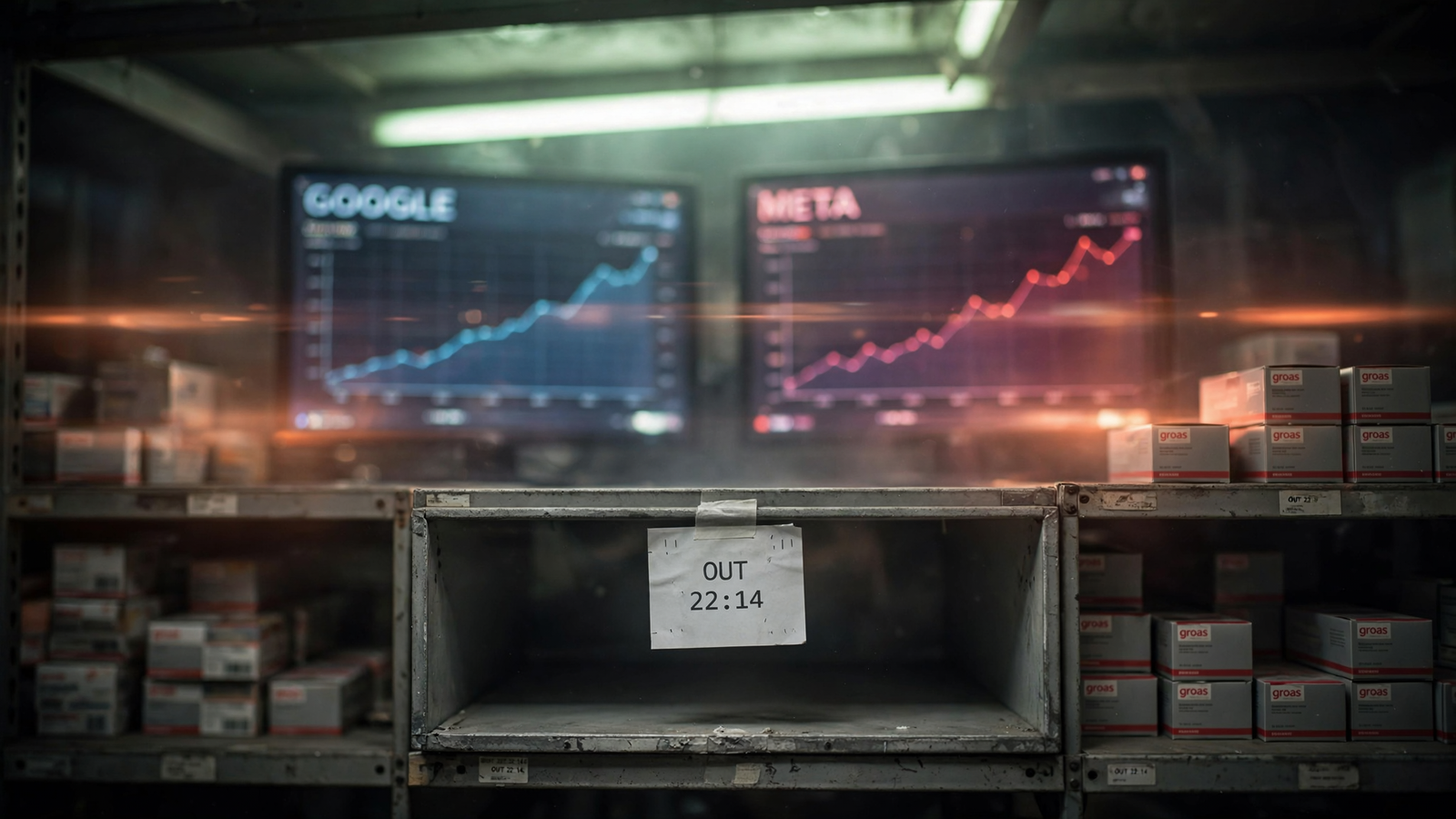
Say you spend $20k a month on ads: your bestseller sells out Friday night, Google Shopping and Meta keep sending shoppers to it, and you find out Thursday. If you run an ecommerce store selling the same stock through both channels, that’s the test I’d use to choose between Claude with the groas Marketing MCP and Claude with separate Google and Meta connectors. I’m not counting connectors. I want to know which setup lets Claude coordinate one response across both channels and whether it stops when the inventory evidence is stale.
I know this failure from running ads. The mechanism isn’t complicated: the ads keep buying clicks after the product stops selling. One stockout teardown puts numbers on it: $60 a day aimed at a bestseller that sells out Friday and goes unnoticed until Thursday. That’s $360 in six days, or about 300 clicks at $1.20 each. Catch it after one day instead of six and you save $300. That’s the clock I care about.
Google and Meta don’t share an auction, a budget, or a pause button. They share your inventory. The same product can show up in Shopping, Performance Max, a Meta catalog ad, and a search ad that links straight to the product page. Pause everything and you kill campaigns that still sell other products. Pause nothing and you keep paying to send shoppers to a page that can’t sell them the thing you advertised. I want to know which ads are affected, what should change, and what actually changed. None of that gives me permission to act until I’ve confirmed the stockout.
| Decision | Claude with groas Marketing MCP | Claude with separate Google and Meta connectors |
|---|---|---|
| Product mapping | One Claude conversation and one SKU-to-campaign list across both platforms | Platform-level results I have to reconcile |
| Approval and execution | One coordinated proposal for changes on both platforms | Manual Google campaign pauses; Meta writes under its own controls |
| Verification and recovery | One action log; one-step undo for a change | Meta history plus my own record of Google changes |
| Inventory proof | External stock evidence required | The same external stock evidence required |
1. Product mapping: Find every ad selling the same SKU
Start with one list of unavailable SKUs and match both platforms against it. It sounds obvious until I’ve accounted for the catalog ad and a standard Meta ad, a boosted post, or a Google search ad is still sending people to the same product page. A catalog can tell me what’s in the catalog. It isn’t a list of every live ad that links to the product.
With groas, I add https://mcp.groas.ai/mcp through Claude’s Connectors screen and sign in. That gives Claude access to Google and Meta Ads from the same connection. There’s a setup difference if I’m on Claude Free: one custom connector slot fits the unified server, not two separate servers. Handy at setup. Not why I’d trust it with a stockout.
I supply a timestamped stock list and start with the same short prompt:
Identify Google and Meta campaigns promoting these confirmed unavailable products. Make no changes yet.
Claude pulls campaign spend and destination URLs from both platforms and matches them to the SKU list. I want two groups on the proposal:
- Product-specific ads or campaigns: If all they sell is the unavailable product, they go on the pause list.
- Mixed-product campaigns: If they still sell other products, I want the affected creative or URL flagged for review, not the whole campaign paused.
That distinction matters when, say, a Google search ad links straight to the sold-out product while a Meta campaign also promotes items I can still ship. Both belong in the response. They don’t belong on the same pause list. If I can’t tell which product an ad is selling, the match gets marked UNSURE, not added to whichever list looks tidier.
With separate connectors, I can get platform-level answers. I still have to make them agree on which SKU each ad is selling. The separate-connector teardown shows why that matters: without a shared plan, a mixed-product campaign can land on a pause list when it needs an edit. I don’t care if both lists look complete on their own. I care whether the combined list catches the search ad pointing at the same sold-out product page.
2. Approval and execution: Know who can actually pause what
A coordinated proposal is useful only if I know who can carry it out. With groas, I review one list before Claude makes changes. Campaigns dedicated to the sold-out product can pause on both platforms. Mixed-product campaigns stay off the blanket pause list; those get a proposed creative or destination change instead. If a line just says “fix the campaign,” I send it back. I want to see whether I’m approving a pause or an edit before I approve either.
The separate official connectors have different write capabilities. The Google server’s tool list includes read tools and some asset and label operations, but no campaign pause or enable action. Claude can find the Google campaigns that need to stop, but I go into Google Ads and stop them myself. That’s a defensible restriction if I want Claude out of those controls. It’s also a manual step right when the ads are still spending.
Meta’s official connector can write. Its paused-by-default rule applies to newly created campaigns, ad sets, and ads. It doesn’t add an activation step to pausing an ad that’s already running. For the stockout, I keep Claude in one named Meta account, have it propose changes before making them, and rule out deletions. If something later needs to go live, I want that activation to be explicit.
There’s a separate job underneath both approaches: updating the feed. Keep the sold-out row and set availability to out_of_stock rather than deleting it. But that update doesn’t rewrite a standard ad that links to the product page. I treat the feed update and the campaign response as separate items to check. One doesn’t earn a tick because the other is done.
3. Verification and recovery: Check what changed on both platforms
An approved proposal isn’t a record of what happened. After the change, I want to know what moved on Google, what moved on Meta, and how I reverse a mistake. I check the result against the approved list. A campaign marked for a creative swap shouldn’t show up as paused just because it shares a product with a campaign that had to stop. And a confirmed Meta pause doesn’t tell me anything about whether the Google campaign is still running.
With groas, I check one action log that records each change and its reason. If I paused something I meant to edit, I can undo that change in one step. That’s not a reason to skip the review up front. It means I don’t have to reconstruct what I approved from a chat after I spot the mistake.
With separate connectors, I check the Meta history and my own record of the Google change. The official Google connector didn’t make that edit, so its output tells me what it recommended, not what I did. The setup works if I keep both records straight. If all I’ve got is a list of recommendations and the memory of clicking around at 11 p.m., I haven’t verified the response.
Undoing a mistaken pause and relaunching after a real stockout are different jobs. In the first case, I’m reversing a change that shouldn’t have happened. In the second, the pause was right; I need to check the store before I bring anything back. After a longer pause, I plan a gradual relaunch rather than going straight back to full budget. Before I let either setup touch real spend again, I run the four safety tests for approvals, recovery, and boundaries.
4. Inventory proof: Reject yesterday’s stock list
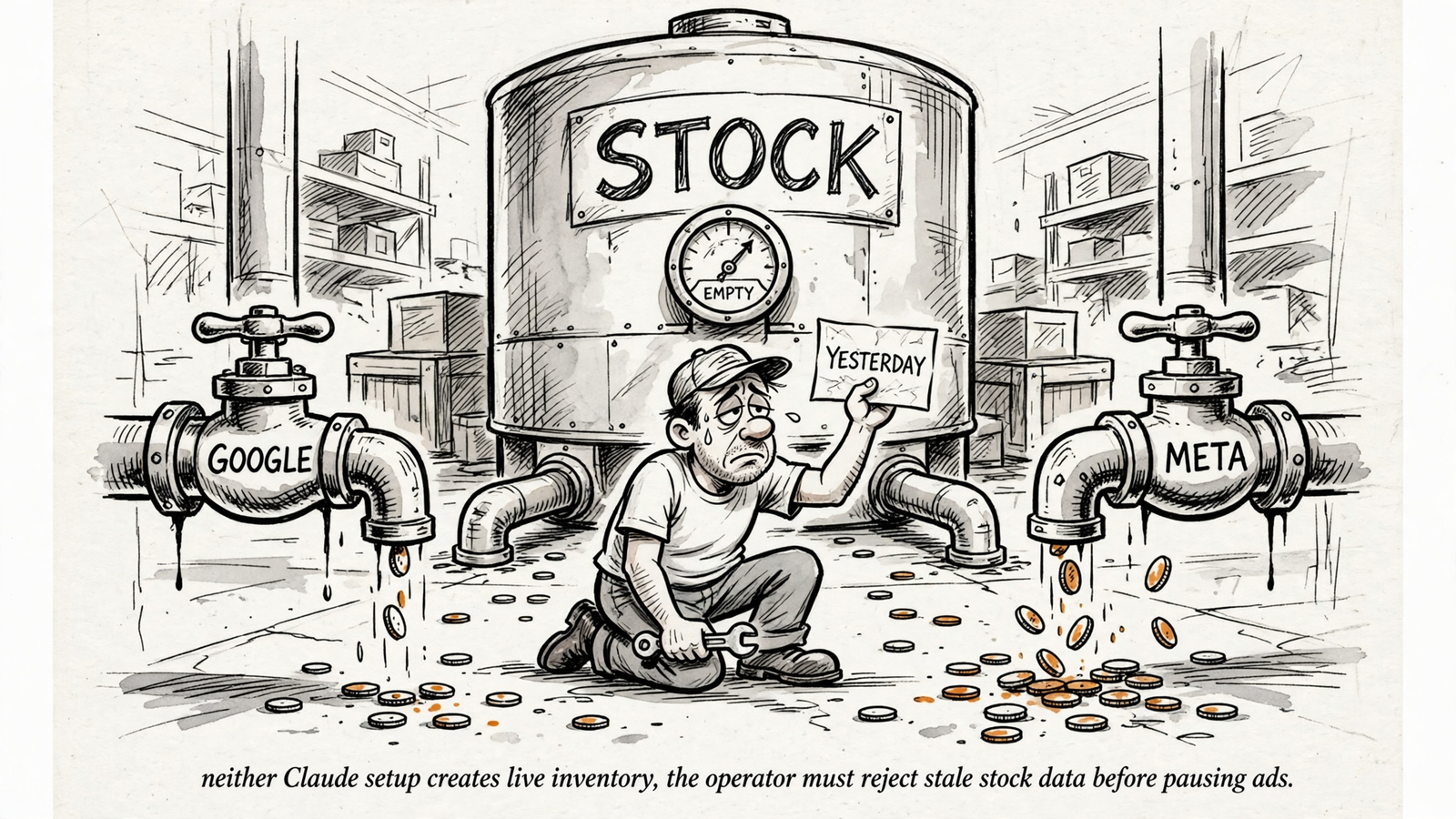
Neither setup creates a live inventory feed. I can hand either one yesterday’s Shopify export and get a perfectly plausible list of ads to pause, including ads for a bestseller that came back into stock overnight. Claude can match the right ad to the right SKU and still propose exactly the wrong action. The failure is in the input, not in how many connectors Claude has.
Meta catalog ads read an availability value, not a live count of units. A Shopify Flow alert can tell me a variant went out of stock. It doesn’t pause the ads, and it doesn’t tell me the variant is still out of stock when I read it. Same with a feed fetch: I want to know when someone checked inventory, not just when a file moved. A fresh fetch of an old export still leaves me with old stock numbers.
My rule is blunt: no timestamp, no pause. If the stock list predates the last feed fetch, Claude can prepare a proposal, but it waits while I verify availability against the store. I don’t take a newer timestamp as a pass if I already know the underlying export is stale. And if I can’t verify the stock, I don’t execute the pause. A cleaner approval screen doesn’t change that call.
When the evidence is missing, I run the 20-minute audit by hand:
- Pull available units and seven-day sales velocity. Record when I checked stock.
- Pull the live ads from both platforms with spend and destination URLs.
- Match URLs to products and reconcile by SKU, not by product name. Mark anything I can’t match
UNSURE. - Split confirmed matches into product-specific pauses and mixed-product edits. Leave uncertain matches out of the changes I approve.
That’s slower than pasting in a sheet and taking the answer. Good. I’m trying to spend less time reconciling ad lists, not less time checking whether a product is actually sold out.
Verdict: Pick groas for one stock pool across Google and Meta
For an ecommerce operator selling the same stock through Google and Meta, I pick Claude with the groas Marketing MCP. Claude can read both platforms in one conversation, build one proposal that distinguishes pauses from edits, and give me one place to check what changed. The broader comparison of setup and controls covers the trade-off beyond stockouts. What tips it here is simpler: I don’t want to merge two campaign lists while both platforms keep spending. In the $60-a-day example, the savings come from addressing the stockout days earlier. The connector doesn’t catch it for me. Its job is to help me act once I’ve caught it.
I’d keep the separate connectors if I’d already solved the coordination somewhere else, had room for both connectors, and specifically wanted Claude to leave Google campaign controls alone while retaining Meta writes. In that setup, I’m choosing to own the Google pause and keep separate records. That’s a real reason to pick the more manual stack. It isn’t a reason to trust yesterday’s export.
Unify the response, not your assumptions: verify the timestamped stock list or reject the pause.





