LinkedIn

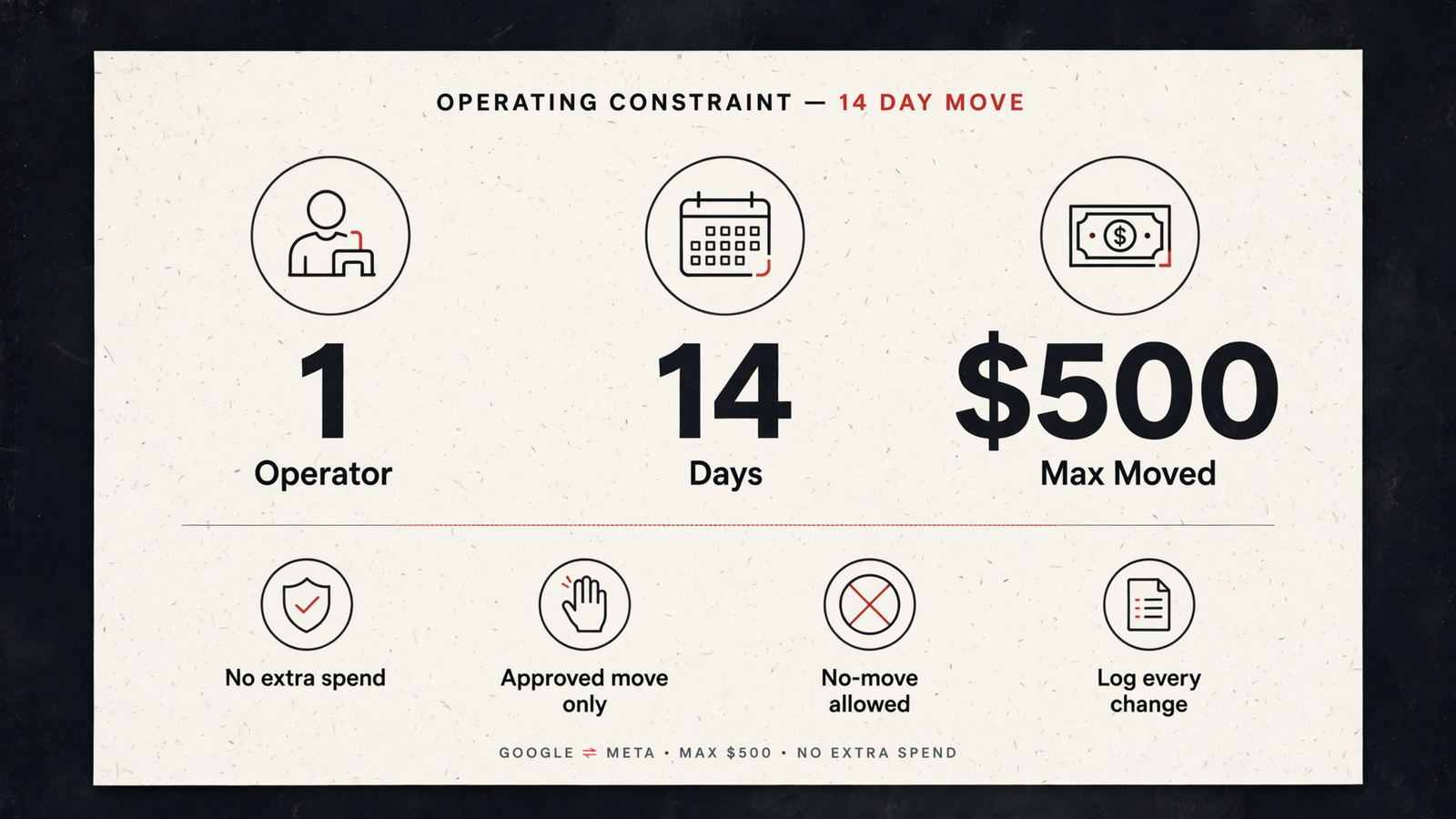
I give one operator 14 days, no extra spend, and a hard ceiling of $500 to move between Google and Meta. If Claude can’t make the case for moving any of it, the right move is $0.
I used to tell clients to shift money to the lower CPA. I was wrong. Average CPA tells me what the last $5,000 did, not what the next $500 will do. And if the platforms take credit for sales under different attribution windows, I can’t even assume those averages describe the same outcome. I use Claude through groas to settle what I’m comparing, show me what still doesn’t line up, and make only the move I approve. A prettier ROAS chart doesn’t count as approval.
1. Lock the $500 ceiling before opening either account
Cost: 20 minutes and $0 moved. Buys: a rule I can’t renegotiate midweek.
The $500 is the total I can reallocate across the 14 days. It’s not $500 per day or $500 per platform. Total planned spend stays flat: if Google comes down $300 for the period, Meta goes up $300 for the same period. The rest of the $500 is headroom, not money I have to find a home for. And if I stop a move early, I don’t get to pretend the money already shifted never moved.
Here’s what I cut: no second test, no new creative, no bid strategy flips, no structure rebuilds, and no audience expansion. Each change needs its own read. If I change the ads and move the money at the same time, I’ll spend Day 14 arguing about which one mattered. That meeting doesn’t need to happen.
I start Claude with a narrow instruction: “Read these two account IDs. Don’t change anything. Wait for my approval before applying any budget edit.” That keeps the first job an inspection, not an execution. I don’t want an assistant editing budgets while it’s still guessing what I call a conversion.
2. Days 1–2: Agree on what counts before comparing channels
Cost: two days and $0 moved. Buys: a comparison that doesn’t confuse platform credit with sales.
I ask Claude for one measurement contract, not a recommendation. For each account, I want the conversion name and the event behind it, the attribution setting for each campaign or ad set, the currency and time zone, the exact dates pulled, and when reporting is expected to be complete. If Google counts a form submission and Meta counts a purchase, I don’t have a budget problem. I have a definition problem. Moving $500 doesn’t fix it.
Even when both platforms count purchases, they may count different purchases. The same $1,000 in spend and the same pool of 50 buyers can show up as 0.8x ROAS on a one-day click window, 1.4x on a seven-day click window, and 1.8x on a 30-day click window. The sales didn’t change. Which sales the platform could take credit for did. Google sets its window per conversion action; Meta sets it per ad set. I ask for the settings in use, not whichever defaults Claude remembers.
The contract needs to keep two rows separate:
- Platform-attributed conversions: the purchases or leads each platform claims under its own rules.
- Deduplicated business outcomes: the orders or qualified leads the store or CRM records once.
Those rows won’t necessarily reconcile. In one published case, Google claimed 80 sales, Meta claimed 65, and Microsoft claimed 30. The business recorded 95. That’s an 84% overcount when the claims get added together. A separate sample of 50 stores put combined platform claims at a median 1.3x matched sales. Event or transaction IDs can help clean up duplicate counts inside a platform. They don’t settle which platform gets credit when both claim the same order. Neither does putting both numbers in one dashboard.

My stop rule is simple: no proposal if Claude can’t tell me what each account counts, which window it uses, what currency and time zone the report uses, or how far the numbers lag. I also need the business outcome I’ll judge the move on. If the contract can’t establish that, the budgets stay put.
3. Days 3–4: Ask for a transfer proposal, not a leaderboard
Cost: two days and $0 moved. Buys: a case for the next dollar, including a case for leaving it alone.
Once the contract holds up, I ask Claude to name a possible donor and recipient for the remaining period. Before it recommends a dollar amount, I want it to check recent budget edits, actual delivery against plan, and conversion cohorts old enough to judge. If a campaign spent $140 of a $200 daily budget because delivery was limited, the unspent budget doesn’t tell me it can absorb another $50 a day. The cheap CPA is answering a different question.
The gap between average and marginal performance can be expensive. In one budget allocation example, Meta averaged $337 per incremental customer, but the last $80,000 of spend cost more than $1,000 per incremental customer, against $510 on YouTube. The average still looked good because it included the cheaper customers acquired earlier. That doesn’t tell me where to put the next $500 in my accounts. It tells me why sorting by average CPA won’t get me there.
I want three options back from Claude:
- Move the full $500. Name the donor, the recipient, and what in the delivery and outcome data supports using the whole allowance.
- Move less. Say what supports a smaller change and why the full amount isn’t justified.
- Move nothing. Show which attribution conflict, delivery problem, or immature cohort makes the case too weak to act on.
That last option needs to use my numbers, not a boilerplate warning about attribution. If Claude has a reason to prefer one channel but no reason to think the recipient can spend the extra budget, I keep the money where it is. Same if the case disappears once I stop comparing the platforms’ headline ROAS.
4. Day 5: Approve the exact edits and the way out
Cost: one approval and $0 moved. Buys: a plan I can check against what actually happens.
Say I approve a $400 transfer over eight execution days, Days 6–13. That’s $50 a day out of Google and $50 a day into Meta: Google goes from $200 to $150 a day, and Meta goes from $150 to $200. I write down both account IDs, the budgets before and after, the start and end dates, and the maximum cumulative transfer I’m approving. The combined planned spend doesn’t change. Actual delivery can still come in differently; changing both budgets doesn’t guarantee that both accounts will spend to plan.
Before I approve, I run the eight checks for connecting Meta Ads to Claude. Then I put the stop conditions in the same note as the amounts:
- Scope: If either account, amount, or date doesn’t match the approved plan, don’t start. If the proposal is to do nothing, there’s no edit to approve.
- Pacing: On Day 9, if either account’s delivered spend is outside 20% of plan, pause the transfer and report. The 20% is my pacing tolerance, not a claim about what Meta’s learning phase can take.
- Reversal: Write down the original budgets and approve restoring them if the stop triggers. Anything beyond that reversal needs fresh approval. Restoring the baseline stops the rest of the move; it doesn’t refund spend that’s already delivered or authorize a transfer in the other direction.

I don’t build in a midweek rescue edit. A significant budget change can send a Meta ad set back into learning, and repeated edits make it harder to tell what I’m looking at. I approve one move and its way out, not a week of improvisation.
5. Days 6–13: Apply the approved move and leave it alone
Cost: up to the approved amount, never more than $500 in total. Buys: a budget change I can trace from approval to delivery.
Before anything changes, I have Claude read the edits back against the Day 5 note. In the $400 example, that’s $50 a day down in Google, $50 a day up in Meta, and the same eight dates in both accounts. If it matches, I tell Claude to apply the edits through groas. Every change is logged with its reason and can be undone in one step. On Day 14, I want to read that log, not reconstruct the week from memory.

I check pacing on Day 9. Within 20% of plan, I hold. Outside it, I ask for the approved reversal by name and verify the daily budgets in both accounts. I don’t trim the recipient, top up the donor, then trim the recipient again. Three small adjustments in a week mostly tell me I like touching settings. If Claude recommended no move on Day 4 and I accepted it on Day 5, I leave both budgets as they are. A good-looking dashboard on Day 9 doesn’t reopen the decision.
If I want a rehearsal before committing to the 14 days, I use the single-transfer cross-channel test instead of running it alongside this one.
6. Day 14: Close the decision record, not the attribution window
Cost: $0 in new transfers. Buys: a decision that distinguishes a weak result from an early read.
I ask Claude for four lines, in this order:
- Budget and delivery: how much of the $500 allowance I used and what each account actually spent.
- Mature outcomes: what the cohorts old enough to clear both reporting windows show, using the deduplicated business outcome from Day 2.
- Immature outcomes: which cohorts still have conversions coming in and shouldn’t be judged yet.
- Unresolved conflicts: where both platforms still claim the same buyer, or where their numbers otherwise won’t reconcile with the business record.
Day 14 ends the work, not the conversion lag. A before-and-after comparison doesn’t prove the move caused any improvement, even if the deduplicated numbers look better. I’m making a budget decision under messy attribution, not running an incrementality experiment.
I write down one of three decisions and stop:
- Retain the split if mature, deduplicated outcomes improved and delivery held to plan. That’s a reason to keep the split, not proof that the move produced the lift.
- Reverse to the Day 5 baselines if delivery slipped, costs rose, or the mature data stayed too conflicted to defend the move. If nothing moved, I record that and leave it alone.
- Wait if the read is immature rather than negative. I name the cohort and the reporting cutoff: say, purchases from Days 10–13 reported through Day 20. Waiting doesn’t extend the temporary transfer. It tells me exactly what to review before approving another one.
I run this through Claude with groas because I need both accounts read, the approved edit made, and the change log ready on Day 14. A Google report in Madgicx’s unified dashboard doesn’t cover that job if the tool can change Meta budgets but not Google’s.
When the constraint lifts, I don’t start by spending more. I start with the next decision: if the mature numbers justify it, I move money in capped steps from below-breakeven toward above-breakeven channels and retest after each move. The next dollar can behave differently once the budget changes. If I can’t make the case for it, it stays where it is.