

 LinkedIn

Optmyzr, Opteo and Adalysis can all find work for a PPC manager to do. If you manage one to five accounts, or run an agency with 10 to 30, the choice is which kind of work you have time to act on. Despite what their different pricing pages might suggest, none removes the need for a person to direct, review or apply much of what it finds.
I ran accounts the slow way for years, negatives at 1am and all of it. My verdict after reading the docs and independent tests is blunt: these three are good at surfacing fixes, but they differ less on the hours a person still spends than their feature lists imply. The right pick depends on whether you have that person, and what you need them to spend those hours doing.
Meet the three contenders
Optmyzr is the rule builder for power users. Essentials starts at $209 per month on annual billing, or $299 month-to-month, for up to $25K in spend and 25 accounts. Premium starts at $389 per month; both scale to $500K in spend, and there is a 14-day trial. Optmyzr covers Google, Microsoft, Amazon, Meta and LinkedIn. Its Rule Engine lets you use View Suggestions to preview what a rule would do before it runs. I used to tell clients rules would save them. I was wrong about how fast that happens: expect four to six weeks to get proficient. Its G2 Ease of Setup score is 8.7, against Opteo’s 9.5. Budget time to build the system before you count the time it saves.
Opteo is the guided list for small teams. Basic costs $129 per month for 10 accounts and $25K in spend, with a 24-hour refresh. Professional costs $249 for 25 accounts and $100K, with a 12-hour refresh; Agency costs $499 for 75 accounts. Annual billing saves two months. You get a prioritized list of fixes, projected impact, one-click apply, and Slack or email alerts. In independent testing across $25K to $200K accounts, it scored 8.5 out of 10 for one-click fixes. That fits the appeal: fast to value on one to five Google Ads accounts. Nothing changes until you click.
Adalysis is the ad-testing and audit specialist. Entry costs $149 per month for $50K in spend, or $126 on annual billing; higher tiers run from $349 at $250K to $2,500 at $4M. Every tier has the same features, unlimited Google Ads and Microsoft Ads accounts, and unlimited users. The trial lasts 30 days, extending to 45 to 60 days on higher tiers. Its depth is in an automated A/B testing engine, Quality Score tracking, 100-plus audit checks, and n-gram and keyword-conflict tools. It can identify winning and losing responsive search ad assets and, with permission, auto-pause losers. Independent testing scored it 8.7 out of 10 for ad testing. If creative testing eats your Fridays, start here.

Axis 1: What runs without your next click?
This is where the sales pages get polite and vague. Optmyzr runs rules, but you write and check those rules first. On Essentials, they run weekly or monthly; on Premium, daily; on Enterprise, hourly. That is useful automation once you know what you want it to do. It is not a substitute for deciding what the rules should be.
Opteo queues fixes and shows projected impact, but changes wait for your click. Adalysis can auto-pause losing ad assets after they clear its significance threshold, but it does not change accounts without permission by default. These are different levels of execution, not identical to-do lists. The common limit is that a human still sets the terms and checks the work. Plan your week around the work left to you, not the word “automation.”
Axis 2: Who takes ad testing off the spreadsheet?
Adalysis wins ad testing. Its engine watches responsive search ad assets, identifies winners and losers when the math clears significance, and can pause losers once you allow it. Quality Score tracking separates expected clickthrough rate, ad relevance and landing page experience. N-gram mining helps you inspect the word combinations behind performance.
Optmyzr offers partial coverage through rules that flag weak assets and a testing log. Its 8.9 out of 10 score for agency rules speaks to a different strength; it does not turn Optmyzr into the ad-testing specialist. Opteo’s comparison entry lists one-click fixes and no ad testing. If you run 40 ads across five clients and check winners in a spreadsheet, Adalysis is the one built to replace that routine. The other two may help you manage the account around it.
Axis 3: Which workflow holds up across client accounts?
Optmyzr has the broadest agency toolkit here. Its Rule Engine spans Google, Microsoft, Amazon, Meta and LinkedIn. PPC Investigator traces a cost spike through campaign, keyword and device, while its Shopping and Performance Max builder reads a Merchant Center feed. Amazon sellers can also bring inventory, Buy Box and returns data into automation. For a manager juggling different channels, that breadth is the point.
Opteo is narrower by design: Google Ads only. It keeps client-facing work tidy because changes appear as an MCC email in client change history, and its London team offers Monday-to-Friday support. Adalysis takes another route: unlimited Google Ads and Microsoft Ads accounts and unlimited users on every plan. It also does not appear as a user or manager in the account. Choose Optmyzr for cross-channel rule work, Opteo for a simpler Google Ads workflow, or Adalysis when more accounts and users should not mean more seats on the bill.
Axis 4: What makes the bill grow?
Optmyzr charges for both spend tier and plan power. You choose a spend ceiling from $25K to $500K-plus, then Essentials, Premium or Enterprise. Plan choice also determines how often rule automations run; Shopping, Performance Max and social Rule Engine features are Premium-only. More speed or more channel capability can therefore change the price even before spend does.
Opteo’s tiers reflect connected accounts and spend. Billable spend is the total monthly spend across connected accounts and MCCs. Basic is $129, Professional $249 and Agency $499 per month, with two months saved on yearly billing. Adalysis keeps features flat while the spend ceiling rises: $149 per month at $50K, $349 at $250K, $950 at $1M and $2,500 at $4M. It offers 10% off a six-month term or 15% off annual billing and sends an auto-tier-up email four days before the move.
The sticker prices matter. So does the line none of them puts on an invoice: your learning and review time. That is where a cheap plan can become an expensive habit.
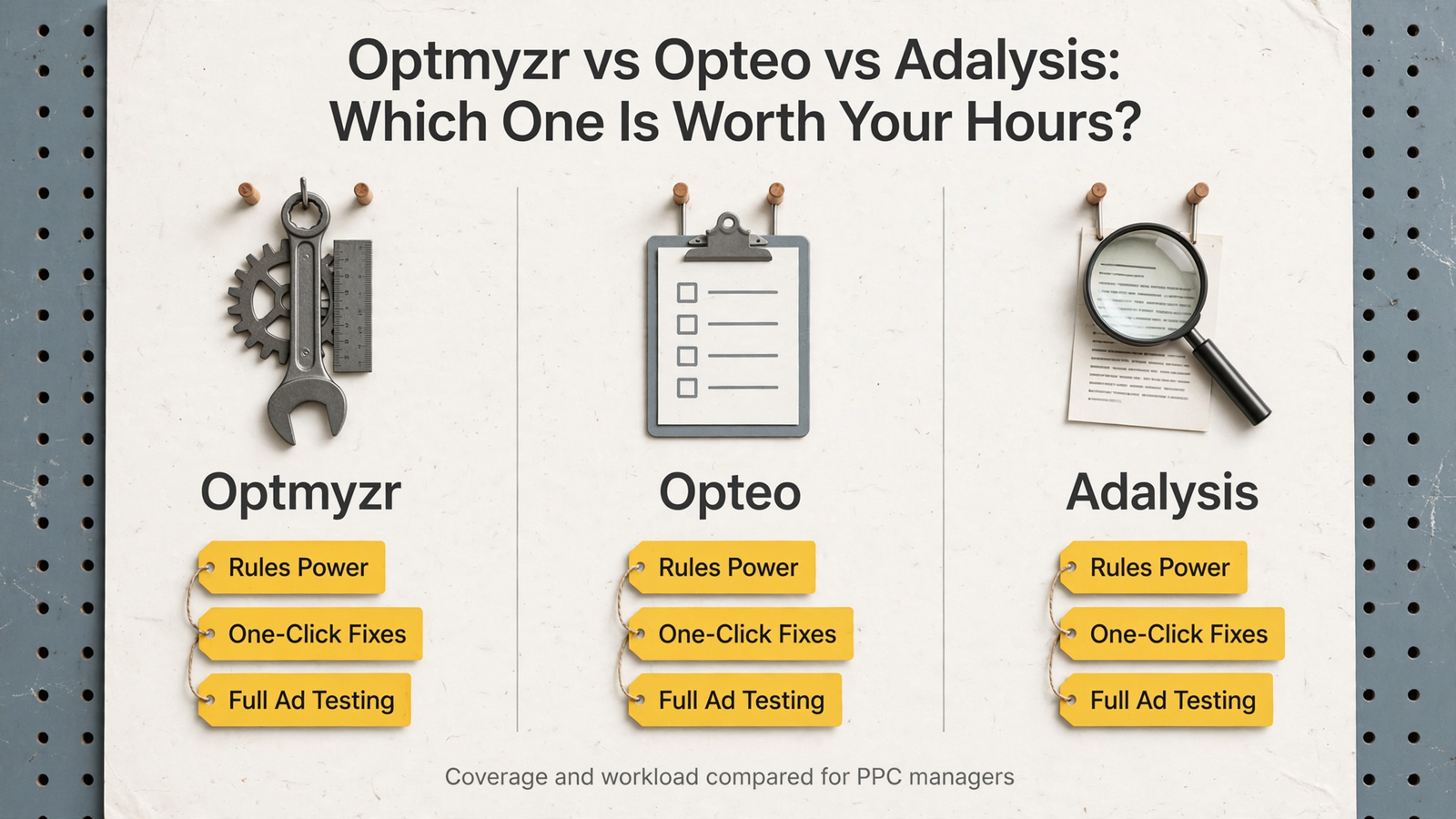
Axis 5: How many human hours does value take?
A 2026 roundup lays out the work in calendar terms: Opteo alerts on Monday, recommendations applied Wednesday, reporting Friday. For Adalysis, it describes a standardized four-week schedule for RSA, landing page, bid and audience testing. Neither schedule is a promise that a tool will run the account for you. It is a reminder to reserve the time.
Here is how I would budget it for a $20K-per-month book across three accounts:
- Opteo: two to three hours a week to read suggestions, apply the ones that make sense and check change history.
- Adalysis: three to five hours a week during test setup, then one to two once the A/B engine is pausing losers. You still need to review tests and supply the next angles.
- Optmyzr: eight to ten hours a week for the first month building rules, then two to four hours ongoing. The learning curve comes before the efficiency gain; one roundup puts that learning at roughly 80 hours.
Those are working estimates, not hours guaranteed by a pricing tier. The difference between tools is less dramatic once you include the person who reads, builds and checks their output. If you cannot spare even three hours a week, you have not bought hands-off management. You have bought homework. For the broader version of that problem, read why recommendation-only tools leave work on the table.
The verdict at a glance
| Optmyzr | Opteo | Adalysis | |
|---|---|---|---|
| Starts at | $209/mo on annual billing | $129/mo | $149/mo |
| Accounts | Up to 25 on entry tier | 10 on Basic; 75 on Agency | Unlimited on every tier |
| Channels | Google, Microsoft, Amazon, Meta, LinkedIn | Google Ads only | Google Ads and Microsoft Ads |
| What runs without a fresh click | Rules you set, on schedule | Nothing; one-click apply | Permitted auto-pause of losing ad assets |
| Ad testing | Partial | None | A/B engine plus n-grams |
| Weekly time to budget | 2–4 hours after learning rules | 2–3 hours reviewing and applying | 1–2 hours once tests are running |
One to five Google Ads accounts: buy Opteo
For a solo in-house manager who can reserve a few hours a week, Opteo is the honest buy. The prioritized feed gives you a place to start, projected impact helps you sort it, and one-click apply cuts the distance between deciding and doing. Its G2 and Capterra ratings make sense beside that straightforward setup.
Know what you bought: a faster to-do list for Google Ads, not someone to own the account. If you also run Microsoft Ads or need dedicated creative testing, pick differently. For another three-way view, see Adzooma vs Opteo vs groas.
Ten to 30 accounts across channels: buy Optmyzr
For a small agency with someone willing to build and maintain rules, Optmyzr wins despite the learning curve. You can write a rule, preview it with View Suggestions, and use that work across Google, Microsoft, Amazon and Meta instead of checking every account by hand. Getting good at that takes time. I did not find a shortcut around the thinking part.
Once the rules are sound, Premium’s daily runs can take repetitive budget checks and negative mining off the account-by-account list. If your agency cannot give one person the first month to set that up properly, do not buy it for the savings you hope to have later. For a wider field, see the autonomy ranking that includes Optmyzr, Ryze and WordStream.
A calendar full of ad-copy tests: buy Adalysis
If creative testing is your bottleneck, buy Adalysis rather than another general dashboard. It watches responsive search ad assets until the results clear its significance threshold, then can pause a loser if you permit it. N-gram mining gives you another way to inspect the phrases showing up in performance.
I used to run winner checks in a spreadsheet every Friday. This is the one of the three built to replace that spreadsheet. You still spend an hour or two a week reviewing tests and feeding it new angles, but that is testing work, not clearing a list of reminders. If ad-copy volume drives your choice, Adalysis is the pick.
No one to act on recommendations: skip all three
This is the buyer most comparison pages skip. If you are the owner and nobody will click Apply, monitor tests or maintain rules, none of these three is the right purchase. A better recommendation feed does not help when no one opens it.
I would buy execution instead. groas runs bids, budgets, keywords and ads around the clock, with a named strategist responsible for direction and accountability. It charges a flat $1,499 per month per service, with no cut of spend, and logs changes with their reasoning. That is the better alternative for an owner without PPC hours: the work gets done while you run the business, rather than waiting in an inbox for a click.
Count the hours before you buy
Optmyzr wins for an agency that can invest time building rules to save repetitive work later. Opteo wins for a solo Google Ads manager with a few hours each week to review and apply fixes. Adalysis wins for the tester buried in ad copy. If you have zero hours and no PPC operator, skip all three. Count the hours you actually have, then buy for that number. Anything else is paying for suggestions you will not use.


