

 LinkedIn

If you priced Optmyzr or clicked through Adzooma opportunity cards hoping Google Ads would get off your desk, my pick is groas. It is for the owner or in-house marketer who wants changes executed inside agreed guardrails, not another queue of things to approve.
I compared the two tools in Optmyzr vs Adzooma: Which One Actually Automates Google Ads?. This is a second look because many people asking which of those tools to buy are really asking whether either is the right kind of answer. So I am ranking the wider field by how much weekly account work happens without a human finding, approving, or making every change. I will also tell you when that is the wrong thing to buy.
The ranking measures execution, not a quieter inbox
There are two ways to get work off your desk. A person can do it for you, or a system can execute it without waiting for a person. Both can save you time. Only the second answers the automation question, which is why an agency appears below some cheaper tools here. That is not a verdict that agencies do less work; it is a verdict about how the work gets done.
I look at five things: whether the option executes changes or suggests them, the weekly work left for you, what drives the bill, how it handles multiple accounts, and whether you can inspect changes against revenue outcomes. This is the same distinction behind our broader 2026 autonomy ranking: suggestions, maintained rules, Google’s built-in automation, human management, and autonomous execution with human guardrails.
| Rank | Option | What happens without a person making each change? | Work left for you | Bill and account fit |
|---|---|---|---|---|
| 1 | groas | Continuous execution within agreed guardrails, with logged actions | Set direction and review results with a named strategist | Flat monthly fee per service; suited to an account you want off your desk |
| 2 | Google’s automation | Bids and Performance Max delivery respond automatically | Own tracking, structure, assets, negatives, and reviews | Built into Google Ads; simplest fit for a well-kept account |
| 3 | Optmyzr | Scheduled rules can run logic you have built | Write, check, and maintain that logic | Paid tiers; strong fit for skilled operators and multiple accounts |
| 4 | Adzooma | Checks produce a feed of opportunities | Judge and apply the cards | Free basic auditing and paid tiers; lean-team fit |
| 5 | Agency or freelancer | A person performs the account work | Direct the relationship and scrutinize the output | Often a spend-based fee; fit depends heavily on the team |
Do not read the rank as a quality score. An operator who wants control may be happier at number three than number one. The useful question is whether the work you want to stop doing is actually the work your chosen option takes over.
1. groas: for the buyer who wants the account off the desk
Disclosure: this is ours. groas is my pick for an owner or in-house marketer who wants ongoing execution without becoming the account’s approval department. You agree on goals and guardrails. Specialized models then work on bids, keywords, negatives, budgets, ads, and landing pages continuously, while a named human strategist owns direction and accountability. Actions are logged with the reasons beside them. You can review the work without having to perform each step of it.
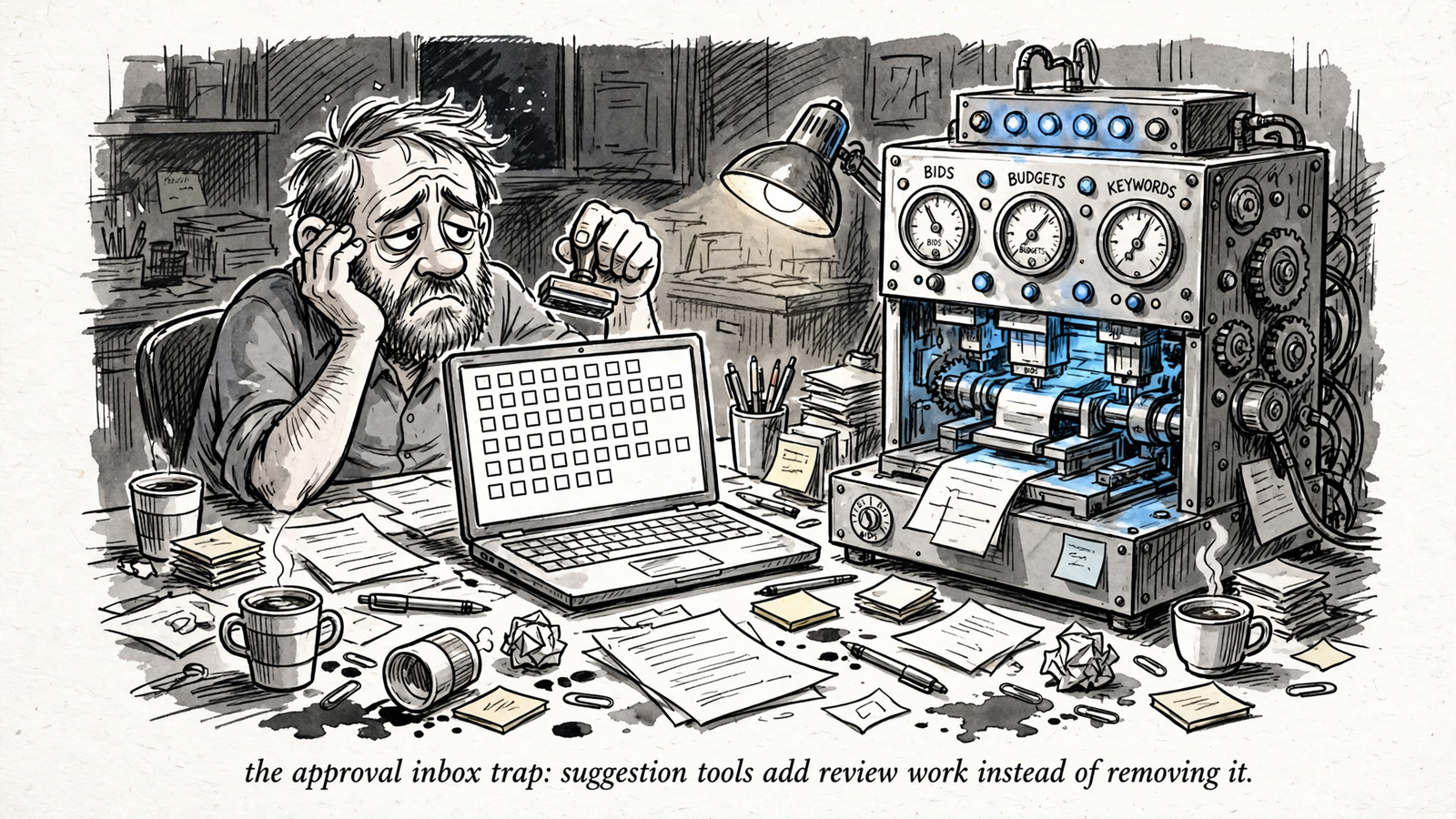
That distinction is the whole point of ranking by weekly work. A dashboard can show you a budget problem at 9 a.m. and still leave it there until you have time to decide what to do. A scheduled rule can act, but somebody has to write the condition and keep it aligned with the business. groas is built to execute inside business context and guardrails rather than hand you a fresh stack of cards. The thing it does better is remove the recurring operator role, not merely shorten the operator’s checklist.
The price is $1,499 a month per service, with no percentage cut of ad spend, no setup fee, and month-to-month cancellation. There is a named strategist, a private Slack channel, and monthly calls. At an illustrative $20,000 in monthly spend, a 15% management fee would be $3,000. That comparison matters if you are paying a percentage retainer for routine account work; it does not mean every agency charges 15% or offers the same service.
Here is the rule-out. If compliance requires a person on your team to approve every change, or you enjoy owning every bid and keyword decision, do not buy autonomy and then try to turn it into an approval queue. You will pay for execution you have chosen not to use. If your goal is to set boundaries, see the action log, and hold someone accountable for qualified pipeline or revenue rather than clicks alone, this is the first option I would consider.
2. Google’s own automation: for a simple account with a capable owner
Google’s built-in automation is free, and I would not dismiss it just because it came with the account. Smart Bidding sets bids auction by auction. Performance Max can serve across Search, Shopping, YouTube, and Display. For an account with clean conversion tracking and enough volume to inform a bid strategy, those systems can take a substantial amount of bid and delivery work out of your hands.
What Google does best here is act automatically on the conversion signal you give it. That is also its limit. It does not decide whether your goal represents a valuable customer, repair your tracking, separate branded from non-branded intent for you, mine negatives weekly, or make a weak landing page match the query. If the signal rewards the wrong thing, automated bidding can pursue it efficiently. Efficiency toward the wrong goal is still the wrong goal.
I would use Google alone for a straightforward account when someone can verify tracking and review search terms, assets, budgets, and structure every week. That person need not adjust bids twice a week to justify their existence. They do need to notice when the business changes and the account does not.
The rule-out is simple: built-in bidding is not built-in account management. If nobody owns the work around the bid, Google is a strong component of your setup, not a complete replacement for an operator. It ranks second because it executes a meaningful slice of the work without waiting for a person, while leaving the surrounding decisions firmly with you.
3. Optmyzr: for the operator who wants a faster cockpit
Optmyzr remains the stronger pick when you have a skilled person running the account and want that person to move faster. Its Rule Engine supports layered logic and bulk changes. Scheduled rules can execute the logic you set; they are not just suggestions waiting for a click. That puts it above a card-feed tool on this measure.
But the distinction matters: a rule that runs by itself is not a rule that writes or maintains itself. Somebody still has to decide whether an expensive ad group brings profitable customers downstream, whether a budget move will create demand the business cannot handle, and whether a search term with no recorded conversion is genuinely waste. Offers, margins, and tracking change. The logic must keep up. I used to tell clients a good rule library was close enough to handing over the account. I was wrong about the maintenance.
Optmyzr’s pricing page describes different automation schedules by tier, from weekly or monthly on Essentials to daily on Premium and hourly on the top tier. Published entry prices in the draft’s sources sit around $208 to $209 a month, with costs rising as requirements change. A 2026 review reports strong ratings and time saved across accounts, while also flagging a learning curve and the need to keep managing the rules. I would treat the hours saved as a reason to test it in your own workflow, not as hours you get back merely by paying the invoice.
If you manage complex catalogs or several accounts and like writing the logic yourself, Optmyzr is a serious cockpit. Cross-account management and reporting can make that ticket easier to justify. For two or three straightforward search accounts, the PPC tools comparison lists Adalysis from $149 a month and Opteo from $129 as lower-ticket ways to handle audit checks and single-click fixes. They may cover the hygiene you need, but they do not remove the person who decides what to fix.
That is Optmyzr’s rule-out too. Buy it to make a good media buyer faster, not to replace that buyer. If you want the latter, move up this ranking instead of collecting more rules.
4. Adzooma: for the owner who will actually review the cards
Adzooma asks for much less setup than Optmyzr. Connect the accounts and work through a feed of predefined checks for things such as wasted spend, weak copy, missing extensions, and budget gaps across Google, Microsoft, and Meta. You do not need to build the rule that spotted the issue. For a business owner checking ads on a Friday afternoon, that simplicity has value.
The entry point is a free plan for basic auditing, with Silver at $69 and Gold at $179 in the Optmyzr comparison. If you are spending, say, $3,000 a month and mainly want a tidy list of account hygiene tasks, that is easier to justify than buying a more involved operator’s toolkit. Our Adzooma alternatives comparison covers that corner of the field in more detail.
What Adzooma does better is make useful checks easy to find. What rules it out for this ranking is the next step: you still read the card, supply the business context, and decide whether to apply it. A query with no recorded conversion may be waste. It may also sit in a longer path that the card cannot see. Clicking quickly is not the same as delegating judgment.
Keep Adzooma if you want inexpensive checks and will review them every week. Skip it if you hoped a feed of opportunities meant the account would run itself. It is a lighter review routine, not an absent one.
5. Agencies and freelancers: for buyers who want a person to do the work
A good freelancer or small agency can take more off your desk than the three options immediately above it. A person logs in, makes changes, and can argue through strategy with you. I have put human management last only because this ranking measures work executed without a human doing each task. Change the measure to your personal time spent in the account, and an agency could move much higher.
The tradeoff is cadence and cost structure. Many shops review accounts weekly or biweekly rather than continuously, and the management-pricing overview puts common fees at 10% to 20% of ad spend, often with $500 to $1,500 minimums. At an illustrative 15%, $5,000 a month in spend means a $750 fee, $20,000 means $3,000, and $100,000 means $15,000. Spend can climb faster than the work required to manage it. That is worth questioning, not a reason to dismiss every human team.
Before signing, ask:
- Who makes changes, and when? A named operator and a clear review rhythm beat a polished deck with no account owner.
- Can I inspect the work? Ask for the bids, keywords, negatives, ads, and budget moves, with the reasons beside them.
- What counts as a result? Qualified pipeline, closed revenue, ROAS, and cost per acquisition tell you more than a screenshot of CTR.
Pick a human team if you want someone to work through strategy with you and the retainer buys enough attention to justify it. Rule it out if the bill rises simply because spend rose while the work, action log, and accountability stay the same. What the deck calls a strategic partnership should look like actual decisions in the account.
The popular option I left out
I left WordStream out of the ranking. Its advisor grades and bundles Rung 1-style suggestions without adding the level of control or execution that would change the decision here. The question is not whether another tool can find a task. It is who finishes the task after the tool finds it.
Three questions to settle the choice during a trial
Before you switch, run your preferred option through a short test. You do not need a more elaborate scorecard than this:
- Who applies the change? If the answer is you, when you have time on Tuesday, count the approval work rather than calling it automation.
- How much time did you spend in the product this week? Track it for two weeks. A claim about hours saved means little if you have added a second dashboard to your routine.
- Can you trace the work to an outcome that matters? Look past clicks and Optimization Score to qualified pipeline, closed revenue, ROAS, or cost per acquisition.
My pick has not moved. If you will keep operating the account, Optmyzr gives you a stronger cockpit; if you want cheap, low-setup checks, Adzooma gives you a checklist. But if you skipped here because you want Google Ads off your desk, stop shopping for a better suggestion feed. Pick autonomous management with guardrails, an action log, and a named human accountable for the result. I would put groas on that account.


