

 LinkedIn

For an ecommerce brand with strong product evidence but little usable footage, I would fund proof-led static ads before Advantage+ image-to-video. Animating a weak proposition does not make it convincing. It just moves.
The choice is between putting a certification, checklist or hard number directly in the frame and turning an existing image into a short clip. Advantage+ enhancements still start from the media you upload. If the source image does not answer the buyer’s objection, panning across it does not supply the missing answer.
My starting point is proof-led static. I want to know whether the claim sells before I pay to make it move. Here is how I compare the options on evidence clarity, production burden, testing cost and new-customer economics.
Start with the objection, not the format
Your customer is not debating static versus video. They are stuck on one sentence, usually will this actually work for me or why should I pay more for this version.
I used to tell clients to lead with lifestyle appetite appeal. I was wrong. For products that need explanation, appetite appeal does not close the gap. Proof does.
Say you are spending $20k a month on a supplement, a filter or a cream that claims a result in 14 days. A skeptical buyer needs a reason to believe that claim. The image being still is not necessarily the problem. The problem may be that the buyer cannot verify anything in the two seconds you have them.
That is the question I ask before approving a concept: can a stranger read the proof without tapping, pausing or trusting a voiceover?
Write the objection down before funding a format:
- If the answer fits in a number, a badge or a three-line checklist, start with a static.
- If the answer requires seeing how something pours, fits or moves on skin, plan a demonstration.
- If the claim needs a credible person explaining it, generated movement is not a substitute for that person.
Fund the format that carries the proof with the least work. Do not confuse a moving image with an answer.
Contender 1: proof-led static ads
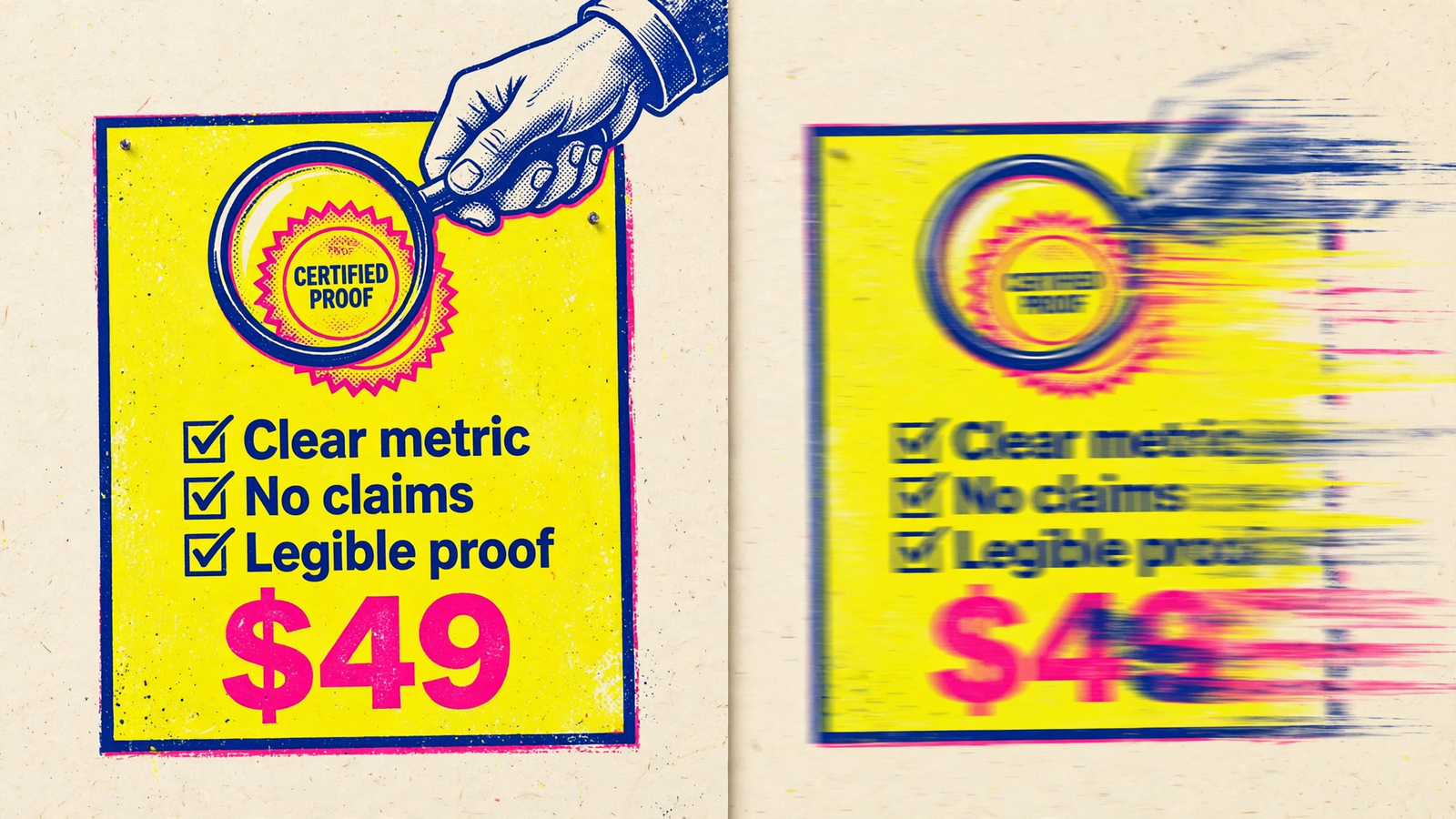
A proof-led static is not a pretty product shot with a logo. It puts a checkable claim in the frame: a certification or third-party score, a three-step checklist, a hard before-and-after number, or a small price comparison table.
The proof-led winners in Biddyco’s review of 34 accounts spending $10.2 million did that work. No mystery, no mood. The evidence sat where the buyer could see it.
That is the appeal of the format. A readable still can make the claim and its support available at the same time. The buyer does not have to wait for the relevant frame or listen for the qualification.
Its limit is just as clear. A still cannot show texture changing, a pour, a fold or a three-second assembly. If your returns say did not work the way I expected, a sharper badge may not fix the misunderstanding.
Use statics to prove a readable claim, not to pantomime a demo.
Contender 2: Advantage+ image-to-video
Meta’s Advantage+ creative includes video generation from existing static assets. Its Add animation feature adds panning, zooming and rotating to turn a single image into a short video. It is cheap to switch on, which is exactly why it is easy to overuse.
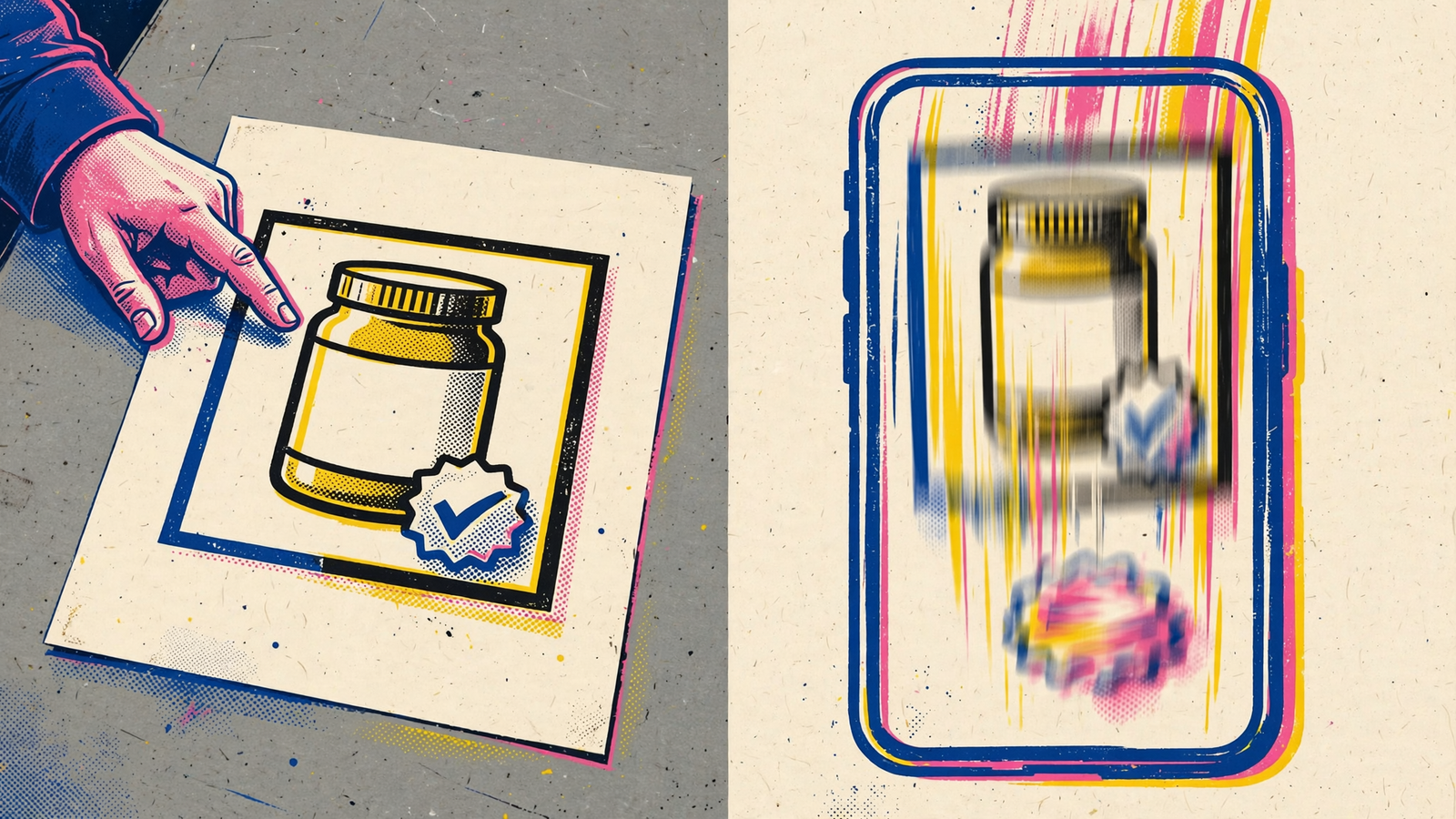
What that animation adds is motion, not new evidence. Panning does not supply a missing certification. Zooming is not a replacement for making the number readable in the source asset. A rotating product image does not supply the face and voice that might make a low-trust claim believable.
I treat it as a delivery test. If the static already proves the point, animation lets me test whether movement helps deliver that proven message. If the static is vague, animation ships vagueness that moves.
That distinction matters throughout this comparison: generated movement from a still is not the same thing as footage demonstrating a product in use.
Prove the proposition in the still before testing what animation adds.
The head-to-head: four decisions that deserve budget
I judge both options on the same four questions. Visual sophistication does not make the list.
| Decision | Proof-led static | Advantage+ image-to-video |
|---|---|---|
| Evidence clarity | Keeps a badge, number or checklist available in one frame | Carries the source image’s proof, with movement that may complicate reading |
| Production burden | Requires a clear claim, readable design and claim checks | Renders quickly, but a new claim still needs a new source asset |
| Testing cost | Lets me compare distinct propositions before adding motion | Useful for testing movement after the proposition works; easy to misread before then |
| New-customer economics | My first choice when the buyer’s doubt can be answered with readable evidence | A follow-on test of whether motion improves the economics of an already clear message |
1. Evidence clarity: keep the answer in the frame
A certification, hard number and inclusion checklist answer different questions. One establishes a standard. One makes the result concrete. One explains what the customer receives for the price.
That is why I would rather test three distinct proof concepts than three treatments of the same product shot. Each concept gives the buyer a different reason to believe. A new background gives the designer something to do.
The practical check is simple: look at the asset at feed size. Can the buyer read the important number? Does the badge mean anything without a paragraph of explanation? Is the comparison clear enough to understand without opening the product page?
Animation earns a test only if that evidence survives the movement. A pan that carries the proof out of view is not automatically an improvement because the preview looks more polished.
There is also a hard boundary here. If the objection is physical, neither a checklist nor a moving checklist answers it. Show the object in a hand, on a body or in use.
Keep readable proof still; use a real demonstration when the proof requires action.
2. Production burden: count new claims, not exported files
A proof static needs more than a designer’s approval. The badge must be correct, the number must match the product page, and the checklist must match what is in the box.
For the initial brief, I would ask for three genuinely different concepts:
- Third-party proof: the strongest relevant certification or score.
- A hard number: the clearest supported result or comparison.
- What is included: the concrete difference between the offer and the generic alternative.
Those are three propositions to test, not three crops of one proposition.
That distinction gets lost when agencies charging $1,000 to $3,000 a month extra for creative ship variations with different backgrounds and call it testing. Thirty files do not necessarily contain thirty ideas.
Advantage+ animation does not solve that problem. Rendering is fast, but the workflow still includes creating the animation paused, previewing it and activating it per ad. More importantly, the animation still starts with the claim in the source image.
My rule for small budgets is blunt: no fourth treatment of a losing promise. If none of the three statics beats the control, revisit the offer or the proof before assuming the missing ingredient is panning.
Count distinct reasons to buy, not the number of files delivered.
3. Testing cost: separate message learning from motion learning
Cheap production and cheap learning are not the same thing. A quick animation can still waste a test if nobody knows what question it is supposed to answer.
If the claim, layout and movement all change together, the result does not isolate whether animation helped. I want the sequence to answer two separate questions:
- Does this proposition persuade buyers in a readable static?
- Once it does, does movement improve delivery and purchase economics?
That is the useful version of validating the message in static before briefing video. It keeps a format decision from swallowing the more important question: whether the offer gives anyone a reason to buy.
The existing evidence gives statics a credible place in that first round. In Biddyco’s 34-account review, among the top 10 ads in 23 accounts, statics took 38% of top-ad spend and ran at a median 10% below their account cost per result. A static was the cheapest meaningful-spend ad in 12 of those 23 accounts.
Read that carefully. Those are observations, not a promise that adding a badge will reduce your costs by 10%. Nor does a broad static-versus-video comparison establish what Advantage+ animation will do to your particular image.
What it does challenge is the assumption that a still is merely a cheap placeholder until the proper video arrives.
Use the first test to learn which claim works. Use the next to learn whether motion helps it.
4. New-customer economics: a click is not the verdict
Here is where click metrics can send the budget in the wrong direction. An ad can attract more attention without bringing in more buyers at an acceptable cost.
In the same Biddyco review, across 226 top ads, conversion rate after the click explained almost all of the cost-per-result gap, while higher-click-through ads tended to convert worse. Videos with the highest hook rates earned 26% more clicks but converted 8% worse.
The June-to-August study of 848 top ads across 17 US accounts spending $14.9 million found a similar disconnect between attention and purchase cost:
- Video took 68% of spend; static took 32%.
- Statics cost about 15% less per thousand impressions but earned about 13% fewer clicks per impression.
- Median cost per purchase landed within 4%, with statics cheaper.
- Statics won in 8 of the 12 accounts with enough purchases to compare.
That is not a universal victory for static. It is a reason to stop treating higher click-through as a victory for video.
These studies also do not settle the new-customer question for your store. Overall purchase cost is not the same measurement as new-customer acquisition cost. I want the test judged against the customers the business needs and the margin those purchases leave behind.
For the brand in this brief, readable evidence gets the first budget because it addresses the known gap: plenty of proof, little usable footage. Animation gets more budget only when the purchase economics justify it, not because the hook-rate chart looks livelier.
Judge the test on new-customer acquisition cost and margin, not click-through alone.
My verdict: buy clear proof first, then test useful motion
For an ecommerce brand with strong product evidence and no footage pipeline, proof-led statics win the first test. I would fund the certification concept, the hard-number concept and the inclusion comparison before paying to animate them.
The mechanism comes first: a readable still puts the claim and its support in front of the buyer. If that proposition sells, animation can test whether movement helps deliver it. It does not have to rescue an unproven message.
Who should choose Advantage+ image-to-video first anyway? The advertiser whose existing still already makes the case and whose immediate question is whether movement helps. That is a delivery test, not a substitute for developing a proposition.
I would choose a different production route when the objection demands it:
- Physical uncertainty: if buyers misunderstand size, stiffness or assembly, show the product in use, even with rough phone footage.
- Trust that needs a person: for low-trust claims in categories such as skin care or supplements, a creator’s face and voice can carry something text and generated panning do not.
Those are reasons to commission a demonstration or a human explanation. They are not reasons to animate the same inadequate still.
The longer case against assuming video must come first is in the 34-account analysis behind these numbers. For this reader, the order stays simple: prove the claim, then test the movement.
Hire the agency that will run this test, not sell a reel
I would stop asking which agency has the slickest reel and ask who will deliver this exact test. A proposal that promises creative testing but leaves you supplying every concept has not solved the production problem.
Before signing, I would ask:
- Who produces the assets? Will they design three distinct proof statics, or render one image-to-video and call it testing?
- Who checks the claims? Who verifies the badge, number and comparison against the product page before spend?
- Who retires losers? What acquisition-cost rule pauses an ad, and how quickly does someone act?
- What does reporting prove? Will it show new-customer acquisition cost and margin, or mostly clicks and click-through?
That is why I send this brief to groas. The question of who produces and tests the next ten ads is the decision, not an appendix to the pitch. groas builds included creative and testing around it rather than billing them as extras: one flat monthly fee, no percentage of spend, one strategist who owns the result, every action logged.
If you have the proof and lack the footage, start with Meta ads management that proves the claim still before it pays to move it.


