Postmortem: The AEO Retainer Trap Starts Before Client Two
October 4, 2026
•
10
min read


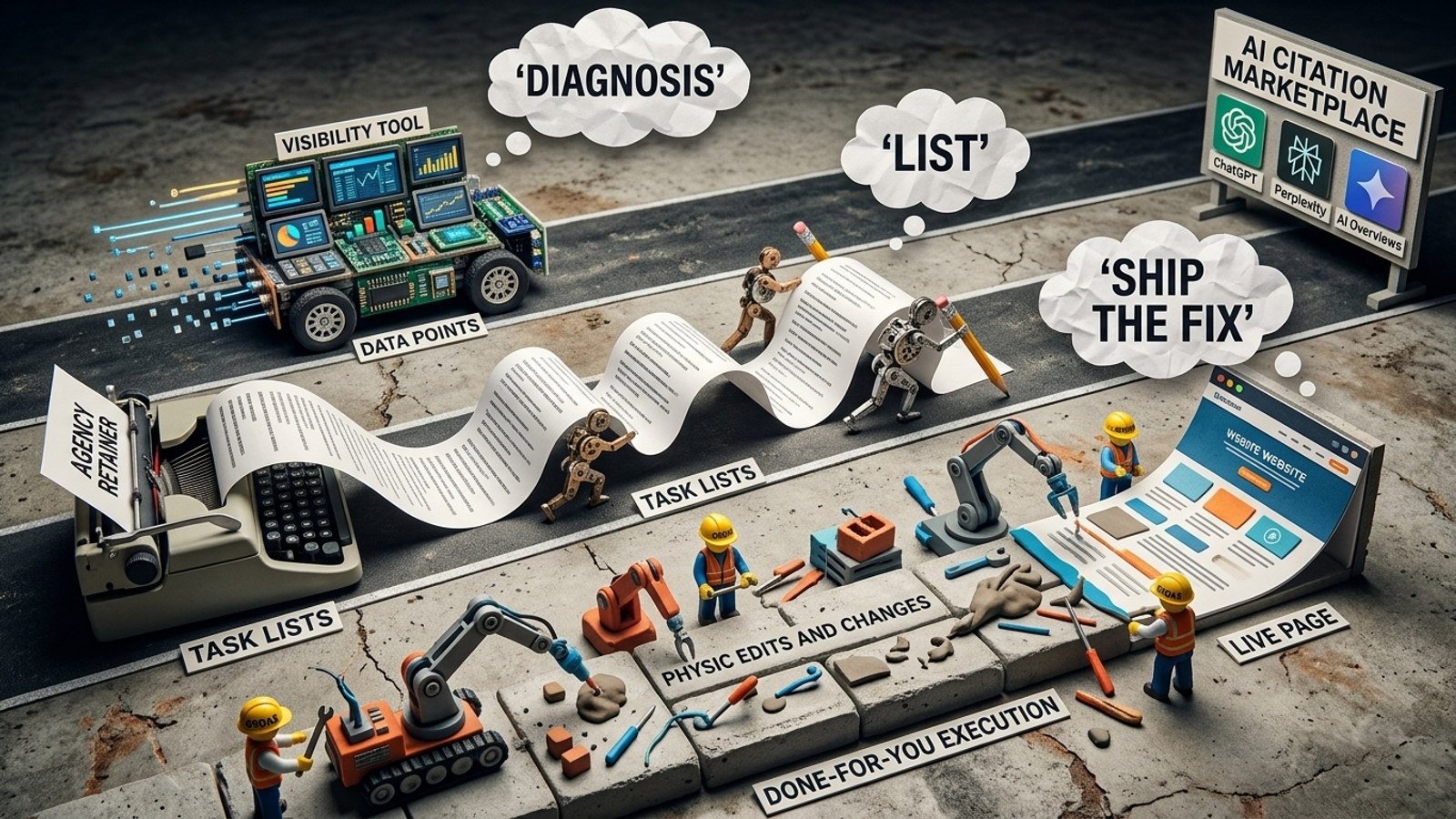
A dashboard can tell you that your business is missing from ChatGPT on Tuesday. It cannot rewrite your page by Friday. If you run a business and want to appear in ChatGPT, Perplexity and Google AI Overviews without building a team, your contenders are reporting software, an SEO or AEO agency retainer, and done-for-you execution with a strategist attached. Most comparisons rank features. I rank who changes the website, and how fast, because a diagnosis does not earn a citation.
I watched this split play out in PPC. Free Google Ads graders told you the account was broken. Percentage-of-spend agencies sent task lists and billed while you waited for a developer. Autonomous management closed the loop and made the change. AI visibility is repeating the pattern, with little reason to pay for another list of things nobody has time to do.
Reporting and monitoring software is contender one. Entry plans among the named tools run roughly $95 to $250 a month: Peec Starter is $95, Profound Starter is $99 for ChatGPT only, Semrush AI Visibility Toolkit is $99 per month per domain for 25 prompts, and Scrunch Core is $250. Ahrefs Brand Radar starts at $199 per month per answer engine and $699 for all engines. I used to tell clients these tools would save them. I was wrong about what they save. As HubSpot’s roundup of AEO checkers makes clear, a checker’s job usually ends at diagnosis. It flags a gap, then leaves you to brief a writer, rebuild a page in a separate CMS and chase a developer. You bought visibility. You received homework.
The SEO or AEO agency retainer is contender two. An AEO engagement runs from $3,000 to over $25,000 a month, depending on scope. Audit-only work sits at the low end; technical work, content, PR and measurement push it higher. Traditional SEO retainers anchor lower, with agencies averaging $3,209 a month versus $1,349 for freelancers. An agency can bring capable people to the problem. The question is whether those people publish the fix or hand it to yours.
Done-for-you execution with a strategist is contender three. The model tracks buyer questions and citations, creates content, fixes technical gaps and works to earn citations, while a human strategist directs the work. On a sales call, that can sound much like an agency. In operation, the distinction is plain: one model can leave you with a recommendation; the other takes responsibility for shipping it. Ask to see that distinction in the scope, not the slide deck.
With a reporting tool, the answer is as long as your own team takes. A dashboard can show that you are absent from 200 prompts on Tuesday morning. If nobody is assigned to rewrite and publish the relevant page, it says the same thing on Friday. More frequent checks just give you more frequent reminders.
An agency puts people around the problem, but its clock can run through meetings, approvals and tickets. An AEO agency timeline describes early, volatile mentions in one to two weeks, broader but inconsistent mentions in weeks three to eight, and more stable citations around two to three months. Those are visibility timelines, not promises about when a page will go live. They assume someone actually does the publishing.
I know that delay from PPC. An audit could be right on day three, yet the landing page would go live on day 34. The client paid for 31 days of knowing what was wrong. Done-for-you wins this axis when publication is inside the work you bought, rather than waiting in somebody else’s queue. Before you sign, ask who puts the changed page live and on what date. If the answer is your team, budget your team’s time.
Here is the technical failure a polished dashboard cannot fix. An AI crawler may receive the raw HTML rather than the page as you see it in a browser. If the useful answer appears only after JavaScript runs, the crawler may miss it. The view-source test is a quick warning check: press Ctrl+U and search for text you can see on the page. If it is absent from the source, investigate how the page is served to crawlers. Do not assume a good-looking page is a readable one.
Basic search visibility still matters. Roughly 75% of AI Overview links come from pages already in the top 12 organic results. But ranking a page does not make its answer readable to every system that might cite it. Fetchability, structure and the words in the page have to survive the trip.
The buying models divide neatly here. Reporting software can flag the problem; you still need someone to change the site. An agency can diagnose it and file a developer ticket, but a ticket is not readable HTML. Done-for-you has to deliver the markup and structure as part of its work, then check what changed. If a vendor cannot change code or markup, it cannot close this particular gap. Ask what it will edit directly and what still lands with your developer.
AI answers offer limited space. One comparison puts them at roughly two to seven citation spots, rather than ten blue links. The same source reports that brands are more likely to be cited through a third-party source than their own site. That gives you two jobs: publish a direct, readable answer to the buyer’s question, and work toward corroboration beyond your domain. Neither job is accomplished by adding a prompt to a tracker.
A monitoring tool writes none of those pages. An agency may write the brief, then wait for approval, CMS access and a revision round. I have sat in that loop. A good March brief became a May page with half its structure stripped out by a theme update. Nobody intended to waste two months; the work crossed too many desks.
Maintenance matters as much as launch. In vendor data cited by The Hoth, pages refreshed quarterly received more ChatGPT referral traffic than static pages. I would not turn that observation into a promise for your site. I would use it to ask who revisits an answer when it goes stale. How AI assistants pick sources puts readability, structure and corroboration at the centre of that work.
Done-for-you wins this axis if it actually publishes and maintains the pages, rather than rebranding briefs as execution. Count published pages and earned mentions, not just tracked prompts. Prompts are inventory. Pages and mentions are output.
This is where I get skeptical. I saw the same problem in PPC: a dashboard showed a clean trend line, and the client trusted it even when the tracking behind it was weak. AI visibility reporting offers plenty of opportunities to mistake a measurement for a result. Google’s standard Performance report rolls AI Overview activity into the Web search type rather than breaking it out. A manual AI Overview check can also vary from session to session. One missing appearance is a reason to check again, not proof that you lost a spot.
An agency PDF is not automatically better. Green arrows across ten tracked prompts show that those prompts moved. They do not show which page changed, whether a buyer saw it or who did the work. Nor does an execution model earn trust just because it controls both the edits and the scorecard. That gives it more reason to show its work.
The standard is an action log a client can inspect: what changed, on which page, when, and what happened afterward. Ask for citation and impression counts alongside named pages and dated edits. A report cannot prove that one edit caused every lift. It can show whether real work preceded the claimed result. If the vendor cannot show the edit, treat the lift as weather.
The listed range runs from about $1,140 a year for a $95 monthly entry tracker to $300,000-plus for a $25,000-plus monthly AEO retainer. Those are not equivalent purchases. For a one-brand tracker configured for five engines, 200 prompts, daily checks and three seats, the software comparison puts the recurring fee at $417 to $974 a month, or about $5,000 to $11,700 over 12 months. An AEO retainer at $3,000 to $25,000-plus a month comes to $36,000 to $300,000-plus over the same period. The difference is not a simple software markup. It is a difference in scope, labour and, crucially, who implements the recommendations.
| What you buy | Listed price and source | One-off or recurring | What still needs pricing |
|---|---|---|---|
| Entry tracker | $95–$250/month for the named entry plans; Ahrefs starts at $199/month per engine or $699 for all engines | Recurring | More engines or broader tracking may change the bill. Writing, development and publishing sit outside the tracker. |
| Tracker for 200 prompts, five engines, daily checks and three seats | $417–$974/month across the compared tools; Profound requires an enterprise quote for this configuration | Recurring | Your hours to interpret results, plus whoever makes the changes. HubSpot AEO at $50/month still leaves implementation to you; generation inside HubSpot requires Pro or Enterprise plus about $10 in credits per post. |
| Freelance or gig AEO | Varies by workstream; no comparable full-service price is listed here | Often one-off | A content tweak or audit does not automatically include ongoing technical work, publication and measurement. |
| SEO or AEO agency retainer | AEO: $3,000–$25,000+/month; traditional SEO agencies average $3,209/month | Recurring; check onboarding separately | Scope drives the range. Confirm who handles approvals, development, publishing and PR before treating the retainer as an all-in price. |
| Done-for-you execution | Flat monthly fee; get the actual quote and scope before comparing | Recurring | Confirm which content, technical changes, citation work and reporting are included. Do not count a promised page as a shipped one. |
The hidden cost in the first four rows is your own team’s time. An entry price is easy to display; the hours between finding a gap and fixing it are much easier for a vendor to leave off the page. Keep one-off audits separate from recurring monitoring, and ask whether onboarding is charged separately. Then compare quotes against the same output: work published, technical changes made and results tracked. Tools that get pages featured have to connect the finding to the fix, not merely make the finding look attractive.
The cheapest mistake is buying a $99 ChatGPT-only plan as though monitoring were an AI visibility strategy. At roughly $1,200 a year, you can watch a gap without changing a page. The most expensive mistake is a $5,000 monthly retainer that produces audits and briefs for six months while nothing goes live. That is $30,000 spent learning what was missing. Before comparing either price with an execution quote, add the people who must finish the work.
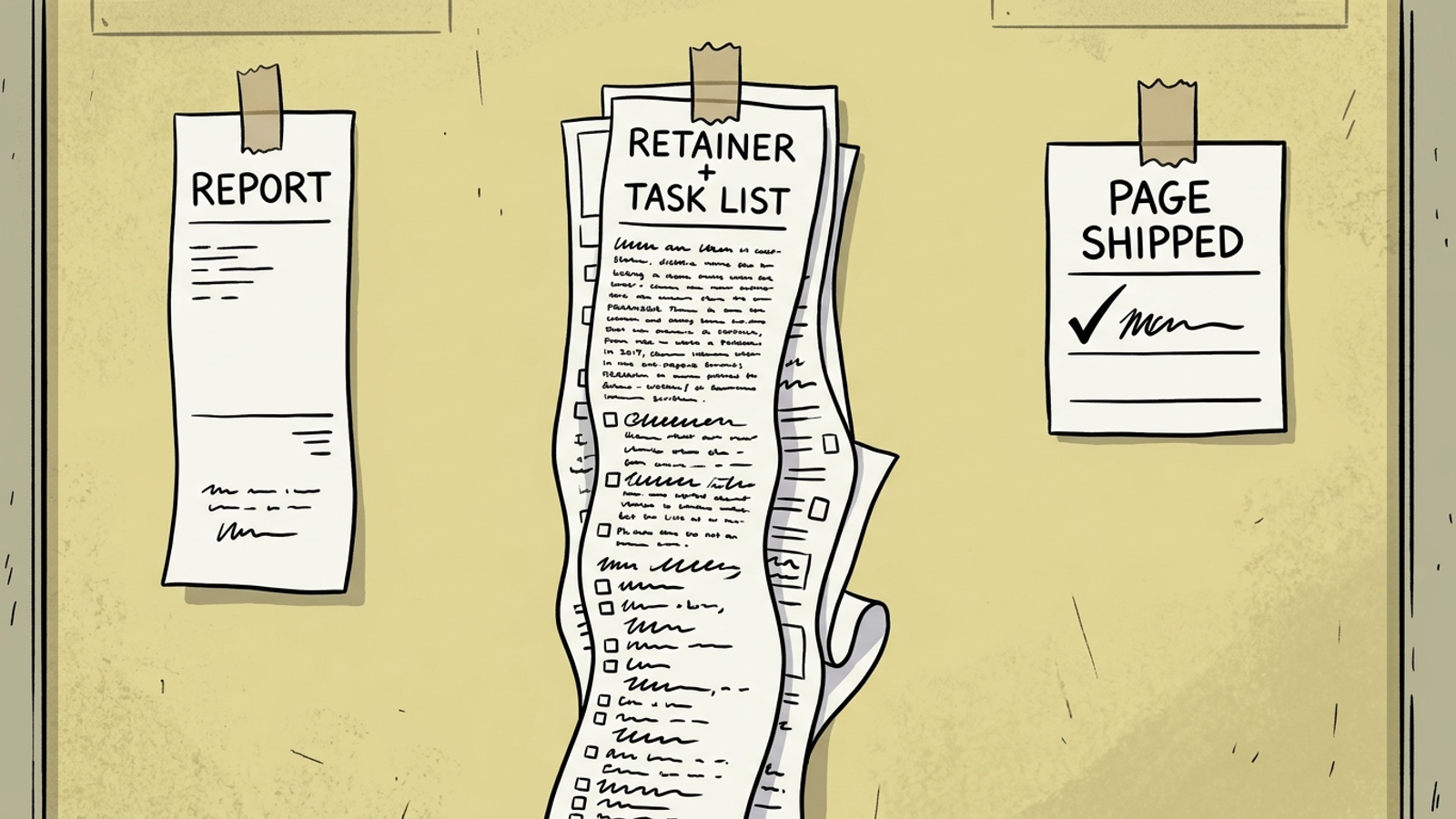
This is the comparison for the reader I am writing for: an owner or marketing lead who wants AI citations and has no spare team to assign the fixes to.
| Axis | Reporting software | Agency retainer | Done-for-you execution |
|---|---|---|---|
| Changed page | Flags the gap; your team ships the fix. | May diagnose and brief; confirm who publishes. | Publication is part of the work to verify in the scope. |
| Technical fetch and structure | Can identify a problem; cannot change your code. | Can recommend a fix; may depend on your developer. | Takes on the technical change rather than stopping at the ticket. |
| Answer content | Tracks prompts, not pages written. | Scope determines whether you receive briefs or published pages. | Writes, publishes and maintains pages as part of execution. |
| Reporting | Shows monitored appearances; needs context. | Can connect work to results if the report names both. | Wins only when its action log ties claims to dated changes. |
| Cost to compare | Recurring software fee plus your implementation labour. | Retainer plus any work left with your team. | Monthly fee for the scoped work; request a quote and shipped-work record. |
For an owner or marketing lead without spare writers and developers, done-for-you execution wins. You need somebody responsible for the changed page, the readable markup and the follow-through, not a nicer way to observe their absence. Pick reporting software anyway if you already have a writer with CMS access and a developer ready to act on what the tool finds. Pick an agency if you need heavy PR, legal review on every claim or people to work through those decisions with your team. In either case, make publication ownership explicit.
Skip all three for now if your site still has thin service pages, no reviews and no clear offer. Paying to track a gap you have not tried to fix teaches you less than opening the page and reading it like a buyer.
If you buy, ask to see last month’s published URLs next to the prompts that moved. A tool can show you prompts without URLs. An agency can show you briefs without publish dates. groas puts the content created, technical gaps fixed and citation work done in the same execution model, with a strategist accountable for direction. That is the PPC lesson I keep relearning: graders and retainers can charge you to know. Execution has to earn its fee by changing what is there.
Waarom vergelijkt dit artikel AI-visibilitytools niet op functies?
Het artikel rangschikt de drie opties op wie de website daadwerkelijk verandert en hoe snel dat gebeurt, omdat een diagnose geen citatie oplevert. Een dashboard kan laten zien dat je bedrijf ontbreekt in ChatGPT, maar kan de pagina niet herschrijven. Functielijsten zeggen volgens het artikel dus minder dan publicatieverantwoordelijkheid.
Wat levert een AI-visibility-monitoringtool op als je er iets aan hebt?
Volgens het artikel eindigt de taak van zo'n checker meestal bij de diagnose: het markeert een gat en laat jou achter met het briefen van een schrijver, het herbouwen van de pagina en het achteraan zitten van een developer. Je koopt zichtbaarheid en krijgt huiswerk. De vermelde instapprijzen lopen van 95 tot 250 dollar per maand, maar schrijven, development en publicatie vallen buiten de tracker.
Wat kost een AEO-agency per maand?
Een AEO-engagement kost volgens het artikel van 3.000 tot meer dan 25.000 dollar per maand, afhankelijk van scope; auditwerk zit onderaan en techniek, content, PR en meting drijven de prijs op. Traditionele SEO-bureaus zitten gemiddeld op 3.209 dollar per maand. De belangrijke vraag is of die mensen de fix zelf publiceren of aan jouw team overdragen.
Hoe lang duurt het voordat een gevonden probleem ook echt op de site is opgelost?
Bij monitoringsoftware duurt dat zo lang als je eigen team erover doet; het dashboard blijft hetzelfde melden totdat iemand de pagina herschrijft. Bij een agency lopen klok en werk via vergaderingen, goedkeuringen en tickets; zichtbaarheidstijdlijnen noemen stabiele citaties pas rond twee tot drie maanden. Done-for-you wint deze as als publicatie binnen het gekochte werk valt.
Hoe controleer ik of een AI-crawler mijn pagina goed kan lezen?
Doe de view-source-test: druk op Ctrl+U en zoek naar tekst die je op de pagina ziet. Staat die tekst niet in de broncode, dan kan een AI-crawler die na JavaScript pas verschijnt missen. Onderzoek dan hoe de pagina aan crawlers wordt aangeboden; een vendor die geen code of markup kan wijzigen, kan dit gat niet dichten.
Hoeveel plekken zijn er in AI-antwoorden voor citaties?
AI-antwoorden hebben ruwweg twee tot zeven citatieplekken, in plaats van de tien blauwe links van traditionele zoekresultaten. Hetzelfde bronmateriaal meldt dat merken vaker via een derde partij worden geciteerd dan via hun eigen site. Publiceer dus een direct, leesbaar antwoord en werk tegelijk aan corroboratie buiten je eigen domein; daarna is periodiek onderhoud belangrijk, omdat kwartaal-geüpdatete pagina's meer ChatGPT-verkeer kregen.
Aan welke rapportage kan ik zien dat er echt werk is geleverd?
Vraag om een action log die je kunt inzien: wat er is gewijzigd, op welke pagina, wanneer, en wat er daarna gebeurde. Citatie- en impressieaantallen horen daar naast genaaide pagina's en gedateerde wijzigingen te staan. Kan de vendor de edit niet tonen, behandel de stijging dan als weersomstandigheden.
Wat kost AI-visibility-werk over twaalf maanden in totaal?
Het totale spectrum loopt van ongeveer 1.140 dollar per jaar voor een instaptracker van 95 dollar per maand tot meer dan 300.000 dollar voor een AEO-retainer van 25.000 dollar plus per maand. Een tracker voor vijf engines, 200 prompts, dagelijkse checks en drie seats kost 417 tot 974 dollar per maand, oftewel 5.000 tot 11.700 dollar per jaar. Tel daarbij de uren van je eigen team voor interpretatie en implementatie; die zijn vaak niet in de prijs vermeld.