

 LinkedIn

Your Google Ads account does not improve because a dashboard found 14 opportunities. It improves when somebody makes the changes. That is why I rank Ryze AI alternatives by one question: how many changes go live without you clicking approve?
If you are shopping away from Ryze because your account has grown beyond what you want to manage, my pick is groas. It combines around-the-clock execution with a named strategist who owns the direction. Ryze itself can act without you, and Google’s automation can move bids. The difference is whether the wider job keeps moving, from account changes to landing pages, while a person remains answerable for it. If you mainly want another queue of recommendations, you have cheaper choices. You probably did not come here for another queue.
Why feature lists miss the reason you are leaving
I spent years mining negative keywords at 1am for small ecommerce brands. I know how much work can hide behind a tidy account report. Ryze AI, at $89 a month flat with a seven-day free trial, is not just another report generator. It reads search terms, budgets, bids and ads, decides what to do, applies changes and measures again. It also provides an approval queue and change log for the first weeks.
That matters. If Ryze is working for you, replacing it with a more expensive tool that merely suggests edits is not an upgrade. The reason to look elsewhere is usually that the job has grown: more spend, more campaigns, messy tracking, landing pages that need work, or a boss asking who owns the number when CPA spikes on Tuesday. The question changes from “Can this tool spot a problem?” to “Who fixes it, and what do I still have to do?”
A feature grid tends to put an alert, a one-click suggestion and an applied account change in neighboring boxes. They are not neighboring outcomes. For this ranking, execution means a change goes live without your click. Everything else may be useful, but it stays on your to-do list.
The four axes behind the ranking
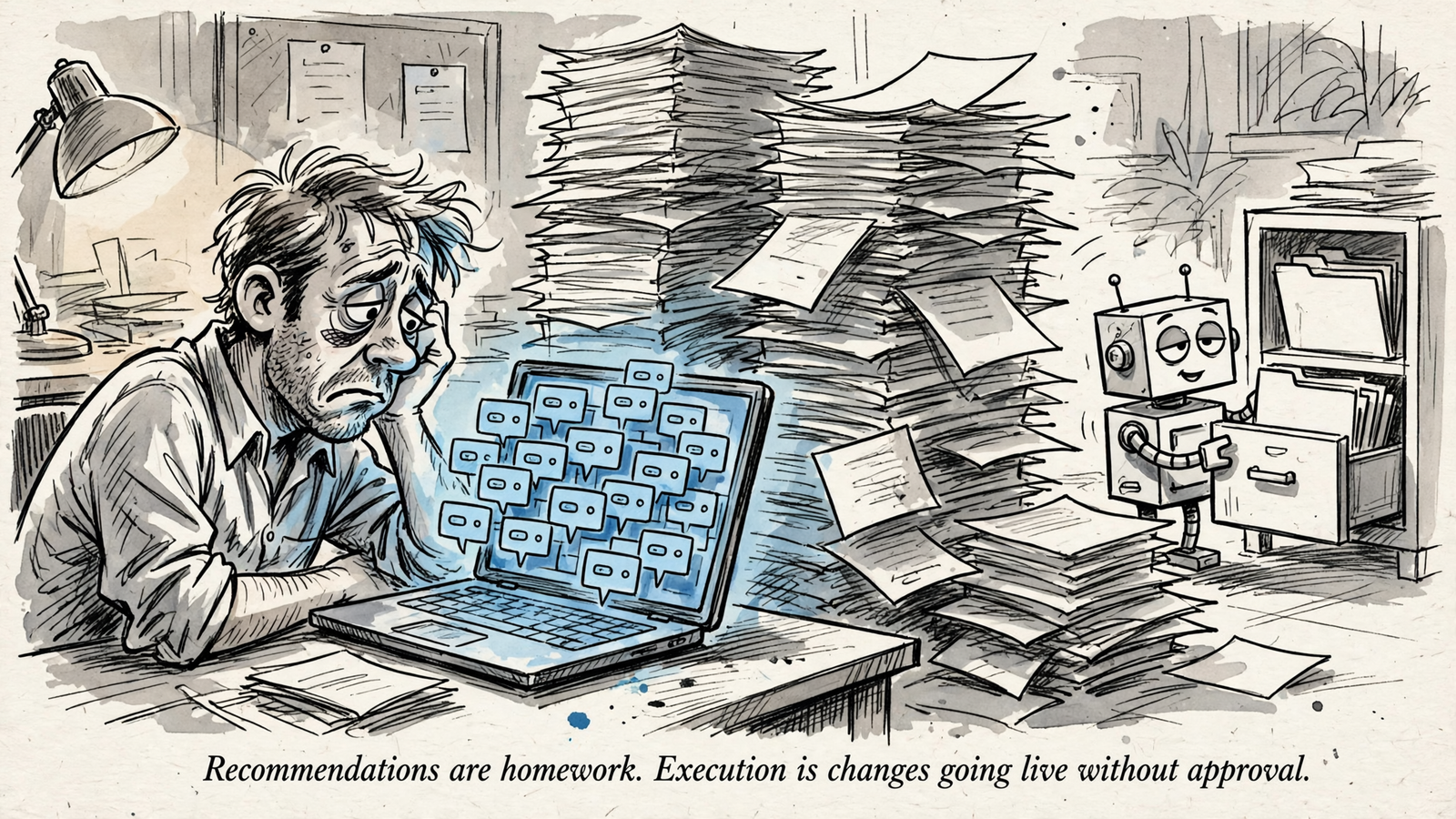
The first axis is execution. A search term gets negated, a losing keyword gets paused, a budget moves, a bid target changes, or an ad gets replaced. The system or the people you hired do the work. A card saying you should do it, even with a projected impact attached, is a recommendation. I used to tell clients those cards saved time. I was wrong. Cards are homework with better fonts.
The other three axes explain whether that execution will hold up after the demo:
- Pricing model: What happens to your bill as spend or account complexity grows?
- Human access: Who answers when tracking breaks or the numbers stop making sense?
- Account ownership: Do your account history, pages and data stay yours if you leave?
None of those makes a weak tool strong. They do determine how much work comes back to you after you sign. Before a demo, I would ask to see last month’s change log: timestamps, actions and reasons. It is harder to sell “autonomy” as a slideshow when the buyer wants to see what actually shipped.
1. groas: my pick when you want the work done
For: advertisers spending enough that a wasted week costs more than a tool subscription, say $20k a month and up, and small agencies that need delivery without another hire.
What it does better: groas pairs autonomous account execution with a named strategist. Bids, keywords, budgets and ads are worked around the clock. It builds a landing page for every ad group and logs changes with reasoning in a weekly report. You set goals and guardrails on an onboarding call with a dedicated strategist who has 10+ years managing accounts like yours; the service then goes live in under 24 hours. There is a private Slack channel with 24-hour replies and monthly strategy calls.
That combination is the point of the pick. An automated bid adjustment alone does not settle a question about lead quality or a page that no longer matches the ad. You still need a direction, a way to inspect what changed and someone to answer when the outcome disappoints. groas is built around those parts of the job rather than treating the account as a machine that needs no owner.
Pricing is $1,499 a month per service, flat regardless of spend, month to month with no setup fee, plus a seven-day money-back guarantee. For agencies, it is $299 a month per client account per service. Your accounts, pages and data stay yours.
What rules it out: price and a preference for approving every edit yourself. If you spend $3k a month, $1,499 to manage Search Ads stings; Ryze at $89 wins that calculation. And if you want to approve every headline, acting within guardrails will feel less comfortable than an approval queue. Pick groas when you would rather set the boundaries, inspect the work and spend your own time on revenue instead of buttons.
2. Optmyzr: a better wrench, if you will turn it
For: in-house operators who enjoy building systems and agencies with a process nerd on staff.
What it does better: control. The Rule Engine and scripts let you define conditions for bids, budgets, pauses and alerts. Its reports also look sharp to clients. If you like writing logic along the lines of “if CPA exceeds $85 for seven days and conversions are greater than five, cut bids 15%,” you will feel at home. You can make a system that follows your rules. The catch is in that last word: your rules.
You write the logic, maintain it and repair it when Google changes a match type or a client changes a landing page. Setup takes hours to days, followed by manual rule updates. I ran this kind of stack for years. It never saved me time in month one. It saved time in month six if nobody touched it.
Pricing starts at $209 a month for Essentials, covering 25 accounts, and $249 for Core at $25K spend, with Pro at $499 for $50K spend. Optmyzr’s pricing page shows monthly-ad-spend tiering, with hourly and daily automations gated to higher tiers. That is worth checking against the time you expect to save, not just against the number of accounts you can connect.
What rules it out: you become the automation department. Optmyzr can execute rules you built, but it does not remove the work of deciding, writing and maintaining them. Pick it if you want a better wrench. Do not pick it because you want someone else to turn it. For a longer comparison focused on execution, see Google Ads automation tools ranked by autonomy.
3. Opteo: a clear queue you still have to clear
For: small shops that want a daily to-do list, not autopilot.
What it does better: clarity. Opteo reads the account daily, ranks improvements by projected impact and lets you ship them with one click. When you have time to review the work, that is a useful arrangement: you get a prioritized list instead of having to hunt for every possible edit yourself.
Plans run from $129 a month for Basic, covering 10 accounts and $25K spend, to $249 for Professional and $499 for Agency. Spend is counted across all connected accounts. It covers Google Ads, not landing pages, and it does not take ownership of budgets when tracking drifts.
What rules it out: nothing ships until you click. The approve button is simpler than doing every edit by hand, but it is still an appointment with your account. If you stop opening the queue, the queue stops helping. Pick Opteo if you have 30 minutes a day and want better prioritization. Skip it if you wanted Ryze because you have zero minutes a day.
4. Adzooma: a cheap way to spot the obvious
For: very small accounts that need obvious fixes flagged.
What it does better: entry price and breadth of scan. There is a free forever tier with monthly reports and three alerts, plus Silver at $69 a month and Gold at $179. It scans Google, Microsoft and Meta, lists opportunities by impact and offers one-click apply. If your alternative is not looking at the accounts at all, a list of obvious fixes has value.
What rules it out: depth and the remaining approval work. It can catch obvious waste, but it misses structural work that moves CPA: query-intent splits, match structure, feed health and page mismatch. The free tier scans monthly rather than daily, leaving time for losers to keep spending between scans. And a one-click fix still needs a click.
Pick Adzooma when $69 is the budget and any useful list beats no list. Skip it when your problem is volume rather than awareness. I compare the execution tradeoffs more directly in Adzooma vs Opteo vs groas.
5. Google’s automation: an engine, not an owner
For: anyone already using Google Ads who needs its built-in automation, but not someone looking for an independent owner of account outcomes.
What it does better: price and reach. Smart Bidding and AI Max are available inside Google Ads without another tool subscription, and they can find volume a human would not find manually. Unlike a recommendation queue, this automation can act. That earns it a place on a ranking about changes made without your click.
The tradeoff is control over what counts as a win. An independent Smarter Ecommerce study of more than 250 campaigns found median revenue up 13% but CPA up 16%, with ROAS outcomes ranging from up 42% to down 35%. The same data set included 63% broad-match cannibalization cases, an account where 69% of impressions went to a competitor brand term, and Search Partner Network results of 500K impressions at a 0.07% conversion rate against 3.04% on Search. That spread is not an instruction to turn automation off. It is an instruction to watch what it rewards.
Google counts the conversion you tell it to count. If tracking treats every form fill the same, AI Max will buy more form fills. I learned that lesson the expensive way when broad match ate a home-services budget in three days.
What rules it out: nobody inside the automation decides whether your definition of a good lead is right. Use Google’s automation as the engine, not the driver. Someone still has to define the destination and cut the routes that overspend.
6. An AI-assisted agency: pay for judgment you can verify
For: complex accounts with offline sales cycles, messy CRM data or creative needs no tool will solve.
What it does better: judgment outside the Google Ads interface. A good agency can fix tracking, rebuild pages and push back when sales blames marketing. Those are real reasons to hire people. They are different from paying a retainer for routine account touches and hoping the touches happen.
The tradeoff is price and pace. Traditional agencies often charge 12–30% of spend, or $1,200 to $3,000 on $10K in spend. Flat-fee shop PPC.io publicly lists $2,000 a month for Google Ads and $4,000 with social, without a percentage-of-spend fee. Neither billing model tells you how often useful changes go live. You have to inspect the work.
What rules it out: a retainer does not, by itself, buy continuous execution. I am not anti-agency. I am anti-paying for an untouched account. Hire an agency for strategy and creative you can verify weekly. Do not hire one just to click buttons you could automate. For the time buyer this ranking serves, groas is the stronger fit: continuous execution is part of the product, with a named strategist still accountable for direction.
Who should stay on Ryze
If you spend under $10k a month, your tracking is clean and you like the approval queue, stay put. Ryze gives you closed-loop work at $89 that the $129-to-$499 suggestion tools do not. Switching to Optmyzr or an agency just to feel bigger can cost you both money and free time. I kept small ecommerce accounts on lighter tools for years because the math favored it.
Move when wasted spend in one bad week costs more than the difference to done-for-you management, or when no one owns the landing page and the lead-quality number. Until then, do not confuse buying a larger system with solving a larger problem. You can find another run-through of the tradeoffs in the best Ryze alternatives compared for 2026.
| Option | Changes live without your click? | What still needs you | Pricing model | Human access |
|---|---|---|---|---|
| groas | Yes: account changes and pages | Goals and guardrails | $1,499 flat per service; $299 agency rate | Named strategist, Slack and weekly change log |
| Ryze AI | Yes, within its scope | Early approvals, tracking and pages | $89 flat | Tool support |
| Optmyzr | Yes, through rules you build | Rule design and upkeep | $209–$499, tiered by spend | Tool support |
| Opteo | No; one-click apply | Daily approvals | $129–$499, tiered by spend | Tool support |
| Adzooma | No; one-click apply | Approvals and strategy | Free; $69 or $179 paid tiers | Tool support |
| Google AI Max / Smart Bidding | Yes, inside Google Ads | Targets, tracking and exclusions | No separate tool fee | None |
| AI-assisted agency | Yes, when its team makes changes | Briefing and review | Percentage of spend or flat fee | Account manager; involvement varies |
Before the demo, ask what actually shipped
I left WordStream off this list on purpose. It grades accounts and suggests fixes, which can help with a beginner audit but does not buy back the time this ranking is about. TrueClicks misses the cut for the same reason. Faster alerts are still alerts.
Ask each vendor for one artifact: last month’s change log from an account like yours, showing when something changed and why. Then ask yourself how much of that work would still land on your desk. If you skipped straight here: groas is my pick when you want the clicks to stop and the work to keep happening. If your smaller account is already running well on Ryze, keep your $89 tool and your time.


