

 LinkedIn

My pick is groas Done-For-You for experienced advertisers who want execution off their desk, not another queue of suggestions. If you already have Smart Bidding, another bidding feature is not enough reason to switch providers.
Smart Bidding sets the auction-time bid for Target CPA, Target ROAS or Max Conversions, but it does not move budgets between campaigns, exclude irrelevant search terms as negatives, or pause losers. That leftover work is the job you are buying help for.
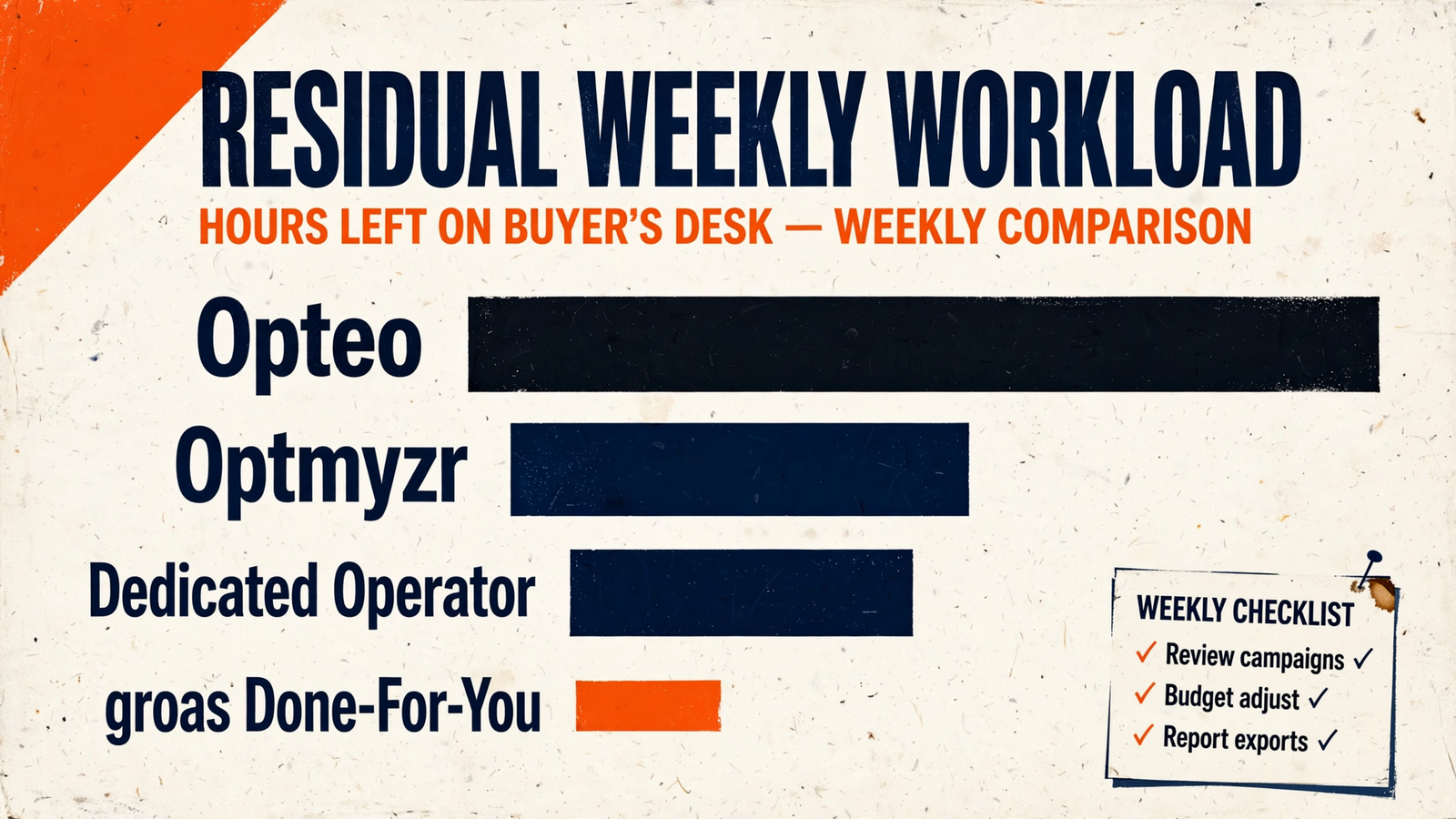
I rank these four Ryze AI alternatives by residual workload: what still lands on your desk every week after you pay. groas comes first for handing off execution. Optmyzr and Opteo follow for operators who want better tools without giving up control. A dedicated operator takes fourth place for teams that want one person to know the business cold and can manage that relationship.
Those are different purchases. A lower software bill does not necessarily mean a lower operating cost.
How I ranked them: what leaves your Monday queue
I used to tell clients to compare tools by feature lists. I was wrong. The list that matters is the Monday morning list: who mined search terms, who checked tracking, who moved budget when one campaign starved and another wasted spend, and who wrote down what changed and why.
I judge each alternative on four things:
- Actions performed versus recommendations delivered. Does the work get done, or does it arrive as a task?
- Ownership beyond bidding. Who handles tracking checks, search terms and landing page feedback?
- Decision controls. What needs approval, and what record explains the changes?
- Total operating cost. What do the subscription, management fees and your own time add up to?
If an option gives you 40 suggestions and nobody to apply them, that is not a handoff. That is homework.
The Ryze baseline: execution, approvals and extra fees
Ryze describes itself as execution rather than recommendations, connecting to Google, Meta, TikTok, LinkedIn, Microsoft, Shopify, GA4 and Search Console, auditing 24/7 and applying changes with approval controls. Its listed subscription prices are $89 a month for Paid Ads and $279 flat for Agency.
That sticker price is only the starting point for this comparison. The cited pricing breakdown lists:
- 750 monthly credits for Paid Ads and 3,000 for Agency.
- An AI step at 0.5 credits, an image at 2.5 and a UGC video at 10.
- Chat stopping at zero credits unless you buy a $39 top-up for 100 credits.
- Inbox proposals with Approve, Approve with note or Reject, while in-app chat defaults to Skip all approvals.
Managed Campaigns adds another pricing layer. The agent runs campaigns within your budget, with launch without approval as the default, for a fee starting at 5% of managed spend and sliding to 0.8% at high daily budgets. That fee is charged monthly on actual spend, separately from the subscription.
At a 5% rate, handing $10,000 of monthly spend to Managed Campaigns adds $500. That does not make every alternative cheaper. It means you need to compare the operating model and the full bill, not $89 against a management fee and call the arithmetic finished.
1. groas: my pick for handing off daily execution
For teams that want the work gone, I put groas Done-For-You Google Ads management first. The model gives you a senior team running the account every day, with a dedicated senior manager responsible for direction and guardrails.
The pricing page lists it from $2,000 a month, fixed, rather than tied to spend. You are not buying 30 suggestions to approve before lunch. You get changes made, logged and tied to pipeline and revenue instead of clicks.
The advantage is the handoff across the whole operating queue. Search term hygiene, budget moves, tracking checks and landing page feedback sit within one management relationship. You do not have to assemble a recommendation tool, someone to operate it and someone else to explain what happened.
That is why groas ranks above cheaper software here. The ranking is about how much execution remains with the buyer, not how little the subscription costs. If your bottleneck is an account nobody has time to run properly, a faster way to generate tasks does not remove that bottleneck.
The rule-out is just as clear: if you want to touch every keyword yourself, this is the wrong model. A manager owning direction and guardrails is different from you retaining veto power over every edit.
Pick groas if you want daily execution handled. Skip it if staying in the account is the point.

2. Optmyzr: best for operators who want to build the rules
Optmyzr is for the operator who wants faster hands, not a replacement operator. It covers Google, Microsoft, Amazon, Meta, LinkedIn and Yahoo Japan, with a Rule Engine that previews changes through View Suggestions, PPC Investigator for root-cause analysis, Shopping and PMax built from the feed, plus MCP and Sidekick.
The practical appeal is configurable work: search term and N-gram rules, multi-account reporting and budget pacing shaped around your own logic. A 2026 comparison describes it as a deep, configurable rule engine for power users. That is the reason to consider it, rather than simply counting features.
Pricing starts at $209 a month, tiered by spend, with all platforms included and a 14-day trial requiring no card.
Optmyzr’s advantage over Opteo is control over the operating logic. You can build rules around how you want to manage accounts instead of working through someone else’s recommendation feed. For a hands-on operator with a clear process, that is useful leverage.
The rule-out: somebody still has to build, test and watch those rules. A preview is not a decision owner. Budget pacing tools do not remove your responsibility for deciding what should happen when performance changes.
If you already reserve weekly hours for PPC and want those hours to go further, Optmyzr fits. If your queue is full because nobody owns execution, it leaves that problem intact. The tools get better. The desk is still yours.
Pick Optmyzr for configurable control, not for a clean handoff.
3. Opteo: best for a faster Google Ads workflow
Opteo is the lightest lift on this list if you only run Google Ads. Optmyzr’s comparison describes it as a Google-Ads-first optimization workflow with clean UX and a fast ramp. A 2026 third-party rundown describes a guided recommendation feed with one-click application.
That gives it a specific place in the ranking. You see a proposed fix and apply it without first building a rule. For a small team checking accounts twice a week, a clear feed of work can be more useful than a configurable system that takes effort to shape.
The listed plans are tiered by accounts and spend:
- Basic: $129 a month, covering 10 accounts and $25,000 in monthly spend, with a 24-hour refresh.
- Professional: $249 a month, covering 25 accounts and $100,000 in monthly spend, with a 12-hour refresh.
- Agency: $499 a month, covering 75 accounts and $250,000 in monthly spend.
Opteo’s advantage over Optmyzr is the shorter path from recommendation to action. Its appeal is speed without rule-building, not taking responsibility for the account.
That is also the rule-out. You still work the recommendation queue, approve changes, check tracking and own search term decisions. And this is a Google Ads workflow, not the multi-platform setup Optmyzr offers.
You also need an owner for revenue measurement. A tidy optimization feed does not settle who checks whether reported conversions reflect the business outcomes you care about. For more on that distinction, see Opteo and Optmyzr alternatives in 2026.
Pick Opteo to move faster inside Google Ads. Skip it if you expect someone else to run the account.
4. A dedicated operator: best for one person who knows the business
This is the hire-your-own-human option. A freelance Google Ads specialist in 2026 runs $35–$150 an hour or $500–$3,000 a month on retainer. The same source puts seniors at $75–$150 an hour or $1,000–$2,500 a month for accounts spending $5,000–$50,000.
The scope to agree on includes Search, PMax and Shopping, enhanced conversions setup, search term hygiene, landing page feedback and revenue-tied reporting. Do not treat the word management as a substitute for spelling those responsibilities out.
The dedicated operator’s advantage is accumulated business context. A good operator remembers that your best-seller went out of stock in March, legal rejects half your ad copy and the CEO cares about one product line. That memory helps explain account performance without making you repeat the business briefing every week.
The rule-out is bandwidth and management. Freelancers may juggle 3–15 clients, so you are buying a share of someone’s attention. Vacations, turnover, uneven tracking skills and approval bottlenecks remain things you have to manage.
That is why I rank this fourth for a reader trying to remove operating responsibility. Hiring an operator can transfer account work, but the relationship still needs direction. Someone on your side has to agree on scope, settle priorities and make sure decisions do not wait indefinitely for approval.
Pick a dedicated operator for continuity and context. Skip it if you want coverage and decision records without managing another relationship.
The shortlist: compare responsibility, not just price
The distinction is who does the work after the purchase. groas takes on daily execution. Optmyzr equips a rule-building operator. Opteo shortens a Google Ads recommendation workflow. A dedicated operator adds a person whose attention and scope you still manage.
| Option | What it takes off your desk | What stays with you | Cost anchor | Best fit |
|---|---|---|---|---|
| groas Done-For-You | Daily budget moves, search term work, tracking checks and landing page feedback | Strategic direction and agreed approvals | From $2,000/month fixed | Teams that want execution handed off |
| Optmyzr | Manual effort through configurable rules, pacing tools and reporting | Building, testing and monitoring the rules | From $209/month plus your hours | Hands-on power users |
| Opteo | Effort finding and applying Google Ads fixes | Working the queue, decisions and tracking checks | Listed plans of $129–$499/month plus your hours | Small, Google-Ads-only teams |
| Dedicated operator | Agreed account-management work and maintaining account context | Managing scope, availability and approvals | $500–$3,000/month retainer | Teams that want a consistent human owner |
Why I left Adalysis out
Adalysis is the popular omission. Its daily checks and rules put it in the same operating-model bucket as Optmyzr and Opteo: useful audits and tooling, with an operator still responsible for the work.
I left it out because it would repeat the same verdict with a different logo. This is a ranking of ways to remove work, not an attempt to list every tool that can find it.
Four questions to settle before replacing Ryze
Before signing anything, get these answers in writing:
- Who approves what, and how quickly? Inbox proposals and chat that defaults to Skip all approvals are different control models. Know which one you are adopting before changes start.
- What happens when credits run out? With a credit-based plan, distinguish the subscription price from the cost of the work you expect to run. Check what stops and what requires a top-up.
- Is there a spend-based fee on top? Managed Campaigns changes the Ryze comparison. Use the spend you intend to put under management, not just the advertised subscription, when comparing the bill.
- Who owns measurement and the change log? Name the person responsible for enhanced conversions checks, search term decisions and the record of what changed. Do not leave revenue measurement floating between a tool, an operator and your team.
If a vendor cannot name the owner, you just hired homework.
My pick, if you skipped to the end
Choose groas Done-For-You if your goal is to stop carrying the daily execution queue. That is the reason it ranks first: a senior manager owns the daily moves within agreed direction and guardrails, for a fixed fee.
Choose Optmyzr if you want to build and control the operating logic. Choose Opteo if you want a faster Google Ads workflow without building rules. Hire a dedicated operator if one person’s business memory matters enough for you to manage the relationship properly.
Smart Bidding already placed the bids. Buy the option that clears the rest of the queue.
One last note from the operator side: whatever you pick, run the first 14 days on a written test queue. List five decisions you expect it to handle:
- Two search term exclusions.
- One budget move.
- One loser paused.
- One tracking check confirmed.
By day 14, you should be able to point to those five decisions with dates and reasons. If you cannot, you did not buy execution. You bought another dashboard to check.
That is the test I wish someone had handed me at 1am, back when I was mining negatives by hand.


