

 LinkedIn

Ryze AI can move money around your Meta account. It cannot hand you the next batch of finished ads or take responsibility for what happens when CPA climbs. If you are spending $3k, $10k or $30k a month and choosing between Ryze AI, DIY with Meta Advantage+ and a flat-fee service like groas, that is the decision: do you already have someone to feed and operate the machine, or do you need an operator?
I have managed ads the manual way and tested the automation meant to replace that work. I respect a tool that saves an operator time. I just would not mistake saved time for a vacant job being filled. On Meta, fresh creative is a major lever, and someone still has to make it, judge it and ship the next batch.
Three contenders, three different jobs
Ryze AI is software for an account you still operate. Its Paid Ads Autopilot is listed at $89 a month, with a seven-day trial. Its materials say it creates campaigns, writes copy, tests creative ideas, tracks performance and adjusts budgets. You still supply goals, tracking, creative assets and oversight. There is no human manager in that entry plan.
DIY with Meta Advantage+ means you remain the operator. Advantage+ covers several kinds of automation, including campaign, audience, placement, creative and budget settings. It can work with what you upload and move spend toward conversions. It does not staff your creative pipeline or decide whether the conversions are worth buying.
A done-for-you flat-fee service takes the operating job. groas lists its Meta Ads service at $1,499 a month, with new ads tested, winners scaled, continuous execution and a named strategist setting direction and guardrails. The fee does not rise with ad spend. Those are different purchases, even if all three appear on a page of “Ryze alternatives.”
Creative: who makes the next 20 ads?
Testing an idea is not producing an ad. Ryze can help test creative ideas; Advantage+ can work with uploaded assets. Neither removes the need for someone to make the images or video, revise the copy and send another round when the current ads tire. If your designer or creator already does that every week, fine. If the plan is “we’ll get to it,” software will not turn that plan into an asset library.
The production burden is not imaginary. One creative-volume benchmark puts it at roughly 12 new ads a month below $10k in spend and 18 a month from $10k to $50k. Another Meta creative discussion describes frequent refreshes and multiple distinct concepts rather than one video asked to carry the quarter. I used to tell clients that one great video could do exactly that. I was wrong. Even a strong ad gets tired, and a dozen variations of the same opening shot are not a dozen distinct ideas.
Buying production separately changes the economics. Listed starting prices include $150 for a static, $300 for a video edit and $450 for a creator video; monthly packages run from $1,750 to $6,500. Those are options, not a promise that every business can produce every concept at the lowest price. With groas, new ads tested and winners scaled sit inside the service fee rather than on a second creative invoice.
The practical test is blunt: if nobody on your team will reliably ship fresh ads, Ryze and Advantage+ leave the main production job with you.
Decisions: who reads the result and kills the loser?
Ryze tracks performance and adjusts budgets. Advantage+ moves spend toward the conversions it sees. That is useful until the number it sees is not the number you care about. A climbing CPA might mean the ad is tired. It might also mean a landing page changed, tracking broke or cheap leads started crowding out qualified ones. A rule can react to a reported result; someone still needs to decide whether the result deserves trust.
I have watched automated rules favor the ad with the cleanest attribution over the ad bringing in the better customer. The fix was not a more reverent reading of the dashboard. It was checking pixel and CAPI, looking at lead quality and being willing to stop an ad the platform appeared to like.
With Ryze or DIY, that call stays with your operator. With groas, a named strategist sets direction, while the service runs testing and optimization. The difference is not whether a machine can move a budget. It is who owns the judgment behind the move.
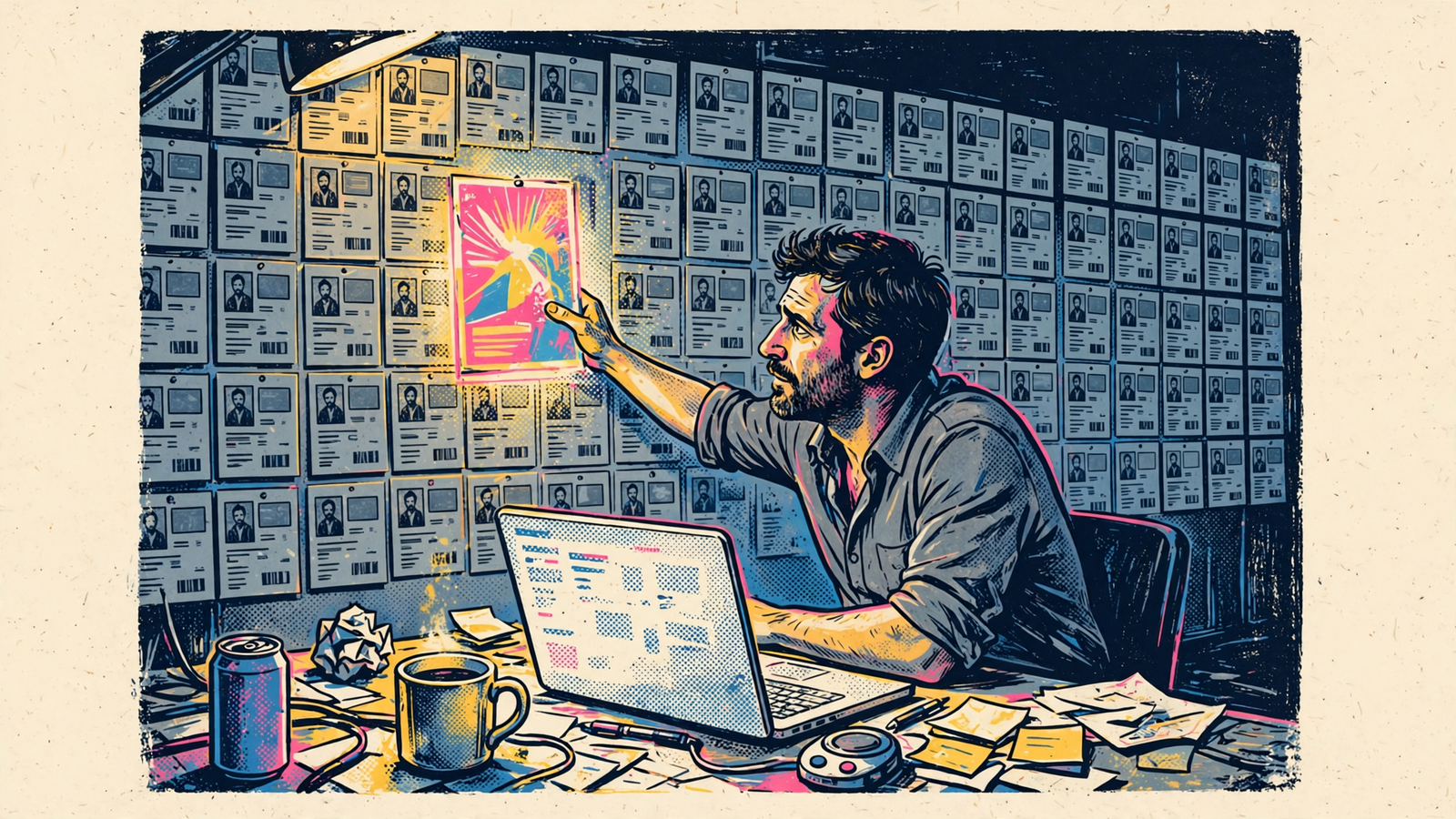
Speed: who acts before the weekend spend is gone?
Ryze and Advantage+ have an advantage over a person who opens the account once a week: they can act without waiting for Thursday’s review. What the deck calls always-on optimization, I call not letting a loser spend through the weekend. That part is worth paying for when there is a real operator using it.
A weekly human review can catch context an automated rule misses, but it can also arrive six days late. groas combines continuous execution by specialized models with a named strategist who sets direction and guardrails. Its action logs show what changed and why. That pairing matters when a fast adjustment needs to be questioned rather than merely applauded.
Fast action is valuable. Fast action with an owner is better. If your in-house operator already provides the context, Ryze can give that person speed. If the only review happens when an owner remembers a password, the tool is not a substitute for ownership.
Accountability: who answers when CPA climbs?
Say CPA rises 40% in a week. Ryze can show the change and execute the settings you gave it. Advantage+ can keep seeking the conversions your account reports. Neither can take the client call, inspect the quality of those conversions and answer for the decision to keep spending. With either route, that responsibility belongs to you or someone you employ.
I have been on the call where a client wants to know why a lookalike brought in freebie hunters. “The algorithm found conversions” is an explanation of what happened, not an answer to the question. Someone has to check the signal, make a call and own it.
At groas, the named strategist works with you on direction, and changes come with reasoning. The service is oriented toward qualified pipeline and cost per acquisition rather than clicks alone. It cannot promise that CPA will never rise; no honest operator can. It does give you an accountable person when it does. A tool reports the fire. An operator is hired to deal with it.
Exit terms: what happens when you want out?
Read the exit before the feature list. Ryze’s entry offer is monthly software with a trial week. Advantage+ has no separate software fee; it lives in your Meta account. Neither price tells you what creative production or your own time will cost.
A percentage-of-spend manager is another option, but its bill can rise with your media budget: 10% to 20% of monthly spend is a cited range, often with a minimum. Flat-fee offers remove that particular incentive. For comparison, Feedbird lists $499 a month with no percentage of spend or contract, plus a $249 one-time tracking setup add-on. That lower sticker price is not a reason to assume it covers the same work.
groas lists $1,499 a month per service, month to month, with no setup fee or cut of spend; you keep your accounts and data. It also lists a seven-day money-back guarantee from checkout. If you might leave in 60 days, price the leaving as well as the staying.
The bill at $3k, $10k and $30k in ad spend
Total first: including media, the illustrated monthly bill at $3k spend is $5,759–$9,359 with Ryze, $6,100–$9,700 with DIY Advantage+, and $4,714 with groas. At $10k spend, it is $13,659–$19,059, $14,000–$19,400 and $11,714 respectively. At $30k, it is $33,659–$39,059, $34,000–$39,400 and $31,714. These are not vendor quotes. They apply the same creative-price and time assumptions below so the missing line items stay visible.
| Monthly cost at stated spend | Ryze AI + your operator | DIY Advantage+ | groas |
|---|---|---|---|
| $3k media: illustrated total | $5,759–$9,359 | $6,100–$9,700 | $4,714 |
| $10k media: illustrated total | $13,659–$19,059 | $14,000–$19,400 | $11,714 |
| $30k media: illustrated total | $33,659–$39,059 | $34,000–$39,400 | $31,714 |
Here are the recurring lines behind those totals. The creative ranges use 12 ads a month at $3k spend and 18 at $10k and $30k, priced between the listed $150 static and $450 creator-video starting points. Actual production cost depends on format, complexity and whether you buy a package. The hours are illustrative time budgets, not fees any vendor has quoted.
| Recurring line and basis | Ryze AI + your operator | DIY Advantage+ | groas |
|---|---|---|---|
| Software or service | $89/month | $0 separate software fee | $1,499/month |
| Bought creative at $3k media: 12 ads at $150–$450 starting prices | $1,800–$5,400 | $1,800–$5,400 | No separate creative charge in the service fee |
| Bought creative at $10k or $30k media: 18 ads at the same starting prices | $2,700–$8,100 | $2,700–$8,100 | No separate creative charge in the service fee |
| Your time, illustrated at $50/hour using roughly 4.33 weeks per month | About $870: 4 hours/week | About $1,300: 6 hours/week | About $215: 1-hour/week check-in |
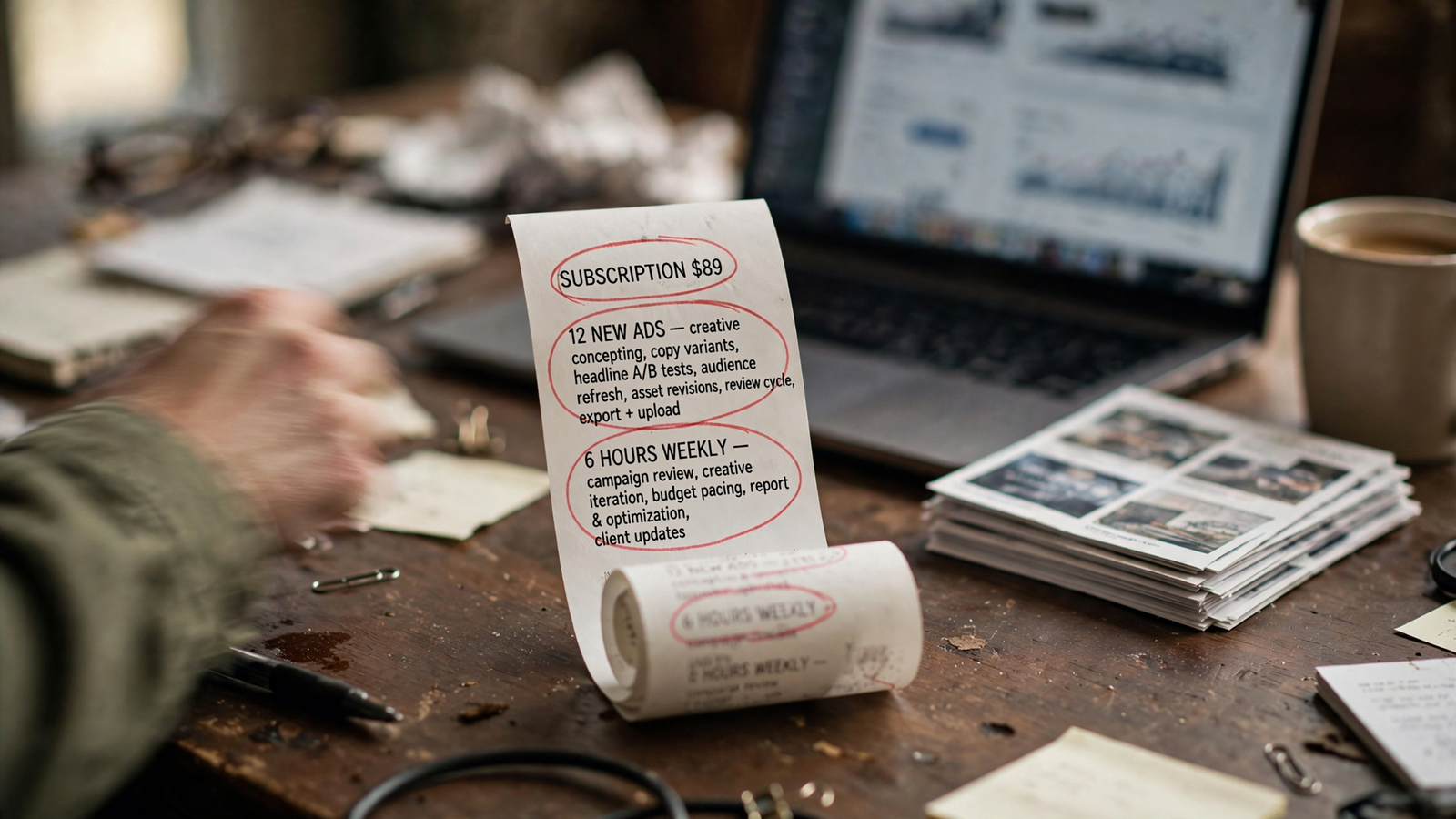
One-off costs are separate from that monthly table. A pixel, CAPI or other tracking fix may be needed on a Ryze or DIY account; its cost depends on the account, so I am not assigning it a tidy number. groas lists no setup fee and checks tracking during onboarding. The table also does not claim that an included creative service will produce any arbitrary number of finished ads. It compares the listed fee with the illustrative bill for buying the stated volume separately.
At $3k spend, the creative range dwarfs Ryze’s $89 subscription. At $10k and $30k, the 18-ad benchmark raises the illustrated production line; if your account needs more, that line can rise again. The flat groas fee does not rise with media spend. Nor does a flat fee make every business ready to test: if you cannot fund enough media for honest decisions, a cheaper operating model may be the sensible starting point.
The cheapest mistake is paying $89, then discovering that you still need to do the job. The expensive one is leaving $10k or $30k a month on Meta with tired creative while a busy dashboard convinces you somebody is operating the account. For the separate DIY, flat-fee and percentage-of-spend comparison, the fee structure gets its own treatment. Here, the question is who does the work.
Verdict: pick the operator unless you already have one
| Decision | Ryze AI | DIY Advantage+ | groas flat-fee service |
|---|---|---|---|
| Next batch of ads | Your team produces it; tool helps test ideas | Your team produces it; Meta works with uploads | New ads tested within the service |
| What to kill | Automation helps; your operator owns the call | Meta optimizes; your operator owns the call | Service runs testing with strategist oversight |
| Speed and context | Fast automation; context comes from your team | Fast automation; context comes from your team | Continuous execution with a named strategist |
| Accountability for CPA | Your team | Your team | Service and named strategist |
| Exit | Monthly software and a trial | No separate software fee | Month to month; cancel anytime |
Pick Ryze if you have the people, not just the budget
Buy Ryze if a designer or creator already ships roughly 12 to 18 fresh ads a month and someone on staff checks tracking, reads lead quality and makes the hard calls. Then $89 buys speed for an operator who is already there. A lean team can make that arrangement work. The Madgicx, Advantage+ and done-for-you comparison turns on the same production question: who feeds the system?
Pick groas if the account has no owner
If creative and daily decisions fall to whoever has a spare hour, buy the operator, not another dashboard. groas is my pick for the owner spending $3k to $30k a month who needs both production and accountable execution. Its flat fee covers the work the software price leaves outside the box. The broader options for running Facebook and Instagram ads are worth a look if you are still choosing an operating model.
If you spend under $2k and cannot yet fund regular testing, skip both purchases for now. Run a simple Advantage+ sales campaign, get pixel and CAPI working, and revisit the decision when you can afford to test new ads. But do not call an empty creative queue an automation strategy. Meta cannot optimize the ad nobody made.


