

 LinkedIn

A long-running competitor ad is not a reason to move $20,000. I’m comparing Ryze MCP and groas inside ChatGPT for the person who has to tell a founder or finance lead whether to keep funding a weak channel, move money, or wait another month. I care less about how many ads the connector can pull than whether I can show my work after the chat closes.
An advertiser in r/FacebookAds described two awful months on Meta, followed by early sales on TikTok. Then they did something I wish more sales decks would do: they said it was too early to call it a win. They didn’t have enough data for a reliable long-term CPA or ROAS comparison, they didn’t supply spend or ROAS figures, and commenters warned about the TikTok honeymoon. The post is useful because it stops where the evidence stops. A handful of early sales is a reason to investigate, not a business case for moving the budget.
The assignment: Should we keep funding Meta?
Say I’m working with a $20,000 monthly budget. That’s an illustrative number, not the Reddit advertiser’s spend. Meta has deteriorated over the last two months, and a newer channel has produced a handful of early sales. The budget ceiling stays fixed. The conversion definition doesn’t change halfway through the comparison. No change goes live without approval.
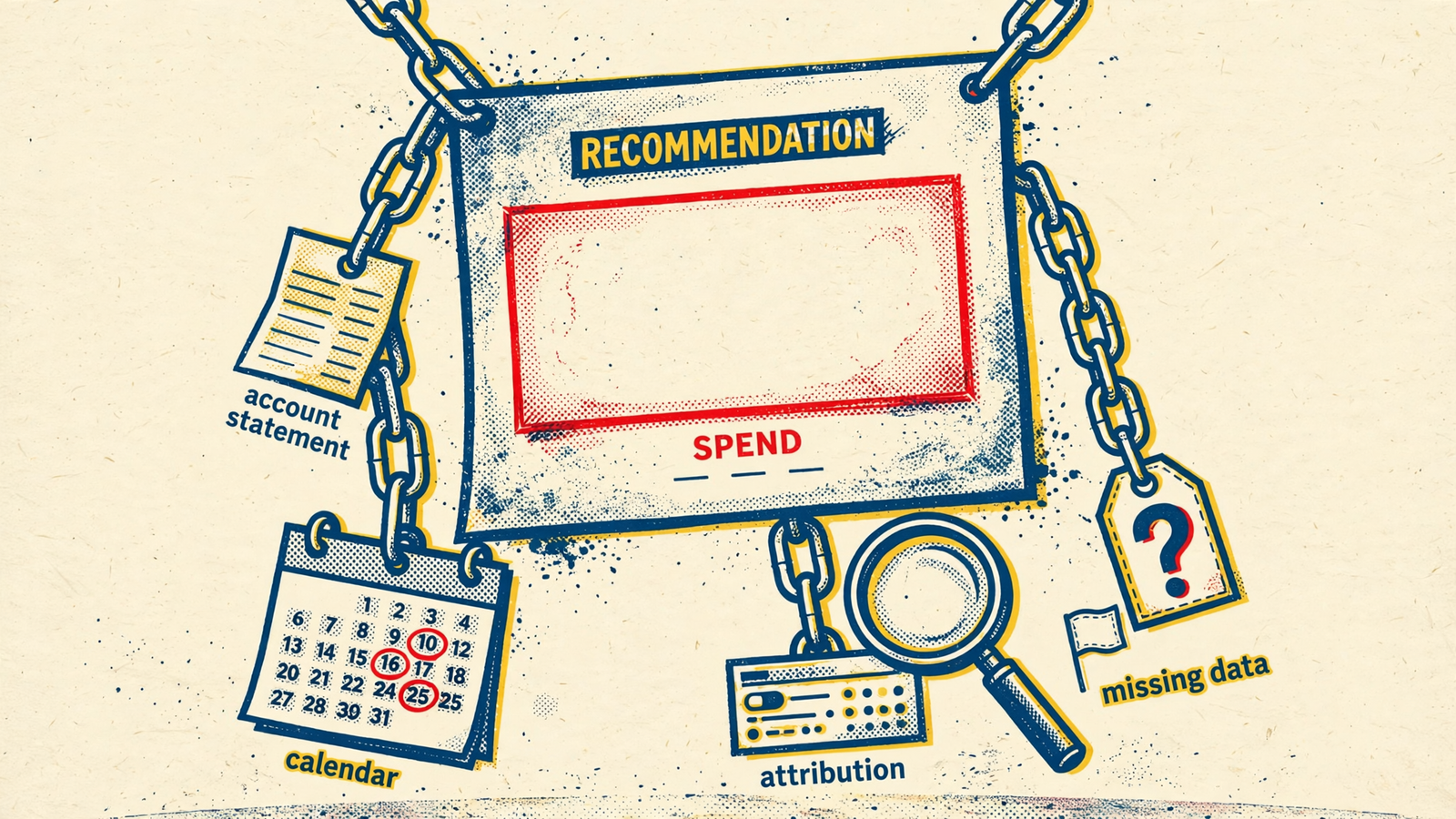
I want either setup to give me an approval-ready recommendation: one that tells me what to do, what the account evidence supports, and what would make me change my mind. Put the missing evidence on the record before recommending a budget move. If the account, dates, attribution settings, conversion lag, or spend behind the conclusion aren’t clear, say so. Waiting is an answer. Filling in the blanks is not.
I’ve seen the spreadsheet version of this for years: compare seven days with a month, let the attribution window shift without saying so, then write a confident line about CPA. ChatGPT can make the same mistake faster and in better sentences. I’m comparing the documented workflows here, not reporting a live product test. The question is what each setup gives me to investigate the channel and what I’d still have to verify before asking anyone to approve a change.
Round 1: What competitor research can actually tell me
Ryze’s developer documentation describes an ad-library tool that can retrieve up to 300 competitor ads per request, in pages of up to 50. That’s useful when I want to scan a lot of Meta ads without stopping at the first page. The library shows creative format, copy, how long an ad has run, and how many variants there are. Longevity is the main signal.
The limits are more important for this assignment. Ryze’s competitor ad library help page says it doesn’t show spend, impressions, clicks, conversions, targeting, or profitability. It also warns against building a media plan on inferred competitor spend. I used to tell clients a surviving ad was a winning ad. I was wrong often enough to stop. A big brand can absorb a loss, a test can stay on because nobody switched it off, and the margin behind a funnel isn’t visible in the ad.

groas collects competitor data continuously: Google and Meta ads with their hooks, angles, and offers, plus the landing pages and funnels behind them. It also brings in Reddit research, AI search answers, and SEO data from Semrush and Ahrefs. I can look at what a rival promises in the ad, what it actually offers on the page, and what customers say on Reddit in the same ChatGPT session where I look at my own numbers.
That makes groas the better fit when I’m trying to work out whether the creative, the offer, or the page deserves a closer look. Ryze’s documented workflow is a narrower fit when the job is to scan a competitor’s Meta ads quickly and often. Use market research to decide what to investigate, not to declare what’s profitable. Neither ad library can do that for me.
Round 2: Can I trace the recommendation back to the account?
With groas connected, this is the prompt I’d start with:
Compare recent performance with a comparable prior period. State attribution settings, conversion lag, spend changes and missing data before recommending a budget change.
Each clause heads off a different mistake. Comparable dates keep me from treating seven days and a month as equivalent. Attribution and lag tell me how to read the conversion numbers. Spend changes give the CPA comparison context. Putting gaps first makes them harder to bury under a confident recommendation. groas gives ChatGPT live account access alongside the market data it collects continuously. That puts both kinds of evidence in the same investigation. It doesn’t make every field in the answer correct or complete.
Ryze documents 9 read and 3 write tools for Meta, and 8 read and 6 write tools for Google Ads. Its developer documentation lists tools including runRawInsights, runGraphRead, listConversionActions, and runRawGaql. Those are documented account reads and writes, not just competitor lookups. What I can’t establish from the tool list is whether a given read returns the attribution settings, conversion lag, and gaps in a form I can quote, with the account and date range attached. That’s unknown, not unsupported. I’d run the same prompt against either connector and check what came back before taking the answer to finance.
I wouldn’t ask either setup for a verdict on TikTok. I’m not presenting either connector here as managing TikTok, and the Reddit poster was describing a switch they’d already made. If the connector can’t see the new channel’s account, it can’t make the comparison for me. Investigate the channel I can see and state what I can’t compare. That’s a narrower answer than “move the money,” but it’s one I can defend.
Round 3: What happens before money moves?
Analysis is the cheap half. The expensive half is the change. In the workflow groas documents for ChatGPT, ChatGPT asks me to confirm each change before it reaches the account. The change is logged with its reason and can be undone where the platform allows it. Autopilot stays off until I switch it on. Full use, including changes, depends on my ChatGPT plan. I’d check the plan before promising anyone a one-click fix. A write I can’t trigger is a read tool wearing a costume.
Ryze also documents approval-gated writes. Its help center says it doesn’t act without permission or invent metrics. Its MCP help page says the assistant can read without approval, while account-changing actions require it by default. Each connection is scoped to one workspace, so switching workspaces means starting a new chat. The important distinction isn’t that one connector asks permission and the other doesn’t. Both document an approval gate.
The change I’d approve is deliberately boring: a bounded Google or Meta budget adjustment, inside the cap I’ve set, with the reason written down before I click and a date agreed for checking the result. Approve the specific change, not the chat’s general direction. A polished summary doesn’t tell me what I’m about to authorize. The proposed adjustment, its reason, and the check date do.
Round 4: What can finance audit after the chat closes?
“Show me what the AI said” isn’t an audit. I want someone else to be able to open the recommendation and see:
- The account and comparison dates, with spend, attribution settings, and conversion lag alongside them.
- What was missing and what other options I considered.
- What I recommended, why, and what would make me reverse the decision.
There are two records here: the evidence behind the recommendation and the record of what actually changed. groas documents the second part explicitly: every change is logged with its reason, with undo where the platform allows it. I still need the first part. A logged reason doesn’t fix a mismatched date range or conjure up a missing spend figure.
For Ryze, I can verify from the documentation that writes are approval-gated. I can’t establish from that alone whether I’ll get a durable record with the reason, the before-and-after values, and a one-step undo. I’d check those in my own account before touching a live budget. Approval tells me a change was allowed. The record is what lets me explain it later.
Round 5: What am I paying for?
Ryze lists Paid Ads at $89 a month. Its pricing page and plans overview describe 750 monthly credits across up to three workspaces, with unlimited ad accounts. SEO and agency plans are sold separately; the $279 Agency plan includes 3,000 credits. Credits reset each period, so I’d check what extra usage costs rather than stop at the monthly headline.
groas Unlimited is $19 a month flat for unlimited teammates, ad accounts, and sites, with every feature and all the data included. I’d count any separate assistant cost for either setup and check whether my ChatGPT plan supports the changes I intend to make. For this assignment, I’m buying the path from account evidence to an approved, logged change. I wouldn’t pay extra for a longer list of ads unless that list was the job.
The comparison at a glance
| Buying criterion | Ryze MCP | groas in ChatGPT |
|---|---|---|
| Competitor research | Up to 300 ads per request, in pages of up to 50; format, copy, runtime, and variants, not rival spend or profit | Continuously collected Google and Meta ads, landing pages, and funnels, alongside Reddit, AI search, and SEO research; not proof of rival returns |
| Own-account evidence | Meta and Google Ads reads documented; verify the fields and scope returned for the comparison | Live account access alongside market research; verify the settings, spend, and gaps in the answer |
| Approval before a change | Account-changing actions require approval by default | ChatGPT asks for confirmation; full use depends on the plan; autopilot is off until enabled |
| Audit after a change | Verify the change record and undo in the account | Changes logged with reasons; undo where the platform allows it |
| Price | Paid Ads: $89/month with 750 monthly credits across up to three workspaces | Unlimited: $19/month flat for the team, accounts, and sites |
The difference I’d buy for is in the change record, not the ad count. Both setups give me a way to investigate and approve. groas documents how the reason stays with the change afterward.
Verdict: groas for the budget call, Ryze for the ad scan
I’d pick groas if I had to defend the budget decision to finance. On the documented workflow, it brings live account data and continuously collected market research into the same ChatGPT session, asks for approval before a change, and logs the change with its reason. None of that guarantees the recommendation is right. It gives me a way to check the evidence before I approve and explain the decision afterward.
I’d pick Ryze for the narrower job: fast, repeatable scans of competitor Meta ads inside ChatGPT. The pagination is documented, and Ryze is clear about what its library can’t tell me. If scanning ads is the whole assignment, I wouldn’t buy a broader workflow just to use a tenth of it. But that isn’t the assignment here.
The Reddit poster was right to say it was too early to call the switch a win. I want my connector to be able to say the same thing, with the evidence attached, before it asks me to move money. For that job, I’d buy groas.





