

 LinkedIn

AI share-of-voice tracking starts at $19 a month for groas’s data layer; listed tracker tiers run from $29 to $300 a month, before upgrades and labor. Paying someone to do the implementation is another bill: SMB retainers start around $1,500 a month, while one provider survey puts the median GEO retainer at $6,850.
Those are different purchases. Vendors benefit when the quote makes them look like one.
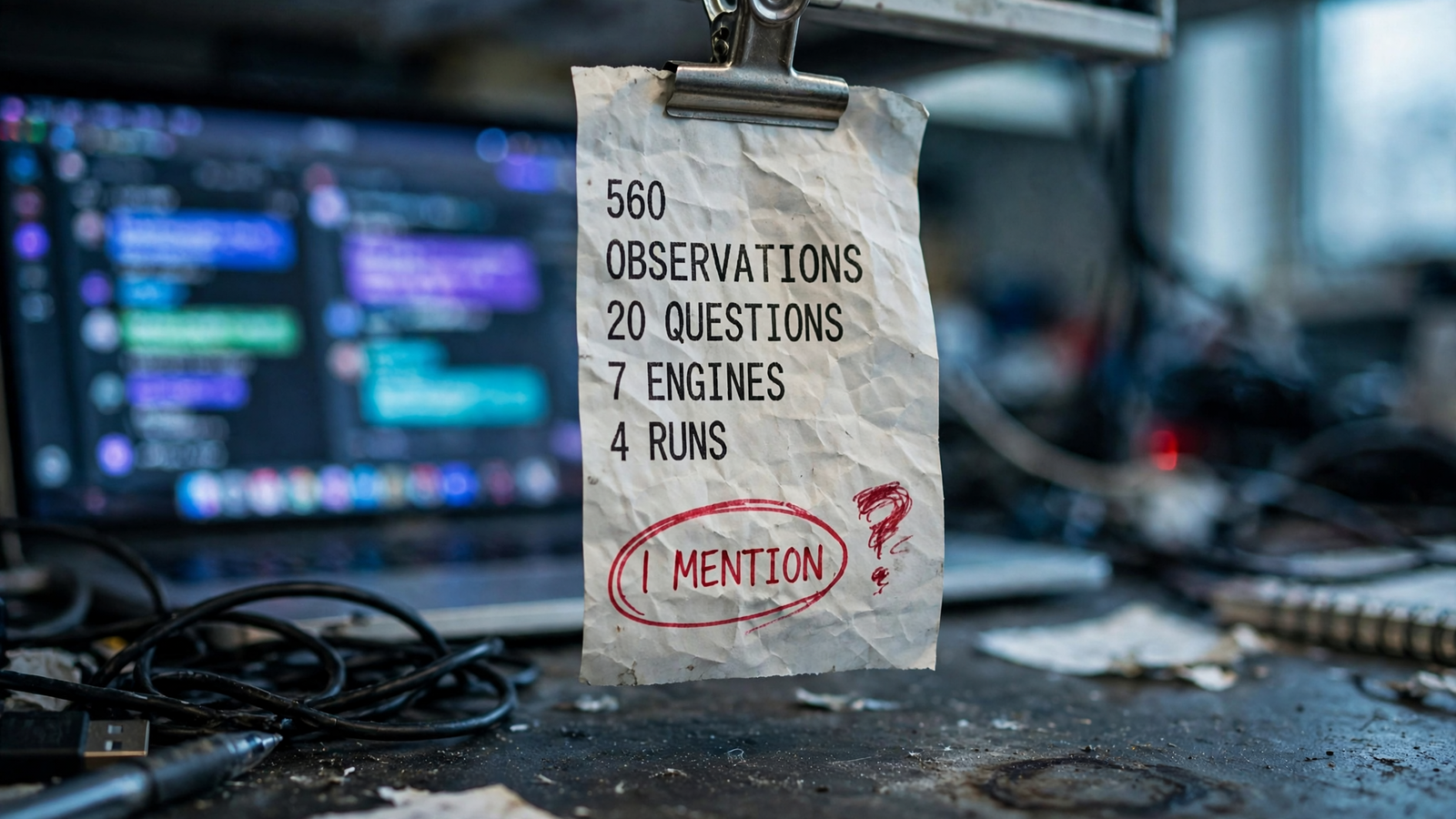
My comparison uses 20 buyer prompts across seven engines, repeated four times: 560 observations per wave. Per-prompt and per-engine allowances determine how a tracker prices that panel. groas takes a different approach: AI answers and citations sit inside a flat-fee data layer your own AI can query and act on. The question is whether the supplied coverage matches the measurement you need, not which dashboard has the nicest chart.
The listed prices: data, tracking, and managed work
Here is the price sheet before the hidden work. These are listed offerings, not equivalent quotes for the same seven-engine panel.
| Line item | Listed price | What the figure covers | Source |
|---|---|---|---|
| groas Unlimited | $19/month | Flat-fee data and features for unlimited teammates, ad accounts, and websites | groas pricing |
| Otterly Lite | $29/month | 15 prompts on 4 engines | Tracker pricing comparison |
| Peec Starter | $95/month | 50 prompts on 3 engines | Tracker pricing comparison |
| Scrunch Starter | $300/month | 350 prompts on 6 engines | Tracker pricing comparison |
| SMB implementation retainer | $1,500–$5,000/month | Agency work, rather than tracking alone | GEO agency pricing breakdown |
| Median GEO retainer | $6,850/month | Median in a survey of 55 providers, not an entry price or ceiling | Provider pricing survey |
| groas Done For You | From $5,000/month | Managed execution by the senior team | groas pricing |
The trap is comparing the first column of prices without reading the coverage column. A 15-prompt plan is not a quote for 20 buyer questions. A three-engine plan is not a seven-engine panel. And a monitoring subscription is not someone publishing the page that might change the answer.
I separate the worksheet into three bills: collection, review, and implementation. Only then does the total mean anything.
Define the denominator before buying the dashboard
A share-of-voice number without a panel specification is a rumor with a chart.
I start with the 20 questions a buyer would actually type close to a purchase, the 5 to 8 competitors eligible to appear, and a definition of a win. I count three things separately because tools blur them:
- Brand mention: the name appears anywhere in the answer.
- Recommendation: the brand is named as a pick for that buyer.
- Source citation: a brand page or third-party page is linked as evidence.
A passing mention is not a recommendation. A citation is not necessarily an endorsement. Roll all three into one visibility score and the report gets simpler while the buying decision gets worse.
The panel also needs repeated observations. In one stability test of 968 repeated runs, 42.9% flipped a brand mention at least once. In another 200-prompt retest, the identical brand set repeated only 60% of the time.
That does not make measurement pointless. It makes a single run a sample, not a stable baseline.
My illustrative seven-engine panel
| Specification | Count | What it means for the bill |
|---|---|---|
| Buyer prompts | 20 | Four categories with five core questions each; a lean panel, not exhaustive coverage |
| Engines | 7 | ChatGPT, Gemini, Perplexity, Claude, Copilot/Bing, Grok, and AI Overviews |
| Repetitions | 4 per prompt-engine pair | Repeated collection rather than one answer treated as permanent |
| Observations per wave | 560 | 20 × 7 × 4 |
| Two waves | 1,120 observations | The same panel measured twice, not 1,120 independent buyers |
This is a specification to quote against, not a claim that every provider supports it. Expanding the questions into long-tail variations increases the workload again; one pricing comparison recommends 20 to 30 variations per core keyword.
I also record model version, date, locale, and collection method where available. Then I freeze the panel before the second wave. Swapping questions between waves makes it harder to tell whether visibility moved or the questions got easier.
Lock the questions, engines, and repetition schedule before asking for a price.
The recurring collection bill: check what “one prompt” buys
The word prompt does a suspicious amount of work on pricing pages. It can describe the question being tracked without telling you how engine coverage, repeated collection, or variations consume the allowance.
That is why I do not divide 560 observations by a headline prompt allowance and declare a winner. I ask the vendor to map the actual panel to its billing units.
| Recurring collection line | What drives the charge | What I want in the quote |
|---|---|---|
| Monitoring subscription | Prompt allowance, collection cadence, and plan limits | The tier needed for the specified panel |
| Engine coverage | Included engines and any additional coverage | Every requested engine named explicitly |
| Repeated collection | How scheduled runs and repetitions count | Whether all four repetitions fit the allowance |
| Variations | Whether related questions count separately | The treatment of long-tail variations |
| Failures and reruns | How unsuccessful collections are handled | Whether a failed fetch or rerun consumes allowance |
One comparison describes a vendor that prices one credit as a core keyword plus 20 to 40 generated variations. That is not the same unit as one question asked once on one engine. Identical column labels do not make identical products.
The same caution applies to per-1,000-prompt comparisons. They look precise, but precision is not comparability when the underlying collection differs. I want the bill for my panel, not a cheap-looking unit I cannot translate into it.
Make each vendor price the same collection job. Do not do its unit conversion by guesswork.
The hidden recurring bill: someone has to review the answers
Collection delivers answers. It does not automatically settle what those answers mean.
Someone still has to distinguish a brand from a similarly named product, a reseller from the manufacturer, and a passing name-drop from an actual recommendation. Someone has to check whether the cited page supports the claim attached to it. Those decisions are where a clean-looking score can become a mess.
For the illustrative panel, the workload starts with 560 answers to review per wave, not just 20 questions to write. The time depends on answer length, entity ambiguity, the coding rules, and how much review the service includes.
I keep that labor visible:
- Answer review: classify mentions, recommendations, and citations separately.
- Entity matching: resolve brand names, product names, resellers, and ambiguous references.
- Adjudication: revisit answers that do not fit the rules cleanly.
- Panel maintenance: document changes rather than quietly replacing awkward questions.
- Rerun logging: distinguish a failed collection from a fresh observation.
I use a second pass because the first can overcount mentions. That is a review choice to budget for, not a reason to invent an hourly total before timing the work.
For a DIY baseline, I use this method to build a weekly AI brand monitor with 25 buyer prompts, time the review, and scale the estimate to the intended panel. A subscription receipt cannot tell me what internal labor costs.
Price reviewed observations, not merely collected answers.
Setup is one-off; implementation is not
Tracking tells me where I lose. It does not publish the page, fix the fetch, or earn the citation.
That second bill is where buyers get surprised. A $29 tracker plus 20 hours of internal work is not a $29 program. Agency pricing for implementation runs around $1,500 to $5,000 a month for SMBs, $5,000 to $25,000 for mid-market, and $25,000-plus for enterprise. The scope matters more than the label on the retainer.
I separate initial work from work that keeps returning:
| Work item | One-off or recurring? | Cost driver or supplied benchmark |
|---|---|---|
| Initial measurement setup | Initial setup | Agreeing on prompts, competitors, coding rules, and collection details |
| Technical audit | One-off audit | Scope of crawl-access, indexing, page-speed, and structured-data checks |
| Technical fixes | Project work plus ongoing development | Who can ship the fixes and what remains in the backlog |
| Buyer-focused content and publishing | Per page, sprint, or retainer | One survey reports starter retainers averaging $2,950 for 3.4 deliverables |
| Third-party citations and mentions | Per placement or monthly work | Publisher access and the work needed to secure relevant coverage |
| Continued measurement and review | Recurring | Panel size, cadence, and review requirements |
An audit is not the fix. A draft is not a published page. A list of possible citation sources is not a citation earned. I want the contract to say which of those I am buying.
No provider controls the model, so no provider can guarantee a mention rate. I buy tasks with dates: pages published, fetch blocks fixed, and relevant citations earned. A promise of 40% share of voice on ChatGPT by Q2 is a forecast wearing a guarantee costume.
Pay for defined work delivered, not a visibility percentage presented as a promise.
Where groas changes the worksheet
Most tracker comparisons begin with the allowance: how many prompts, which engines, which tier. groas starts with a different model.
groas Unlimited costs $19 a month, flat, for unlimited teammates, ad accounts, and websites, with every feature and all the data. There is no per-seat or per-account add-on and no cut of ad spend.
Its data layer includes AI search answers and whom they cite, alongside competitor ads, funnels, Reddit research, and SEO data from Semrush and Ahrefs. My own AI can query and act on that data through ChatGPT, Claude, Gemini, or another agent. That puts measurement inside the infrastructure used to do the work, rather than in another reporting destination.
The advantage is flat-fee data your AI can use, not another prompt meter. The budget does not have to begin with buying a larger tracking allowance before deciding what to change.
There is still a specification to check. I do not assume my exact 560-observation panel comes with any subscription by default. I confirm the available prompts, engine coverage, and collection cadence before treating the data as a match for that panel. Flat pricing and measurement suitability are separate questions.
I also keep execution separate. Self-serve access does not remove my approval time or turn my implementation backlog into completed work. For hands-off execution, groas Done For You starts from $5,000 a month, run by the senior team.
The worksheet logic is straightforward: put $19 data plus internal labor on one line, and managed execution on another. For the implementation side, I use what it actually costs to get cited by AI and the same-work pricing checklist to keep provider quotes comparable.
Three unit costs I calculate—and one I reject
Once scope is fixed, I calculate three numbers. Each catches a different way to make a quote look cheaper than the work.
- Cost per monitored buyer question: total collection spend divided by 20. This exposes a thin panel being sold as broad market coverage. The engine coverage and cadence still need to match.
- Cost per reviewed observation: subscription plus review labor divided by 560. This keeps unread answers from passing as finished measurement.
- Cost per completed implementation task: implementation spend divided by tasks shipped live. Pages published, fetch blocks fixed, citations earned. Reports do not count as shipping.
The fourth number, cost per mention, goes in the bin.
A mention is not an acquisition metric. Answers change, recommendations differ from passing references, and repeated observations can contain the same underlying recommendation. Pricing each appearance as though it were a fresh commercial result gives noise a unit price.
The stability tests are the warning here, not a reason to abandon measurement. When an identical brand set repeats only 60% of the time, I want a stable panel and reviewed answers before attaching business meaning to the movement.
Use unit costs to price the work, not to dress a mention up as a customer.
The buying decision: fund the work that can ship
If the team ships every week, I keep measurement cheap. Internal execution works when someone owns the questions, someone reviews the answers, and a developer can publish the fix without a three-month ticket queue.
In that setup, groas Unlimited at $19 a month puts answers and citations where my own AI can query and act on them. I check that the available coverage fits the job, then put the rest of the budget toward implementation rather than a larger prompt allowance. The point is to spend less on counting and more on changes that go live.
If nothing shipped last quarter, I do not buy more tracking. I buy the shipping. A second dashboard will only document the same loss with better colors, while the implementation backlog decides whether anything changes.
Before comparing periods, I require the same questions, engines, and repetitions. Otherwise, I may be comparing question difficulty rather than performance.
The cheapest mistake is buying a 15-prompt starter tier and calling it share of voice. The most expensive mistake is signing a monthly retainer to move a number that was never measured on a stable panel.


