

 LinkedIn

Say you have $1,500 a month for ads. A $600 Bing retainer eats almost half the money before you buy a click. Should a small business pay for Bing Ads management at all? Smart operators disagree because protecting the test budget and protecting it from bad execution are not always the same thing.
One side says to keep Bing narrow, run it yourself, and spend the money learning whether the channel works. The other says a small budget is exactly what bad tracking and sloppy imports punish hardest. The cheapest management fee is not necessarily the cheapest way to acquire a customer. But sometimes the honest recommendation is not to hire anyone yet.
The real dispute: what is left after the fee?
Agency sales pages love to blur three separate bills:
- Media spend: the money you pay Microsoft for advertising.
- Management: the fee you pay someone to run it.
- Your time: the hours you take out of your own week.
Bing looks cheap if you stare only at the first bill. Microsoft clicks can run 40–60% cheaper than the same keywords on Google in many categories, with one tracker putting search CPC at $1.40–$1.55. That discount makes a small test tempting. It does not tell you whether a management retainer makes sense.
On $800 a month in media, a separate $500 fee asks a lot of a low-volume channel. If that fee comes out of the same total budget, it also removes money you need for the test itself. Yet keeping every dollar in media achieves nothing if you cannot tell which clicks become customers.
That is the disagreement worth having. Not whether professional management helps in principle, but whether you can still afford a useful test after paying for it.
The case for DIY: a small Bing account does not need another retainer
The strongest argument for self-management starts with arithmetic, not a dislike of agencies. Google still takes the bulk of search queries. For many small advertisers, Bing is an additional slice of an already small search budget. A standalone fee can overwhelm that slice before the campaign gets moving.
One UK breakdown recommends skipping Microsoft below £400 in total monthly PPC spend and considering Google plus Microsoft above £600, with roughly 75% going to Google and 25% to Microsoft. Another guideline puts Microsoft at 10–15% of search budget. I use that smaller allocation as a starting point, stretching toward 25% for desktop-heavy B2B.
Those are allocation guides, not instructions to launch a channel on whatever loose change the percentage produces. If the resulting budget cannot support a concentrated test, I would wait.
Keep the test small enough to manage, not too small to learn
The DIY case is strongest when you resist building a miniature version of your entire Google account. I would start with:
- One exact-match campaign.
- Five to fifteen proven search terms from your Google search terms report.
- One metro area.
- An ad schedule limited to the hours you answer the phone.
- A fixed review date and a protected media budget.
A suggested starting cap of $6–$12 per day limits the amount at risk, but a low daily cap is not the same as a sufficient testing budget. The same source suggests planning around $500 a month per campaign. UK managers make a similar case for at least £500 a month in ad spend so the account gets enough clicks to begin showing which keywords produce enquiries.
I treat that as a planning allowance, not a promise that four weeks will settle the question. Concentrate the budget before expanding the account.
Replace the retainer with an actual weekly routine
Self-management is not the absence of management. It means you take responsibility for the work:
- Set up Microsoft conversion tracking. Install Microsoft’s UET tag and check that the conversion goals work. Your Google tag does not report conversions to Microsoft.
- Review search terms every seven days. A tight keyword list still needs attention, particularly when syndicated partner traffic brings irrelevant queries.
- Judge leads and closed work, not cheap clicks. Check calls, form fills and resulting jobs against spend. Cut terms that attract tire-kickers even when their CPC looks pretty.
The lower CPC is useful only if the traffic becomes business. Cheaper clicks still lose when they never become jobs. That is why I would rather see a narrow account reviewed weekly than an elaborate import nobody opens.
The DIY advocate also has a perfectly respectable third option: do not launch yet. If Google has broken conversion tracking, no negative-keyword routine and no follow-up process, Bing gives those problems another place to live. If you cannot spare 60 minutes a week, the work does not disappear. It just goes undone.
The strongest DIY case is a working Google account, a protected Bing budget and an owner who will do the checks. Without those, postponing beats pretending.
The case for paid management: cheap execution can waste an expensive share of the budget
The strongest argument for paying starts where the DIY plan is most vulnerable: measurement. A disciplined weekly routine sounds straightforward. It still requires someone to set it up correctly, notice when it breaks and act on what it shows.
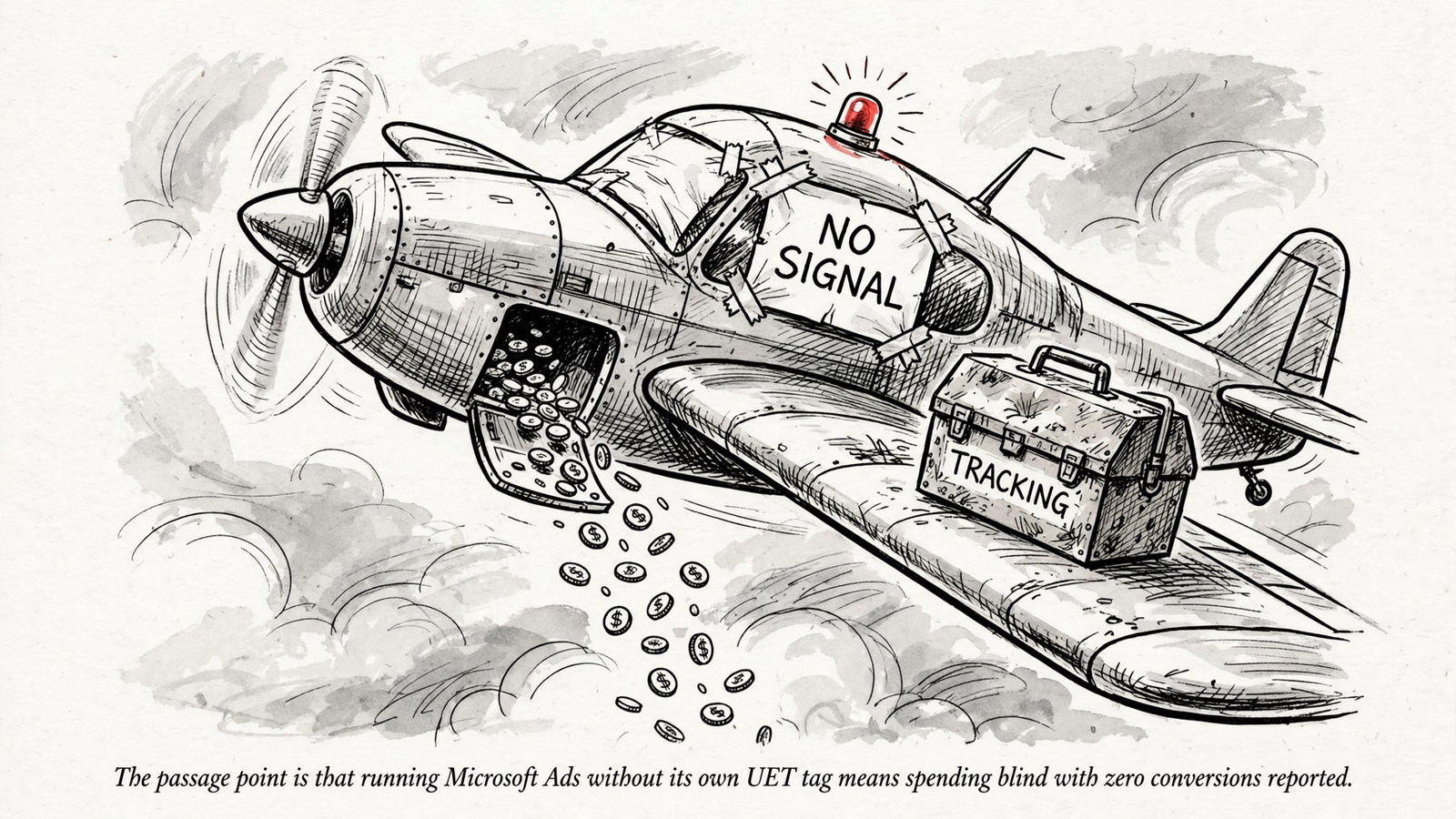
Microsoft needs its own UET tag and conversion setup. Without that feedback, the account cannot reliably connect its spend to the actions you want. You may see clicks, costs and apparent activity without knowing which terms produce enquiries.
That is not a reporting inconvenience. It changes what you can sensibly optimize. A small budget leaves less room to spend blind.
An import saves setup time, not the audit
The native Google import copies campaigns, keywords, match types and extensions in minutes. It does not make the two accounts interchangeable. Microsoft’s broad and phrase expansion differs from Google’s, so keyword-level performance will not necessarily follow the same pattern.
The paid-management advocate points to the checks that come after the import:
- Bidding: check whether the strategy changes, including a switch to Maximize Clicks when no conversion goal exists.
- Locations: confirm that the intended towns and areas survive the import.
- Distribution: inspect search partners and syndication rather than accepting them unnoticed.
- Attribution: check tracking parameters so Bing traffic is not misattributed as organic.
- Re-imports: make sure scheduled imports do not overwrite Microsoft-specific fixes.
Then comes the patience problem. Target CPA and ROAS bidding can take longer to gather conversion data on Microsoft. Small samples look noisy from week to week. The person managing the account needs to distinguish a problem that needs fixing from a thin run of data that needs more time.
That is a stronger reason to pay than “we know the platform.” You are buying responsibility for the checks and the decisions that follow.
Someone has to own the leaks
A budget cap can choke the keyword that works. A re-import can undo a useful change. Poor-quality syndicated traffic can keep spending while everyone assumes someone else is watching.
None of those problems needs a polished monthly deck. Each needs an owner.
What the deck calls managed should mean something concrete: UET checked, search terms reviewed, bids assessed against qualified enquiries and closed jobs, and changes logged with reasons you can read. If you will not open the account, a named person needs to own those outcomes.
That is the paid side at full strength. A fee can be cheaper than wasted media, missed leads and hours you do not have. Management earns its place by preventing waste, not by making the dashboard look occupied.
The deciding distinction: is Bing a second invoice?
Now I can judge the two cases without pretending every management arrangement has the same economics.
A standalone Microsoft Ads retainer is priced as a separate service. One UK shop lists £325 a month standalone, or £1,095 bundled with Google and Meta, with media paid separately. The fee may be reasonable for the work. That does not make it reasonable for your budget.
Say you spend $20k a month across search and someone quotes another $600 just for Bing. The question is not whether Bing can produce cheaper clicks than Google. It is whether the business it brings justifies its media spend and the extra $600 management cost. Thin volume makes that additional hurdle harder to clear.
That is why I am sceptical of selling Microsoft Ads as a lead-generation upsell when it arrives as another invoice. “Another channel” is not, by itself, another source of profitable customers.
groas takes a different approach: one flat $1,499 monthly management fee covers Google, Bing and ChatGPT Ads together, with media spend separate and no percentage-of-spend charge. For a business already paying for that combined service, adding a Bing test does not require another management retainer.
That distinction matters. It removes a separate fixed cost from the Bing decision. It does not make the media free, guarantee the channel works or turn a $1,499 service into a sensible purchase for someone with $1,500 total to spend.
The advantage is shared management without a second Bing fee, not permission to ignore the total budget.
My verdict: protect the test before paying for its management
For a small business considering a standalone Bing retainer, I side with the DIY argument: do not hire anyone yet if the fee leaves too little money to test the channel properly. The single consideration that decides it is the media budget left after management.
My planning rule is to protect roughly $500 in monthly Bing media before considering a standalone fee. At around $1.50 a click, that buys a few hundred clicks, not a guaranteed answer. Some accounts will need longer. The point is to leave enough room to learn rather than use the first month’s budget to purchase supervision of an underfunded campaign.
Take an $800 total budget and remove a $325 fee: $475 remains for clicks. That is not a magical failure line. It is a warning that the fee is squeezing an already small test. I would not split that budget merely to say the business has professional Bing management.
Here is how I would act on that verdict:
- Self-manage when Google already converts, you can protect roughly $500 in Bing media for four weeks, and you will handle tracking and weekly search-term reviews. Keep one campaign and a fixed review date.
- Bundle when Bing fits inside cross-channel management you already pay for. groas’s combined fee avoids the second-retainer problem; the Bing test still has to justify its media spend.
- Postpone when total PPC sits below that £400–£600 planning band, Google tracking is broken, or nobody can own the weekly checks. Concentrate the money rather than starve another channel.
Before signing, ask four questions that expose the real cost
If the budget does support paid management, I would ask every shortlisted provider the same four questions. For a longer checklist, use these 7 questions to ask before hiring a fully managed agency. I am listening for ownership, not enthusiasm.
- Scope: Is Bing included in the current fee or billed separately, and what Bing-specific work does that cover?
- Ownership: Who sets up and checks UET, reviews search terms weekly, and turns off syndication when it brings junk?
- Reporting: Will you report cost per qualified enquiry and closed jobs, rather than just clicks and CPC?
- Exit: If I cancel, do I keep the account, its history and the negative-keyword lists?
If a provider hedges on those, I would keep the money. The cheapest headline fee is not necessarily the cheapest way to win a customer. But that does not mean a small business should buy management it cannot afford to test underneath.
My verdict is not to shop for the smallest Bing retainer. It is to protect the media left after the fee, track it cleanly and point it at terms that turn into work. Bing earns its place inside management you already pay for, supports a standalone fee when the budget allows it, or waits. Sometimes the right person to hire for Bing is nobody yet.


