

 LinkedIn

I want one answer when Google and Bing disagree, not two reports and a spreadsheet. Should Bing get its own MCP connector in Claude anyway? Smart operators split on this because they’re solving different problems: one side wants a single place to compare accounts and approve changes; the other wants a tool or an access boundary the shared connection can’t give them. I keep Google and Bing together by default. A second connector has to supply a capability the work actually needs. Being able to connect it doesn’t count.
I start a review in Claude with groas with a deliberately boring request: “List the Google and Microsoft Advertising accounts available for this review. Make no changes.” That gives me the scope of the review without asking Claude to change either account. The debate starts after that, when I have to decide whether another connection would change what I can do or just give me another place to do it.
The case for one connection: the comparison is the work
The consolidation case starts with the weekly review. Google’s search share is around 90%, against Microsoft’s roughly 7%, and Microsoft clicks often cost 30% to 60% less. That’s exactly why I want the accounts in the same conversation. A cheaper click doesn’t settle where to put the next dollar. I want to see what each platform spent, what it got back, and whether either has room to take more budget.
Put the accounts in two chats and I become the join key, copying Bing CPA next to Google CPA and trying to remember which account had the budget change last Thursday. With one connection, one request can read both accounts, compare them on the same terms, and propose an action without taking it. I still want separate findings for each platform. I just don’t want to assemble the comparison myself. If the recommendation is to move budget from Google to Bing, the case for taking it out of Google belongs right next to the case for putting it into Bing.
There’s a duller argument, too. Claude Free allows one custom connector, and on Team, a connector has to be added by an Owner. One groas connection fits the Free limit. It also means I can keep the report, the proposal, and my approval in one thread instead of moving an action from the chat that found the problem to the chat that can fix it.
My usual request is: “Prepare a Google-and-Bing exception report, with separate platform findings and proposed actions. Do not execute.” The seven Google and Bing exception reports to ask Claude for give me more specific versions of that prompt. If I approve a change, groas logs it with the reason, and I can review it afterward. That’s the case for consolidation at its strongest: keep the evidence, the decision, and the action close enough that I can check one against the others.
The case for a specialist: some tools are worth a separate connection
The strongest specialist argument starts with the tool list, not the connector count. I don’t assume a marketing server covers everything its underlying API can do. This Google Ads MCP server reads data and offers a narrow set of changes through a propose-and-confirm flow. Other servers can create campaigns, which is why I check write scope before connecting. The fact that two connectors handle ads tells me almost nothing about whether they handle the same job.
Take Teads. Its Ad Manager MCP integrations offer audience insights, reach forecasting, and inventory discovery in Claude, Gemini Enterprise, and Copilot. If I’m planning a Teads buy and need a reach forecast my shared connection doesn’t offer, the forecast is enough to justify the specialist. The connector doesn’t need to launch the campaign to earn its place. The planning task is the job.
Access can be a capability in its own right. If a client contract requires isolated access, a connector that can provide and document that isolation gives me something a shared route may not. Microsoft’s official advertising server is free and read-only, with nine tools in open pilot. If the task is reporting and the route must not be able to change account data, read-only isn’t a shortcoming. It’s the point. “Don’t execute” tells Claude what I want it to do. A read-only connection limits what it can do. If the requirement is about access, I care about the second one.
A third-party Bing wrapper with a limited set of write tools makes a different case. It can pause or enable campaigns and ad groups, set daily budgets, and add or remove negative keywords. It can’t change keyword bids, keywords, ads, or bid strategies. That’s a useful distinction when the task is an approved pause rather than a report. I used to tell clients a dedicated connector meant tighter control. I was wrong about what made it tighter. Control comes from the actual permission scope and approval rule, not the logo on the connector.
Cross-examination: name the job the shared route can’t do
Both arguments sound good until I make them name the task. I give Claude the two connector descriptions and ask it to compare the exposed tools, account scope, approval requirements, and evidence for each. Anything the descriptions don’t establish stays unknown. If the answer says “supports campaign management,” I want to know whether that means reading a campaign, pausing it, or launching one. Those are three different permissions, not three ways to say the same thing.
This is where Teads is a good argument for specialists and a bad argument for splitting Google and Bing. Teads announced the integrations in closed beta for TAMbassadors, with broader access planned through the end of 2026. The published tools make a case for planning and discovery. They don’t establish that an agent can pause, rebudget, or launch a campaign. I’d count the forecast if I needed it and could access it. I wouldn’t count campaign creation just because someone described a workflow that ends there.
I apply the same test to Bing. The official Microsoft server needs an app registered in Microsoft Entra ID and Claude’s callback URL. If I need a separate read-only route, that setup buys me something. If I already get the Bing reads I need through groas and there’s no requirement to isolate access, it buys me another set of permissions to check. And if I need a write the wrapper doesn’t expose, adding it won’t solve the problem either.
The early usage examples explain why I start with reporting. Campaign reporting accounted for almost a third of MCP queries in Adform’s early data, and every agency example was a read task. In the same coverage, one team hit Claude usage limits with a stack that made 12 separate MCP calls and argued for routing through one buyer agent. That isn’t proof that two connectors will hit a limit. It’s a reason not to mistake more connections for a better answer. If I can’t name the missing tool, scope, or approval rule, the second route stays disconnected.
My verdict: keep routine Bing work with Google
If I’m running Google and Bing together, I keep reporting, budget checks, search term reviews, campaign copies, and approved changes on one groas connection in Claude. The deciding question is whether the separate route supplies a necessary capability. I don’t add one for a different interface to the same account, and I don’t rule one out when it does a job the shared route can’t.
Say I spend $20k a month on Google and $3k on Bing. In a shared review, Claude can flag that Bing’s brand CPA is 40% lower but volume is capped, propose moving $500 with a cap, and wait for my approval. The 40% gets my attention. The volume cap is what I check before I say yes: if Bing can’t use the extra budget, the lower CPA isn’t enough reason to move it. If I approve the move, I have one log to check and one place to undo it. Behind that proposal is the comparison I asked for, not a Bing answer I have to reconcile with a Google answer in another thread. That’s the longer argument in All-in-One Marketing MCP vs Separate Connectors: Stop Being the Join Key.
Give each task one owner
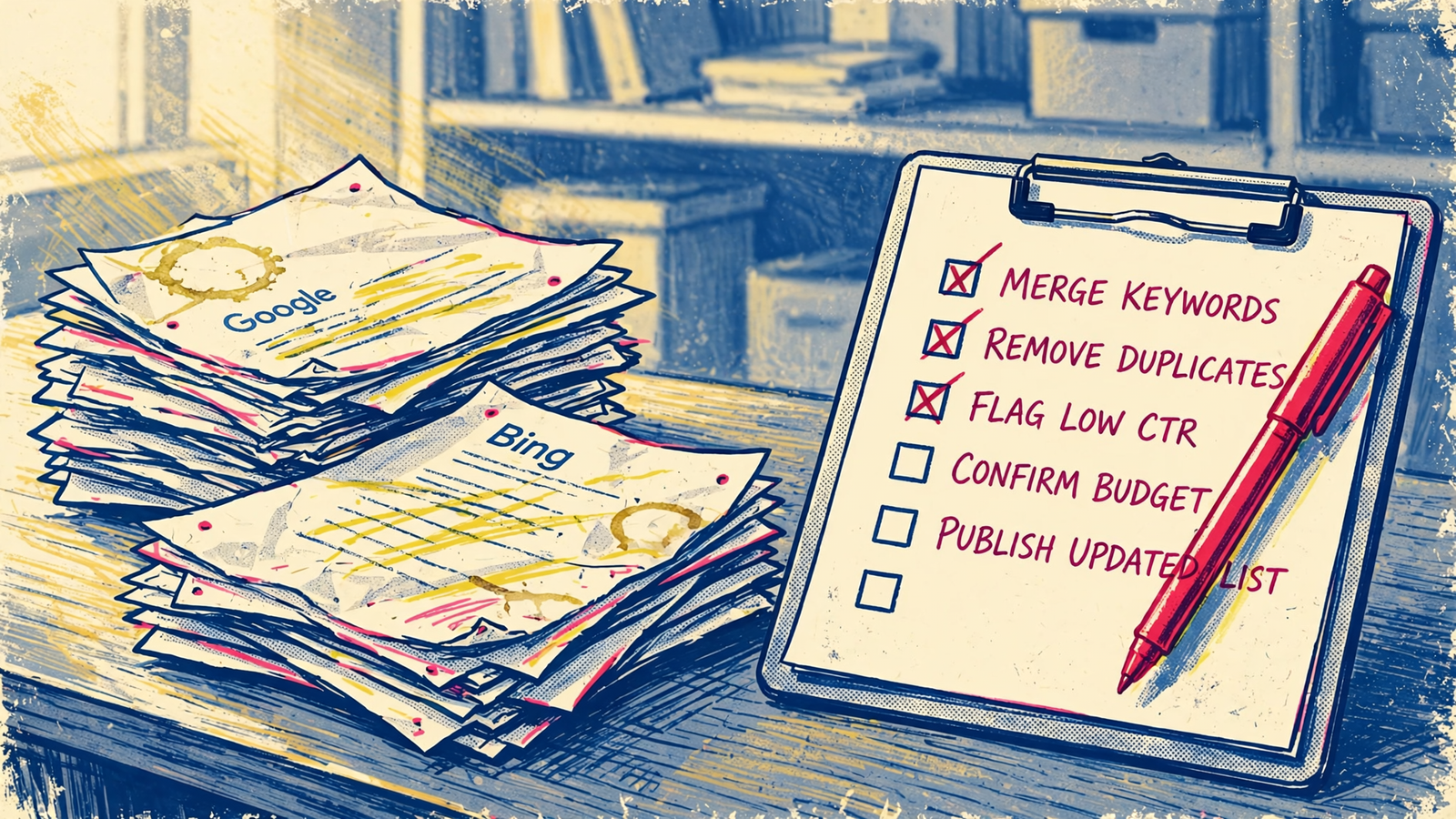
I write down which connection owns the task before anyone approves a change:
- Shared connection: the weekly exception report, cross-platform budget comparisons, Google-to-Bing campaign copies, and approved Bing pauses, budget changes, and negative keyword additions.
- Specialist connection: only the gap its tools demonstrably fill, such as reach forecasting for a Teads buy or isolated access a client contract requires.
Before a write, I confirm the account, campaign, proposed change, and budget limit in plain text. Afterward, I check the groas action log for changes made through groas.
A specialist doesn’t inherit Bing work just because I connected it. If the job is to read a forecast, it owns the forecast. If the job is to move budget, the execution route needs to be clear before I say yes.
Make the second connector earn its place without touching spend
I’d rather spend an afternoon on this than a month discussing it in Slack. I start with this prompt: List every write tool each connection exposes, the account scope each one requests, and which tasks require approval. Mark anything you cannot verify as unknown. Then I try three jobs through the shared route:
- Run the Google-and-Bing exception report without executing any recommendations.
- Draft a Google-to-Bing campaign copy without launching it.
- Propose a small Bing budget change with a cap, then stop before approval.
I look for the exact point where the shared route falls short. Can I review the comparison without copying figures into a spreadsheet? Can I see the proposed campaign copy before launch? Is the budget proposal clear enough to approve in plain English? If the proposal doesn’t name the campaign or the cap, I ask for both before I call it a connector problem. A vague answer isn’t evidence of a missing tool. I can judge review time and manual copying from that dry run. I can’t tell whether an unexecuted budget move changes CPA.
If Bing is 40% of spend and Google is the afterthought, I’ll look harder at what the Bing route needs. The spend split still isn’t a reason to add a connector on its own. If a team has Entra approval requirements the shared route can’t meet, that’s a gap worth testing. I’d give the specialist 30 days as the primary route for that job and measure review time, rather than let two routes own it indefinitely.
I make the rule explicit at the top of the chat: “groas owns Bing changes this week. The Teads connector owns forecast reads only.” It sounds fussy until a budget move gets approved in the wrong thread and Friday becomes a hunt for the right log. That’s the part of the connector debate I care about. If the specialist fills a gap, give it that job. Otherwise, keep the review in one place so you’ll actually read it.


