

 LinkedIn

A healthy blended CPA can still leave you unable to explain what Bing contributed. Should Claude judge Google and Microsoft Advertising as one portfolio, or make Bing clear its own bar? Smart operators disagree because they are protecting against different mistakes: one camp wants the budget to serve the whole business; the other wants to stop Google’s volume from concealing a weak channel.
Say you’re spending $20k a month on paid search, with about a tenth going to Microsoft. The blended CPA looks healthy. Nobody pushes back until the founder asks what Bing actually contributed. You have a merged report, one paid-search row, and no answer that survives the follow-up.
My position: one shared review, separate channel economics, and explicit permission before anything moves. One AI connection into Claude or ChatGPT should not become one blended performance target. But the case for pooling deserves a proper hearing, not the usual dismissal about averages hiding things. It gets its round first.
The case for pooling: the business has one budget
The strongest pooling argument starts here: the budget is one pot, so its ultimate performance target should be one number. If blended cost per acquisition clears the target your finance lead signed off on, and total qualified conversions are climbing, separate scorecards can become an expensive way to protect channel ownership.
Google does not need to win. Microsoft does not need to win. The business does.
Suppose Google carries 90% of spend and Microsoft 10%. Rigid channel targets invite two bad reflexes:
- Throttle Microsoft as soon as it looks expensive on a thin sample.
- Defend Microsoft out of habit because “diversification,” even when the money would close more pipeline elsewhere.
A portfolio target rejects both. It asks where the budget does the most useful work, rather than whether each platform produces a tidy report in isolation.
The benchmarks give this position something concrete to work with. The Silverback 2026 Paid Media Benchmark Report puts Microsoft at a $1.54 average CPC and $41.44 CPA, against Google Search at $2.96 to $4.22 CPC and a $53.52 CPA (Silverback’s benchmark report). SearchLab’s compilation points in the same direction: roughly $31 per conversion on Microsoft versus $45 on Google (SearchLab’s Microsoft Ads statistics).
Cheap incremental conversions lower the blended CPA. A pooled target rewards exactly that contribution instead of treating the smaller channel as a separate business that must justify its existence every week.
The reporting argument is just as practical. With groas connected, I can ask Claude to review both accounts in one thread:
Compare Google and Microsoft Advertising over the same dates. Show spend, conversions, conversion definitions and attribution differences before calculating combined results.
That is one request, one date range, and one place to inspect the evidence. It avoids two disconnected workflows that produce two confident recommendations nobody has reconciled.
The best version of pooling does not demand that I ignore channel detail. It says the final test belongs at the business level. If Microsoft adds qualified conversions at a cost the business accepts, a separate target should not turn that contribution into a failure of presentation.
The practical case is strong: judge the budget by what it produces, not by how neatly each platform fits its own box.
The case for separation: Google can keep the report green
The separation advocate starts with an equally blunt claim: a blended CPA cannot tell me whether Bing deserves its allocation.
Google’s volume dominates the merged total. If Microsoft is losing money at the margin, the blended figure may barely move. The report stays green while the smaller channel keeps spending under a target it cannot meaningfully disturb.
This is not an objection to arithmetic. It is an objection to asking an average to answer a question about one of its parts.
Databox makes the related point that blending top-of-funnel campaigns with branded search can produce a number that obscures rather than explains performance (Databox on cross-channel paid ads reporting). The same problem appears across platforms. Copying two reported CPAs into a sheet and averaging them does not produce a defensible portfolio CPA. And even a correctly calculated blended CPA cannot establish whether the smaller channel is worth its budget.
The separation case rests on three things: comparable outcomes, enough evidence, and visibility into where the money went.
First, make sure “conversion” means the same thing
A lower reported cost per lead can win a budget argument simply because its underlying definition is broader. If Microsoft counts form fills while Google counts sales-accepted leads, the cheaper channel is not necessarily cheaper. It is measuring something easier.
A Google and Microsoft conversion-parity audit illustrates that problem. The operational lesson is more useful than another platform average: compare the same business stage before comparing its cost.
That means checking the machinery behind the columns:
- Which conversion actions count toward the reported total?
- Do those actions represent the same stage in the customer journey?
- What attribution windows and reporting dates apply?
- Do account time zones and reporting periods align?
- Can representative records be traced from the ad report into the CRM?
Microsoft’s conversion-reporting documentation explains why reporting dates and conversion treatment need attention. A practitioner comparison also identifies separate tags, attribution windows, time zones, and inconsistent column labels as sources of disagreement (ReportsMate’s reporting comparison).
I do not need the platforms to produce identical totals before making any decision. I do need to know what the difference means. When I cannot establish parity, I want the channels shown side by side with the limitation stated plainly, not merged into an apparently cleaner answer.
Match the business outcome first. Calculate the comparison second.
Second, do not mistake a small sample for a verdict
Microsoft usually occupies a smaller part of the search budget. SearchLab puts Bing at roughly 4.7% of search worldwide, closer to 9% of US desktop traffic, with the average advertiser routing 8–15% of search budget to Microsoft (SearchLab’s Microsoft Ads statistics).
At that scale, a couple of conversions can move a weekly CPA sharply. A thin week may tell me very little about whether the account has improved or deteriorated.
Pooling does not solve that uncertainty. It conceals it. Google supplies the smooth curve, Microsoft’s variation disappears inside it, and the channel I most need to examine becomes the one I can no longer see.
The answer is not to punish Bing for having less volume. It is to show the sample size beside the recommendation. If the evidence is too thin to justify increasing or cutting its allocation, the report should say so. “Not enough evidence yet” is less satisfying than a confident arrow. It is also more useful than pretending Google’s conversions strengthen a conclusion about Microsoft.
Make the review window fit the evidence. Do not make the evidence fit the meeting.
Third, inspect the traffic behind the average
Operators’ experiences with Microsoft differ sharply. In one r/PPC discussion about whether Bing ads are worth running, one commenter describes Microsoft as a way to add another 5–10% of conversions for brands already succeeding on Google. Others describe poor conversion quality and clicks that fail to turn into business.
Those reports do not settle what will happen in my account. They explain why a benchmark cannot settle it either.
Another operator discussion comparing Bing and Google includes complaints about substantial spend landing on unwanted placements. That is a reason to inspect where Microsoft’s spend went, not to assume that every Microsoft campaign has the same problem.
A merged row cannot tell me whether the smaller channel is adding useful demand, buying the wrong traffic, or simply waiting on conversions that have not yet appeared. Each explanation calls for a different decision.
That is the separation camp’s strongest point: the budget allocation belongs to a specific channel, so the evidence must remain specific enough to defend it.
My verdict: share the review, not the performance target
I side with separation on the decision and pooling on the workflow. The deciding consideration is whether I can defend Bing’s allocation on Bing’s evidence. A blended number cannot do that job, however healthy it looks.
I am writing for the operator who has to defend that line item across a table, not the one who wants a tidier dashboard. When the founder asks what Microsoft contributed last quarter, I need its spend, comparable business outcomes, reporting limitations, and sample size. Google’s stronger volume is not an answer.
I still want the combined result. It tells me whether total paid-search spending clears the business’s efficiency target. But that is a portfolio check, not permission for every channel inside it to keep its budget.
The rule is therefore straightforward:
- Review Google and Microsoft together over the same period.
- Keep their economics separate and identify what is comparable.
- Recommend Bing’s allocation from its own evidence.
- Require explicit approval before changing anything.
This is not a compromise between two equally useful targets. The pooled target loses as the basis for Bing’s budget. A shared review survives because disconnected workflows would make the decision harder, not better.
Have Claude prepare a recommendation someone else can challenge
This is where connecting Claude to the accounts through groas earns its keep. I do not want to ask “How did Bing do?” and accept the first fluent paragraph back. Before Claude reads the actual numbers, that paragraph is a guess with good grammar.
Pull the evidence first, then ask for an argument I can attack. My request would look like this:
Compare Google and Microsoft Advertising over the same 90 days. For each channel separately, show spend, conversions, conversion definitions, attribution model, reporting lag, and monthly conversion volume. Flag anything that is not comparable across channels and anything based on too few conversions to support a firm conclusion. Identify missing information rather than guessing. Then give me the argument for holding, increasing, or decreasing Bing’s allocation, plus the specific evidence that would reverse each recommendation. Do not change anything.
Two details do much of the work.
The first is reporting lag. Microsoft’s Conversion Delay column describes the typical time a campaign needs to collect 90% of its conversions (Priority Pixels on Microsoft conversion tracking). A dip at the end of the reporting period may reflect conversions that have not happened yet, rather than broken tracking or deteriorating performance. I want that possibility examined before the budget recommendation appears.
The second is the request for evidence that would reverse the recommendation. A case for cutting Bing should name what would justify keeping it. A case for increasing its allocation should name what would make that increase look wrong.
That turns a polished summary into a decision someone else can challenge. It also exposes the difference between “Microsoft performed poorly” and “I do not yet have enough comparable evidence to judge Microsoft.” Those are not interchangeable conclusions.
I want the uncertainty attached to the recommendation, not buried beneath it.
Approve one change, then inspect what happened
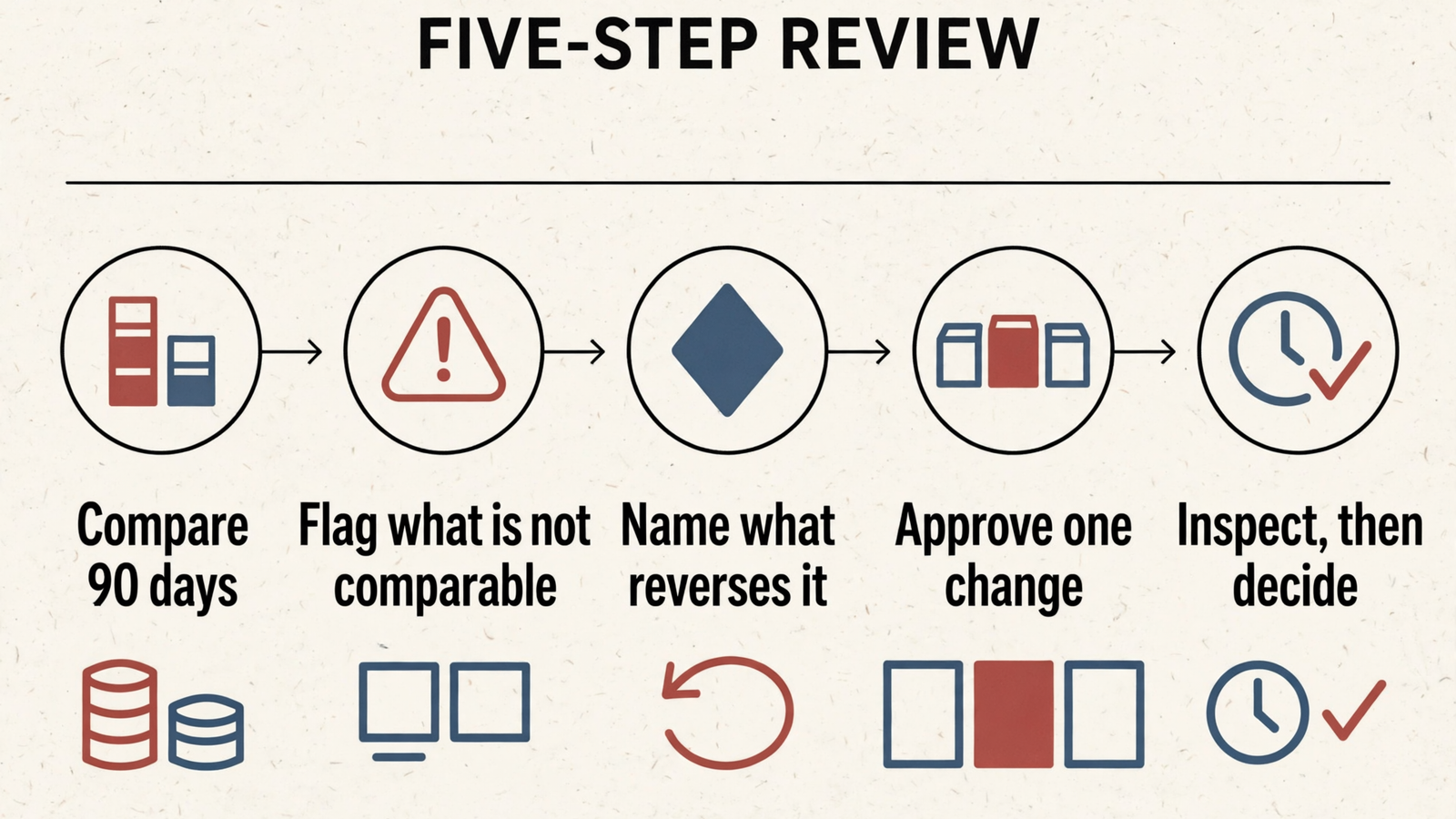
The last discipline is approve a specific change, not a standing instruction to rebalance.
If the evidence supports moving Bing’s allocation, approve a defined amount for a defined window. If it supports holding, record what would need to change before the next allocation decision. Either way, leave a reason the next reviewer can find.
I would keep the sequence explicit:
- Ask: get the analysis and inspect its limitations.
- Approve: authorize the specific budget change and record why.
- Inspect: review the result before making the next allocation call.
The ask/approve/autopilot framing makes the distinction clear. Asking for analysis is not permission to execute it. Approving one change is not permission to keep changing the account indefinitely. Continuous execution is a separate decision.
For this review, I would leave autopilot off. The point is to establish what Microsoft does at the approved allocation before handing over an ongoing instruction. groas logs changes with their reasons and allows changes to be undone in one step, so the approval does not have to become an irreversible commitment.
The failure mode is easy to describe: a standing instruction rebalances spend using the same pooled average that hid the problem in the first place. The recommendation sounds disciplined because it happens on schedule. The underlying evidence has not improved at all.
My alternative is deliberately boring. Separate the evidence. Compare conversion definitions at the same business stage. Name the sample size. Approve one change, then inspect what happened before calling the result a trend.
One review, separate evidence, explicit permission. Anything else is a merged row where a real question used to be.


