

 LinkedIn

Your ChatGPT Ads test has spent $18,000 in six weeks: 22 demos, six sales-accepted opportunities, zero closed deals. Should you double the budget or freeze it? Smart operators disagree because waiting for revenue can starve a useful channel, while scaling on demos can fund months of expensive noise. My ruling: qualified pipeline can earn a capped continuation budget, not unrestricted scaling.
Your agency wants to keep moving. Your CFO wants proof. Neither position is stupid, which makes this a more useful argument than the usual agency-versus-finance pantomime.
I separate three things before taking either side:
- The management fee pays for work done. It is not evidence that the channel works.
- The media spend buys evidence. The question is whether the next tranche is worth buying.
- The sales cohort needs time to mature. An open opportunity is neither a win nor automatically a failure.
Mix those together and the budget call becomes three people arguing about different numbers. Separate them and the real question appears: how much should you risk before revenue can settle the argument?
The case for scaling on pipeline: revenue arrives too late to steer the test
The strongest pro-pipeline argument is not that demos look encouraging. It is that closed-won revenue is too slow to be your only decision signal.
If your sales cycle runs 90 days and you insist on a closed deal before changing the budget, you get roughly one revenue-led decision per quarter. Meanwhile, the campaign keeps spending. You still have to decide what to keep, what to cut, and where the next dollar goes.
B2B paid media with long sales cycles needs earlier signals. The useful version is a ladder, not a bucket labelled leads:
- Day zero: engagement and a qualified form submission.
- Days 3–14: a meeting actually attended.
- Days 5–21: sales acceptance.
- Days 10–45: an opportunity created.
- Days 45–120 and beyond: closed-won revenue.
Each step asks more of the prospect. Each gives you something more useful than a booking notification.
A sales-accepted opportunity matters because someone in sales checked the account, assessed fit, and committed time to it. That human filter is much closer to a revenue proxy than a raw demo count. It does not prove the deal will close. It does give you a reason to keep testing before it does.
The advocate for scaling would go further: if qualified opportunities keep arriving at an acceptable cost, refusing any increase until revenue lands can hold back a channel that is doing its job. The campaign cannot shorten your procurement process just because finance wants a cleaner spreadsheet.
I used to tell clients to hold budget flat until revenue landed. I was wrong to make that an automatic rule. It preserved cash, but it could also stop learning precisely when the early evidence became useful.
Judge each cohort on the clock it has actually lived through
The strongest evidence for the pipeline position is the mismatch between campaign speed and sales speed. You cannot fix that mismatch by blending everything into one ROAS number.
I use separate windows:
- Daily and weekly: tracking, pacing, and obvious junk.
- 30 days: qualification and meeting rates.
- 60 days: opportunities and cost per opportunity.
- 90–120 days: closed revenue, CAC, and payback, where the sales cycle allows that judgment.
Never compare seven-day revenue from a new campaign with 120-day revenue from a mature one. That comparison makes the new test look stupid and the established channel look brilliant. Mostly, it proves that one cohort is older.
On a six-month cycle, even the 120-day window will not settle the revenue question. The calendar is a review schedule, not permission to pretend every deal should have closed by then.
This is why I would stop making a ChatGPT Ads manager wait for closed-won before optimizing. Earlier signals let the operator adjust the campaign while there is still something to learn.
The best pipeline argument: let qualified opportunities influence investment before revenue arrives. Otherwise, the sales-cycle lag becomes a blanket veto on learning.
The case for waiting: pipeline can flatter almost anything
Now give finance its strongest case. A pipeline number is only as good as the rules that let a deal into it.
Take those 22 demos. Say nine are students, four are existing contacts who clicked an ad on the way back to your site, and three are one-person companies that will never pass procurement. The deck calls it early momentum. I call it a qualification problem with a calendar invite attached.
A ChatGPT demo booking is not yet a customer. Attendance does not equal buying intent. A completed call does not automatically make an account qualified.
The waiting side has a concrete objection: agencies can get paid while weak pipeline sits open for months. Revenue forces an eventual reckoning that booking counts do not.
Pipeline inflation usually comes from three places:
- Duplicate contacts: several records make one buying conversation look like several opportunities.
- Stale opportunities: deals remain open long after anyone can explain the next step.
- Overgenerous attribution: an ad gets credit for demand that other activity already created.
If 40% of the reported pipeline was already warm before paid touched it, last-touch reporting overstates what the campaign contributed. Moving to multi-touch attribution can reduce apparent pipeline by 15–30%. The deal did not disappear. The reporting stopped giving one touch all the credit.
That is a serious objection to increasing spend. If the campaign mainly intercepts people already talking to sales, doubling the budget may buy more credit rather than more business.
A CRM match is not proof the ad created the deal
Even clean attribution has limits. An ad can touch an account that later closes without being the reason it closed.
The familiar Google Ads workflow captures a click ID at the form, stores it in Salesforce or HubSpot, and imports a later milestone. But that click-ID matching window has limits. On a long sales cycle, an upstream milestone can matter alongside closed-won reporting.
That is a reporting example, not a capability you can assume exists in ChatGPT Ads. Nor does a successful import prove incrementality. It establishes a connection, not the counterfactual: what would have happened without the ad?
ChatGPT Ads makes the distinction especially important because the reporting described here is aggregate, not prompt-level. Your agency cannot tell you which individual prompts produced qualified opportunities when it cannot see those prompts. It cannot conjure a native CRM connection that the platform has not shipped, either.
I would therefore reject any argument for scale that depends on reporting the agency cannot actually show. Ask what is observed, what is joined through your own records, and what is inferred. Those are different kinds of evidence. A polished dashboard does not make them interchangeable.
The best waiting argument: revenue is harder to flatter than pipeline. Until qualification and attribution survive scrutiny, more budget can simply make the reporting problem more expensive.
My verdict: buy one more tranche of evidence, not a blank cheque
For a B2B team with a three- to six-month sales cycle and no closed-won data yet, I take the capped-continuation side. The deciding consideration is the cost of being wrong in each direction.
Freeze a useful channel and you lose learning while the first cohort works through sales. Double spend on weak pipeline and you pay more to discover what a tighter qualification rule could have exposed earlier.
The cap limits that second mistake without forcing the first.
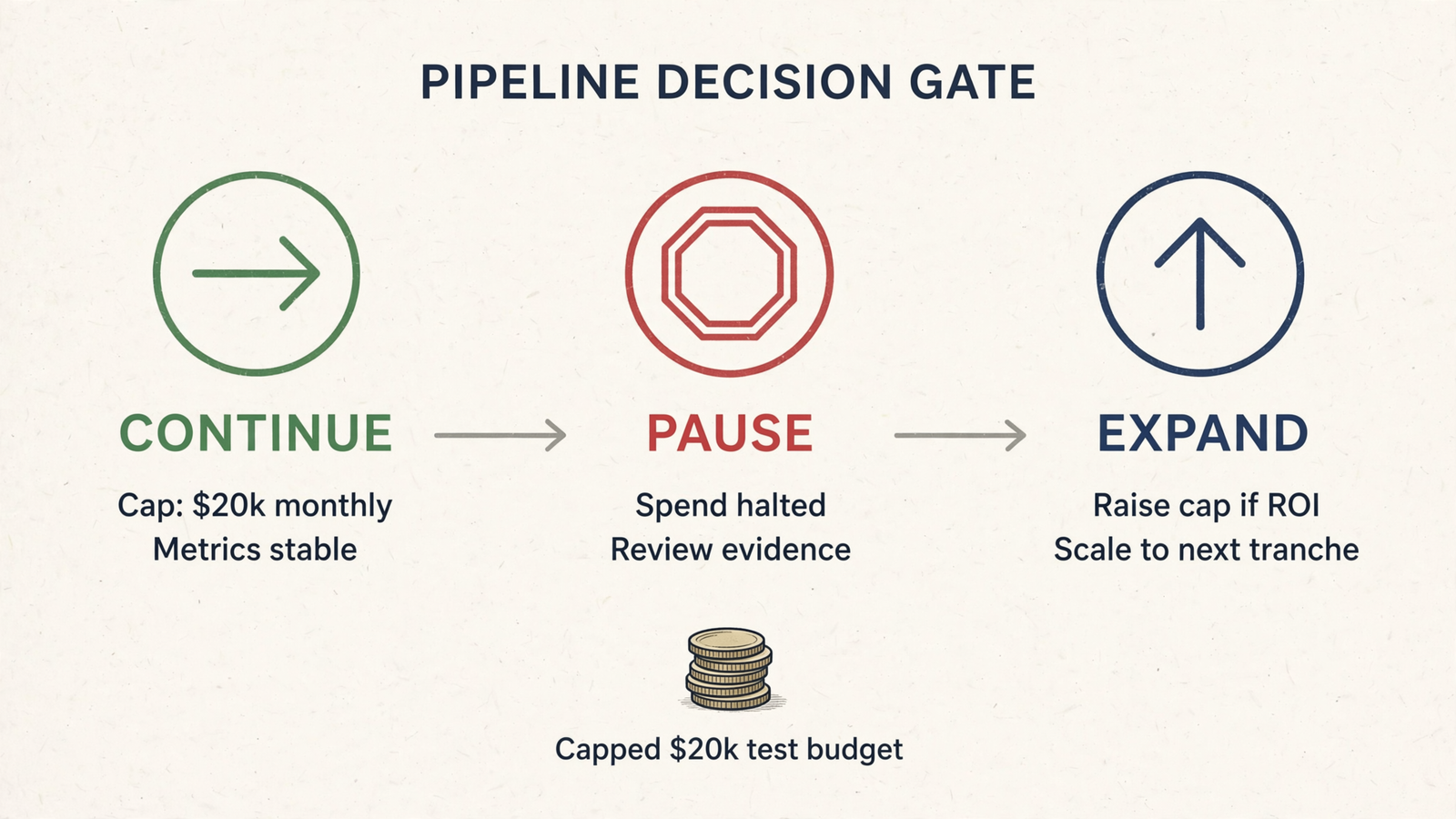
For the next decision, use a round-number example: media spend of $20,000 a month, plus the management fee. Doubling means committing $40,000 a month before the original evidence has matured. Continuing at $20,000 for another 30 days buys another defined window without doubling the exposure.
That is not a declaration that the channel works. It is permission to find out more.
I would keep the next month’s spend within the agreed cap, favour the campaign segments that can actually be linked to sales-accepted opportunities, and avoid expanding the test in every direction at once. No creative sprawl to make the activity report look busy. No increase because the demo chart points up.
When the ad books a demo but the sale takes six months, define the interim success condition now: which stage, accepted by whom, and de-duplicated how.
You are not scaling a proven winner. You are paying for one more month of cleaner evidence.

Put three conditions on the continuation budget
I would agree these rules before approving the next dollar:
- Define sales acceptance. Specify title, company size, and a completed discovery call. Sales confirms acceptance in the CRM. The agency does not award it to itself in a slide.
- De-duplicate the paid-pipeline figure. Exclude contacts already in an open opportunity or touched by outbound in the prior 90 days from the figure used to justify this continuation. Keep that rule consistent across reviews.
- Value the pipeline using history. Use historical close rates and average contract value to set the pipeline-to-spend hurdle. Optimistic quote totals are not expected revenue.
The third condition matters because pipeline multiples can sound much better than the economics underneath them.
One illustrative nine-month-cycle model starts with 48 enquiries, then narrows to 20 qualified enquiries, eight opportunities, and four proposals at £40,000 each. That produces £160,000 of proposal pipeline on £36,000 of spend: 4.4x pipeline-to-spend.
It sounds comfortable until you apply the model’s 25% proposal-to-close rate. That leaves one £40,000 contract, with the return fairly tested at month nine rather than month six. Proposal value is not cash in the bank. Four proposals are not four customers.
The same model expects month one to establish tracking and fit, month three to identify one to four winners, and month six to show qualified pipeline by stage. It kills the test if pipeline remains below spend and stays flat from months three to six.
The useful lesson is not to copy someone else’s timetable blindly. It is to write down what progress must look like before you get attached to the test.
For this continuation, the exposure is explicit: $20,000 in media and 30 days until the next review, with the management fee accounted for separately. Review qualification at 30 days, opportunity economics at 60, and revenue as the cohort becomes old enough to judge.
The approval rules I would put in the meeting notes
A cap without a decision rule is just a smaller blank cheque. Write down what earns continuation, what triggers a pause, and what could justify a higher cap.
- Continue at flat spend if the sales-accepted rate holds and cost per accepted opportunity stays below the agreed ceiling.
- Pause and fix qualification if MQL-to-SQL falls below 20% or most reported pipeline was already in the CRM. Do not solve a weak qualification process with more traffic.
- Consider a higher cap only when a cohort reaches the 60-day window with real opportunities at a defensible cost per opportunity. That remains a bounded decision, not permission for unrestricted scaling.
Demo count alone earns none of those approvals.
Before the call ends, I want five answers:
- Which measurable campaign segments produced sales-accepted opportunities, rather than just bookings?
- How many reported opportunities were net-new, rather than already in the pipeline?
- What tracking connects campaign activity to CRM milestones, and where does that connection stop being reliable?
- What is the pipeline-to-spend ratio using de-duplicated, sales-accepted value?
- What gets cut if that number is flat next month?
An agency that answers in specifics earns consideration for the next tranche. One that answers in momentum does not.
That is how groas runs it: continuous execution inside agreed guardrails, with a named strategist accountable for explaining the pipeline maths in plain language. The work keeps moving. The budget does not get a free pass.
My verdict stays narrow: qualified pipeline earns a capped continuation, not unrestricted scaling. Buy evidence by the month, and let revenue decide the scale.


