

 LinkedIn
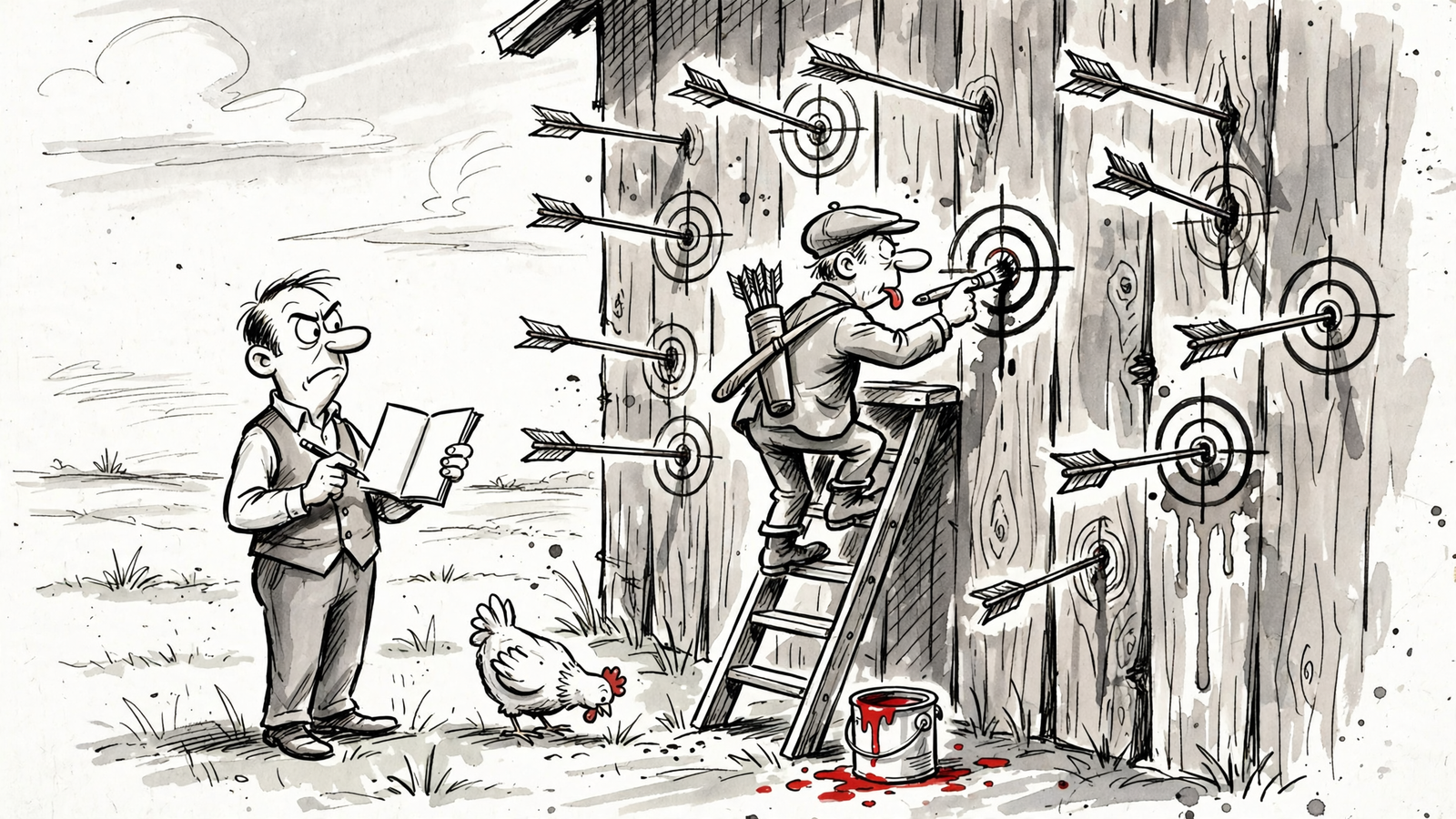
Should your Google Ads manager get paid only when you do? Smart buyers disagree because pay-per-result pricing puts the manager at risk but can let them define the result, while a flat fee removes the reward for higher spend but asks you to trust work you may not see. I have managed accounts both ways. The question is not which invoice looks more accountable. It is which incentive you can control.
The spend-based fee both sides want to escape
Start with the arrangement behind the argument. Percent-of-spend pays your manager more when you spend more. The going band is 10 to 20% of ad spend. That is $1k to $2k on $10k of spend; double the budget and the fee doubles. At $20k a month, you pay $2k to $4k before anyone has shown you a closed deal. Move to $30k and the management line rises immediately, whether or not the extra $10k bought anything worth having.
Goodfirms warns that this structure can reward raising budget instead of improving efficiency unless you pin it down with hard targets. I have lived inside that incentive. When a campaign was already efficient, finding somewhere else to spend was an easier route to a bigger fee than finding more profit in the account. That does not mean every manager takes the easy route. It means the contract pays them if they do.
A fixed retainer can dodge that incentive, though it brings another worry. In 2025, the US range ran roughly $200 to $4,000 a month, mostly $500 to $2,000. Billing was predictable, but tiered scopes could quietly cap the work. In the UK, the same split between fixed fees and percent-of-spend pricing appears, with performance pricing flagged as more complex to manage.
So neither side gets to win by pointing at a bad percent-of-spend contract. The real debate is between paying for a defined outcome and paying a fixed price for visible work. Each solves one incentive problem and leaves the buyer with another.
The strongest case for paying per result
If the manager only eats when you eat, they have a reason to care about what the ads produce, not how much budget they can persuade you to approve. That is the appeal. The manager takes on risk that normally sits with you, and a slow month hurts their invoice too.
The pricing can take several forms: $15 to $150 per conversion for lead generation, or 10 to 30% of attributed ecommerce revenue. Another version uses a base of $3k to $10k plus a 10 to 30% bonus, or a straight revenue share of 5 to 20%. Say you do $100k in tracked ad revenue at a 15% cut. You pay $15k. If that revenue falls to $60k, you pay $9k. The manager feels that change in the same month you do.
For a buyer tired of paying for activity, that connection matters. Nobody has to translate a report about impressions, bid adjustments and a new dashboard into a business outcome. The contract names an event; the invoice follows it. A manager who cannot produce that event cannot keep billing as if the work succeeded.
This case is strongest when the cash register sits close to the click. Think clean Shopify revenue with intact tracking, or a home services account where calls are recorded and tagged back to the campaign. In B2B, a closed-loop CRM can make it work if sales actually marks SQLs and closed-won deals. The biller then has to answer to a sales record rather than a form-fill count.
I used to tell clients performance deals were a gimmick. I was wrong about that slice. When attribution is airtight and margins are healthy enough to share, paying for the outcome can be a direct way to find out whether someone can sell your product with Google Ads. The buyer gets a clear test, and the manager gets paid for passing it. If you can count the money without arguing about it, a cut can be fair.
The strongest case for a flat fee
The flat-fee advocate starts with a different kind of control: the manager does not get a raise because the budget rises. At groas’s $1,499 a month per service, the fee stays the same whether you spend $20k or $30k on ads. You do not have to wonder whether a proposed budget increase also benefits the person proposing it. If the account grows more efficient, you keep the gain rather than paying a larger management fee for the same scope.
That separation matters in day-to-day decisions. A budget increase has to stand on its own numbers. A cheap conversion is not automatically worth chasing because it fattens a payout. The manager can work on the account without negotiating which sales deserve a commission each month. It is less exciting than a revenue share, which is probably why nobody builds a dramatic sales deck around a stable invoice.
The best flat-fee argument is not that a fixed price creates effort by magic. It is that you can judge the work without letting the manager define a payable result. Ask for an action log: bid, keyword, budget and ad changes, with the reason beside each one. You can see what happened, ask why, and compare it with the outcomes you care about. The manager has to keep earning the renewal, not a bonus on the next batch of attributed conversions.
There is a trade. A flat fee does not move a bad month onto the manager’s invoice in the neat way a result-based deal can. You still pay while they test, correct and sometimes fail. But you also keep control of what a sale means to your business. For a buyer whose sales cycle or attribution makes commission math contentious, that is not a small advantage. Buy the fixed price only with proof of work attached.
Where pay-per-result breaks its promise
Now for the argument the performance-pricing pitch would rather leave until after the signature. Whoever defines the result controls the invoice. Pay per lead sounds accountable until you ask what counts as a lead. In B2B, a per-lead price can reward filter-passing junk: recycled contacts, fake phone numbers and people sales would never accept. Auditors of these programs call for a written acceptance definition, a rejection window, net-new CRM deduplication and proof of opt-in (the breakdown is here). Without those terms, you may be buying names rather than pipeline.
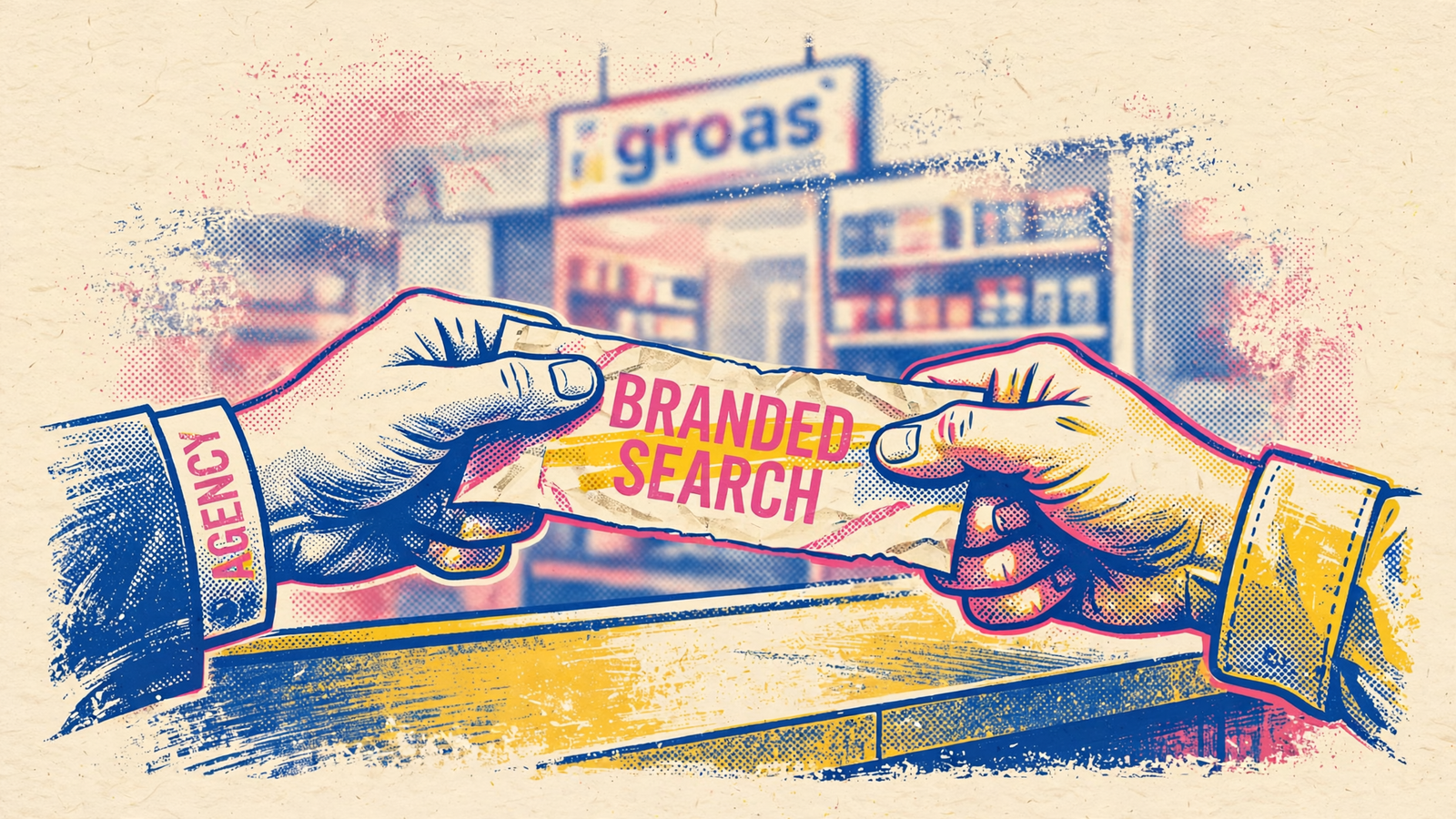
Revenue share has its own version: branded search. Some 20 to 50% of search-tracked sales come from brand phrases, but people typing your name may already have decided to buy. An ad can receive credit for that sale without having created it (the classic argument). One benchmark of 225 DTC geo tests put branded search median incremental ROAS at 0.70x, against a 2.31x average.
A manager paid on attributed revenue has a reason to like that traffic. It converts and is cheap, even when the ad’s contribution is limited. Performance Max can muddy the picture further by absorbing brand traffic and claiming credit unless brand exclusions and meaningful conversion values are in place (as this practitioner synthesis notes). What looks like a manager creating demand may be a manager billing for demand you already had.
Lead quality creates the same problem earlier in the funnel. One B2B benchmark puts MQL-to-SQL conversion at 25 to 40% and SQL-to-opportunity conversion at 50 to 65%. If your contract pays at the top, those later stages do not change the invoice. The arithmetic makes the point: a $65 lead that converts to an SQL 9% of the time costs about $722 per SQL. A $90 lead converting at 28% costs about $321 per SQL. The apparently cheaper lead is much more expensive by the time sales gets something usable.
I have seen CPL fall for three months straight while pipeline missed target. The manager still wanted the bonus because, technically, leads got cheaper. That is what happens when the payable event stops short of the business outcome.
Weak attribution makes the risk harder to price, too. If tracking double-counts, offline sales never return to Google Ads or margins are thin, the manager may add a base retainer or premium. A pricing guide notes both that pattern and the need for airtight attribution, healthy margins and downstream sales data. I have seen the workaround up close: a longer attribution window here, an assisted-brand click there, and suddenly the invoice claims revenue your email list did much of the work to produce. If you cannot agree on what counts without a spreadsheet fight, do not pay on what counts.
Where a flat fee breaks instead
A flat fee removes the direct reward for higher spend or more attributed conversions. It does not guarantee attention. A $1,500 retainer that buys two bid tweaks and a PDF of screenshots is still a poor deal. It just has calmer billing.
The danger is less visible than a disputed performance invoice. Work can slow while the monthly charge stays reassuringly predictable. A manager can describe a quiet account as stable; you need enough visibility to tell considered restraint from neglect. Practitioners make a similar distinction in that synthesis of PPC pricing discussions: flat fees can suit lean accounts, while performance deals need clean attribution and can drift toward easy wins.
So do not treat an action log as decorative reporting. It should show what changed and why, week to week. If the manager recommends holding a campaign steady, ask for the reason behind that decision too. The point is not to reward frantic account touching. It is to make the work inspectable so you are not buying trust by the month and hoping it turns into effort. Do not buy flat-fee calm. Buy flat fee plus proof of work.
Put the argument into the contract
Whichever model you choose, the paperwork decides whether its best argument survives the first invoice. I have seen clean flat fees turn lazy and clean performance deals turn expensive. The headline rate was not the deciding line; the terms underneath it were. Get these points in writing before spend goes up, not after the first dispute.
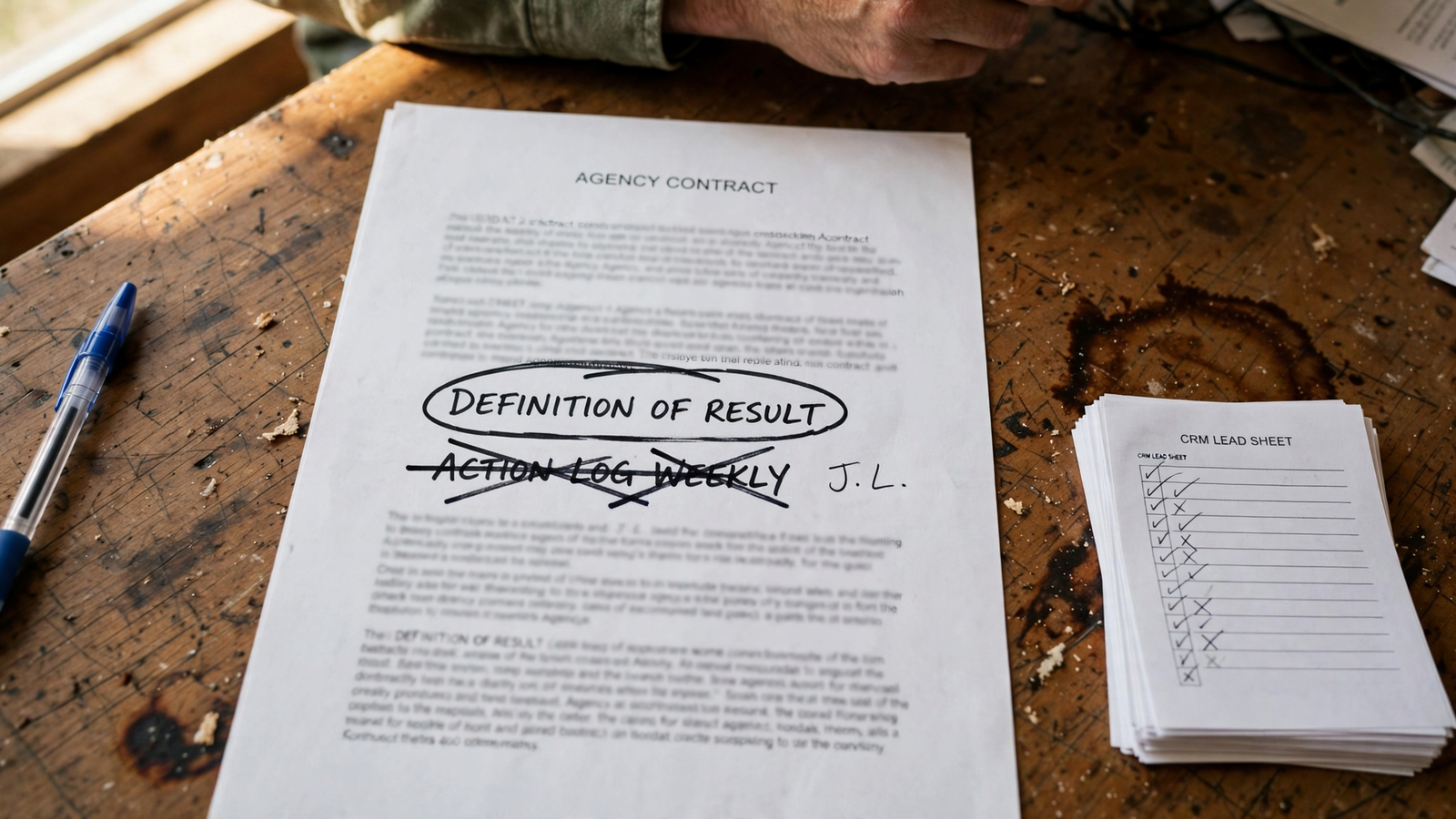
- Define the paid event in one sentence. For a performance deal, name an accepted SQL, a closed-won deal or collected revenue. Do not leave it at “lead,” “opportunity” or “attributed conversion.”
- Exclude brand and house lists from a payout. Spell out what happens to brand search, remarketing to past buyers and contacts already in your CRM.
- Fix attribution in numbers. Set the window and model, and decide who gets credit when email, sales and ads all touch a deal.
- Add a rejection window. Give yourself 14 to 30 days to reject junk leads with reasons, and dedupe them against the CRM.
- Cap the upside and show the work. Use a monthly cap or tiered breakpoint for performance cuts. For a flat fee, require a weekly log of bid, keyword, budget and page changes with the reason beside each one.
The list is not a substitute for choosing a side. It is how you keep your chosen model from becoming the version its opponent warned you about. If a manager will not agree to a clear paid event or show the work behind a fixed fee, they have told you something useful before you sign.
My verdict: choose the definition you can control
I would take a result-based deal only when three conditions hold at once:
- Money lands close to the click, and you can prove the connection without debate: clean Shopify revenue or a CRM where sales marks SQLs and closed-won deals promptly.
- Margins can carry the cut, whether that is a 10 to 30% share, without forcing you to raise prices to pay the manager.
- Brand is carved out of the payout in writing, so the manager cannot collect on your name by default.
Then I would pay on closed-won revenue or accepted SQLs, never raw leads or all attributed revenue. If you want the longer revenue-share math, my parallel piece on whether your search partner should take a cut of revenue walks through how branded sales can inflate the invoice.
For everyone else, I would choose a flat fee with a full action log. Say you spend $20k a month and pay $1,499 flat. Nobody earns more by nudging that budget to $25k, and nobody gets a bonus simply for bidding on your own name. You give up the clean-looking theater of shared risk. You get back control of the definition that determines what your business earned. For the fee math at that spend level, the nine pricing questions with the numbers worked out are the companion to this debate.
The deciding consideration is who controls the payable result. I have watched that definition stretch more often than I have watched a transparent flat-fee manager coast. Pay for the outcome when you can define it without arguing. Otherwise, pay a flat fee, demand the log, and keep the definition on your side of the table.