

 LinkedIn
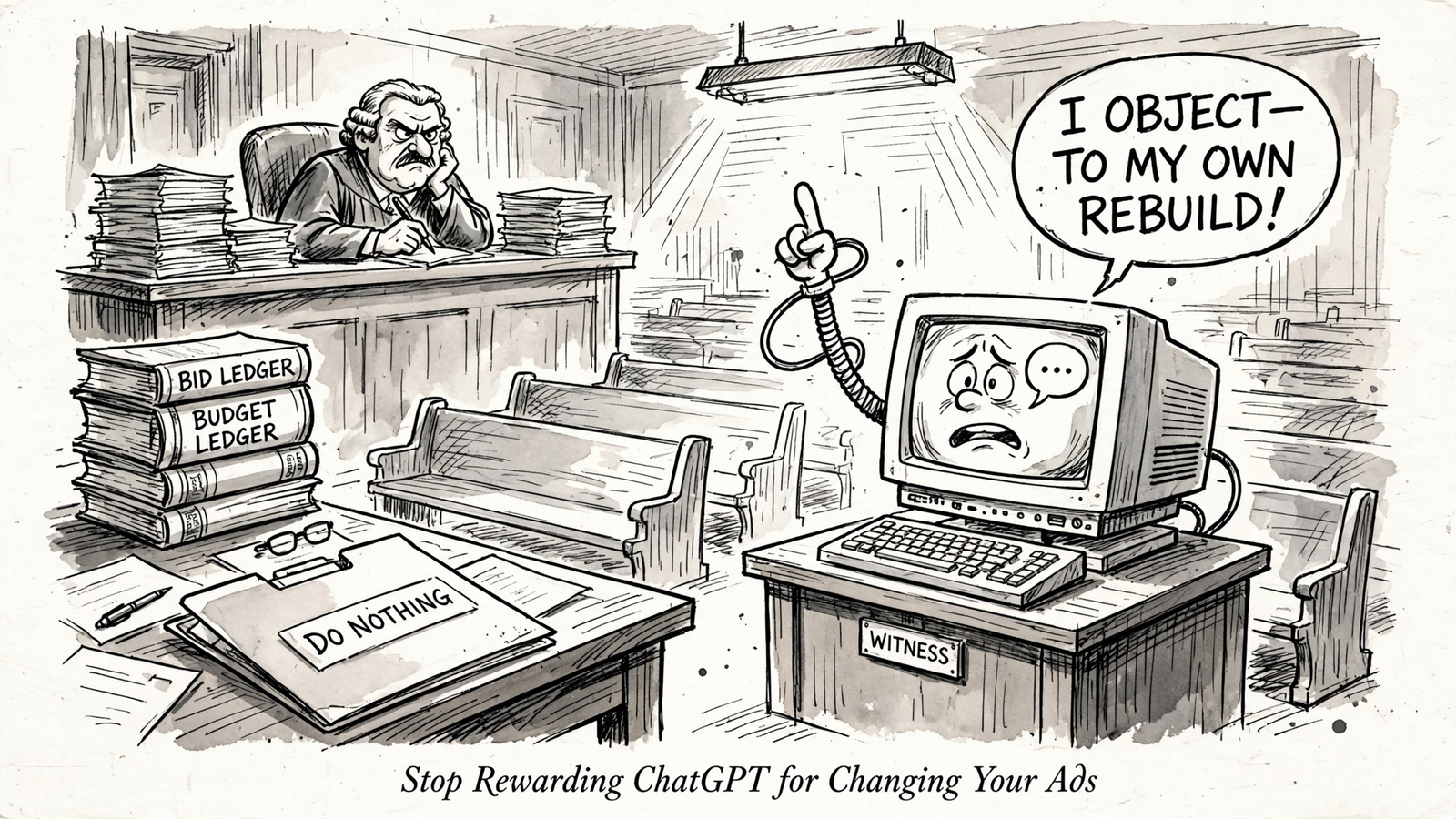
Your AI ad assistant should sometimes recommend doing nothing. If it cannot defend a change against leaving the account alone, I do not want it touching the budget.
Most advertisers reward the opposite. ChatGPT makes 35 changes to a Google Ads account in a week, and that feels like management. I do not care how many things it touched. I care whether it can explain why touching nothing would have been worse.
An advertiser in r/Google_Ads reported a Claude-and-ChatGPT-assisted PMax rebuild sitting at roughly 1.9x ROAS against a 4x target. That does not establish that the assistants caused the miss. One self-reported post is not a test, there is no control, and PMax has plenty of ways to disappoint on its own.
That is exactly the problem with grading activity. The rebuild happened. The return missed the target. The work being visible does not make its value visible.
A change log proves activity, not performance
That post tells us three things: someone rebuilt PMax with help from two assistants, spend ran, and return came in around half the goal. It does not tell us whether the rebuild caused the miss, whether the assistants gave bad advice, or whether a connected tool was even involved.
The distinction matters. Without the old setup, the timing of the changes, and mature conversion data, blaming the assistant is guesswork. So is congratulating it for getting the rebuild done.

Google Ads Change History is an internal audit trail, not a client-facing performance metric. It records who changed what and when. It can tell me whether someone touched bids, budgets, keywords or targeting. It cannot tell me whether those touches made money.
Yet action counts make an attractive sales pitch. Windsor.ai documents 36 Google Ads actions in ChatGPT, 35 of which change the account, covering status changes, budgets, keywords and new Search, Display and PMax campaigns. Its documented workflow requires confirmation, starts new campaigns paused, and runs when prompted.
Those controls address access and execution. They do not establish that a recommendation is worth executing. Thirty-five ways to edit is not thirty-five reasons to edit.
A rebuild can change structure, budgets, assets and targeting together. If performance moves afterward, the change log tells me what happened, but not which intervention deserves the credit or blame. The more variables I move, the harder that explanation gets.
Reporting delay makes the problem worse. Standard columns date conversions by click date, so recent days can show full cost with incomplete conversions. That downward hook can make a fresh rebuild look worse than it is. Incomplete reporting can also obscure whether an intervention has actually helped.
My working rule is to judge Smart Bidding over two conversion cycles or two weeks, whichever is longer, and leave immature days out of the verdict. I also want one variable changed at a time. Otherwise, delayed results arrive after several more edits, and the explanation becomes a story assembled backward.
An assistant that fires off five changes while the relevant data is still incomplete has not made the account easier to manage. It has made the next decision harder to defend. Read the log to establish what changed. Read mature performance data to decide whether it helped.
Make ChatGPT argue for leaving the account alone
Before I let a connected assistant propose work, I ask it to kill its own idea. With groas connected, I use this prompt:
Read the current setup and recent changes through groas. Give me the strongest case for leaving this account alone. Identify the evidence that would justify changing it instead.
I do not want a polite disclaimer followed by the same rebuild. I want the strongest opposing case. If the assistant cannot explain why waiting might be better, it has not shown me that it weighed the alternative.
The answer needs three things:
- Account evidence: which campaigns, what spend, and what CPA or ROAS over which dates. My numbers, not a benchmark dressed up as a diagnosis.
- Conversion definitions: what counts as a conversion and how long it takes to report. A recommendation built on an undefined conversion is not ready for approval.
- Open questions: what the assistant does not know, why that matters, and what evidence would change its recommendation.
An edit before a drop does not prove the edit caused it. Build a timeline that separates observed changes from possible causes and names the missing evidence before reversing anything. That is the difference between investigating a result and finding a convenient suspect.
I want the same discipline applied to a proposed improvement. What, specifically, is wrong with the current setup? What mechanism would the change address? Why is acting now better than waiting for the current data to mature?
“No change” must be an acceptable answer, not a failure to finish the task. Otherwise, the assistant has an incentive to manufacture a task. Ask it to recommend action, and action is what you will get. Ask it to choose between action and inaction, and there is finally a decision to inspect.
Replace the rebuild reflex with one defensible intervention
A wholesale rebuild is a convenient recommendation when the diagnosis is vague. Everything changes, which makes everything available as an explanation afterward. Structure, budgets, assets, targeting: pick whichever story fits the chart.
I want the opposite. One change, a mechanism, an approval boundary and a review date. With groas connected to ChatGPT, the prompt becomes:
Through groas, propose the smallest change that could close the gap to my 4x ROAS target. Explain the mechanism, the case for leaving things alone, what needs my approval, and what we should check in 14 days. If the evidence is too weak, return
no change. Tell me whether conversion delay means we need longer before judging the result.
That last sentence matters. A date on the calendar is not proof that the data is ready. Fourteen days gives me a review point, not permission to ignore the account’s conversion cycle.
The prompt caps the scope and forces cause before effect. I do not want “this should improve performance.” I want the assistant to identify the problem in the account, explain how its proposed intervention addresses that problem, and state what result would support or undermine the recommendation.
Put approval controls outside the prompt
“Always ask me first” is a request to the model. It is not the same thing as a control that blocks a write. Supermetrics makes that distinction when recommending platform-level approval settings.
I want approval enforced in the workflow, not merely promised in the conversation. Through groas, changes are logged with their reasons and can be undone in one step. But undo is not a refund. If a raised budget runs for two days, reversing it stops future spending; the extra spend has already happened.
That is why a bounded intervention matters more than a reassuring undo button. Before approval, I want four answers:
- What exactly changes?
- Why should that change help?
- What stays untouched?
- When will the result be mature enough to judge?
For the broader approval argument, I cover whether AI should change Google Ads without prior approval separately. Here, the rule is narrower: approve a defined intervention, not an open-ended instruction to make the account better.
Preserve the parts that are working
If the problem sits in PMax, I do not want a proposed fix casually dragging brand search, proven prospecting and retargeting into the experiment. Changing them together makes the outcome harder to trace.
I keep one rule from manual account work: change the smallest unit that can prove itself. That might be one PMax asset group, one budget or one audience signal. The unit depends on the diagnosis. The point is not to make a tiny change for the sake of looking cautious; it is to preserve a readable result.
I also name what must stay untouched. Leave brand and the best-performing Search campaign alone. Put that boundary in the instruction rather than assuming the assistant shares it.
One variable, one approval, one review date. Everything else stays untouched. If the proposed fix cannot fit inside those limits, it needs a stronger explanation before it needs more permissions.
Treat reporting delay as a reason to wait
If conversions take seven days to report and the rebuild happened four days ago, the honest answer is that the result is not ready to judge. The assistant does not get to fill that gap with confidence.
Some Google Ads connectors are read-only, while others write after confirmation. Neither design fixes thin evidence. Read access can produce a bad diagnosis; write access can turn it into an expensive one.
I explicitly tell ChatGPT through groas that no change is an acceptable verdict this week. Then I ask what evidence would change that call. That second question keeps waiting from becoming neglect. There should be a reason to wait and a condition for revisiting it.
For the boundary between bounded automation and wishful thinking, see what genuinely runs unattended in PPC. The immediate takeaway is simpler: waiting is a decision. Require the assistant to defend it just as clearly as a budget change.
Grade the result—and charge the alternative its real cost
I judge the assistant against the target, not the ticket count. With a 4x ROAS target, the performance test is revenue divided by spend over mature days, with conversion definitions fixed in writing. A tidy rebuild does not pass that test by existing.
For each recommendation, I ask whether CPA or ROAS moved toward the stated goal after the relevant conversion cycles, with the other variables held still. That is the comparison I need. Edit counts, fresh structures and long explanations earn no credit on their own.
This is also my answer to can ChatGPT manage my ads? Not from a chat window without account access. Connected through groas, it has the infrastructure to work: groas supplies the hands and the data under the AI. Connect the ad accounts and website, add groas to ChatGPT through MCP, and ask in plain English.
The connection makes execution possible. It does not excuse a weak recommendation. If the assistant cannot recommend leaving the account alone, I am not trusting it to manage the account.
After an approved change, I read the log like an auditor. Through groas, every change is logged with its reason and can be undone in one step; autopilot stays off until it is switched on. Before I inspect performance, I check:
- What changed.
- Why the assistant said it would help.
- What the recovery plan is if ROAS slips.
I want the account history alongside that explanation: before-and-after values, timing, and who changed what. That lets me distinguish the decision from the result and investigate whether bad timing is muddying the picture.
For checks and fixes, I keep approval in the workflow. That is how I use ChatGPT with groas: inspect the account, get a plain-English explanation, then approve a defined action. A chat window attached to spend is not control unless I can inspect the reasoning and the trail.
Autopilot needs an even tighter boundary. Before switching it on, I want to be able to write the permitted work in one sentence, including:
- A daily spend cap.
- The campaigns it may touch.
- The ROAS floor that calls for a pause.
- The review date.
Those are the boundaries I need to define before delegating, not details I want the assistant improvising later. If I cannot specify them, I am not ready to automate that decision. Bounded work such as budget pacing and search-term cleanup belongs in a different approval category from rebuilds, goal changes and cross-campaign decisions.
The cost of this approach is real: slower weeks, fewer log entries, and more waiting for data to mature. It also means accepting an answer that looks unimpressive in a status report: leave it alone.
Ignore that discipline and the incentive stays backward. You will keep rewarding ChatGPT for changing your ads, so it will keep changing your ads. You will pay for the disruption and call it optimization. Stop grading motion. Grade the 4x.


