The AEO Retainer Swipe File: Tiers, Scope Clauses and Client Scripts
October 6, 2026
•
11
min read


Stop rewriting your content for AI citations before you know whether the bots can read your page. A perfect answer behind a blocked URL or an empty HTML shell is still invisible.
I keep meeting owners who paid for answer-first rewrites and saw nothing move in ChatGPT, Perplexity or Google's AI Overviews. The copy got cleaner. The citations still went elsewhere. I know the shape of that problem from PPC: a client once swapped a landing page without telling me, and Quality Score tanked. The ads had not changed. The destination had.
The standard advice goes like this: lead with a direct answer in the first 40 to 60 words, add question-based headings, drop in a table and an FAQ, then add schema. Ten Speed's B2B guide makes the case clearly for AI Overviews: ranking in the top 10 earns eligibility, but a passage the system can lift earns the citation. It recommends starting with pages already ranking 1 to 10.
That advice is not wrong. It is ordered backwards if nobody has checked whether the page is accessible and readable. A content package has a price, a delivery date and a before-and-after screenshot. A fetch audit has server logs, user-agent strings and an uncomfortable conversation about your theme. Guess which one is easier to put in a proposal.
A live-answer system has to find a source it can use. Permissions affect whether it can request the URL. The response determines whether it gets the page or a block. The HTML determines whether the answer is there to extract. Butterfly's explanation of technical SEO for AI search puts it as a sequence: fetch, read, understand. Good writing cannot jump the queue.
Permissions are more specific than a single switch marked ‘AI’. OpenAI splits its crawlers by job: GPTBot handles training, OAI-SearchBot handles ChatGPT search, and ChatGPT-User handles live fetches. Google uses Googlebot for the index that feeds AI Overviews, while Google-Extended governs a different use of content (Eggknite's breakdown of AI crawler permissions). Blocking a training crawler is not the same decision as blocking a search crawler. Treating those names as interchangeable can close the door you meant to leave open.
The block might not even be in the file you checked. A copied robots.txt template, a WordPress virtual robots.txt, a staging Disallow: / shipped to production or a WAF preset can change what a bot reaches. A permissive robots.txt is little comfort if a security rule returns a 403. Check the response, not just the permission you intended to give.
Then comes the page itself. Many non-Google AI crawlers fetch raw HTML without executing JavaScript. A React or single-page site may look complete in your browser while returning almost no useful text to a crawler. Google may render that page for search, which makes the problem harder to spot: the URL can rank while an answer bot sees a shell (Butterfly on how AI crawlers read pages). A Vercel study reported that major AI crawlers fetch JavaScript files 10 to 25% of the time but do not execute them (Search Engine Land's technical SEO guide). If your price, service description or answer paragraph appears only after hydration, polishing that paragraph does not put it in the response the crawler receives.
This is why I want the raw source, not a screenshot of a finished page. Browser inspection shows you what your browser assembled. View-source or a raw HTML request shows you what arrived before that assembly. Neither tells you everything about every answer system, but the difference between an answer in the HTML and an empty shell is not subtle. Put the useful answer in the page the bot actually gets.
I used to tell clients the ad was the hard part. I was wrong about how often the destination made that work irrelevant. In the account where a client swapped the landing page, I could keep refining the ads and still miss the thing that had changed underneath them. Google judged the click's destination, not my intentions in the ad account.
The parallel is not that Quality Score and AI citations use the same rules. They do not. It is that upstream polish cannot repair a broken handoff. Your answer-first rewrite is the ad; the fetchable page is the landing page. When the destination fails, work done before the handoff stops carrying its weight.
That matters even more when teams use rankings as permission to skip the technical check. In July 2025, about 76% of AI Overview citations came from pages in Google's top 10. By early 2026, an analysis covering 863,000 keywords and roughly 4 million cited URLs put that share at about 38% (Ahrefs data in an editorial breakdown). Rank still helps. It is not a receipt proving that a particular answer system can use the page you want cited.
Citation also changes with the question. In one measured ChatGPT and Perplexity test, overlap between Google page one and answer-engine citations was 8 to 12% on the queries studied; adding one word to a query could flip a page from cited to absent. That does not mean every missing citation is a technical fault. It means a rewrite is not a diagnosis. If the bot fetches a shell, phrasing will not save you. If the page arrives intact, then phrasing, relevance and other sources become worth arguing about.
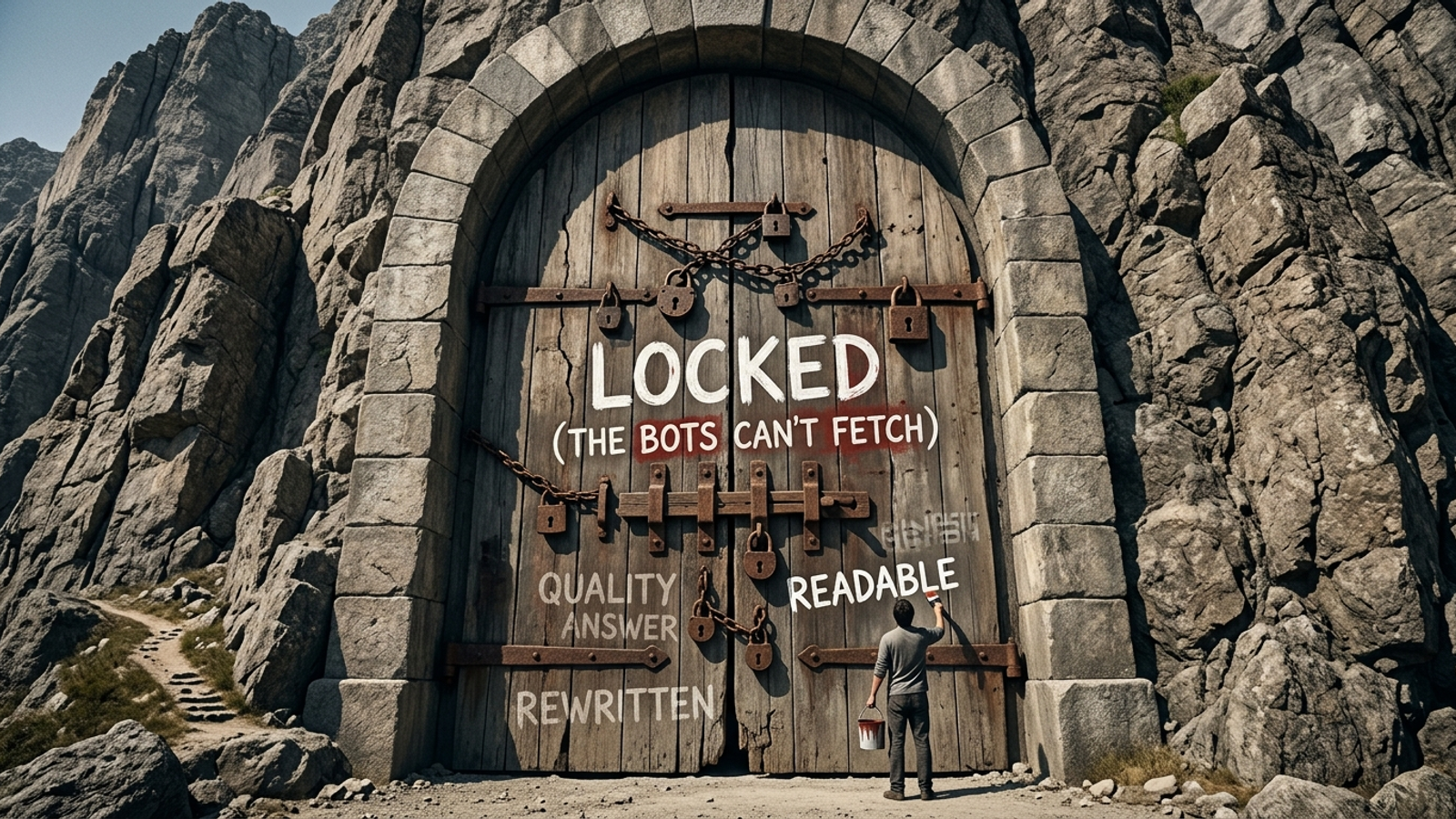
Some readers can skip the fetch repair. If your key URLs return 200, the answer appears in raw HTML, the canonicals point where you expect, and your logs show the relevant bots reaching those URLs, go work on the copy. That is a reason to rewrite. A JavaScript-heavy theme, an inherited robots.txt or aggressive bot rules are reasons to check the door first. Rewriting before that check is paying for paint while the door is locked.
Run this before you approve another paragraph. Start with the pages that already matter to revenue, not an entire blog. The list separates a permission problem from an HTML problem and a content problem. If you need the longer version with the actual clicks, use this step-by-step guide to fixing technical SEO issues that hurt AI visibility.
robots.txt and AI user agents. Confirm that OAI-SearchBot, PerplexityBot and Googlebot are allowed if you want them to reach these pages. Treat decisions about GPTBot and Google-Extended separately. Check virtual files, a production copy of a staging Disallow: /, and Cloudflare or WAF rules too.FAQPage, HowTo, LocalBusiness or Product markup should describe what the page actually shows. Do not use markup to promise an answer the page does not contain.lastmod dates accurate. A tidy sitemap will not fix a blocked response, but a stale one is not helping you direct discovery.Only then does rewriting pay. Once a bot can reach a page and find the answer in its HTML, answer-first content has a job to do: give the question a direct answer near the top, use a heading that fits the prompt, and make a useful passage easy to lift. I would start with five pages that already drive revenue, not fifty blog posts. One clear passage on a fetchable service page is worth more than a redesigned content hub that returns a shell to PerplexityBot.
Notice what that order does to the budget conversation. Without the technical check, a team can commission fifty rewrites and still have no idea whether the problem was wording, permissions or rendering. With it, the team can point to a small set of pages and say what each bot was allowed to request, what the server returned and whether the answer was present. That does not guarantee a citation. It does stop you from buying the same guess twice.
Your own site is only part of what an answer bot can draw on. That practitioner test's low overlap with Google page one keeps rattling around my head because the bot may assemble an answer from Reddit threads, Stack Overflow, directories or comparison pages your CMS cannot edit. Cleaning your fetch layer makes your pages usable. It does not make other sources disappear.
So after the fetch check, look at whether the information a bot finds elsewhere agrees with your page. If you sell local services, inconsistent hours, prices or service names give the system competing versions of the same business. If you sell SaaS, docs and changelogs hidden behind a login cannot help a bot read your explanation. The mechanism is plain: a clear page has a harder job when other readable sources tell a different story. Fix your own door first; then deal with the information beyond it.
Here is the short check I would run before approving a rewrite budget. Pull raw HTML with curl or view-source on your top five revenue pages and search for the answer text. If the price or service list is absent, that page fails the raw-HTML check. Then pull the last 14 days of server logs and filter for OAI-SearchBot, PerplexityBot, Googlebot and any other crawler relevant to the surface you care about. Look at the money URLs and their responses, not a sitewide total that hides where the requests went.
If you see 403s, investigate the security rule. If you see no hits, ask whether the logs cover the right host, path and period before declaring a block. If you see successful fetches and complete HTML, stop blaming the server and examine the answer itself. This is less glamorous than an ‘AI visibility framework’. It also tells you which problem you are paying someone to solve.
If you do not have log access, ask your host for 14 days of bot requests and responses on those five URLs before you approve copy work. A ranking report answers a different question. I want to know what reached the page and what the server sent back. Then I would track citations on those money pages after the fix, rather than celebrate a cleaner FAQ in a document nobody has tested against the live URL.
Keep starting with rewrites and the bill is predictable: more polished prose, the same unresolved fetch problem, and citations going to a competitor whose plainer page the machine can actually read. I learned the destination lesson from a swapped landing page and a falling Quality Score. Do not pay to learn it again with AI answers. Fix the fetch layer first, or keep writing for a reader who never gets through the door.
Why isn't my content getting cited by ChatGPT or Perplexity even after a rewrite?
Most likely the bots cannot reach or read the page. If the URL is blocked by robots.txt or a WAF rule, or if the answer only appears after JavaScript runs, an AI crawler receives an empty shell no matter how good the copy is. Check permissions, raw HTML and server logs before paying for another rewrite.
Should I block GPTBot if I don't want my content used for AI training?
You can decide that separately, because GPTBot handles training while OAI-SearchBot handles ChatGPT search and ChatGPT-User handles live fetches. Blocking the training crawler is not the same decision as blocking the search crawler. Treating these user-agent names as interchangeable can accidentally close the door you meant to leave open.
Do AI crawlers see my JavaScript-rendered website?
Often not. Many non-Google AI crawlers fetch raw HTML without executing JavaScript, and a Vercel study found major AI crawlers fetch JavaScript files only 10 to 25% of the time without executing them. A React or single-page site can rank in Google while returning almost no useful text to an answer bot, so check the raw source rather than the rendered browser view.
Does ranking on Google page one guarantee AI citations?
No. In July 2025, about 76% of AI Overview citations came from pages in Google's top 10, but by early 2026 an analysis of 863,000 keywords put that share at about 38%. Rank still helps, but it does not prove an answer system can fetch and read your page.
What should I check before paying for AI-focused content rewrites?
Run a fetch-first check on your money pages: confirm the right AI crawlers are allowed in robots.txt and WAF rules, verify the answer text appears in raw HTML, check status codes and canonicals, make sure schema matches visible content, and filter server logs for the relevant bots on those URLs. Only then is rewriting worth the budget.
How do I check whether AI bots are actually visiting my site?
Pull the last 14 days of server logs and filter for the relevant crawlers such as OAI-SearchBot, PerplexityBot and Googlebot, then look at the specific money URLs and their responses rather than sitewide totals. If you see 403s, investigate the security rule; if you see no hits, first confirm the logs cover the right host, path and period before declaring a block.
If my page is readable by bots, why might I still not get cited?
An answer bot can assemble its response from other readable sources such as Reddit threads, Stack Overflow, directories or comparison pages. If those sources disagree with your page, for example through inconsistent hours, prices or service names, your clear page has a harder job. Fix your fetch layer first, then check whether the information found elsewhere agrees with yours.