

 LinkedIn
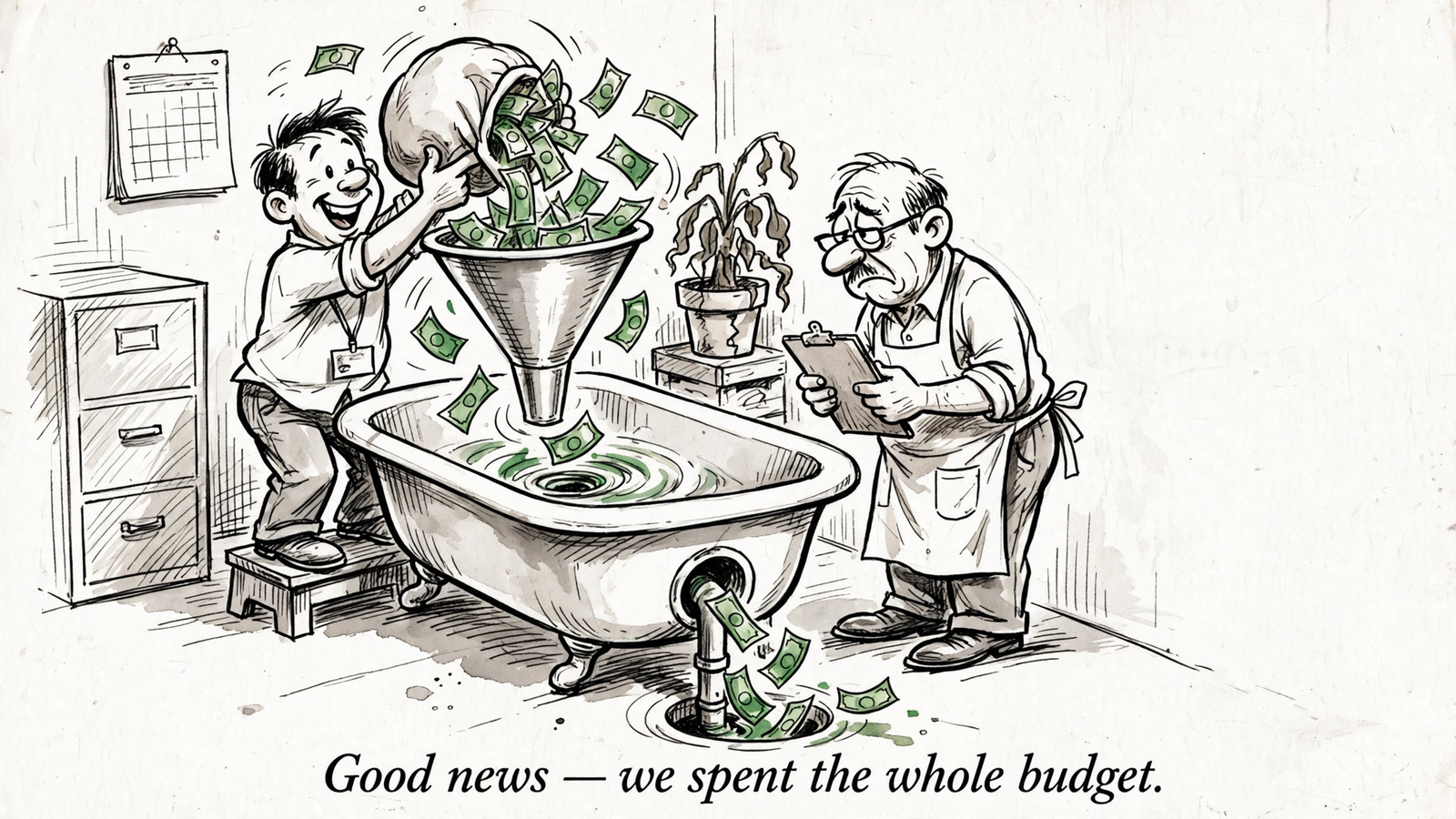
Your Microsoft Ads budget is a ceiling, not an assignment. If the account can hit it only by buying clicks you would never approve on purpose, let it underspend. A manager who treats delivery as the first problem to solve has mistaken your money for a quota.
A practitioner column on Search Engine Land puts it well: “That framing ignores that a budget cap is a ceiling, not an invitation.” I have made some version of that argument to clients staring at a dashboard with half the monthly allocation untouched while a manager explains that more reach will fix it. More reach does not fix a campaign that has no useful job for the money it already spends.
Consider a first-time advertiser on r/PPC who imported Performance Max and Shopping, then ran them for 30 days. The account reported a $0.34 average click, 99.32% absolute top impression share, and zero conversions. The clicks arrived. The dashboard did not show a single customer.
The familiar response is to widen: more keywords, looser match, partner networks, a bigger number to chase. That turns a channel test into a spending obligation. Before anyone buys more traffic, I want to know whether the failure is measurement, timing, traffic, or the offer. Then I want to give Microsoft Ads one narrow, commercially useful job and make it earn the right to expand.
Find out whether the failure is real
Do not widen a campaign while its measurement is in doubt. Broken tracking, irrelevant traffic, conversion lag, and an offer nobody wants can all produce a disappointing dashboard. They require different responses.
Start with the conversion journey. Microsoft’s “no conversions” troubleshooting guidance notes that a new UET tag or goal can take up to 24 hours to show activity. It distinguishes Unverified, Tag inactive, and No recent conversions statuses, and points to UET Tag Helper for checking whether a tag fires and which goals match. The usual failures are less glamorous than the dashboard: a tag missing from the conversion page, a typo in a goal URL, or a goal that fires before the form is submitted. I have seen that last one report leads the business did not have.
Walk the journey yourself. Submit the form, place the call, or complete the purchase, then confirm that the goal fires at the right point. Check consent settings too. Microsoft’s UET consent guidance matters particularly if recorded conversions vanished around a consent-banner or site change. That is not a bidding problem.
Next, give conversions time to arrive. Microsoft attributes conversions to the click date, not the conversion date. Recent clicks can therefore look worse until later conversions fill in: CPA appears high and ROAS low. Its Conversion delay column shows how long a campaign takes to collect 90% of its conversions; Microsoft also recommends the earliest date from which to judge a period fairly. That data is available only for clicks from June 1, 2025 onward. I have watched managers kill a campaign on day twelve of a B2B sales cycle that closes on day forty. The clock had not finished.
Finally, compare platform conversions with what the business recognizes. Microsoft’s conversion documentation lists reasons counts can diverge: goal definitions, conversion windows, Unique versus All counting, and click-date versus conversion-date reporting. In one documented UET case, five raw events became two attributed conversions because the dashboard counted only eligible events tied to Microsoft Ads clicks within the configured window. Event counts are not acquisition counts. Put the platform’s figures beside your CRM, call records, and sales. How many prospects could pay? If the goals fire correctly but sales disqualifies the leads on the first call, stop debugging the tag. Inspect the traffic.
Stop buying reach to fill the allocation
Your business can set a firm allocation, but Microsoft’s daily budget setting is a target, not a cap: spend can land above or below it. Neither number tells you whether an additional click is worth buying. A full budget is not evidence of a healthy campaign.
The places to inspect are real. A DIY advertiser on r/PPC spending $100 a day reported that roughly 60% of traffic came from find.domains.com and similar sources, with the same scripted click pattern visible in Hotjar. The thread’s proposed fixes amount to an inventory audit: inspect search partners and audience publishers, mine search terms, review devices and match types, and consider whether search-only traffic makes more sense. Do not apply every change blindly. Find out which traffic is consuming your money and what it produces.
Check imports while you are there. Microsoft’s import documentation says a Google campaign set to include search partners maps to Microsoft’s search networks, including syndicated partners. Scheduled imports can keep running after the initial copy. In a Microsoft Q&A case, an auto-import reactivated campaigns the advertiser had paused and brought across a higher Google budget; the advertiser reported three billing cycles with zero leads. If settings you cut keep returning, inspect the import schedule before blaming the auction. I wrote up the full Microsoft Ads audit order separately for accounts that need it.
Cheap clicks can still be expensive customers
Lower CPC is the number that keeps a weak Microsoft campaign alive. The account looks efficient until someone asks what those clicks became. Fewer bidders can mean cheaper clicks; they do not guarantee cheaper acquisitions. The conversion rate has to hold, and thin volume can make that hard to judge early on.
A team comparing the platforms for B2B SaaS notes the lack of a clean Microsoft-only cost-per-lead benchmark. In SpyFu’s account-level comparison, Bing conversion rates were 50.6% lower than Google’s. That is one account in one vertical, not a rule for yours. It is a useful reminder of what a CPC comparison leaves out.
Broad benchmarks will not settle your account’s economics either. WordStream’s 2026 study of more than 13,000 US campaigns reports a $5.42 average CPC and an 8.18% conversion rate, but blends Google and Microsoft. Your own cost per qualified acquisition is the number to watch. Without a ceiling for that cost, the easiest thing to measure is how quickly the allocation disappears.
Give Microsoft Ads one commercially useful job
I am not arguing that the channel has no customers. April 2026 market-share data puts Bing at 5.14% of worldwide search and 13.73% of US desktop search. It booked $13.88 billion in net ad revenue in 2025. The point is that a smaller channel need not support every campaign shape or every imported budget. Its desktop-weighted audience may suit a specific offer better than a broad attempt at coverage.
One practitioner running e-commerce and B2B at roughly $3,500 a day on enhanced CPC is desktop-only and blunt about partner inventory: “do NOT use partner sites/network, I get a lot of junk from those.” A Performance Max discussion makes the case for the high-intent search portion. Those are operator experiences, not instructions to copy settings without looking. They do suggest a better first assignment than “establish a presence on Microsoft.”
Give the channel one job: high-intent search, one offer or geography, and the device and network settings your traffic review can defend. If desktop search is the viable slice, start there. Turn off reach that has failed to produce qualified prospects. Size the campaign to demand that can earn its cost, not to the allocation you would like it to spend.
Set the cost ceiling before the test. Start with what a new customer is worth in the first twelve months, decide how much of that you can afford to spend acquiring one, and use your actual lead-to-customer rate to work back to a maximum cost per qualified lead. For a qualified-acquisition ceiling, define exactly what counts as qualified and make the sales team use the same definition. Say you spend $20k a month across search channels and your arithmetic sets the Microsoft ceiling at $1,200 per qualified acquisition. The slice either produces those outcomes at or below $1,200, or it does not keep that budget. Not $1,200 per click. Per qualified acquisition.
Then look at available inventory. One practitioner’s budget example suggests that a campaign needing $150 a day on Google might support $30 to $50 on Microsoft. Another rule of thumb puts Bing spend potential around 15% of Google’s. Neither is a budget prescription. Both are reasons not to assume that a Google-sized allocation has a profitable home on Microsoft.
Pick the review date from the Conversion delay column and your sales cycle, not your impatience. An r/PPC case describes $10k a month on Bing producing around eight leads at roughly $1,250 each, compared with $50k to $60k on Google; contracts ranged from $5k to $250k a year. The thread debated whether $1,250 was acceptable. First ask how many of those leads qualified and what they became. Eight leads a month will not give you a settled answer in a fortnight. Cap the cost, allow the sales window to run, and resist the urge to widen the tap just to make the dashboard busy.
Make expansion earn its place
Once the narrow job produces qualified acquisitions within the ceiling over a full sales cycle, add one meaningful source of reach: a second geography, a new match type on proven terms, or another offer variant. Change one thing at a time. If performance moves, you need to know which change moved it. Adding Audience Ads, search partners, and broad match in the same week gives you more traffic and a worse explanation.
Microsoft’s new-advertiser guidance recommends pruning keywords and ads that spend without converting, then shifting budget toward top performers. That is the order: prune first, reallocate second, expand last.
When an expansion fails your economics, roll it back and accept the underspend. An account that leaves 30% of its allocation untouched can be doing its job if the amount it does spend buys customers within the ceiling. An account that spends 100% and produces noise has failed, however impressive its delivery chart looks. If your dashboard shows a full bar and your CRM shows disqualified leads, the bar is not a victory.
The takeover brief I would give a manager
If you hire someone to take over an account that spends without producing customers, skip the strategy deck. Give them a written brief with answers you can check. Make qualified outcomes, not budget delivery, the assignment.
- Prove measurement before changing bids. Walk the form, call, or purchase journey with UET Tag Helper. Confirm where each goal fires, then reconcile a full prior month of platform conversions with CRM or sales records. Optimizing before that work is a way to look busy on your budget.
- Keep the history and log the decisions. Retain the account and its data. Require a written record of each expansion: what changed, what qualified outcomes followed, and what got rolled back. Without that record, a manager can turn every review into a fresh story.
- Ask the same question at every review. What changed, and what qualified outcomes followed? Activity and impressions are not an answer. Qualified leads and closed revenue measured against your ceiling are.
Pay for management that can live with underspend. Percentage-of-spend fees give an agency a financial reason to recommend more spend. Performance-only fees require tracking clear enough that both sides agree on what counts. A flat fee paired with a qualified-acquisition ceiling avoids making a fuller allocation a better invoice. The manager earns the same fee whether the account spends all its allocation or half; the test is whether the right customers arrive.
Where groas fits
This is where I tell you who I work with. The fee structure matters more than a feature list: groas runs Microsoft Ads alongside Google and ChatGPT Ads for $1,499 a month, regardless of ad spend, with no setup fee and month-to-month terms. The fee does not rise when a manager loosens match types to hit an allocation. That removes one reason to buy junk for the sake of a full report.
The work still has to be done: UET and conversion-goal checks, search-term mining, network exclusions, import reviews, and a qualified-acquisition ceiling set with a named strategist who answers for the result. Actions and their reasoning are logged, so an expansion decision is a record you can inspect rather than a story told after the fact. Not a promise to spend every dollar. A promise to tell you which dollars did not earn their keep.
Ignore that distinction and the account will do what it was told. It will fill the allocation. Impressions will look healthy. Someone will recommend a higher budget while sales quietly disqualifies leads from traffic nobody checked. The report will look fine each month, and the business will still be waiting for customers. A budget is a ceiling. Anyone treating it as a quota is working for someone, and it is not you.


