

 LinkedIn

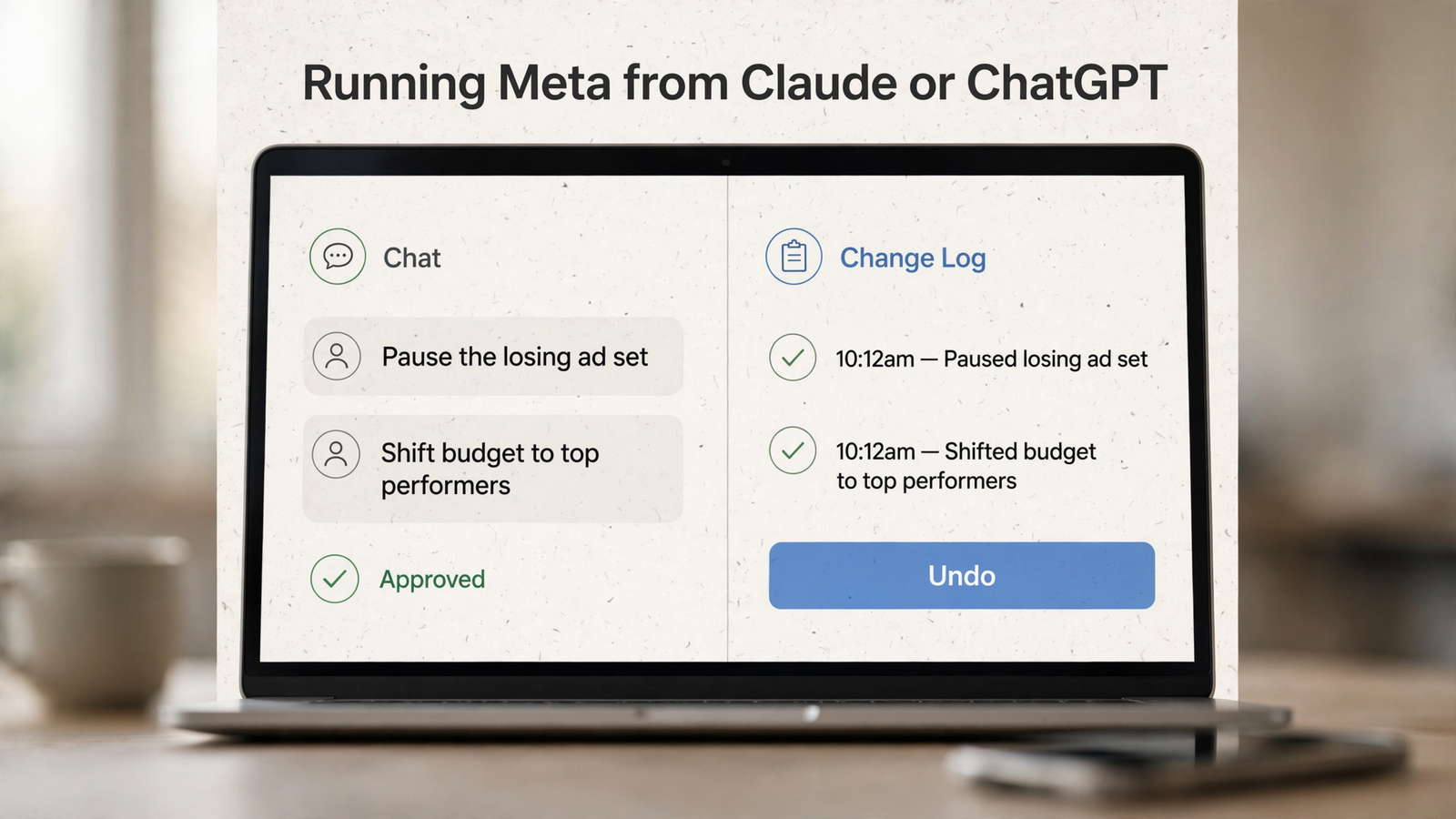
My pick for the owner stuck running Meta ads is the AI assistant already open on their desktop, connected through groas. For $19 a month flat, you describe the change in Claude or ChatGPT, your assistant makes it, and every edit is logged with its reason and undoable in one step.
I would start there before hiring a freelancer or buying another course on Advantage+. Not because advertising stops needing judgment. Because judgment is a poor use of your time when it means hunting through menus to carry out a decision you have already made.
I spent years managing accounts by hand: rebuilding structures, mining negatives at 1am, watching performance suffer after someone changed what should have been left alone. I respect the work. I have less patience for treating every repetitive task as strategic genius.
The ranking below measures how much work stays on your desk after you pay. The cheapest invoice is not always the shortest escape route.
The ranking rule: count the jobs you still own
Being stuck in Ads Manager usually means you bought three jobs at once: media buyer, creative producer, and analyst. Then you discovered a fourth unpaid job: coordinating the other three.
An option can remove the clicking without removing the coordination. Another can bundle the work but charge you for a department you do not need. Those are different purchases, even when both proposals promise to “save you time.”
I compare each route on five questions:
- Who runs campaign execution day to day?
- Who makes the next ad?
- Who fixes tracking?
- Who coordinates the pieces?
- Who explains what happened in plain English?
This ranking is for owners who want less account-management work, not experienced media buyers shopping for another tool. It does not assume software can invent a good offer, approve your creative, or make an unnamed person responsible for tracking.
If you enjoy living in Ads Manager, your ranking will look different. Mine starts with getting out of it.

1. Your AI through groas: run Meta from the chat already open
Best for the owner who wants to direct account changes without carrying them out by hand. The thing this route does better is shorten the distance between a decision and its execution.
You open Claude or ChatGPT and type what you would otherwise have clicked: Pause the ad set that spent $140 with zero checkouts, move that budget to the winner, and show me cost per booked call before and after.
Because groas connects through MCP, your assistant can read your real Meta numbers, make the change, and explain it in plain English. Every edit is logged with its reason and undoable in one step. Autopilot stays off until you switch it on.
That is the mechanism, not a promise that an AI suddenly understands your business better than you do. You still decide what the offer is, how much you are willing to spend, and which creative deserves approval. The account work no longer requires you to translate those decisions into a tour of Meta’s menus.
groas Unlimited costs $19 a month, flat, with unlimited teammates, ad accounts, and websites, and every feature included. You connect your accounts once and add groas to your AI without code. The same conversation becomes a place to inspect performance, request changes, and review what changed.
What rules it out? Expecting account execution to replace business decisions. If you cannot approve an offer, set a budget ceiling, or approve creative, chat does not resolve that bottleneck. Nor should you mistake an account-management handoff for a named owner who will repair every tracking problem or produce your next ad.
My reason for ranking it first is narrower and more useful: you keep approval authority without keeping the clicking job. Start there before buying a recurring human handoff.
2. A freelance media buyer: skilled hands, but you coordinate
Best for the owner with a proven offer and someone available to brief and follow up. A good freelancer buys back your clicking hours and knows where the levers hide. That used to make this my default recommendation for accounts spending under $10k a month.
The pricing is familiar: freelancers run $500 to $3,000 a month or 15–25% of spend. Upwork Meta specialists list at $15 to $40 an hour, so five hours a week lands around $330 to $880 a month before creative.
What a freelancer does better than a software-only handoff is give you a person responsible for media buying. You can brief them, question their judgment, and ask them to explain a decision. That matters when you want to delegate judgment as well as execution.
What rules this out for the stuck owner is the work around that person. Most freelancers do not make creative monthly, rebuild weak pages, or fix follow-up. You can still end up:
- Hiring and briefing a designer.
- Approving hooks and variants.
- Finding someone to fix the landing page.
- Checking who owns tracking.
- Chasing the next ad before the current one runs out of road.
The media buying can be perfectly competent while the next ad never ships. That is not necessarily a freelancer problem. It is an ownership problem.
If someone inside your business owns those handoffs, a freelancer is sensible. If that coordinator is still you, price the coordination before calling the hire a handoff. For straightforward account execution, I would try the $19 chat route first.
3. A full-service agency: buy the bundle, inspect the scope
Best for the owner who needs creative, landing pages, and media buying under one roof. An agency’s advantage over a freelancer is not a more impressive dashboard. It is fewer handoffs between vendors.
When the scope is real, one vendor owns the account work, the creative pipeline, and landing-page fixes. That is worth evaluating on the total result rather than the management fee alone.
The illustrative $5k-spend comparison here makes the distinction concrete: $6,750 all-in for 42 booked calls works out to $161 per booked call, versus $5,800 for 25 calls at $232 each. The cheaper bill is not the cheaper acquisition. I care about that distinction more than a low retainer.
What rules an agency out for many stuck owners is price combined with vague scope. Agency fees run $1,000 to $10,000 a month or 10–20% of spend. Another small-business pricing breakdown puts management at $500 to $2,500 a month, plus $500 to $2,000 setup, with ad spend separate.
Those are different levels of service, not interchangeable quotes. Before signing, I would put four requirements in writing:
- You own the ad account, pixel, audiences, and Page; the agency works as a partner.
- The proposal names who handles CAPI and tracking.
- The scope specifies how many new ads arrive each month.
- Reporting follows CRM booked calls and show rate, not just Meta dashboard leads.
Buy an agency when you need the bundled production work, not merely relief from Ads Manager. An unnamed owner for tracking or creative is a hole in the service, however polished the proposal. Without the bundle, you may be buying a freelancer with a receptionist.
4. An in-house hire: business context, not an instant department
Best for the owner whose advertising warrants sustained internal ownership. The strongest reason to hire is context. An employee sits in your meetings, hears sales calls, and learns why a lead was junk without waiting for a monthly briefing.
That proximity is the thing an in-house hire does best. It becomes useful when advertising needs a full-time owner inside the business, not just someone to execute this month’s promotion.
The bill is bigger than the salary line: a $70k specialist costs $7,300 to $8,200 a month loaded. An offshore dedicated resource still starts around $3,500 a month before spend, tools, and creative.
Say you spend $20k a month on ads. You need to be clear whether you are buying a decision-maker or hiring someone to operate the same interface you are trying to escape. Those job descriptions should not command the same reasoning just because both contain “Meta.”
What rules this out for the stuck owner is everything the hire still needs. One person is not automatically a creative team, a landing-page builder, a tracking specialist, and weekend QA.
The failure pattern is easy to recognize: a capable hire inherits a messy account, starts rebuilding, then waits on a designer while tracking remains somebody else’s problem. The payroll line is clear. The ownership lines are not.
Hire for sustained internal judgment, not to staff a clicking problem. If the immediate need is account execution and reporting, compare that job description against running it from chat before posting the role.

5. Software and Meta’s connector: leverage for an existing operator
Best for an operator who already owns the account and wants fewer manual steps. This bucket includes rules tools, reporting dashboards, and Meta’s official MCP connector.
The important distinction: the connector is not just a reporting feed. It supports reading account data and making changes. Access uses Facebook Login for Business, with reporting or management permissions, and setup does not require a developer app or token. It is free during open beta, with no post-beta price published.
What this route does well is give an existing operator another way to work. It can reduce interface work rather than merely describe what someone should click next.
What rules it out as my first recommendation for the stuck owner is confusing that access with the whole handoff. There are still workflow limits:
- New campaigns start paused and require separate activation.
- There is no delete tool for campaigns or ads; the options are pause and edit.
- The creative tool builds single-image link ads from assets already in the account, without upload.
- Edits to live campaigns can take effect immediately, so judgment still comes before execution.
My preference for groas is not that Meta’s connector cannot write. It can. It is that groas combines the chat workflow with competitor ads and funnels, Reddit research, and Semrush and Ahrefs data, plus Google, Bing, and Meta in one place. It also provides the change log with reasons and one-step undo.
I would pay $19 for that broader context and change control before assembling the narrower route. Software is leverage when a capable operator already owns the process. It is not a substitute for deciding who that operator is.
The comparison: what you buy and what stays with you
Read the last column before comparing the monthly fees. That is where an apparently inexpensive option turns into your next job.
| Ranked option | Best for | Strongest advantage | Work or cost that remains |
|---|---|---|---|
| 1. Your AI through groas, $19 flat | Owner who wants account execution out of their hands | Plain-English changes, logged reasons, one-step undo | Offer, budget ceiling, creative approval, and named owners beyond account execution |
| 2. Freelancer, $500–$3,000 or 15–25% | Proven funnel with an internal coordinator | A person responsible for media buying | Creative, pages, tracking, and coordination may remain |
| 3. Agency, $1,000–$10,000 or 10–20% | Owner needing creative, pages, and media | One vendor can own the bundle | Higher fees and careful scope checks |
| 4. In-house, $7,300–$8,200 loaded | Business needing a full-time internal owner | Deep business context | Supporting production and technical resources |
| 5. Software / Meta MCP, free in beta | Existing account operator | Fewer manual interface steps | Judgment, coordination, and workflow limits |
I left one popular option out deliberately: doing it yourself with more hours in Ads Manager. That is the trap you are already in. More tutorials do not appoint a tracking owner, produce the next ad, or turn repeated account tinkering into a strategy.
Before I paid any finalist, I would ask the same four questions:
- Tracking and ownership: Who fixes tracking, confirms CAPI is firing, and owns the account assets?
- Creative: Who makes the next ad, how many are included, and who replaces the loser without being chased?
- Spend: Who changes budgets and pauses spend? What would trigger a recommendation to spend less?
- Results: Are decisions judged on CRM booked calls and show rate, or dashboard clicks and leads?
Reject a proposal that leaves a required job unnamed. Apply the same standard to your own setup: using chat does not excuse leaving creative or tracking ownerless.
And be honest about when to skip my pick. If you have no offer worth scaling, no defensible budget ceiling, and nobody who can approve creative within 48 hours, no hire fixes that, chat included. Fix the offer first.
For the longer comparison, read who should run your Facebook and Instagram ads, or compare an in-house hire against groas on the work, not the fee.
You got stuck because Meta put several jobs behind one login. Do not buy your way out with a percentage of spend and a monthly report on clicks when what you need is execution. My pick is Claude or ChatGPT connected through groas: $19 a month flat, every change logged with its reason, undo in one step. Go back to approving decisions instead of hunting checkboxes.


