

 LinkedIn

One client can turn a $299-per-unit PPC fee into a $1,495 monthly bill. The rate is real, but so is the five-account-service-unit minimum. Until you fill those units with work you can bill, the cheapest advertised fee may be an expensive way to serve your first client.
I have made the mistake of reading a volume price as a starting price. The distinction looks fussy on a pricing page. It looks less fussy when the provider invoices you for five units and only one client pays you back.
This is a utilization analysis, not a forecast of campaign performance. I use groas’s $299 unit rate and five-unit minimum for the calculation, then test an illustrative resale price against it. Client ad spend is separate. So are your sales, onboarding, reporting, and quality-control hours. The question is narrow: when does the advertised unit rate become a workable delivery cost for a small agency?
First, separate a volume rate from a one-account price
The wider white-label market gives you a reason to inspect the small print. One provider lists $499 per month for one account, $399 each for two to four, and $299 each for five to 14. DesignLoud publishes the same ladder. On those schedules, $299 is explicitly a volume-tier price, not the price of buying one account.
Those ladders are context, not the source of groas’s minimum. For the math in this piece, the relevant terms are groas’s $299 rate and five-unit minimum: five times $299 is $1,495 in monthly fulfillment fees. Whether you have one occupied unit or five, you need enough billable work to carry that purchase.
A unit means one account receiving one fulfilled service for the month. Five Google Ads accounts can occupy five units. If eligible services share the minimum, a mix of services can occupy them instead. That is why I count service slots, not client logos. One client buying two eligible services may use two slots; a client buying one uses one. Confirm how the provider counts each service before you build a quote around the minimum.
The fulfillment fee also does not buy media. SEOVendor states the separation explicitly: client ad spend is paid separately. Whether the client spends $2,000 or $20,000 on ads, that spend does not fill an unused service unit or reduce the fulfillment bill. Keep the two lines apart in your model: what the client pays the ad platform, and what you pay for delivery.
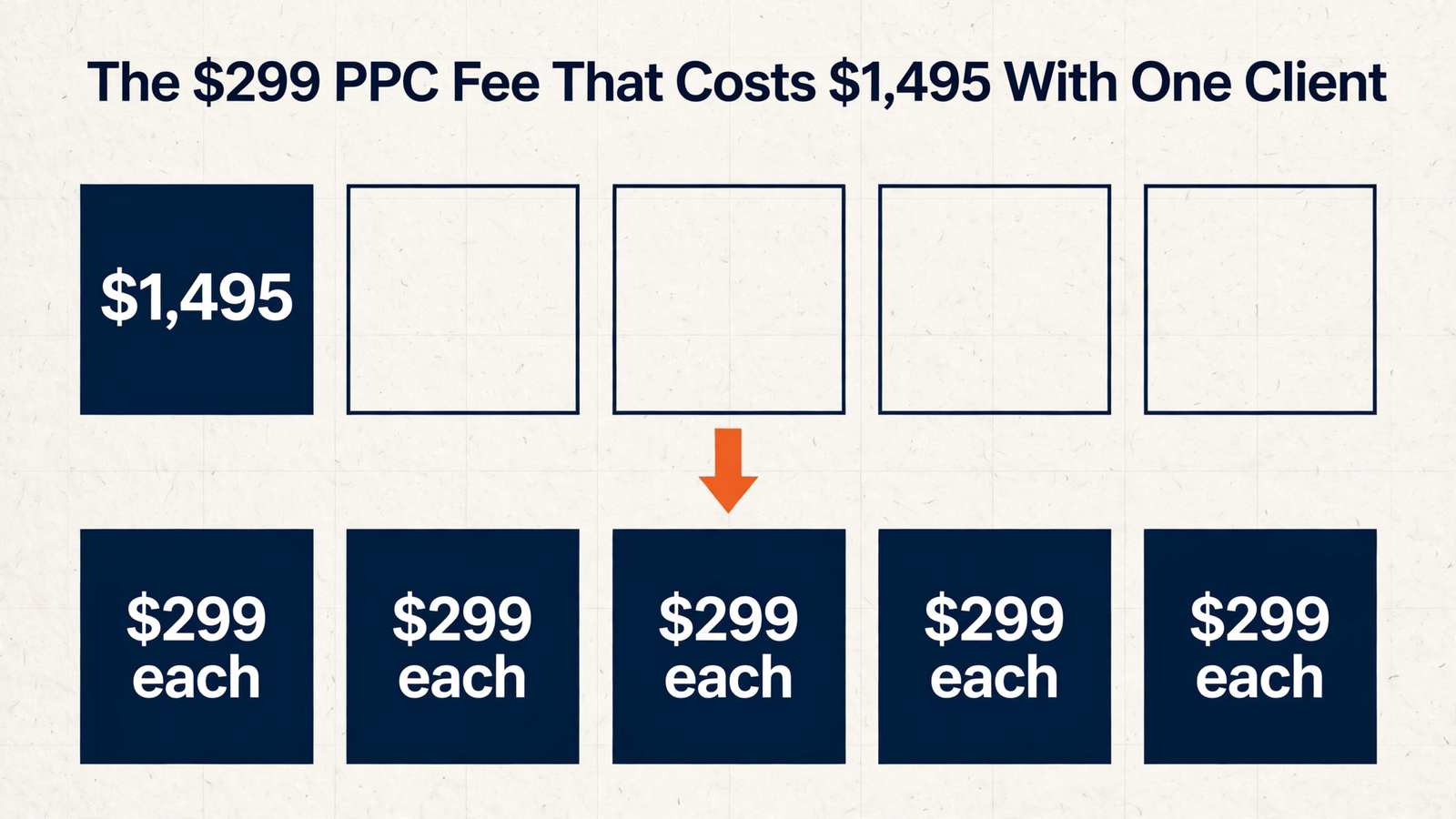
The utilization table: what one to five occupied units actually cost
The table divides the fixed $1,495 monthly minimum by the number of occupied units. These are calculated effective costs, not additional provider price quotes. It assumes an unused purchased unit produces no resale revenue that month.
| Occupied units | Empty units | Monthly provider bill | Effective cost per occupied unit |
|---|---|---|---|
| 1 | 4 | $1,495 | $1,495.00 |
| 2 | 3 | $1,495 | $747.50 |
| 3 | 2 | $1,495 | $498.33 |
| 4 | 1 | $1,495 | $373.75 |
| 5 | 0 | $1,495 | $299.00 |
At one occupied unit, the full $1,495 sits on one paying account. At two, each account carries half the bill. At three, the calculation reaches about $498.33 per occupied unit. Nothing about the provider’s invoice has changed. You have only spread it across more work that can earn revenue.
That difference matters when comparing quotes. A single-platform freelancer range of $500 to $1,500 per month covers one account in the cited $2,000-to-$15,000 ad-spend band; a broader freelance range runs from $500 to $5,000 per month. Those ranges do not establish identical scope or execution. They do show why a $299 headline is a poor one-account comparison. With one unit occupied, your actual fulfillment commitment is $1,495, before you do any agency work.
By four occupied units, the effective cost falls to $373.75. At five, it finally reaches the advertised $299. I used to treat that falling average as a discount. It is not. You bought the same minimum each month; more of it is now attached to paying work. If a slot stays empty, you have no client revenue against its share of the bill.
The practical calculation is short: monthly provider bill ÷ occupied billable units = effective fulfillment cost per unit. Run it using units you can bill now, not accounts you hope to sign next quarter.
At a $500 resale price, three units leave just $5
Delivery cost is only half the decision. You also need to know what the agency collects. Suppose you charge $500 per occupied account per month. I use that price to expose the arithmetic, not to recommend it as a market rate. It falls within the cited single-platform freelancer band, but that band does not tell you what your own clients will pay or what your scope will cost to service.
The table multiplies occupied units by the illustrative $500 resale price, then subtracts the same $1,495 provider minimum. The final column is before your labor and overhead.
| Occupied units | Illustrative monthly resale revenue | Provider bill | Left before agency labor and overhead |
|---|---|---|---|
| 1 | $500 | $1,495 | −$995 |
| 2 | $1,000 | $1,495 | −$495 |
| 3 | $1,500 | $1,495 | $5 |
| 4 | $2,000 | $1,495 | $505 |
| 5 | $2,500 | $1,495 | $1,005 |
Three paying units nearly cover the provider fee: $1,500 collected, $1,495 owed. The remaining $5 is not profit, and calling it margin would flatter the spreadsheet. It has to withstand the first onboarding call, reporting request, or client email. It will not.
With all five units occupied, the same resale price leaves $1,005 before agency labor and overhead, or $201 per account. That is a different starting position, but still not a net result. White-label margin guidance puts SMB wholesale fees at $300 to $600 per account and discusses a 30% to 50% markup. Those figures provide context, not a margin guarantee for this particular purchase. Revenue minus wholesale still has to cover selling, onboarding, communication, and quality control.
Change the illustrative $500 to your actual resale price before making a decision. If the price is lower, the remainder shrinks. If it is higher, the remainder grows. Neither change makes your account-service hours disappear. The table measures room to operate, not profit.
Mixed-service capacity helps only when the work is already sold
The five-unit minimum is easier to carry if eligible services can share it. Suppose three Google Ads accounts and two SEO accounts count toward the same five-unit purchase. All five slots are occupied, so none of the minimum rests on an empty slot. You have reached full utilization without holding five Google Ads clients.
That is a conditional example, not permission to assume every service has identical pricing or scope. Confirm which services count toward the minimum and what each unit costs. If a second channel or a different build carries another fee, the simple $299-per-unit calculation needs that fee added before you quote the client. One published white-label menu, for example, lists $350 monthly for single-channel work, $650 for Google plus Meta, and $750 for an eCommerce package that includes Shopping, Performance Max, and feed work. Those are another provider’s listed prices, not groas prices. Their relevance here is the distinction between filling capacity and promising a bundle your base fee does not cover.
Do not make the mixed portfolio look profitable by assigning $299 to every Google Ads slot and hiding the rest of the minimum in another service line. Allocate the actual bill across the billable work occupying it, then account for any service-specific charges. Otherwise the portfolio may appear healthy while one offer quietly subsidizes another.
I would ask two questions before using a mixed-service plan in a proposal: Does this service count as an eligible unit, and is this the complete fulfillment fee for its scope? A slot you have not sold cannot answer either question for you.
Fulfillment cost is not the cost of serving a client
The utilization tables deliberately stop at the provider bill. An occupied unit still needs a sale, onboarding, account access, conversion-tracking checks, ad approvals, reporting the client can understand, billing, collections, and someone at the agency willing to review the work before it reaches the client. That list is not a theoretical objection. It is the work between a wholesale invoice and a client relationship.
At the illustrative $500 resale price, five occupied units leave $1,005 across the portfolio before those tasks. Divide it by five and you have $201 per account to absorb them. You do not need a complicated forecast to see the constraint. You do need an honest estimate of your own hours, because the provider fee alone cannot supply it. The gross-margin distinction in the white-label guidance matters for exactly this reason: the remainder after wholesale is not the amount you take home.
I also would not book automatic salary savings. Buying fulfillment removes payroll cost only if you actually remove hours or headcount. A small agency may keep its account manager and add the provider bill. If that is your setup, model both rather than telling yourself one replaces the other.
The same restraint applies to campaign results. More frequent execution can address work that waits for a periodic review; it cannot promise a particular CPA or guarantee renewal. This analysis contains no measured campaign return. It tells you what capacity costs and how much resale revenue remains to support the agency work around it. Use provider fee plus your service hours when you set the resale price.
Buy against signed capacity, not the next-quarter pipeline
With one Google Ads client ready to sign, a five-unit minimum leaves four empty slots and puts the entire $1,495 bill on that account. A bounded single-account quote can be useful as a cost check, but it is not automatically the same product. A freelancer may quote for a build, a negative-keyword cycle, and a monthly optimization pass. That scope tells you what the smaller commitment buys; it does not turn periodic work into continuous execution.
No-minimum white-label offers also exist. ROI Minds lists a one-account minimum on a month-to-month basis, while ClicksGeek advertises a one-client starting point without minimums or contracts. Their entry terms make them comparison points for an agency with one account, not proof that they deliver the same work as groas. For a closer look at the single-account calculation, see the comparison of a freelance PPC manager with groas’s $299 headline and $1,495 starting bill.
Here is the decision I would put in front of an agency owner:
- Count occupied, billable service units this month. Include mixed services only after confirming that they qualify and what they cost.
- Multiply those units by the resale price you can actually charge. A hopeful pipeline is not current revenue.
- Subtract the provider bill, then your agency labor and overhead. If the result is thin or negative, do not mistake the $299 unit rate for an affordable one-client starting bill.
That test does not require you to pretend the cheaper single-account commitment is the better long-term operating model. It tells you when to wait before buying unused capacity. Once five eligible units are filled with paying work, the $1,495 minimum works differently: each occupied unit bears $299 in base fulfillment cost, and the empty-slot tax is gone.
That is where I would put groas ahead of a freelancer patchwork for an agency that can fill the minimum. A freelancer’s smaller one-account fee can look attractive while leaving periodic reviews, follow-up on keyword work, and reporting translation on your desk. groas runs bids, keywords, and budgets continuously, with a dedicated manager owning the result. Full utilization makes the advertised unit rate meaningful; continuous execution is what that rate buys. If you are modelling what remains for client service at a higher resale price, the $1,000-resale analysis of the same $299 fee takes the labor question further.
So I would not buy the headline. I would count the units I can bill, subtract the real monthly commitment and the hours my agency still owes, and make the decision from what remains. Fill the minimum with sold work first. At one occupied unit, $299 is a rate on a pricing page. At five, it is your effective base fulfillment cost.


