AI Visibility Tools vs. Agencies vs. Done-for-You: Who Actually Ships the Fix?
October 4, 2026
•
12
min read



A vendor deck landed in my inbox with 14 new acronyms in 12 slides. I counted one sentence about work being done and nine pages about scores going up.
I used to write decks like that when I managed Google Ads by hand, back when vague language could hide a slow week. Much of today’s AEO vocabulary is old PPC and SEO vocabulary with the accountability stripped out. A visibility score resembles impression share without the auction data. An AI Overview ad and an AI Overview citation sound related, but one is bought and the other earned. Here are the terms, their older ancestors, and the pitch to watch for.
Plain English: SEO helps a page earn search rankings and clicks; AEO makes its answer easier to surface directly; GEO aims to make a brand and its content usable as sources in AI-generated answers.
Yext draws a similar distinction: SEO for clicks, AEO for answers, GEO for citations across LLMs. I used to buy keywords. Now vendors sell acronyms. The misuse is the triple retainer: three service lines for the same underlying work. Even a jargon guide notes the heavy overlap and the lack of an agreed boundary between AEO, GEO and LLMO.
Ask what gets done under each label. If all three mean fixing technical blocks, writing answer-first pages, earning off-site proof and measuring results, you have one job with three invoices.
Plain English: an AI Overview citation is a linked source Google shows alongside an AI-generated answer.
Its SEO ancestor is an earned search appearance, but a ranking and a citation are not the same result. Google can assemble an answer from pages that address different parts of a question, so a page ranking No. 1 for the typed query need not be the one it cites. An analysis of 863,000 keywords found that only 38% of cited pages also ranked in the top 10 for the same query, down from 76% in July 2025. BrightEdge found even less overlap, around 17%.
The pitch to reject: “You rank No. 4, so you’re getting cited.” Track citations separately from rankings. Give each important question a self-contained answer with enough detail to be useful, then check whether that page actually appears as a source. A position report cannot do that job.
Plain English: AI Overview ads are paid placements that can appear around, and in some cases within, a Google AI Overview.
The ancestor is the Search auction, not a new kind of earned citation. Google’s help page describes how existing Search, Shopping, Performance Max and App campaigns can appear above or below an Overview; eligible Text and Shopping ads can also appear within one. There is no separate AI Overview buy or direct placement targeting.
The misleading bundle is “pay us and we’ll get you shown as an ad and cited.” Paid placement does not buy earned citation. A SE Ranking analysis found a text ad on 29% of commercial keywords it checked in AI Mode, while the advertiser domain was cited 11% of the time. Ask for ad impressions and earned citations on separate lines. If a vendor blends them, you cannot tell which result you bought.
Plain English: a mention names your brand, a citation links to a source, and a recommendation tells the reader to choose you.
The PPC ancestor is the habit of separating an impression from an action. The analogy has limits: a citation is a link, not a click, and a mention can be unfavorable. A report boasting 40 mentions sounds less impressive if 38 answers tell readers a competitor is better.
Ask for linked citations and positive recommendations as separate counts. Then ask to see the answer text. A tally alone cannot tell you whether the model helped you or politely escorted the buyer elsewhere.
Plain English: prompt tracking asks AI systems a fixed set of questions on a schedule and records whether your brand appears in the answers.
It is rank tracking’s fuzzier cousin. Tools submit prompts, parse the responses and turn the results into dashboards; that makes them useful for trends, not precise measures of everything buyers see. The mechanics of automated tracking matter because the prompt list determines what the tool can notice.
I used to check rank trackers every morning at 8am. The same habit is tempting here. But a tool can miss long-tail questions that matter to buyers, and an answer can change without your business changing at all. Ask for the prompts, models and checking schedule. Read the trend line with the underlying answers beside it, not as a score carved into stone.
Plain English: AI share of voice compares how often you appear in a tracked set of answers with how often competing brands appear there.
The ancestor is PPC impression share. The difference is that an AI prompt set is chosen by whoever runs the tracker; it is not an auction report with loss reasons attached. Brand24 describes the usual calculation as brand mentions divided by total category mentions across a fixed prompt set, and notes that results differ by platform.
That platform distinction is not small print. A study of 161,286 prompts found ChatGPT, Gemini, Perplexity and AI Overviews cited the same domains in just 3.8% of cases. Never accept “share of voice” without the prompt list, platforms and formula. Otherwise, you do not know what share you are looking at.
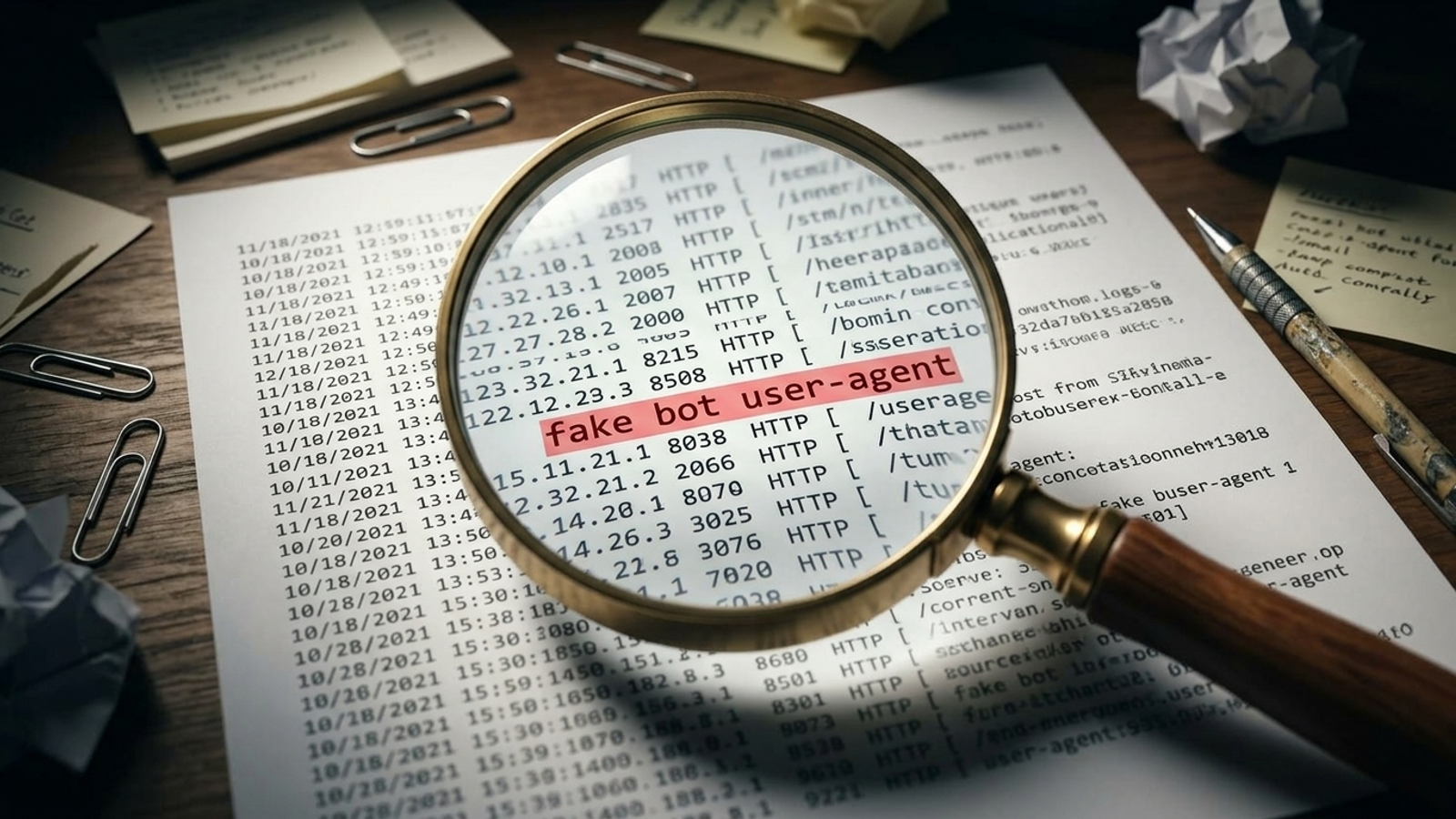
Plain English: a user-agent hit is a log entry claiming a bot visited; a verified crawler hit checks whether that visitor was the bot it claimed to be.
Anyone can write “Googlebot” in a user-agent string. Google says not to trust that string alone: check the IP using its verification methods, including reverse and forward DNS. The PPC ancestor is click-fraud filtering. You would not count every suspicious click as a customer; do not count every self-declared bot as proof that Google read your page.
The pitch is “400 AI crawler visits this month, so the machines love you.” Ask which hits were verified, how they were verified and which pages those crawlers requested. The costume is not the visitor.
Plain English: a live answer fetch is a request for page content while an AI system is forming an answer, rather than an earlier crawl used to discover or index the page.
Think of the crawl as stocking the pantry and a live fetch as cooking the meal. Not every AI answer depends on a fresh fetch, and being indexed does not prove a later request will work. A blocked, slow or blank-rendering page can fail at the moment a system tries to use it.
If a vendor points to an indexing chart as proof that every answer can use your content, ask what they know about successful fetches. These are different checks. A green light on one is not a green light on the other.
Plain English: a content gap is a buyer question you do not answer well enough for your page to be useful as a source.
Its PPC ancestor is an uncovered search term. I used to find these at 1am while mining negatives for a home services account: pricing queries kept appearing, but there was no pricing page to meet them. Here the missed opportunity may be an answer that cites someone else instead of you.
The misuse is calling a spreadsheet of 200 gaps a strategy. It is a list. Sort gaps by buying intent, address the highest-priority questions with pages that answer them directly, and check whether those pages earn citations. Finding an empty space is not the same as filling it.
Plain English: answer-first content puts a direct response near the top of a page, then supplies the explanation and proof behind it.
Its SEO ancestor is the useful page that does not make readers hunt through 800 words of introduction for the point. I used to bury the answer because an SEO checklist told me to. I was wrong. A clean, self-contained section gives both a person and an answer system something they can use without reconstructing the argument from scattered sentences.
The sales-pitch version treats formatting as a citation button. It is not. Put the answer up front, then make it worth citing: give the specifics and context the question needs. A tidy heading cannot rescue an empty answer.
Plain English: an entity is a distinct thing, such as a business or product, and Google’s knowledge graph connects what it knows about those things.
This is established SEO vocabulary, not an invention of AI search. The misuse is the promise to build your entity as though it were a new account feature a vendor could switch on.
Keep the basic facts consistent wherever your business appears: name, address where relevant, description and product details. If three places describe three different businesses, another layer of jargon will not settle the confusion.
Plain English: structured data labels information in page code so a search system can identify things such as products, prices or page types.
Its SEO ancestor is schema markup. It can help describe a page; it is not a ticket into an AI Overview. Google’s AI search guidance says no special markup is needed for AI search: pages still need to be indexed and eligible to appear with a snippet.
The pitch to watch for starts with schema work and ends there. Labels cannot replace an answer. Ask what the markup describes, what page problem it fixes and what useful content a visitor will find after the technical work is done.
Plain English: technical AI visibility issues are page or server problems that stop an answer system from reaching or using content you have already published.
The ancestor is technical SEO: blocked URLs, rendering failures and pages too heavy to load reliably. The vocabulary may be new; the repair work is not. A monitor can tell you something failed. Someone still has to change the code, template or server rule.
When a vendor sells an “AI health score,” ask for the affected URL and the fix shipped. Did the key content render? Was the relevant request blocked? What changed? A score that cannot point to the broken page is decoration, not diagnosis.
Plain English: off-site authority is the evidence about your business that appears beyond your own website.
Reviews, coverage, forum discussions and video can all shape what a search or answer system finds. In one citation analysis, more than 18% of citations whose pages did not rank in the top 100 were YouTube URLs. That is a useful reminder that the older SEO idea of authority was never limited to the words on your site.
The misuse is trying to buy the appearance of independent proof. An account of companies spamming a subreddit shows how quickly that turns into the old bought-link routine with a new destination. Earn off-site proof you can defend. If you want the version focused on work rather than the score, see this breakdown of tools that help you get featured in Google AI Overviews.
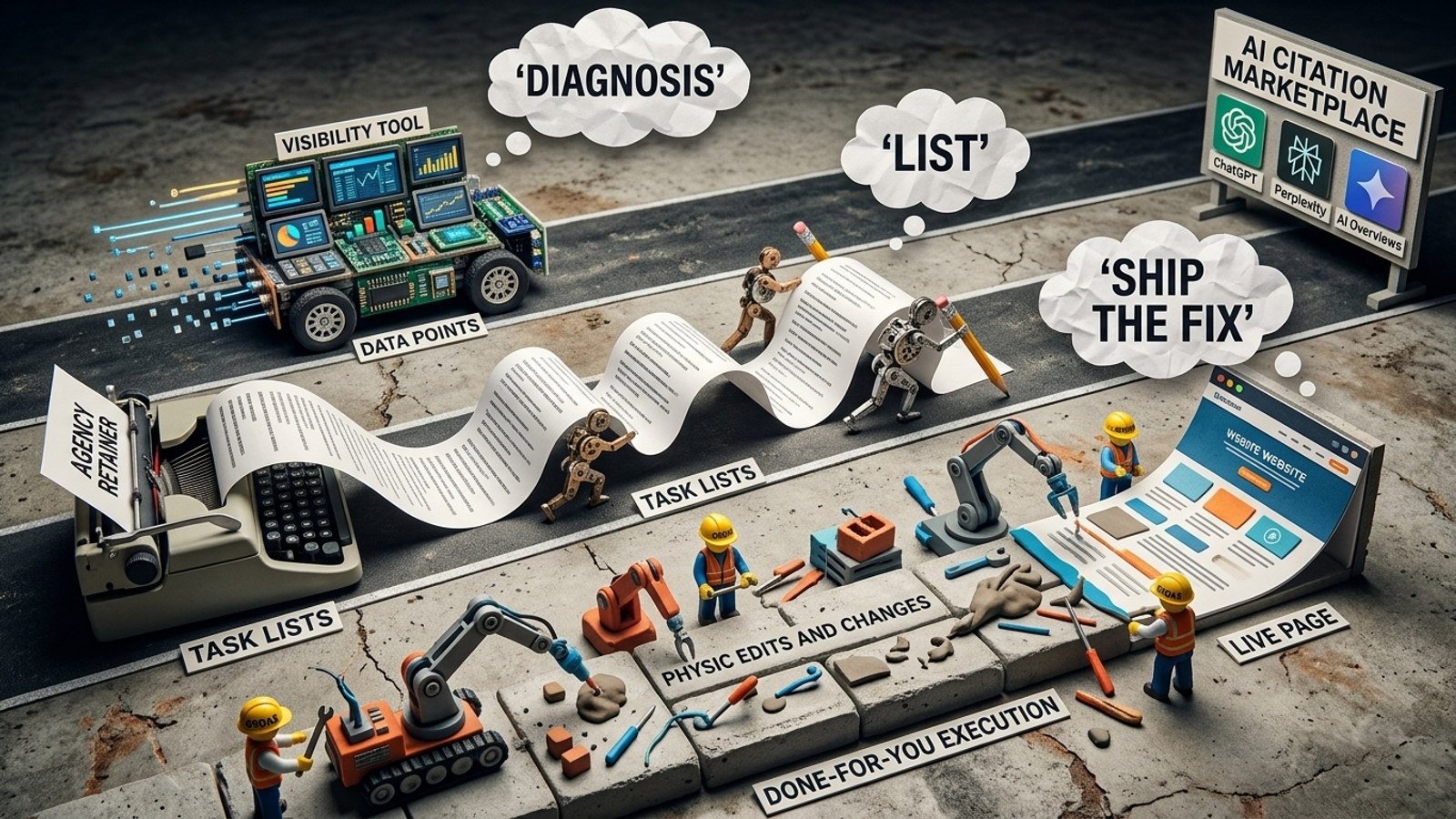
Plain English: an audit identifies what is broken; execution makes the changes and checks what happened afterward.
The PPC ancestor is the account grader that scores you 34 out of 100, then quotes a retainer to fix it. I have sold audits. I have bought them. They are useful when they name blocked URLs, missing answers and lost citations, then attach an owner and a next step to each problem.
They become a stall tactic when the deliverable is a health score and a monthly call to admire it. Ask who will put fixes live inside your guardrails and what evidence they will report afterward. Diagnosis has value. It is not treatment.
Plain English: done-for-you means the vendor does the agreed work in your accounts and on your site instead of sending you a list of homework.
In old agency language, that meant writing ads, building pages and pushing changes live. For AEO work, the test is just as concrete: unblock pages, publish useful answers, pursue off-site proof and keep measuring what appears. The lie is done-for-you reporting. Slides do not ship changes.
Ask who holds the logins, who pushes publish and what changed last week. If the answer is “nothing,” you did not buy execution, however polished the dashboard looks.
Plain English: a monitoring-only tool watches AI answers and graphs your presence but cannot itself change the pages or systems behind those answers.
Its ancestor is a rank tracker with no access to the ad account or website. That is fine if you bought it for a signal. It is not fine if someone calls the dashboard optimization and charges you as though work is being shipped.
I wrote the longer version of this complaint in why monitoring-only tools overstate optimization. A chart saying citations fell 12% is useful information; it does not publish the missing answer or repair the blocked page. Buy monitoring for the signal and execution for the work. Do not pay execution prices for a login to a chart.
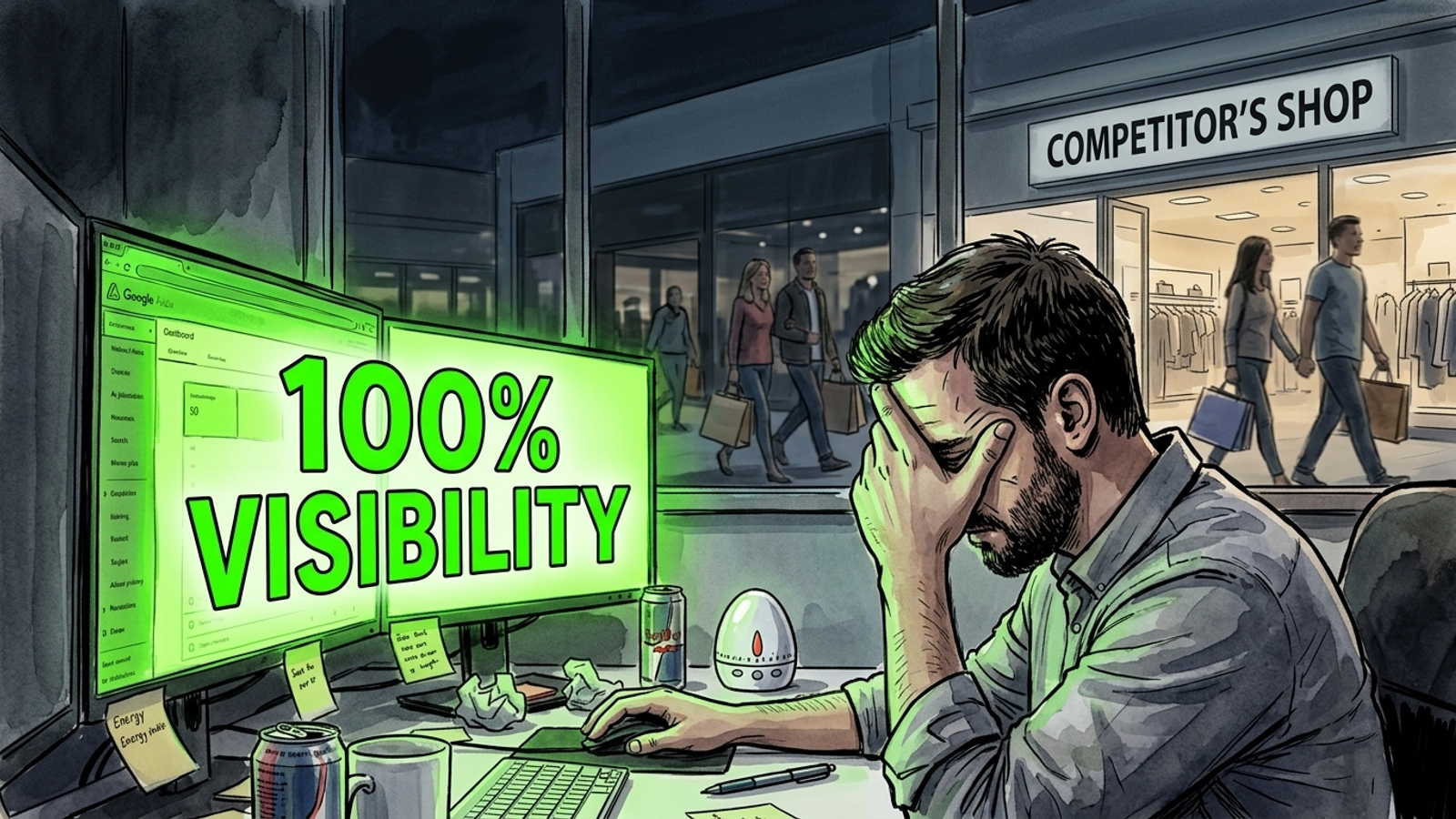
Plain English: a visibility score is a percentage summarizing how often your brand appears across a tool’s chosen prompts and AI systems.
This is the term I would retire. I spent years selling impression share with auction data behind it. A visibility score keeps the percentage and drops that proof. “42% visibility” does not mean 42% of buyers saw you. It could mean 42% of 80 canned prompts mentioned you last Tuesday.
Before you sign, get three definitions in writing:
Retire the score; keep the work. Pages that fetch clean, answers a system can use, citations you can click. That is the part a deck cannot fake.
Do I need separate AEO, GEO and SEO services, or is it the same work?
Often the same work. AEO makes answers easier to surface, GEO aims for citations in AI-generated answers, and SEO earns rankings and clicks, but under all three labels the tasks are usually fixing technical blocks, writing answer-first pages, earning off-site proof and measuring results. Ask what gets done under each label before paying three invoices for one job.
If my page ranks highly in Google, does that mean AI Overviews will cite it?
No. A page can rank No. 1 for a typed query and still not be the one an AI Overview cites, because Google can assemble an answer from pages covering different parts of a question. In an analysis of 863,000 keywords, only 38% of cited pages also ranked in the top 10 for the same query. Track citations separately from rankings.
Can paying for AI Overview ads also get my site cited in the answer?
No. AI Overview ads are paid placements that can appear around or within an Overview, while citations are earned, and paying for one does not buy the other. A SE Ranking analysis found a text ad on 29% of commercial keywords checked in AI Mode, but the advertiser domain was cited only 11% of the time. Ask for ad impressions and citations as separate line items.
Is a mention of my brand in an AI answer the same as a citation?
No. A mention names your brand, a citation links to a source, and a recommendation tells the reader to choose you. A mention can even be unfavorable, such as an answer saying a competitor is better. Ask for linked citations and positive recommendations as separate counts, and ask to see the actual answer text.
What should I ask for before trusting an AI share of voice number?
The prompt list, the platforms covered and the formula. A tracker's prompt set is chosen by whoever runs it, and results differ by platform; one study of 161,286 prompts found ChatGPT, Gemini, Perplexity and AI Overviews cited the same domains in only 3.8% of cases. Without those three definitions, the share means nothing.
Does a log entry showing Googlebot visited my site prove Google read my page?
Not by itself. Anyone can write Googlebot in a user-agent string, so a log entry only claims a bot visited. Google says to verify the visitor by checking the IP using its methods, including reverse and forward DNS. Ask which crawler hits were verified, how, and which pages the crawlers requested.
If my page is indexed, can AI systems always fetch its content when generating an answer?
No. Indexing is an earlier crawl used to discover the page, while a live answer fetch is a request for page content while an answer is being formed. A blocked, slow or blank-rendering page can fail at fetch time even though it is indexed. These are different checks, and a green light on one is not a green light on the other.
What does a 42% AI visibility score actually mean?
Usually not that 42% of buyers saw your brand. A visibility score summarizes how often your brand appears across a tool's own chosen prompts and AI systems, so it could mean 42% of 80 canned prompts mentioned you on one day. Before signing, get in writing which prompts and models are included and what formula produces the number.