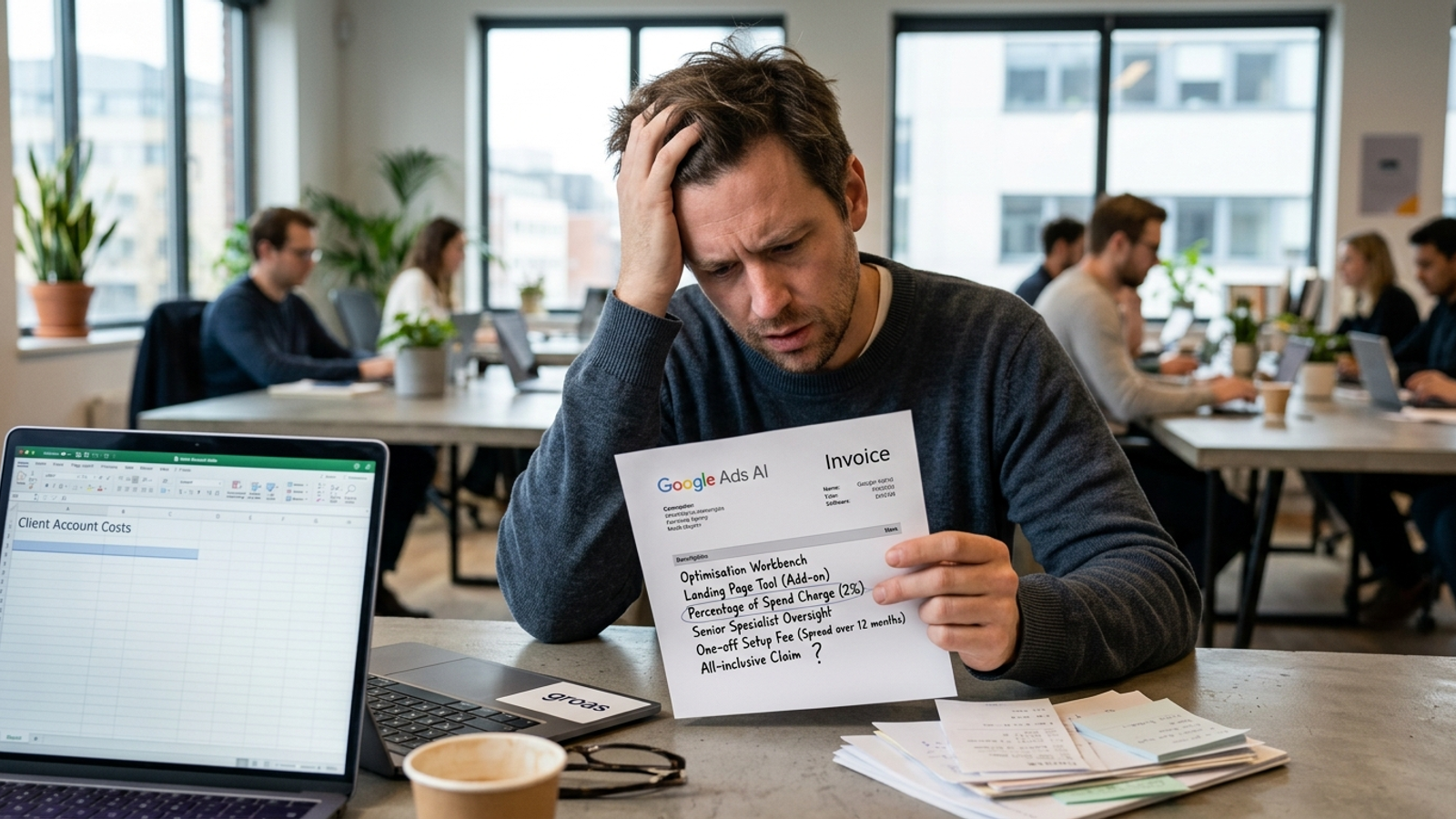
A screenshot of ChatGPT recommending your brand is easy to sell. Getting your brand into an answer when the buyer has never heard of you is the hard part.
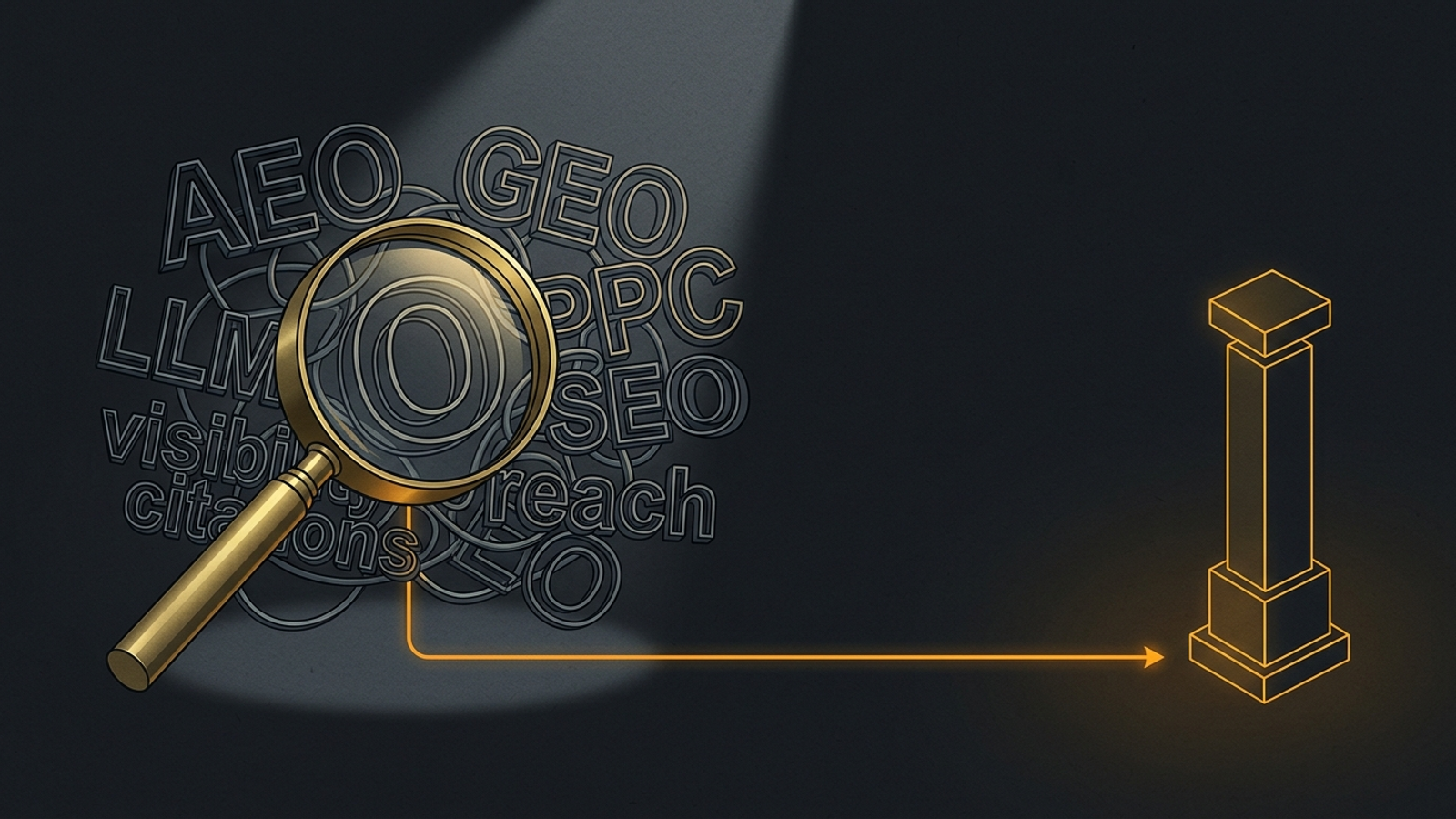
That distinction disappears fast in an AI-search sales deck. AEO and GEO become interchangeable, brand monitoring gets sold as brand visibility, and “citation building” can mean anything from useful site work to a directory submission. The shift toward AI-generated answers is real: buyers ask ChatGPT, Perplexity, Claude, and Google AI Overviews questions they once typed into a search box. So is the vendor fog around it. Here is how I use the terms, and what I ask when someone uses one to justify a retainer.
AEO (Answer Engine Optimization)
Answer Engine Optimization, or AEO, is the technical and editorial work that helps an AI answer engine retrieve information about your business and use it to answer a relevant question.
The sales-deck version makes AEO sound like a mystical replacement for search marketing. It is usually less mysterious and more labor-intensive: crawled pages, structured markup, responsive servers, and consistent information about the business across the web all affect what an engine can find and use.
The distinction I care about is execution versus observation. A monthly deck of prompt screenshots may show where your brand appears today. It does not structure your schema, fix pages an engine cannot read, or publish the factual answers buyers need. If an AEO engagement never changes anything an answer engine can retrieve, you have bought a subscription to a list of chores.
GEO (Generative Engine Optimization)
Generative Engine Optimization, or GEO, is the work of making content and source information more useful to generative engines when they assemble answers.
The term appeared in a late-2023 study by researchers from Princeton, Georgia Tech, and the Allen Institute for AI. It described interventions such as adding authoritative statistics, direct quotes, and citations to improve a source’s inclusion in generated answers by up to 40%. That is a more concrete proposition than “we make your brand AI-ready.”
In agency decks, GEO often means AEO with a different logo on the slide. Sometimes it means ordinary blog production with a new price tag. Ask what will change on the page and why that change should make a specific answer easier to retrieve or cite. If the entire deliverable is a quarterly audit and a list of keyword ideas, you are buying recommendations, not generative-search execution. Padding an article with adjectives will not make its product specifications easier to extract.
Brand monitoring
Brand monitoring records where and how AI responses mention your company by name.
That is a useful diagnostic, and it does not have to be elaborate. For a small business checking branded mentions in-house, an automated script or webhook can query variations of the company name through the OpenAI or Anthropic API once a week and put the outputs in a spreadsheet for less than $5 in API credits.
But a mention on a query containing your name is not new discovery. Monitoring tells you what happens when you ask about yourself. A vendor should not label that number “brand visibility” and present it as evidence that buyers are finding you.
Brand visibility
Brand visibility measures whether an AI answer names or recommends your business when a buyer describes a need without naming you first.
This is where the comfortable dashboard number tends to get uncomfortable. When a prospect asks ChatGPT, Gemini, or Google AI Overviews to evaluate providers in your category, does your brand appear as a relevant option, or does the answer send them to a competitor? Branded prompts can make visibility look reassuring because you supplied the name yourself. Unbranded buyer questions test whether the engine surfaces it.
I would separate three measures rather than collapse them into one score:
- Mention rate: the share of category prompts that name your brand.
- Citation rate: the share of queries that link to your domain as a source.
- Sentiment framing: whether the answer recommends you or emphasizes your drawbacks.
Those measures answer different questions. A model can mention you without linking to you, or cite a page while framing your product as a poor fit. To look beyond a handful of flattering screenshots, run 50 to 100 long-tail, unbranded buyer queries that specify a job title, company size, and concrete problem. Keep the distinction clear when you read the results: appearance in an answer is not the same as a qualified visit or pipeline.
Prompt tracking
Prompt tracking repeatedly runs natural-language queries through AI models and records whether, where, and how a brand appears in their answers.
Platforms such as Profound, Peec AI, and the Semrush AI Visibility Toolkit automate the mechanical job of querying systems including ChatGPT, Perplexity, Gemini, and Claude. That is useful. Treating the tracking itself as an optimization strategy is like watching a thermometer and expecting your fever to break.

The pitch I distrust is the fixed prompt package: $1,500 a month to watch the same bucket of 50 questions. Identical prompts can produce different mentions as model settings and retrieved information change. More importantly, buyers do not all type the same neat six-word query. They describe their software stack, team size, and immediate operational headache in whatever words come to mind.
A fixed prompt set is a sample, not the market. Ask how the vendor refreshes the questions, handles variation between answers, and connects what it finds to work that can change the next answer. Otherwise you are paying for a recurring snapshot of a moving target.
Citation building
Citation building in AI search is the work of making a source useful enough for an answer engine to reference and link when it responds to a relevant query.
I ask vendors to define this one before they put it in a proposal. In local SEO, citation building commonly meant submitting a business name, address, and phone number to directories. In AI-search pitches, the same phrase can describe three very different jobs:
- Recycled directory submissions. A vendor puts your URL into web directories and calls the listings “AI entity citations.” That does little to provide a useful answer to a buyer’s question.
- Paid listicle placement. A vendor buys a mention in a roundup on the theory that an engine may cite the page. Engines do cite roundups, but paying $4,000 for a sponsored mention does not give you control over whether the engine chooses that passage.
- Extractable source content. An operator restructures high-intent pages so an engine can find clear, factual answer blocks on your own domain.
The third is work on an asset you control. In my testing across earned search environments, pages that earn live citations do not depend on link blasts. They give engines proprietary benchmark numbers, unambiguous product specifications, and clean HTML they can parse without running heavy client-side JavaScript. A CXL study of Google AI Overviews found that 55% of cited passages appeared within the first 30% of the source page.
A third-party mention can still matter. It is not, however, a substitute for making your own pages useful sources. If a “citation building” contract never touches your content architecture or the way your pages respond, check whether it is a traditional link package with an AI label on the invoice.
Knowledge graph
A knowledge graph connects identifiable things, such as companies, products, and people, to information about them and their relationships.
This term matters when an engine needs to tell your company from another one with the same name or acronym. Structured information, including schema markup, can help express those relationships. It cannot, by itself, make an agency’s preferred claim about your authority true.
The pitch to watch is “Knowledge Graph optimization” as a magic submission process: add a large JSON-LD block and your business becomes an established industry leader. Markup formats information; it does not manufacture a verified public footprint. If the rest of the web offers little consistent information about your business, 200 lines of nested schema in a page header will not solve that problem.
Entity disambiguation is a real reason to do the work. You do not want an AI answer confusing your cybersecurity SaaS with an offshore consulting firm that shares its acronym. But establishing that your business exists and sells what it says it sells is an entry ticket, not a guarantee of recommendation.
Content gap (for AI)
An AI content gap is a missing or hard-to-retrieve fact on your site that leaves an answer engine relying on another source to answer a buyer’s question.
Legacy SEO dashboards with an “AEO Insights” tab often define the gap differently. They compare page length, count a phrase a competitor used three more times, and send your copywriter off to add it. That mistakes more words for more useful information.
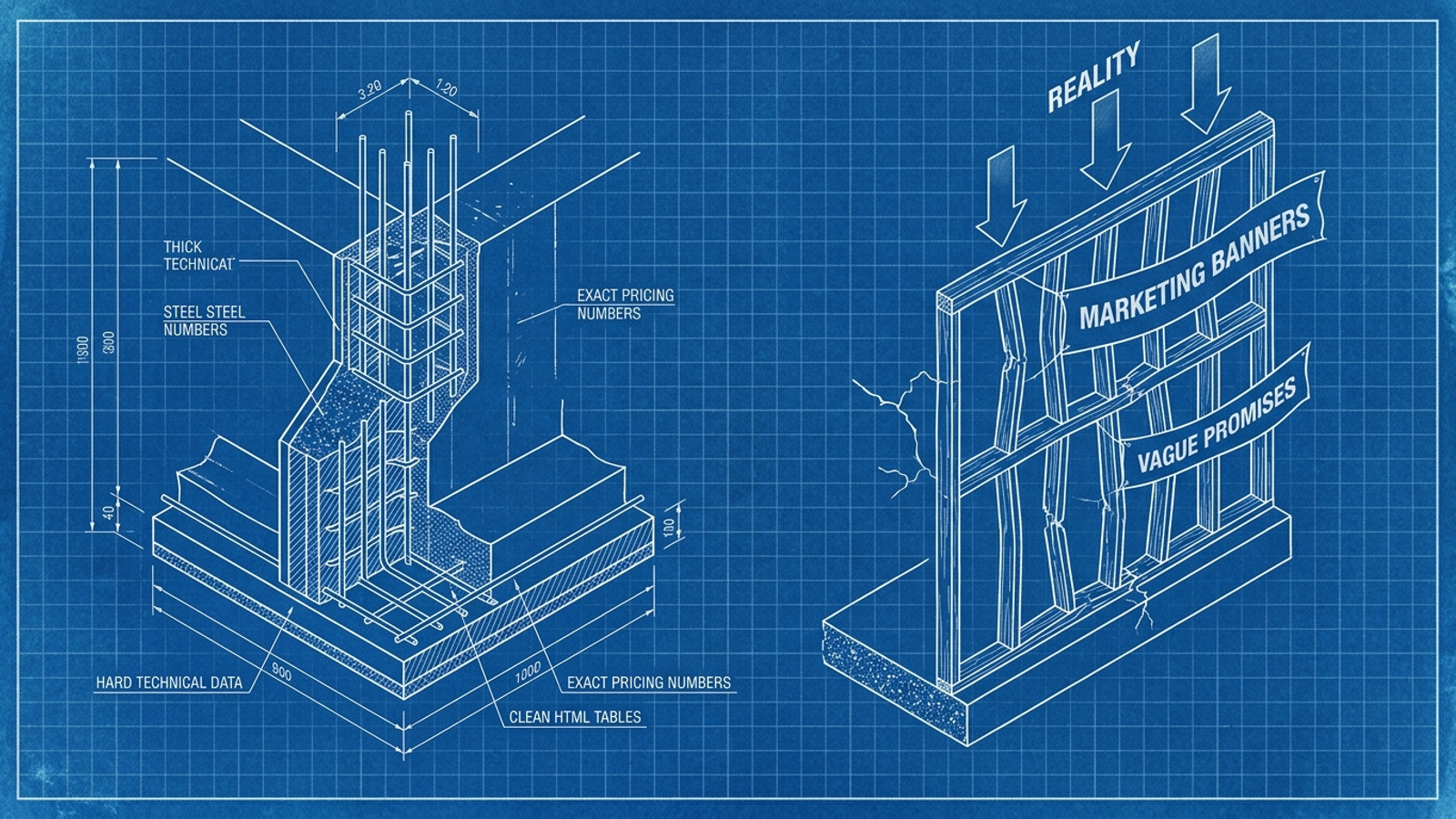
The gaps worth fixing tend to be concrete:
- Gated commercial data: A competitor publishes pricing tiers, seat minimums, and contract lengths, while yours sit behind a “Book a Demo” form a retrieval bot cannot fill out.
- Hard-to-parse specifications: Your technical limits and integration requirements live in a 30-page PDF, while a competitor answers the same questions under a plain
<h3> heading in HTML.
- Client-side rendering traps: Your comparison matrix depends on JavaScript that takes four seconds to hydrate, while a competitor’s answer sits in raw static HTML.
I have seen those kinds of gaps matter more than another round of buzzword editing. Closing the gap means exposing the numbers, limits, and tradeoffs a buyer needs, in a form an engine can retrieve. Sometimes that is a content edit. Sometimes it is an engineering fix. A word-count target is neither.
AEO retainer
An AEO retainer is a recurring fee for answer-engine optimization work, though the phrase says nothing about what the vendor will actually do.
If I could strike one term from agency proposals, this would be it. The word retainer too often brings a familiar operating model with it: periodic check-ins, ranking reviews, metadata tweaks, and hours billed for slide decks. Putting AEO in front does not make that cadence fit an answer surface that can change between meetings.
Before signing an AI-search contract, I would put three questions to the person selling it:
- Does your team execute technical fixes, or export a PDF of recommendations? If your internal team must do all the implementation, know that before you pay for “optimization.”
- How does your visibility metric handle changing answers and retrieval? A fixed set of 30 phrases checked once a week is a limited sample. Do not let it masquerade as a complete view of buyer discovery.
- What business metric sits beside the citation score? Ask how the work connects to unbranded organic impressions, referral clicks, or qualified pipeline. A citation count alone is not revenue.
Search marketing does not divide neatly into one team checking Google Ads bids on Tuesdays and another writing posts on Thursdays. At groas, we built a fully autonomous growth engine because paid-search auctions and organic answer surfaces both demand continuous execution. Specialized models handle campaign adjustments, technical work, and citation architecture under the guardrails of a named human strategist accountable for attributable revenue.
The next time an agency pitches a high-priced AEO retainer, ask who actually does the work. If the answer is an account manager interpreting a diagnostic dashboard on your dime, keep your budget where it earns a return.